
BuddhistCatholicContemplativeEvangelicalGeneral ChristianHinduJewishLatter-day SaintMuslimNew VisionsProgressive Christian
Beliefs
- Buddhist
- Catholic
- Contemplative
- Evangelical
- General Christian
- Hindu
- Jewish
- Latter-day Saint
- More Voices
- Muslim
- New Visions
- Pagan
- Progressive Christian
Topics
- Religion News
- Food and Religion
- Sports and Religion
- Religious Art
- Religious Music and Entertainment
- Religious Events
- History and Religion
- Style and Religion
- Politics and Religion
- Women in Religion
- Recreation Outdoors and Religion
- Business Finance and Religion
- Careers Workplace and Religion
- Education and Religion
- Family Parenting and Religion
- Health Fitness and Religion
- Home and Religion
- Relationships and Religion
- Technology and Religion
- Travel and Religion
Columnists
- Buddhist Columnists
- Business Finance and Religion Columnists
- Careers Workplace and Religion Columnists
- Catholic Columnists
- Contemplative Columnists
- Education and Religion Columnists
- Evangelists Columnists
- Family Parenting and Religion Columnists
- General Christian Columnists
- Health Fitness and Religion Columnists
- Hindu Columnists
- History and Religion Columnists
- Home and Religion Columnists
- Jewish Columnists
- More Voices Columnists
- Latter Day Columnists
- Muslim Columnists
- New Visions Columnists
- Nonreligious Columnists
- Pagan Columnists
- Politics and Religion Columnists
- Progressive Columnists
- Recreation Outdoors and Religion Columnists
- Relationships and Religion Columnists
- Religion News Columnists
- Religious Art Columnists
- Religious Events Columnists
- Religious Music and Entertainment Columnists
- Sports and Religion Columnists
- Style and Religion Columnists
- Technology and Religion Columnists
- Travel and Religion Columnists
- Women in Religion Columnists
Resource Library
- 2026 Calendar
- Library of World Religions
- The 100 Most Holy Places on Earth
- Patheos Answers
- Podcasts
- Videos
- Faith Leaders Database
- Anglican Episcopalian
- Bahai
- Baptist
- Buddhism
- Christianity
- Confucianism
- Eastern Orthodoxy
- Hinduism
- Holiness and Pentecostal
- ISKCON
- Islam
- Judaism
- Lutheran
- Methodist
- The Church of Jesus Christ of Latter-day Saints
- New Age
- Paganism
- Presbytarian and Reformed
- Protestantism
- Religion Behind the Scenes
- Roman Catholic
- Scientology
- Shia Islam
- Sikhism
- Sufism
- Sunni Islam
- Taoism
- Zen
- See all religions
Research Tools
 Ad-Free & Subscriber Log-In Subscription Support
Ad-Free & Subscriber Log-In Subscription Support
Follow Patheos 

- Trending:
- Forgiveness
- |
- Marriage
- |
- Consciousness
- |
- Death Penalty
- |
- Election
- |
- Halloween
 To Give a Defense
- Home
- Catholic
- On Harper Lee’s New Book: Should “To Kill a Mockingbird” Have a Sequel?
On Harper Lee’s New Book: Should “To Kill a Mockingbird” Have a Sequel?
Last updated on: March 9, 2017 at 1:04 am by Scott Eric Alt
On Harper Lee’s New Book: Should “To Kill a Mockingbird” Have a Sequel? 2017-03-09T01:04:30-04:00 Scott Eric Alt
Patheos Explore the world's faith through different perspectives on religion and spirituality! Patheos has the views of the prevalent religions and spiritualities of the world.
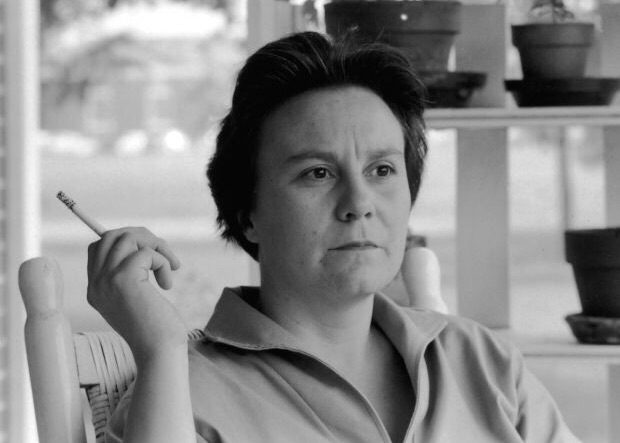
Harper Lee in 1962 (public domain)
It is very big news however you think of it: On July 14, Harper Lee will publish her first novel since To Kill a Mockingbird. Called Go Set a Watchman, it is set twenty years later, in the 1950s, and is told from the point of view of the grown-up Scout Finch in the midst of the Civil Rights Movement.
Lee said, in a statement released by Harper (the publisher):
In the mid-1950s, I completed a novel called Go Set a Watchman. It features the character known as Scout as an adult woman, and I thought it a pretty decent effort. My editor, who was taken by the flashbacks to Scout’s childhood, persuaded me to write a novel (what became To Kill a Mockingbird) from the point of view of the young Scout.
I was a first-time writer, so I did as I was told. I hadn’t realized it [the original book] had survived, so was surprised and delighted when my dear friend and lawyer Tonja Carter discovered it. After much thought and hesitation, I shared it with a handful of people I trust and was pleased to hear that they considered it worthy of publication. I am humbled and amazed that this will now be published after all these years.
So this is not a new novel but the earlier version of what became To Kill a Mockingbird. It is a 60-year-old manuscript that will be published as is, with zero edits. So no one is tampering with Lee’s words. Nor was it written with the intent of being a sequel, but it was what she originally intended the story to be. To call it a “sequel” may be a bit of a misnomer.
***
Still, not everyone is excited by the news. E! Online and Jezebel caution us to “be suspicious.” Madeleine Davies explains.
Harper Lee’s sister Alice Lee, who ferociously protected Harper Lee’s estate (and person) from unwanted outside attention as a lawyer and advocate for decades, passed away late last year, leaving the intensely private author (who herself is reportedly in ill health) vulnerable to people who may not have her best interests at heart.
Lee had a stroke in 2007, is almost blind and deaf, and even her attorney Ms. Carter concedes that she may not always fully understand what she is signing. Gawker had reported a lot of this last July, when an “unauthorized” biography of Lee, written by Marja Mills, was published.
When the news came out, a few folks on Twitter were suspicious that, only three months after Lee’s fiercely protective sister died, a sixty-year-old lost and unpublished manuscript would out of nowhere, all of a sudden, shazaam, magically be found.
Seija Rankin says:
[I]t’s hard to deny the somewhat sudden release of this sequel doesn’t quite fit the pattern of the life that Harper Lee has led for the past half-century. It’s important, to us at least, to balance a book’s interest with the legacy and wishes of its author. Especially when that same author once told an audience, during a rare public appearance, that “It’s better to be silent than to be a fool.”
***
Well, Go Set a Watchman may not exactly make Harper Lee look like a “fool.” That might be the self-doubt of a reclusive author talking, or the jadedness of a public that has learned to take a low view of sequels. (One person on Facebook quipped that the main character of the new novel will be Jar Jar Radley.)
I suspect that Lee was unwilling to publish anything after Mockingbird for two reasons: (1) she was, as she once said, more like Boo Radley than Scout Finch, and public attention did not suit her; (2) she knew that nothing else she ever wrote, however good, would be To Kill a Mockingbird. She was publicity shy and wrote a book that is just impossible to match.
But then, one does ask: Why a sequel? Would that not, all the more, invite unfair comparison? And isn’t To Kill a Mockingbird so good that it stands on its own and does not need to be added to?
Lee says—and given the state of her health, some will wonder whether the words are entirely her own—that she was pleased her friends thought it worthy of publication. Well, okay. Not knowing who those friends are, one cannot speak for their ability to judge literary merit. Go Set a Watchman will sell, and sell big. It will do so for no other reason than the fact that Harper Lee wrote it, and she has published nothing else for fifty-five years, and her only other book is a beloved and unspeakably beautiful classic. So some will ask if that is real point here: that a sequel, a new book by Harper Lee, will make some people a lot of money. (Minus whatever goes to medical care.) People worry themselves a lot about the motivations of others.
But then, all this would have happened anyway, after Lee dies. Hemingway’s unpublished novels, and Nabokov’s unfinished Original of Laura, all came out regardless of their merit as literature or the wishes of the author. One can only guess what future titles we may or may not see that were written by J.D. Salinger. Many shudder to think of it.
No one wants to see Harper Lee taken advantage of, or her true wishes manipulated, due to her inability to decide for herself. (If that has happened. Who knows?) But neither can anyone doubt that the unpublished works of famous writers end up finding their way into print anyway once they are no longer with us. Like it or not, that is what happens when a famous writer is dead, or can no longer make decisions for herself. Something she may not otherwise have wanted published, is.
But is it moral? Is it right? I don’t know. Whether or not Go Set a Watchman has any merit as literature, it will certainly be of value to literary scholars who study the origin of great fiction. This is, after all, not a sequel so much as it is the first version of what would become To Kill a Mockingbird. Lee’s editor simply convinced her to expand on the flashbacks and publish them as their own novel.
People love to argue over this question too: whether one ought to publish something against a famous author’s true wishes, just because the author was famous and, whatever else it benefits, it also benefits scholarship. I do not doubt that argument will be hashed out again in the months before and after this new book comes out.
It is a complex question and I have never fully made up my own mind about it.
***
Megan Garber, writing in The Atlantic, sounds an elegiac note. The title of her article is “Harper Lee: The Sadness of a Sequel.” She asks: Why? and, Why now?
Perhaps it really was as simple as a manuscript lost and recovered, serendipitously for all involved. Perhaps all those doubts Lee had previously expressed about the publication of a second novel were merely the results of the natural, but not invincible, anxiety that comes with that infamously fraught project. Perhaps Lee regretted having signed over her copyright of Mockingbird, and wanted something else she could call, in the fullest sense, truly hers. Perhaps Lee, approaching her 90s, figured that age will afford her what her attempts at a sheltered life could not: the easy relief of silence.
…
Or perhaps Lee, alive but ill, is being treated the way so many deceased authors are: as ideas rather than people, as brands and businesses rather than messy collections of doubts and desires.
We won’t know. We can’t know. All we will have, in the end, is a book, a thing that will raise as many questions as it answers. And, for better or for worse, that is probably just how Harper Lee … would prefer things.
Garber is right, in the main. We can ask questions, we can speculate, we can rehash old arguments about whether this kind of thing is worth it or better left undone. But what it all comes down to—at least for right now—is a book, and one that only a few have read. All we know, for sure, is the title and a few details of plot and setting. The rest is silence, until July.
There will be plenty of time, then, to talk about its merits, or lack of them, and whether this ought to have been done.
It is a great title. It comes from Isaiah 21:3-6, where the prophet compares his pain over the captivity in Babylon to the pain of a woman in childbirth.
Therefore are my loins filled with pain: pangs have taken hold upon me, as the pangs of a woman that travaileth: I was bowed down at the hearing of it; I was dismayed at the seeing of it. My heart panted, fearfulness affrighted me: the night of my pleasure hath he turned into fear unto me. Prepare the table, watch in the watchtower, eat, drink: arise, ye princes, and anoint the shield. For thus hath the Lord said unto me, Go, set a watchman, let him declare what he seeth.
Lee’s only book until now, To Kill a Mockingbird, is so incredibly and astonishingly good that there is no way anything else she wrote could equal it. And no one should expect her to have done that. So if that is what people go in wanting or expecting, they will be disappointed. They would be setting themselves up for it. And it is a false expectation in any case.
Go Set a Watchman will be its own book. That is all it can be or should be. So I am content to withhold judgment on it until I read it, and hope that there are some nice surprises waiting for me there. But even a dud can not ruin To Kill a Mockingbird.
Still, I can not wait until July.
***
If you like the content on this blog, your generous gift to the author helps to keep it active. I remember all my supporters in my Mass intentions each week.
Next Post

February 5, 2015 No, Mr. Obama, The Crusades and ISIS Are Not The Same Thing
Browse Our Archives
Select a Category Abortion About Me Answers for Calvinists Answers to Media Fictions Answers to Objections Anti-Catholicism Apologetics Apostolic Succession Atonement Authority of the Church Baptism Benedictines Biblical Exegesis Blogging Book Reviews Books & Writing &c. Calvin's Institutes Capital Punishment Catholic Church Chastity Christology Church Fathers Church Social Doctrine Confession Contraception Conversion Stories Crusades Debates Depression & Suicide Deuterocanon Development of Doctrine Ecumenism English Language Eucharistic Adoration Exorcism Extra Ecclesiam Fisks & Rebuttals Freedom of Religion Freedom of Speech Fundamentalism Gender Politics Gender Theory Good Works Homosexuality Humor Idolatry Immaculate Conception In the News Inquisition ISIS Islam Just for Fun Just War Justification LCWR Limbo Liturgical Abuse Liturgical Year Magisterium Marriage and Family Mary Mortal Sin New Evangelization NFP Papacy Papal Documents Papal Infallibility Personal Narrative Politics Pope Francis Pope Francis Derangement Syndrome Population Control Praying to the "Dead" Priesthood Primacy of Peter Protestant Denominations Purgatory Radical Islam Radical Traditionalists Real Presence Right to Conscience RIght to Life Saints Same-Sex "Marriage" Seven Quick Takes Social Justice Social Media Sola Scriptura Spirit of Vatican II SSPX The Eucharist The Mass The Resurrection Traditionalism Vatican II Year of Mercy
Select a Month August 2019 July 2019 June 2019 May 2019 November 2018 October 2018 August 2018 July 2018 June 2018 April 2018 November 2017 October 2017 September 2017 May 2017 April 2017 March 2017 February 2017 November 2016 October 2016 September 2016 August 2016 July 2016 June 2016 May 2016 April 2016 March 2016 February 2016 January 2016 December 2015 November 2015 October 2015 September 2015 July 2015 June 2015 May 2015 April 2015 March 2015 February 2015 January 2015 December 2014 September 2014 August 2014 July 2014 June 2014 May 2014 April 2014 March 2014 February 2014 January 2014 December 2013 November 2013 October 2013 May 2013 April 2013 February 2013 January 2013
Follow Us!
TAKE THE
Religious Wisdom Quiz
Who was sent by the Jerusalem church to witness revival in Samaria?
Select your answer to see how you score.
Peter and John Silas and Timothy Paul and Barnabas James and John
Related posts from To Give a Defense

The desperate need love and mercy, not judgment.
Clergy Sexual Assault Not About Homosexuality But Power

I, Scott Eric Alt, Forced Trump's Hand and...
TRENDING AT PATHEOS Catholic

Rejecting Doom: Christian Hope And Human Action
Christianity is a religion of hope. We are to have hope and...

It’s What Comes From Within Which Matters
One of the most difficult things for us to understand is why...

Why I Choose the Eucharist Over the Sermon
Choose the Eucharist, Not the Sermon What are we supposed to get...

5 Design Elements Found in Spiritually Rooted Homes
Putting Spirituality Into Home Decor Our homes are more than our living...

Credo: A Story of God Told with the...
About 10 years ago, I began to imagine a personal "Credo" that...

The Anatomy of Divine Revelation in Catholic Thought
The claim that God has made Himself known to human beings is...
view all Catholic blogs
Ad-Free & Subscriber Log-In Subscription Support
- About Us
- 2026 Calendar
- Videos
- Podcasts
- Library of World Religions
- Faith In Media Tracker
- Advertise With Us
- Write for Us
- Privacy Policy
- Terms of Service
- Do Not Sell My Data
- Contact Us
- Radiant Digital
- Manage Newsletter Subscriptions
- Unsubscribe From Notifications
- Sitemap
Copyright 2008-2026, Patheos. All rights reserved.
Subscription Support Ad-Free & Subscriber Log-In
Follow Patheos