
BuddhistCatholicContemplativeEvangelicalGeneral ChristianHinduJewishLatter-day SaintMuslimNew VisionsProgressive Christian
Beliefs
- Buddhist
- Catholic
- Contemplative
- Evangelical
- General Christian
- Hindu
- Jewish
- Latter-day Saint
- More Voices
- Muslim
- New Visions
- Pagan
- Progressive Christian
Topics
- Religion News
- Food and Religion
- Sports and Religion
- Religious Art
- Religious Music and Entertainment
- Religious Events
- History and Religion
- Style and Religion
- Politics and Religion
- Women in Religion
- Recreation Outdoors and Religion
- Business Finance and Religion
- Careers Workplace and Religion
- Education and Religion
- Family Parenting and Religion
- Health Fitness and Religion
- Home and Religion
- Relationships and Religion
- Technology and Religion
- Travel and Religion
Columnists
- Buddhist Columnists
- Business Finance and Religion Columnists
- Careers Workplace and Religion Columnists
- Catholic Columnists
- Contemplative Columnists
- Education and Religion Columnists
- Evangelists Columnists
- Family Parenting and Religion Columnists
- General Christian Columnists
- Health Fitness and Religion Columnists
- Hindu Columnists
- History and Religion Columnists
- Home and Religion Columnists
- Jewish Columnists
- More Voices Columnists
- Latter Day Columnists
- Muslim Columnists
- New Visions Columnists
- Nonreligious Columnists
- Pagan Columnists
- Politics and Religion Columnists
- Progressive Columnists
- Recreation Outdoors and Religion Columnists
- Relationships and Religion Columnists
- Religion News Columnists
- Religious Art Columnists
- Religious Events Columnists
- Religious Music and Entertainment Columnists
- Sports and Religion Columnists
- Style and Religion Columnists
- Technology and Religion Columnists
- Travel and Religion Columnists
- Women in Religion Columnists
Resource Library
- 2026 Calendar
- Library of World Religions
- The 100 Most Holy Places on Earth
- Patheos Answers
- Podcasts
- Videos
- Faith Leaders Database
- Anglican Episcopalian
- Bahai
- Baptist
- Buddhism
- Christianity
- Confucianism
- Eastern Orthodoxy
- Hinduism
- Holiness and Pentecostal
- ISKCON
- Islam
- Judaism
- Lutheran
- Methodist
- The Church of Jesus Christ of Latter-day Saints
- New Age
- Paganism
- Presbytarian and Reformed
- Protestantism
- Religion Behind the Scenes
- Roman Catholic
- Scientology
- Shia Islam
- Sikhism
- Sufism
- Sunni Islam
- Taoism
- Zen
- See all religions
Research Tools
 Ad-Free & Subscriber Log-In Subscription Support
Ad-Free & Subscriber Log-In Subscription Support
Follow Patheos 

- Trending:
- Forgiveness
- |
- Marriage
- |
- Consciousness
- |
- Death Penalty
- |
- Election
- |
- Halloween
 To Give a Defense
- Home
- Catholic
- “Not Infallible” does not mean “Contains Errors.”
“Not Infallible” does not mean “Contains Errors.”
Last updated on: August 19, 2019 at 10:54 am by Scott Eric Alt
“Not Infallible” does not mean “Contains Errors.” 2019-08-19T10:54:10-04:00 Scott Eric Alt
Patheos Explore the world's faith through different perspectives on religion and spirituality! Patheos has the views of the prevalent religions and spiritualities of the world.
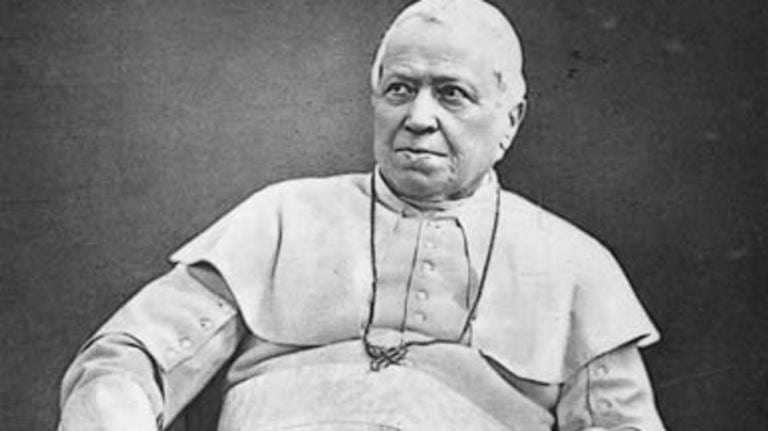
Pius IX is not impressed with FaithfulCatholics™
Strictly speaking, “infallibility” covers whatever teachings fall under a divine guarantee to be free from any possibility of error. That does not mean, and never meant, that non-infallible teachings—the Ordinary Magisterium—do contain errors. Still less does it mean that the pope could under any circumstances teach heresy. Pope Pius XII says in Humani Generis 20:
Nor must it be thought that what is expounded in Encyclical Letters does not of itself demand consent, since in writing such Letters the Popes do not exercise the supreme power of their Teaching Authority. [In other words, just because it’s not infallible doesn’t mean you can take it or leave it.] For these matters are taught with the ordinary teaching authority, of which it is true to say: “He who heareth you, heareth me.
Even when a pope is teaching with ordinary authority, he is still teaching with the authority of Christ. He who hears you, hears me; he who rejects you, rejects me; he who rejects me, rejects the one who sent me.
“And generally,” Pius XII goes on,
what is expounded and inculcated in Encyclical Letters already for other reasons appertains to Catholic doctrine. But if the Supreme Pontiffs in their official documents purposely pass judgment on a matter up to that time under dispute, it is obvious that that matter, according to the mind and will of the Pontiffs, cannot be any longer considered a question open to discussion among theologians.
Even for ordinary teachings.
But the CDF, in Donum Veritatis, expands this to include even the Magisterium’s “interventions in the prudential order.” Imagine that. (For Pius IX condemned, as a Modernist error, the complaint that popes interfere in political matters. That’s #23 on the Syllabus.) Here’s the CDF in DV:
When it comes to the question of interventions in the prudential order, it could happen that some Magisterial documents might not be free from all deficiencies. [Might not be free from all.] Bishops and their advisors have not always taken into immediate consideration every aspect or the entire complexity of a question. But it would be contrary to the truth, if, proceeding from some particular cases, one were to conclude that the Church’s Magisterium can be habitually mistaken in its prudential judgments, or that it does not enjoy divine assistance in the integral exercise of its mission (24).
And the CDF takes care to specify the nature of the “deficiencies” that “might” creep in:
[I]n addition to solid principles, [ordinary teachings may include] certain contingent and conjectural elements. It often only becomes possible with the passage of time to distinguish between what is necessary and what is contingent. … The theologian knows that some judgments of the Magisterium could be justified at the time in which they were made, because while the pronouncements contained true assertions and others which were not sure, both types were inextricably connected. Only time has permitted discernment and, after deeper study, the attainment of true doctrinal progress (24).
So for example, the Church has recently come to understand that the licitness of the death penalty is contingent upon whether it is necessary to protect society. St. John Paul II points out (Evangelium Vitae 56) that, with improvements in prison security, the death penalty is not necessary in the way it once was. This does not mean that either the prior teaching or the current teaching is “in error.”
And the Church is very clear that Catholics are bound to the Church’s authentic Magisterium even when it’s not definitive. (In fact, Pius IX in Syllabus 22 condemned as a heresy the idea that Catholics are bound “to those things only which are proposed to universal belief as dogmas of faith by the infallible judgment of the Church.) Lumen Gentium 25 says: “[R]eligious submission of mind and will must be shown in a special way to the authentic magisterium of the Roman Pontiff, even when he is not speaking ex cathedra.” This language is repeated in the Catechism of the Catholic Church, the Profession of Faith, and Canon 752.
If the Church is going to bind Catholics to the full Magisterium—even the technically non-infallible part—it makes no sense at all to think that a pope could teach actual heresy. That is consequent upon the Holy Spirit’s protection of the Church from error and its promise to guide the Church into all truth (John 16:13).
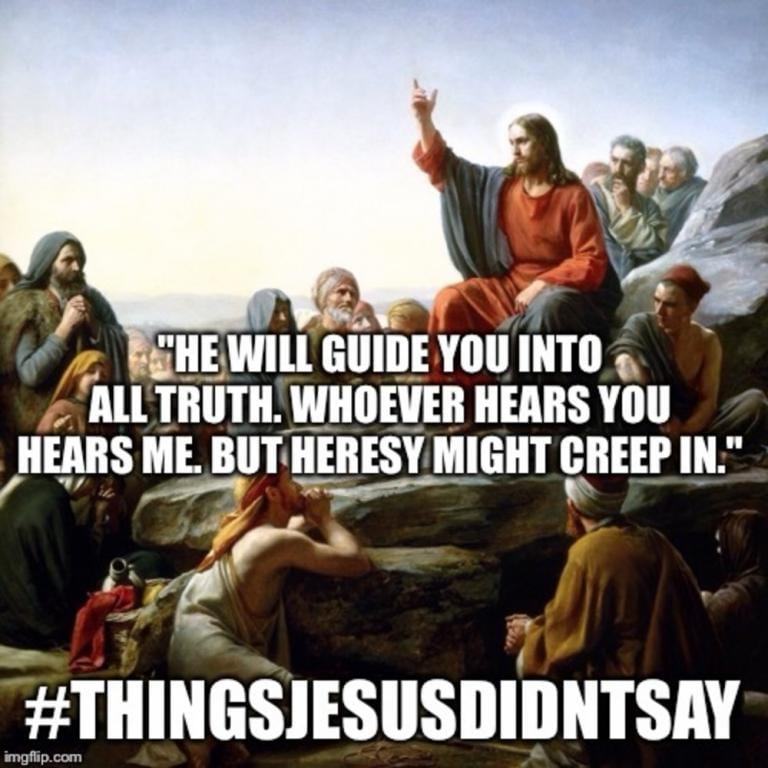
Vatican I defines the conditions for infallibility, but implicit in that teaching is the guarantee that a pope can’t bind the Church to heresy. And if Catholics are bound even by ordinary teachings, it follows they can’t contain heresy either. To suggest otherwise is false.
•••
I bring this up because every time I write an article like my last one, invariably someone shows up to say that I don’t know what infallibility is or think everything a pope says is infallible. Fact is, not only have I never said that everything a pope says is infallible, I’ve expressly denied it.
Here I am on November 24, 2015:
[Infallibility] does not mean that everything a pope says, or every opinion of the pope, is infallible. The pope must be speaking ex cathedra. A Wednesday audience, or a papal interview, are not infallible. The pope must be speaking on a question of faith or morals. The pope’s opinion about a scientific theory is not infallible. The pope’s opinion of the Red Sox is not infallible.
Here I am on April 5, 2017:
Things the pope says in an interview with the press are not Magisterial.
Here I am on October 15, 2017:
I have never taken the position that everything a pope says is infallible. I defy you to find me making any such argument, at any time, anywhere. Search as long as you please and report back to me.
So I know that perfectly well. What I have said (if my actual views matter to anyone) is that a pope can’t teach heresy (one / two). And what I have said is that it doesn’t matter whether a teaching is infallible or not as long as it’s authoritative. And incidentally, the Church also says this. Here’s one place it says so—Donum Veritatis 17:
All acts of the Magisterium derive from the same source, that is, from Christ who desires that His People walk in the entire truth. For this same reason, magisterial decisions in matters of discipline, even if they are not guaranteed by the charism of infallibility, are not without divine assistance and call for the adherence of the faithful.
It is incoherent to say that just because a teaching is not infallible, “divine assistance” is going to permit heresy to creep in. It can’t happen, not unless the Church has utterly erred in its understanding of Magisterial teaching authority consequent upon John 16:13, John 21:15, and 1 Timothy 3:15, to name just three.
Previous Post

August 17, 2019
Pope Francis Derangement Syndrome XXIV: Cardinal Burke's Rebel Yell.

Browse Our Archives
Select a Category Abortion About Me Answers for Calvinists Answers to Media Fictions Answers to Objections Anti-Catholicism Apologetics Apostolic Succession Atonement Authority of the Church Baptism Benedictines Biblical Exegesis Blogging Book Reviews Books & Writing &c. Calvin's Institutes Capital Punishment Catholic Church Chastity Christology Church Fathers Church Social Doctrine Confession Contraception Conversion Stories Crusades Debates Depression & Suicide Deuterocanon Development of Doctrine Ecumenism English Language Eucharistic Adoration Exorcism Extra Ecclesiam Fisks & Rebuttals Freedom of Religion Freedom of Speech Fundamentalism Gender Politics Gender Theory Good Works Homosexuality Humor Idolatry Immaculate Conception In the News Inquisition ISIS Islam Just for Fun Just War Justification LCWR Limbo Liturgical Abuse Liturgical Year Magisterium Marriage and Family Mary Mortal Sin New Evangelization NFP Papacy Papal Documents Papal Infallibility Personal Narrative Politics Pope Francis Pope Francis Derangement Syndrome Population Control Praying to the "Dead" Priesthood Primacy of Peter Protestant Denominations Purgatory Radical Islam Radical Traditionalists Real Presence Right to Conscience RIght to Life Saints Same-Sex "Marriage" Seven Quick Takes Social Justice Social Media Sola Scriptura Spirit of Vatican II SSPX The Eucharist The Mass The Resurrection Traditionalism Vatican II Year of Mercy
Select a Month August 2019 July 2019 June 2019 May 2019 November 2018 October 2018 August 2018 July 2018 June 2018 April 2018 November 2017 October 2017 September 2017 May 2017 April 2017 March 2017 February 2017 November 2016 October 2016 September 2016 August 2016 July 2016 June 2016 May 2016 April 2016 March 2016 February 2016 January 2016 December 2015 November 2015 October 2015 September 2015 July 2015 June 2015 May 2015 April 2015 March 2015 February 2015 January 2015 December 2014 September 2014 August 2014 July 2014 June 2014 May 2014 April 2014 March 2014 February 2014 January 2014 December 2013 November 2013 October 2013 May 2013 April 2013 February 2013 January 2013
Follow Us!
TAKE THE
Religious Wisdom Quiz
Who was the brother of Moses and helped him confront Pharaoh?
Select your answer to see how you score.
Joshua Joseph David Aaron
Related posts from To Give a Defense
Steve Hays posits false dichotomy between authority and...

Do Catholics think God owes them a debt?...

Protestant asks: When would Catholics know they're in...

Of course the Church can ordain women.
TRENDING AT PATHEOS Catholic

Rejecting Doom: Christian Hope And Human Action
Christianity is a religion of hope. We are to have hope and...

It’s What Comes From Within Which Matters
One of the most difficult things for us to understand is why...

Why I Choose the Eucharist Over the Sermon
Choose the Eucharist, Not the Sermon What are we supposed to get...

5 Design Elements Found in Spiritually Rooted Homes
Putting Spirituality Into Home Decor Our homes are more than our living...

Credo: A Story of God Told with the...
About 10 years ago, I began to imagine a personal "Credo" that...

The Anatomy of Divine Revelation in Catholic Thought
The claim that God has made Himself known to human beings is...
view all Catholic blogs
Ad-Free & Subscriber Log-In Subscription Support
- About Us
- 2026 Calendar
- Videos
- Podcasts
- Library of World Religions
- Faith In Media Tracker
- Advertise With Us
- Write for Us
- Privacy Policy
- Terms of Service
- Do Not Sell My Data
- Contact Us
- Radiant Digital
- Manage Newsletter Subscriptions
- Unsubscribe From Notifications
- Sitemap
Copyright 2008-2026, Patheos. All rights reserved.
Subscription Support Ad-Free & Subscriber Log-In
Follow Patheos