
BuddhistCatholicContemplativeEvangelicalGeneral ChristianHinduJewishLatter-day SaintMuslimNew VisionsProgressive Christian
Beliefs
- Buddhist
- Catholic
- Contemplative
- Evangelical
- General Christian
- Hindu
- Jewish
- Latter-day Saint
- More Voices
- Muslim
- New Visions
- Pagan
- Progressive Christian
Topics
- Religion News
- Food and Religion
- Sports and Religion
- Religious Art
- Religious Music and Entertainment
- Religious Events
- History and Religion
- Style and Religion
- Politics and Religion
- Women in Religion
- Recreation Outdoors and Religion
- Business Finance and Religion
- Careers Workplace and Religion
- Education and Religion
- Family Parenting and Religion
- Health Fitness and Religion
- Home and Religion
- Relationships and Religion
- Technology and Religion
- Travel and Religion
Columnists
- Buddhist Columnists
- Business Finance and Religion Columnists
- Careers Workplace and Religion Columnists
- Catholic Columnists
- Contemplative Columnists
- Education and Religion Columnists
- Evangelists Columnists
- Family Parenting and Religion Columnists
- General Christian Columnists
- Health Fitness and Religion Columnists
- Hindu Columnists
- History and Religion Columnists
- Home and Religion Columnists
- Jewish Columnists
- More Voices Columnists
- Latter Day Columnists
- Muslim Columnists
- New Visions Columnists
- Nonreligious Columnists
- Pagan Columnists
- Politics and Religion Columnists
- Progressive Columnists
- Recreation Outdoors and Religion Columnists
- Relationships and Religion Columnists
- Religion News Columnists
- Religious Art Columnists
- Religious Events Columnists
- Religious Music and Entertainment Columnists
- Sports and Religion Columnists
- Style and Religion Columnists
- Technology and Religion Columnists
- Travel and Religion Columnists
- Women in Religion Columnists
Resource Library
- 2026 Calendar
- Library of World Religions
- The 100 Most Holy Places on Earth
- Patheos Answers
- Podcasts
- Videos
- Faith Leaders Database
- Anglican Episcopalian
- Bahai
- Baptist
- Buddhism
- Christianity
- Confucianism
- Eastern Orthodoxy
- Hinduism
- Holiness and Pentecostal
- ISKCON
- Islam
- Judaism
- Lutheran
- Methodist
- The Church of Jesus Christ of Latter-day Saints
- New Age
- Paganism
- Presbytarian and Reformed
- Protestantism
- Religion Behind the Scenes
- Roman Catholic
- Scientology
- Shia Islam
- Sikhism
- Sufism
- Sunni Islam
- Taoism
- Zen
- See all religions
Research Tools
 Ad-Free & Subscriber Log-In Subscription Support
Ad-Free & Subscriber Log-In Subscription Support
Follow Patheos 

- Trending:
- Forgiveness
- |
- Marriage
- |
- Consciousness
- |
- Death Penalty
- |
- Election
- |
- Halloween
 To Give a Defense
- Home
- Catholic
- Mr. X Struggles With Metaphor, Transubstantiation, & John 6
Mr. X Struggles With Metaphor, Transubstantiation, & John 6
Last updated on: March 9, 2017 at 1:40 am by Scott Eric Alt
Mr. X Struggles With Metaphor, Transubstantiation, & John 6 2017-03-09T01:40:07-04:00 Scott Eric Alt
Patheos Explore the world's faith through different perspectives on religion and spirituality! Patheos has the views of the prevalent religions and spiritualities of the world.
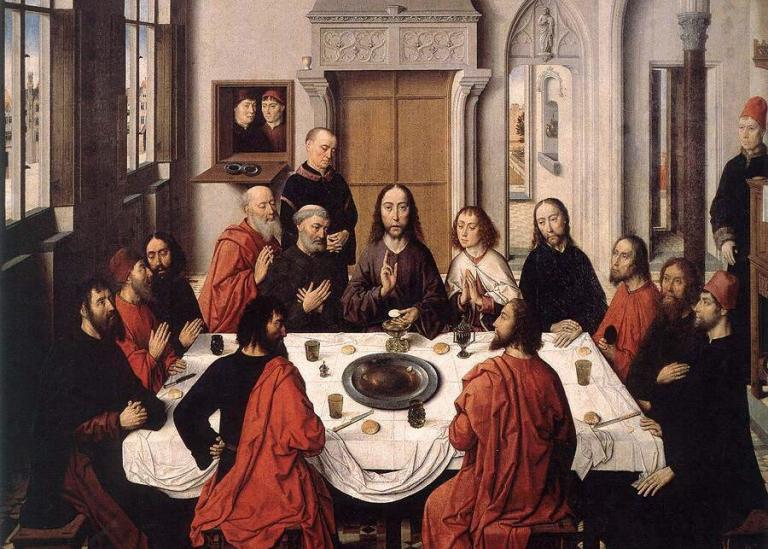
Dieric Bouts, “The Last Supper,” 1460s
Of late, the anonymous blogger, five-pointer, and crack theologian TurretinFan—known on this blog as Amazing and Undaunted Mr. X of Calvinism—has been struggling with the concept of metaphor as it applies to John 6. (And a very hard struggle it has been, too; see his two blog posts here and here.) He argues that the expression “this cup is my blood” (Matt. 26:28; Mark 14:24; Luke 22:20; 1 Cor. 11:25) should be a clear sign that the text is not meant to be taken literally. For not even Roman Catholics will say that the cup itself is Christ’s blood. Obviously Christ is speaking metaphorically here.
The poor man apparently needs the help of an English teacher. It is good for Mr. X that I am here. The assumption his argument relies on is this: that, if one thing in a passage is metaphorical (“this cup”), therefore everything in the passage is metaphorical (“my blood”). But no.
Now, the technical name for the figure of speech Christ is using here is metonymy. In a metonymy, either a part is substituted for a whole, or the whole for a part. Thus, in “this cup is my blood,” the cup itself is substituted for its contents. (It would seem Mr. X would have no problem with the Roman Catholic argument, if only Christ had said, “This cup contains my blood.”)
Here are some other metonymies:
I. “Roma locuta est; causa finita est” (St. Augustine). Here “Rome” is substituted for “the Church”; or, “the pope.”
II. “Bell, book, and candle shall not drive me back” (Shakespeare, King John, III.iii.12). Here, “bell, book, and candle” are substituted for “excommunication.” What the bastard son Philip (Philip II of France) means is that, even should he be excommunicated, he will not be driven from his purpose (the rebellion of Aquitaine against King John). He does not fear the Church, which means he does not fear God.
III. “The pen is mightier than the sword.” Here “pen” is substituted for “literature,” or “writing”; and “sword” is substituted for “war.” Bulwer-Lytton does not mean that pens literally have more power than swords do, but that writing has a greater effect on the course of history than war.
So far so good. All this is nothing more than a well-known fact of how people use words. But let us look at some other metonymies, this time from Scripture itself.
I. “And the Lord said to her, Two nations are in thy womb” (Gen. 25:23). Of course, Rebekah was not literally carrying two nations in her womb. That would have caused some pain. But she had asked God why her unborn twins—Jacob and Esau—“struggled together within her.” His answer was, in effect, that Jacob and Esau would each be the father of separate nations (the Israelites and the Edomites) that would war with each other.
We should be careful, here, though: Just because two nations were not literally in Rebekah’s womb, that does not mean that the nations themselves were metaphors. The Lord was not saying, “Jacob and Esau fight together as though they are two nations at war.” No. The two nations were very real, very literal nations—it is just that they were not physically located within Rebekah’s womb; only the fathers of those nations were. Not everything in this text is a metaphor.
II. “At the mouth of two or three witnesses, shall he that is worthy of death be put to death” (Deut. 17:6). Now, obviously God is not mandating here that two or three mouths be the literal instrument of execution. This is not the plot of Twain’s “Cannibalism in the Cars.” Here, “mouth” is substituted for “testimony in court,” and the meaning is that two or three witnesses’ testimony be sufficient to justify a sentence of death. But: Although “mouth” is used metaphorically here, “death” is not. This is not a metaphorical execution God is speaking of here, but a literal one.
In a like way, just because Christ uses “cup” as metaphor does not imply that he uses “blood” that way too. We must not be sloppy. We must not, as students of literature, get so excited by having found a symbol, or a metaphor, that suddenly everything becomes symbol or metaphor. Sometimes a pencil is just a pencil, Mr. X.
But alas! Mr. X goes even more astray than that. For he attempts to find other texts, elsewhere in the Bible, in which the word “blood” is used metaphorically (such as 2 Sam. 23:13-17), and then claims that if it was metaphorical in 2 Samuel, it must also be metaphorical in John 6 and at the Last Supper.
That is mad. Why not go all the way, Mr. X, and tell us that “blood” is metaphorical at the crucifixion, too? Mr. X will protest that that is absurd. I agree. Just because it is a metaphor here does not mean it is a metaphor there.
Or perhaps the deluge didn’t consist of real water. No; mankind were just metaphorically drowned. And the ark was just symbolic of the shelter from the consequence of sin, enjoyed by the Elect. Right, Mr. X?
But you can’t say that, if some passage in the Old Testament is metaphorical, this other passage in the New Testament must be as well. For taken to its logical consequence, that would mean either that the Bible is entirely literal, or that it is entirely metaphorical. Both positions are absurd. Rather, the only line of reason into the discussion of John 6 must be to ask why we should take this passage either literally or metaphorically. The existence of metaphor elsewhere in the Bible is of no meaning at all.
That will be the question I take up in a future post.
***
If you like the content on this blog, your generous gift to the author helps to keep it active. I remember all my supporters in my Mass intentions each week.
Previous Post

July 26, 2014
In Defense of Ben Seewald
Next Post
July 30, 2014 Three Reasons to Take John 6 Literally
Browse Our Archives
Select a Category Abortion About Me Answers for Calvinists Answers to Media Fictions Answers to Objections Anti-Catholicism Apologetics Apostolic Succession Atonement Authority of the Church Baptism Benedictines Biblical Exegesis Blogging Book Reviews Books & Writing &c. Calvin's Institutes Capital Punishment Catholic Church Chastity Christology Church Fathers Church Social Doctrine Confession Contraception Conversion Stories Crusades Debates Depression & Suicide Deuterocanon Development of Doctrine Ecumenism English Language Eucharistic Adoration Exorcism Extra Ecclesiam Fisks & Rebuttals Freedom of Religion Freedom of Speech Fundamentalism Gender Politics Gender Theory Good Works Homosexuality Humor Idolatry Immaculate Conception In the News Inquisition ISIS Islam Just for Fun Just War Justification LCWR Limbo Liturgical Abuse Liturgical Year Magisterium Marriage and Family Mary Mortal Sin New Evangelization NFP Papacy Papal Documents Papal Infallibility Personal Narrative Politics Pope Francis Pope Francis Derangement Syndrome Population Control Praying to the "Dead" Priesthood Primacy of Peter Protestant Denominations Purgatory Radical Islam Radical Traditionalists Real Presence Right to Conscience RIght to Life Saints Same-Sex "Marriage" Seven Quick Takes Social Justice Social Media Sola Scriptura Spirit of Vatican II SSPX The Eucharist The Mass The Resurrection Traditionalism Vatican II Year of Mercy
Select a Month August 2019 July 2019 June 2019 May 2019 November 2018 October 2018 August 2018 July 2018 June 2018 April 2018 November 2017 October 2017 September 2017 May 2017 April 2017 March 2017 February 2017 November 2016 October 2016 September 2016 August 2016 July 2016 June 2016 May 2016 April 2016 March 2016 February 2016 January 2016 December 2015 November 2015 October 2015 September 2015 July 2015 June 2015 May 2015 April 2015 March 2015 February 2015 January 2015 December 2014 September 2014 August 2014 July 2014 June 2014 May 2014 April 2014 March 2014 February 2014 January 2014 December 2013 November 2013 October 2013 May 2013 April 2013 February 2013 January 2013
Follow Us!
TAKE THE
Religious Wisdom Quiz
I am a city that comes down from heaven, adorned as a bride. My streets are gold, my gates are pearls. What am I?
Select your answer to see how you score.
New Jerusalem Heaven Bethlehem Zion
Related posts from To Give a Defense
Does the Mass crucify Jesus another time? Part...
Does the Mass "banish the remembrance of Christ's...
How much does God hate lying? (Proverbs 6:16-19)
Don't Cite Leviticus 18 If You're Going to...
TRENDING AT PATHEOS Catholic

Rejecting Doom: Christian Hope And Human Action
Christianity is a religion of hope. We are to have hope and...

It’s What Comes From Within Which Matters
One of the most difficult things for us to understand is why...

Why I Choose the Eucharist Over the Sermon
Choose the Eucharist, Not the Sermon What are we supposed to get...

5 Design Elements Found in Spiritually Rooted Homes
Putting Spirituality Into Home Decor Our homes are more than our living...

Credo: A Story of God Told with the...
About 10 years ago, I began to imagine a personal "Credo" that...

The Anatomy of Divine Revelation in Catholic Thought
The claim that God has made Himself known to human beings is...
view all Catholic blogs
Ad-Free & Subscriber Log-In Subscription Support
- About Us
- 2026 Calendar
- Videos
- Podcasts
- Library of World Religions
- Faith In Media Tracker
- Advertise With Us
- Write for Us
- Privacy Policy
- Terms of Service
- Do Not Sell My Data
- Contact Us
- Radiant Digital
- Manage Newsletter Subscriptions
- Unsubscribe From Notifications
- Sitemap
Copyright 2008-2026, Patheos. All rights reserved.
Subscription Support Ad-Free & Subscriber Log-In
Follow Patheos