
BuddhistCatholicContemplativeEvangelicalGeneral ChristianHinduJewishLatter-day SaintMuslimNew VisionsProgressive Christian
Beliefs
- Buddhist
- Catholic
- Contemplative
- Evangelical
- General Christian
- Hindu
- Jewish
- Latter-day Saint
- More Voices
- Muslim
- New Visions
- Pagan
- Progressive Christian
Topics
- Religion News
- Food and Religion
- Sports and Religion
- Religious Art
- Religious Music and Entertainment
- Religious Events
- History and Religion
- Style and Religion
- Politics and Religion
- Women in Religion
- Recreation Outdoors and Religion
- Business Finance and Religion
- Careers Workplace and Religion
- Education and Religion
- Family Parenting and Religion
- Health Fitness and Religion
- Home and Religion
- Relationships and Religion
- Technology and Religion
- Travel and Religion
Columnists
- Buddhist Columnists
- Business Finance and Religion Columnists
- Careers Workplace and Religion Columnists
- Catholic Columnists
- Contemplative Columnists
- Education and Religion Columnists
- Evangelists Columnists
- Family Parenting and Religion Columnists
- General Christian Columnists
- Health Fitness and Religion Columnists
- Hindu Columnists
- History and Religion Columnists
- Home and Religion Columnists
- Jewish Columnists
- More Voices Columnists
- Latter Day Columnists
- Muslim Columnists
- New Visions Columnists
- Nonreligious Columnists
- Pagan Columnists
- Politics and Religion Columnists
- Progressive Columnists
- Recreation Outdoors and Religion Columnists
- Relationships and Religion Columnists
- Religion News Columnists
- Religious Art Columnists
- Religious Events Columnists
- Religious Music and Entertainment Columnists
- Sports and Religion Columnists
- Style and Religion Columnists
- Technology and Religion Columnists
- Travel and Religion Columnists
- Women in Religion Columnists
Resource Library
- 2026 Calendar
- Library of World Religions
- The 100 Most Holy Places on Earth
- Patheos Answers
- Podcasts
- Videos
- Faith Leaders Database
- Anglican Episcopalian
- Bahai
- Baptist
- Buddhism
- Christianity
- Confucianism
- Eastern Orthodoxy
- Hinduism
- Holiness and Pentecostal
- ISKCON
- Islam
- Judaism
- Lutheran
- Methodist
- The Church of Jesus Christ of Latter-day Saints
- New Age
- Paganism
- Presbytarian and Reformed
- Protestantism
- Religion Behind the Scenes
- Roman Catholic
- Scientology
- Shia Islam
- Sikhism
- Sufism
- Sunni Islam
- Taoism
- Zen
- See all religions
Research Tools
 Ad-Free & Subscriber Log-In Subscription Support
Ad-Free & Subscriber Log-In Subscription Support
Follow Patheos 

- Trending:
- Forgiveness
- |
- Marriage
- |
- Consciousness
- |
- Death Penalty
- |
- Election
- |
- Halloween
 To Give a Defense
- Home
- Catholic
- Misquoting St. Cyprian; Or, How “John Bugay” Abuses the Church Fathers.
Misquoting St. Cyprian; Or, How “John Bugay” Abuses the Church Fathers.
Last updated on: March 30, 2018 at 10:52 pm by Scott Eric Alt
Misquoting St. Cyprian; Or, How “John Bugay” Abuses the Church Fathers. 2018-03-30T22:52:50-04:00 Scott Eric Alt
Patheos Explore the world's faith through different perspectives on religion and spirituality! Patheos has the views of the prevalent religions and spiritualities of the world.
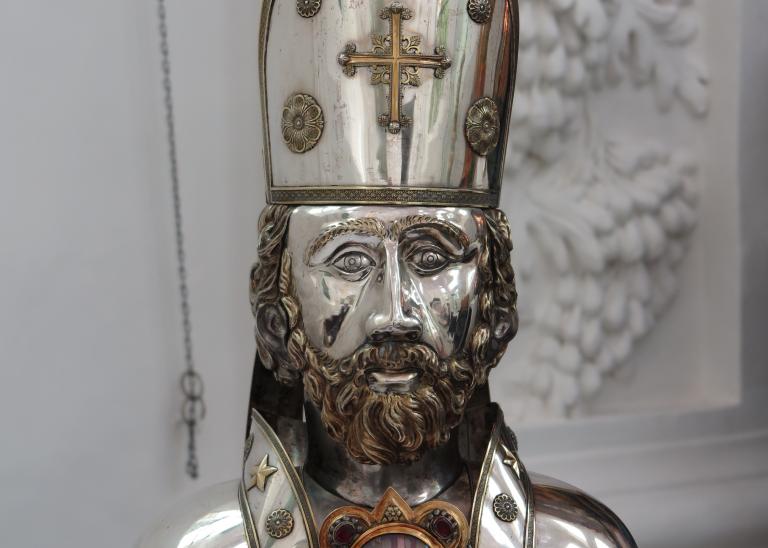
Relic of St. Cyprian in Kornielmunster Abbey (ACBahn, Creative Commons)
Perhaps you have heard, dear reader, that Pope Francis will visit Philadelphia in September for the World Meeting of Families. Occasions like these always give the anti-Catholics a chance to crawl out of the woodwork and make a buggy spectacle of themselves. If you go, therefore, be prepared to swat. To this wery day, Dr.* James White of Alpha & Omega Sophistries crows that, during the visit of Pope St. John Paul II to Denver, in 1993, he and several of his Elect compeers showed up to harass the multitudes, hand out Jack Chick tracts, and otherwise disturb the peace. (He also used his time there to debate Gerry Matatics on the papacy.)
Now it is a full twenty-two years later, and no less a personage than “John Bugay”—polemical rogue and inept scribbler at Failablogue—is promoting a similar effort led by someone named Geoff Robinson. Mr. Robinson is soliciting funds so that his “informal organization” (he calls it “Operation St. Cyprian”) can descend upon Philadelphia like a swarm of locusts; chirp at random Catholics—the ones who look the most unwary, easy to confuse, and, if all goes well, upset—about “the sufficiency of Christ’s sacrifice on the Cross” (as though Catholics somehow don’t believe in that); palm off tracts; and with any luck stage a debate. As of this writing, “Mr. Bugay’s” post has helped Op.St.C reach a grand total of ONE contribution for $100. And here’s to you, Mr. Robinson. With that kind of cash, you’ll be able to provide the locusts with a delicious lunch of cheesesteaks.
“Mr. Bugay” explains why this mission trip to lost and heathen Catholics goes by the name “Operation St. Cyprian.” (N.B., “Mr. Bugay” is decent and respectful enough, in his blog post, to put the pope’s name in scare quotes; that is why, dear reader, I extend him the same courtesy. For I do not know whether “John Bugay” is his real name. I’ve not seen his birth certificate. Maybe no such a personage as “John Bugay” exists. Maybe that is a police artist’s composite sketch above. Maybe the deceiver who is writing blog articles under this fictitious name has just and noble reasons for his subterfuge. But I, from my own position of ignorance, can make no such assumption; thus I am just as willing to extend this cloudy and mysterious personage the same courtesy of scare quotes that he extends the very Vicar of Christ!)
Anyway, “John Bugay,” as I was saying, informs us that St. Cyprian lived in a purer age—the third century—“when claims of papal authority were rejected.” In an effort to prove this strange point of anti-Catholic folklore, “Mr. Bugay” quotes, thus, from the Seventh Council of Carthage. (But the bolding is his own.)
It remains, that upon this same matter each of us should bring forward what we think, judging no man, nor rejecting any one from the right of communion, if he should think differently from us. For neither does any of us set himself up as a bishop of bishops, nor by tyrannical terror does any compel his colleague to the necessity of obedience; since every bishop, according to the allowance of his liberty and power, has his own proper right of judgment, and can no more be judged by another than he himself can judge another. But let us all wait for the judgment of our Lord Jesus Christ, who is the only one that has the power both of preferring us in the government of His Church, and of judging us in our conduct there.
“Mr. Bugay,” as is his wont, slaps these words down on his blog, screaming bold-face and all, without giving us any meaningful context for them. So we shall have to search on our own to find out (1) what the “Seventh Council of Carthage” was, (2) when it was held, (3) who attended it, (4) what topics it addressed, (5) what the bishops were talking about when they wrote these words. “Mr. Bugay” tells us none of these things, for he’s sloppy that way.
***
Before I get to any of that, however, I want to call to your attention some other words that St. Cyprian wrote. “Mr. Bugay” must think them too trivial to mention, but they all come from On the Unity of the Church. And, because I write an honest and thorough blog and am not slapdash like “Mr. Bugay,” I will go further than he dares and be fully open with you about the historical context of this important treatise of the third century.
St. Cyprian wrote On the Unity of the Church in order to combat the schism of Novatian, which arose in the wake of a wave of Christian persecution during the reign of the Roman emperor Decius (249-251). On January 20, 250, Pope Fabian was martyred and, under the circumstances, no successor could be elected. During the following year, many Christians, under duress, renounced their faith and lapsed into paganism. When the persecution ended in 251, a debate arose what to do with those who wanted to return to the Church. Novatian believed that penance was not enough and that they would need to be re-baptized. But St. Cyprian and the new pope, Cornelius (who was elected in March 251), disagreed. In their view, confession and contrition were enough. So Novatian, with the aid of a few bishops friendly to him, set himself up as a rival pope to Cornelius.
It was in this context that several synods took place in Carthage between 251 and 257, led by St. Cyprian. The major questions they considered were the identity of the true pope (Cornelius? Or Novatian?) and the nature of both baptism (Is baptism once for all, or can a person be re-baptized?) and confession (Is the Church limited in what sins it can absolve?). On the first question, Cornelius was supported by the entire African episcopate who attended these synods. The Catholic Encyclopedia explains why that was so important an issue to settle.
There could be no more startling proof of the importance of the Roman See than this sudden revelation of an episode of the third century: the whole Church convulsed by the claim of an antipope; the recognized impossibility of a bishop being a Catholic and legitimate pastor if he is on the side of the wrong pope.
The dispute simply makes no sense unless it was just assumed that the bishop of Rome is head of the whole Church and his teaching on such matters—baptism and confession—were authoritative for all. Otherwise, why did Novatian need to set himself up as a rival to Cornelius? Or why did multiple synods need to be called to sort out the matter? Why was the result of it not just that Novatian was named a false pope but excommunicated as well? And why did St. Cyprian—who, if we are to believe “Mr. Bugay,” did not believe that any bishop could “compel obedience”—take the side of Cornelius? These are questions that “Mr. Bugay” does not raise, let alone answer. He is, as I have said, sloppy.
Thus, some time in the 250s, St. Cyprian writes On the Unity of the Church, and he begins by noting that the greatest danger to Christian unity does not lie in open persecution, but rather the “craft of subtle fraud” that spreads within (3). Those deceived by such “craft” will “of necessity waver and wander” (2). “Under the very title of the Christian name,” St. Cyprian warns, Satan conspires to “deceive the incautious.”
He has invented heresies and schisms, whereby he might subvert the faith, might corrupt the truth, might divide the unity. Those whom he cannot keep in the darkness of the old way, he circumvents and deceives by the error of a new way. He snatches men from the Church itself; and while they seem to themselves to have already approached to the light, and to have escaped the night of the world, he pours over them again, in their unconsciousness, new darkness; so that, although they do not stand firm with the Gospel of Christ, and with the observation and law of Christ, they still call themselves Christians. (3)
Schism, for St. Cyprian, is more dangerous than persecution. Novatian is more dangerous than Decius. One wonders what he might have said about Luther and Calvin!
So how is schism to be avoided? How is heresy to be rooted out, and truth remain incorrupt? St. Cyprian tells us. (Pay attention to this, “Mr. Bugay.” This is key.)
The Lord speaks to Peter, saying, I say unto you, that you are Peter; and upon this rock I will build my Church, and the gates of hell shall not prevail against it. And I will give unto you the keys of the kingdom of heaven; and whatsoever you shall bind on earth shall be bound also in heaven, and whatsoever you shall loose on earth shall be loosed in heaven. And again to the same He says, after His resurrection, Feed my sheep. And although to all the apostles, after His resurrection, He gives an equal power … yet, that He might set forth unity, He arranged by His authority the origin of that unity, as beginning from one. (4)
Unity is found—are you paying attention to this, “Mr. Bugay”?—in the see of Peter. Well, you know, strike me dead if it doesn’t make perfect sense that St. Cyprian would head off to synod in Carthage to make perfectly sure everyone knew which man really did sit in that see! It mattered because the two rivals taught very different doctrines about two of the sacraments. And which of these doctrines was true was all tied up with the question of who really did sit in that see.
But St. Cyprian does not end there.
Who, then, is so wicked and faithless, who is so insane with the madness of discord, that either he should believe that the unity of God can be divided, or should dare to rend it—the garment of the Lord—the Church of Christ? He Himself in His Gospel warns us, and teaches, saying, And there shall be one flock and one shepherd. (8)
One flock and one shepherd, “Mr. Bugay.” And that’s Peter. There is no such shepherd as Cornelius and Novatian. No. It is either Cornelius or Novatian. And as for those who separate from that one shepherd, from the unity that is in Peter alone, St. Cyprian has this to say:
We are to be congratulated when such as these are separated from the Church [i.e., when schismatics like Novatian are excommunicated], lest they should lay waste the doves and sheep of Christ with their cruel and envenomed contagion. …
These are they who of their own accord, without any divine arrangement, set themselves to preside among the daring strangers assembled, who appoint themselves prelates without any law of ordination, who assume to themselves the name of bishop, although no one gives them the episcopate; whom the Holy Spirit points out in the Psalms as sitting in the seat of pestilence, plagues, and spots of the faith, deceiving with serpent’s tongue, and artful in corrupting the truth, vomiting forth deadly poisons from pestilential tongues; whose speech does creep like a cancer, whose discourse forms a deadly poison in the heart and breast of every one. …
For we have not withdrawn from them, but they from us; and since heresies and schisms have risen subsequently, from their establishment for themselves of diverse places of worship, they have forsaken the Head and Source of the truth. (9-12)
Well, now. Those are strong words. (Would you not say so, “Mr. Bugay”?) “Cruel and envenomed contagion.” “The seat of pestilence, plagues, and spots of the faith.” “Vomiting forth deadly poisons.” “Cancer.” “Deadly poison.” Strong words! And St. Cyprian applies them to those who have separated from the unity that is in—wait for it, “Mr. Bugay”—Peter! You know, one gets the feeling that this Cyprian fellow was … well … Catholic! Just to imagine that!
But he has more to say. Of those who have separated from the unity that is in Peter, St. Cyprian also says this:
They cannot dwell with God who would not be of one mind in God’s Church. Although they burn, given up to flames and fires, or lay down their lives, thrown to the wild beasts, that will not be the crown of faith, but the punishment of perfidy; nor will it be the glorious ending of religious valour, but the destruction of despair. Such a one may be slain; crowned he cannot be. He professes himself to be a Christian in such a way as the devil often feigns himself to be Christ, as the Lord Himself forewarns us, and says, Many shall come in my name, saying, I am Christ, and shall deceive many. (14)
Those who are not in communion with Peter “cannot dwell with God.” They may die a martyr’s death, but they will not get a martyr’s crown. They may say they are Christians, but only as Satan himself feigns to be Christ. Strong words! (Don’t you think so, “Mr. Bugay”? Are you paying attention?)
Remember—remember!—St. Cyprian is writing these words in condemnation of Novatian, who had refused to submit to the teaching of Pope Cornelius. Novatian set himself up as his own head. But to listen to “Mr. Bugay” tell it, St. Cyprian was of the opinion that all prelates in the church were coequals, including the bishop of Rome. How is it that Cornelius had authority over Novatian? Shouldn’t St. Cyprian have been taking Novatian’s side? Who was Cornelius to compel obedience on sacramental understanding? Where does all this talk about the need to be in union with Peter come from? “Error deceives!” Cyprian says, referring to Novatian. “Envy inflames! Covetousnouss makes blind! Impiety depraves! Pride puffs up! Discord exasperates! Anger hurries headlong!” (16) Don’t stop him now; St. Cyprian is on a roll, rebuking a man who had put himself in place of the pope.
Such a one is perverted and sins, and is condemned of his own self. Does he think that he has Christ, who acts in opposition to Christ’s priests, who separates himself from the company of His clergy and people? He bears arms against the Church, he contends against God’s appointment [i.e., the pope]. An enemy of the altar, a rebel against Christ’s sacrifice, for the faith faithless, for religion profane, a disobedient servant, an impious son, a hostile brother, despising the bishops, and forsaking God’s priests, he dares to set up another altar, to make another prayer with unauthorized words, to profane the truth of the Lord’s offering by false sacrifices, and not to know that he who strives against the appointment of God [i.e., the pope], is punished on account of the daring of his temerity by divine visitation.
Now, why does “Mr. Bugay” fail to mention any of this? I had thought that he was a man who hated all dishonesty and false report. If words like those St. Cyprian writes in On the Unity of the Church do not get even so much as the honor of a parenthesis or footnote on Failablogue, where is honesty to be found among men? There is none that saith truth, no, not one!
***
But you may ask, dear reader, how we are to square the words “Mr. Bugay” does quote, from the Seventh Council of Carthage, with what St. Cyprian writes against the errors of Novatian. If you have asked this question, I am glad for it. Now, if you go to an authoritative list of the 21 ecumenical councils recognized by the Catholic Church, here is what you will find listed:
- First Council of Nicaea (325)
(You know, we’re already near a century past Carthage.)
- First Council of Constantinople (381)
- Council of Ephesus (431)
- Council of Chalcedon (451)
- Second Council of Constantinople (553)
- Third Council of Constantinople (680-681)
- Second Council of Nicaea (787)
- Fourth Council of Constantinople (869)
- First Lateran Council (1123)
- Second Lateran Council (1139)
- Third Lateran Council (1179)
- Fourth Lateran Council (1215)
- First Council of Lyons (1245)
- Second Council of Lyons (1274)
- Council of Vienne (1311-1313)
- Council of Constance (1414-1418)
- Council of Florence (1431-1439)
- Fifth Lateran Council (1512-1517)
- Council of Trent (1545-1563)
- Vatican I (1869-1870)
- Vatican II (1962-1965)
No council of Carthage of any kind listed here, let alone a seventh one. Well, isn’t that interesting?
Now, such a gathering did take place, but it is something of a misnomer to call it a “council.” In fact, these third-century assemblies in Carthage were local synods attended by the bishops in northern Africa. (See here for a detailed history.) Now, their canons were affirmed by Rome—which means that the African bishops understood that Rome’s affirmation was needed. But an equally relevant point is that the bishop of Rome did not attend these synods. The very text “Mr. Bugay” quotes from begins by listing all those who are in attendance at Carthage.
When, in the kalends of September, a great many bishops from the provinces of Africa, Numidia [modern Algeria and Tunisia], and Mauritania, had met together at Carthage, together with the presbyters and deacons, and a considerable part of the congregation who were also present …
So when St. Cyprian says (the document is quoting him at that point) “neither does any of us set himself up as a bishop of bishops,” the bishops in question include only the bishops from North Africa. He does not say, “No one should set himself up as a bishop of bishops.” He says, “None of us do”! Well, come now, “Mr. Bugay”: None of them should be “setting himself up as a bishop of bishops,” because none of them is from Rome!
It as though St. Cyprian were saying, “Now remember, none of us is the pope, and we are not going to do here what Novatian did.” If the bishop of Rome had been among them, perhaps “Mr. Bugay” might have had something to tell us on that point, but since Cornelius was not there, “Mr. Bugay’s” breathless cry of “See! see! see! St. Cyprian rejected claims of papal authority” rings as dumb and hasty and hollow as any of so many other ravings on Failablogue. The whole point of the synods at Carthage was not to reject the pope’s authority but to figure out who was the pope and who had the authority.
Have you anything else to tell us, “Mr. Bugay”? For if, as you say in your post, it is important to talk about “the true nature of the papacy,” I am willing to have that talk. With or without you, “Mr. Bugay,” from now until the pope’s visit in September, I will be writing on this blog about “the true nature of the papacy,” as we find it in St. Cyprian and the other Fathers. So have you anything else to tell us, “Mr. Bugay”?
***

Next Post
April 23, 2015 Two Highly Illogical Arguments for Sola Scriptura.
Browse Our Archives
Select a Category Abortion About Me Answers for Calvinists Answers to Media Fictions Answers to Objections Anti-Catholicism Apologetics Apostolic Succession Atonement Authority of the Church Baptism Benedictines Biblical Exegesis Blogging Book Reviews Books & Writing &c. Calvin's Institutes Capital Punishment Catholic Church Chastity Christology Church Fathers Church Social Doctrine Confession Contraception Conversion Stories Crusades Debates Depression & Suicide Deuterocanon Development of Doctrine Ecumenism English Language Eucharistic Adoration Exorcism Extra Ecclesiam Fisks & Rebuttals Freedom of Religion Freedom of Speech Fundamentalism Gender Politics Gender Theory Good Works Homosexuality Humor Idolatry Immaculate Conception In the News Inquisition ISIS Islam Just for Fun Just War Justification LCWR Limbo Liturgical Abuse Liturgical Year Magisterium Marriage and Family Mary Mortal Sin New Evangelization NFP Papacy Papal Documents Papal Infallibility Personal Narrative Politics Pope Francis Pope Francis Derangement Syndrome Population Control Praying to the "Dead" Priesthood Primacy of Peter Protestant Denominations Purgatory Radical Islam Radical Traditionalists Real Presence Right to Conscience RIght to Life Saints Same-Sex "Marriage" Seven Quick Takes Social Justice Social Media Sola Scriptura Spirit of Vatican II SSPX The Eucharist The Mass The Resurrection Traditionalism Vatican II Year of Mercy
Select a Month August 2019 July 2019 June 2019 May 2019 November 2018 October 2018 August 2018 July 2018 June 2018 April 2018 November 2017 October 2017 September 2017 May 2017 April 2017 March 2017 February 2017 November 2016 October 2016 September 2016 August 2016 July 2016 June 2016 May 2016 April 2016 March 2016 February 2016 January 2016 December 2015 November 2015 October 2015 September 2015 July 2015 June 2015 May 2015 April 2015 March 2015 February 2015 January 2015 December 2014 September 2014 August 2014 July 2014 June 2014 May 2014 April 2014 March 2014 February 2014 January 2014 December 2013 November 2013 October 2013 May 2013 April 2013 February 2013 January 2013
Follow Us!
TAKE THE
Religious Wisdom Quiz
What Christian tradition refers to its pastors as "elders"?
Select your answer to see how you score.
Catholic Presbyterian Orthodox Anglican
Related posts from To Give a Defense
Does the Mass "banish the remembrance of Christ's...
Infant Baptism is Not in the Bible! Answers...
Stop It Already With "But Paul Corrected Peter"
Luke 10:16: Whoever Rejects the Pope Rejects God
TRENDING AT PATHEOS Catholic

Rejecting Doom: Christian Hope And Human Action
Christianity is a religion of hope. We are to have hope and...

It’s What Comes From Within Which Matters
One of the most difficult things for us to understand is why...

Why I Choose the Eucharist Over the Sermon
Choose the Eucharist, Not the Sermon What are we supposed to get...

5 Design Elements Found in Spiritually Rooted Homes
Putting Spirituality Into Home Decor Our homes are more than our living...

Credo: A Story of God Told with the...
About 10 years ago, I began to imagine a personal "Credo" that...

The Anatomy of Divine Revelation in Catholic Thought
The claim that God has made Himself known to human beings is...
view all Catholic blogs
Ad-Free & Subscriber Log-In Subscription Support
- About Us
- 2026 Calendar
- Videos
- Podcasts
- Library of World Religions
- Faith In Media Tracker
- Advertise With Us
- Write for Us
- Privacy Policy
- Terms of Service
- Do Not Sell My Data
- Contact Us
- Radiant Digital
- Manage Newsletter Subscriptions
- Unsubscribe From Notifications
- Sitemap
Copyright 2008-2026, Patheos. All rights reserved.
Subscription Support Ad-Free & Subscriber Log-In
Follow Patheos