
BuddhistCatholicContemplativeEvangelicalGeneral ChristianHinduJewishLatter-day SaintMuslimNew VisionsProgressive Christian
Beliefs
- Buddhist
- Catholic
- Contemplative
- Evangelical
- General Christian
- Hindu
- Jewish
- Latter-day Saint
- More Voices
- Muslim
- New Visions
- Pagan
- Progressive Christian
Topics
- Religion News
- Food and Religion
- Sports and Religion
- Religious Art
- Religious Music and Entertainment
- Religious Events
- History and Religion
- Style and Religion
- Politics and Religion
- Women in Religion
- Recreation Outdoors and Religion
- Business Finance and Religion
- Careers Workplace and Religion
- Education and Religion
- Family Parenting and Religion
- Health Fitness and Religion
- Home and Religion
- Relationships and Religion
- Technology and Religion
- Travel and Religion
Columnists
- Buddhist Columnists
- Business Finance and Religion Columnists
- Careers Workplace and Religion Columnists
- Catholic Columnists
- Contemplative Columnists
- Education and Religion Columnists
- Evangelists Columnists
- Family Parenting and Religion Columnists
- General Christian Columnists
- Health Fitness and Religion Columnists
- Hindu Columnists
- History and Religion Columnists
- Home and Religion Columnists
- Jewish Columnists
- More Voices Columnists
- Latter Day Columnists
- Muslim Columnists
- New Visions Columnists
- Nonreligious Columnists
- Pagan Columnists
- Politics and Religion Columnists
- Progressive Columnists
- Recreation Outdoors and Religion Columnists
- Relationships and Religion Columnists
- Religion News Columnists
- Religious Art Columnists
- Religious Events Columnists
- Religious Music and Entertainment Columnists
- Sports and Religion Columnists
- Style and Religion Columnists
- Technology and Religion Columnists
- Travel and Religion Columnists
- Women in Religion Columnists
Resource Library
- 2026 Calendar
- Library of World Religions
- The 100 Most Holy Places on Earth
- Patheos Answers
- Podcasts
- Videos
- Faith Leaders Database
- Anglican Episcopalian
- Bahai
- Baptist
- Buddhism
- Christianity
- Confucianism
- Eastern Orthodoxy
- Hinduism
- Holiness and Pentecostal
- ISKCON
- Islam
- Judaism
- Lutheran
- Methodist
- The Church of Jesus Christ of Latter-day Saints
- New Age
- Paganism
- Presbytarian and Reformed
- Protestantism
- Religion Behind the Scenes
- Roman Catholic
- Scientology
- Shia Islam
- Sikhism
- Sufism
- Sunni Islam
- Taoism
- Zen
- See all religions
Research Tools
 Ad-Free & Subscriber Log-In Subscription Support
Ad-Free & Subscriber Log-In Subscription Support
Follow Patheos 

- Trending:
- Forgiveness
- |
- Marriage
- |
- Consciousness
- |
- Death Penalty
- |
- Election
- |
- Halloween
 To Give a Defense
- Home
- Catholic
- The Singular “They”; and, “Anthropos” in Matt. 13:44.
The Singular “They”; and, “Anthropos” in Matt. 13:44.
Last updated on: August 1, 2018 at 6:09 pm by Scott Eric Alt
The Singular “They”; and, “Anthropos” in Matt. 13:44. 2018-08-01T18:09:45-04:00 Scott Eric Alt
Patheos Explore the world's faith through different perspectives on religion and spirituality! Patheos has the views of the prevalent religions and spiritualities of the world.
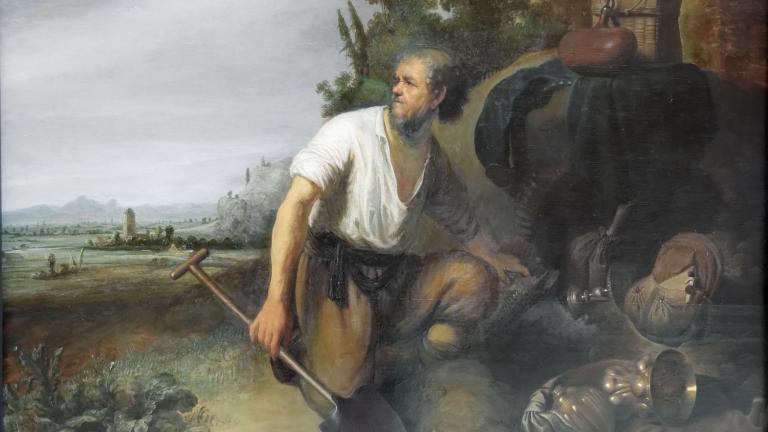
“Parable of the Hidden Treasure” (Rembrandt)
A weird discussion broke out on Facebook today, as they have a way of doing. It was in a friends-only post; so I won’t reveal names, or too many details. It involved a priest’s change to the reading of Matt. 13:44. The NAB translation reads:
The kingdom of heaven is like a treasure buried in a field, which a person finds and hides again, and out of joy goes and sells all that he has and buys that field.
The priest seems to have changed “sells all that he has” to “sells all that they have.” That was it, but that was enough for some to complain about “progressives” and “liberal feminism” conspiring against our pronouns. Nothing’s safe anymore, I tell you.
Another said: “It’s the work of a homosexual with an agenda to change how we see ourselves and God.” (And we know the priest’s sexual orientation and intentions … how?)
Still one more decried the “rottenness”; the Greek anthropos, this person said, should not be translated “person.” Anthropos means ‘man in the general sense.” (Actually, I think “person” does mean “man in the general sense,” but never mind.)
Now, let’s set aside the question of whether a priest ought to change the wording of the Gospel reading. If the discussion on Facebook had started and ended there, it would have been well enough. I’m more interested in the meltdown over the singular “they” and the translation of anthropos as “person.”
To begin with, the singular “they” predates the culture wars by a few hundred years. It has nothing—repeat with me, dear reader: nothing—to do with “liberal feminism” or some “homosexualist” agenda to confuse people about gender identity. The singular “they” dates back to—mark this, now—the fourteenth century. That’s right: the 1300s. Well before the culture went to war. Check out the examples in this article.
- It’s in Wycliffe’s Bible (1382): “Eche on in þer craft ys wijs.” (Each one is wise in their craft.)
- John Ruskin uses it in 1857: “When perspective was first discovered, every body amused themselves with it.”
- The King James Bible (1611) uses it in many places, including 2 Kings 14:12: “And Judah was put to the worse before Israel, and they fled every man to their tents.”
- Jane Austen (1814) uses it in Mansfield Park: “Had the Doctor been contented to take my dining tables as any body in their senses would have done.”
- Shakespeare uses it: “There’s not a man I meet but doth salute me / As if I were their well-acquainted friend.”
Was Shakespeare trying to promote a homosexualist agenda? Well, there’s a lot of cross-dressing in his plays, so maybe. Shakespeare is icky and dangerous.
But the singular “they” was known centuries ago; and that explains why, as early as the eighteenth century, grammarians began to argue against it. Think what you will about the singular “they,” but do not attribute the usage to the baneful influence of feminism or gender politics. The long, long literary record of its use is against you.
***
The notion that the Greek anthropos means “man” specifically, and nothing else, is even odder, if it be possible. “The translation [as person] is driven by an agenda!” one person cried. It’s a “deliberte distortion.”
Really? Then Strong’s has an agenda and deliberately distorts the truth, which some random person on Facebook has a better grasp of. According to that valuable source—I mean Strong’s, not the Facebook person—anthropos means
man, also the generic term for “mankind”; the human race; people, including women and men.
Strong’s quotes Wuest: “There are two words in Greek which mean ‘man,’ anēr, which refers to a male individual of the human race, and anthrōpos, which is the racial, generic term, and which has the general idea of ‘mankind.'”
And Thayer’s Greek Lexicon, from the nineteenth century, has this to say of anthropos: “universally, with reference to the genus or nature, without distinction of sex, a human being, whether male or female.”
Just an agenda? I doubt it.
A little Google will cure us of a lot of our weird conspiracy theories. If you’re going to complain about liberal feminism or the “homosexualist” agenda, at least try to get some basic facts right first. If you’re going to complain about priests changing the words of the Gospel reading, don’t veer off into something else that’s just plain weird.
***
Next Post

August 2, 2018 On Death Penalty, Roma Locuta Est
Browse Our Archives
Select a Category Abortion About Me Answers for Calvinists Answers to Media Fictions Answers to Objections Anti-Catholicism Apologetics Apostolic Succession Atonement Authority of the Church Baptism Benedictines Biblical Exegesis Blogging Book Reviews Books & Writing &c. Calvin's Institutes Capital Punishment Catholic Church Chastity Christology Church Fathers Church Social Doctrine Confession Contraception Conversion Stories Crusades Debates Depression & Suicide Deuterocanon Development of Doctrine Ecumenism English Language Eucharistic Adoration Exorcism Extra Ecclesiam Fisks & Rebuttals Freedom of Religion Freedom of Speech Fundamentalism Gender Politics Gender Theory Good Works Homosexuality Humor Idolatry Immaculate Conception In the News Inquisition ISIS Islam Just for Fun Just War Justification LCWR Limbo Liturgical Abuse Liturgical Year Magisterium Marriage and Family Mary Mortal Sin New Evangelization NFP Papacy Papal Documents Papal Infallibility Personal Narrative Politics Pope Francis Pope Francis Derangement Syndrome Population Control Praying to the "Dead" Priesthood Primacy of Peter Protestant Denominations Purgatory Radical Islam Radical Traditionalists Real Presence Right to Conscience RIght to Life Saints Same-Sex "Marriage" Seven Quick Takes Social Justice Social Media Sola Scriptura Spirit of Vatican II SSPX The Eucharist The Mass The Resurrection Traditionalism Vatican II Year of Mercy
Select a Month August 2019 July 2019 June 2019 May 2019 November 2018 October 2018 August 2018 July 2018 June 2018 April 2018 November 2017 October 2017 September 2017 May 2017 April 2017 March 2017 February 2017 November 2016 October 2016 September 2016 August 2016 July 2016 June 2016 May 2016 April 2016 March 2016 February 2016 January 2016 December 2015 November 2015 October 2015 September 2015 July 2015 June 2015 May 2015 April 2015 March 2015 February 2015 January 2015 December 2014 September 2014 August 2014 July 2014 June 2014 May 2014 April 2014 March 2014 February 2014 January 2014 December 2013 November 2013 October 2013 May 2013 April 2013 February 2013 January 2013
Follow Us!
TAKE THE
Religious Wisdom Quiz
I refused to bow to a high official and sat at the king's gate, sparking a genocidal plot. Who am I?
Select your answer to see how you score.
Haman Nehemiah Daniel Mordecai
Related posts from To Give a Defense
Does the Mass crucify Jesus another time? Part...
How much does God hate lying? (Proverbs 6:16-19)
Don't Cite Leviticus 18 If You're Going to...
TRENDING AT PATHEOS Catholic

Rejecting Doom: Christian Hope And Human Action
Christianity is a religion of hope. We are to have hope and...

It’s What Comes From Within Which Matters
One of the most difficult things for us to understand is why...

Why I Choose the Eucharist Over the Sermon
Choose the Eucharist, Not the Sermon What are we supposed to get...

5 Design Elements Found in Spiritually Rooted Homes
Putting Spirituality Into Home Decor Our homes are more than our living...

Credo: A Story of God Told with the...
About 10 years ago, I began to imagine a personal "Credo" that...

The Anatomy of Divine Revelation in Catholic Thought
The claim that God has made Himself known to human beings is...
view all Catholic blogs
Ad-Free & Subscriber Log-In Subscription Support
- About Us
- 2026 Calendar
- Videos
- Podcasts
- Library of World Religions
- Faith In Media Tracker
- Advertise With Us
- Write for Us
- Privacy Policy
- Terms of Service
- Do Not Sell My Data
- Contact Us
- Radiant Digital
- Manage Newsletter Subscriptions
- Unsubscribe From Notifications
- Sitemap
Copyright 2008-2026, Patheos. All rights reserved.
Subscription Support Ad-Free & Subscriber Log-In
Follow Patheos