
BuddhistCatholicContemplativeEvangelicalGeneral ChristianHinduJewishLatter-day SaintMuslimNew VisionsProgressive Christian
Beliefs
- Buddhist
- Catholic
- Contemplative
- Evangelical
- General Christian
- Hindu
- Jewish
- Latter-day Saint
- More Voices
- Muslim
- New Visions
- Pagan
- Progressive Christian
Topics
- Religion News
- Food and Religion
- Sports and Religion
- Religious Art
- Religious Music and Entertainment
- Religious Events
- History and Religion
- Style and Religion
- Politics and Religion
- Women in Religion
- Recreation Outdoors and Religion
- Business Finance and Religion
- Careers Workplace and Religion
- Education and Religion
- Family Parenting and Religion
- Health Fitness and Religion
- Home and Religion
- Relationships and Religion
- Technology and Religion
- Travel and Religion
Columnists
- Buddhist Columnists
- Business Finance and Religion Columnists
- Careers Workplace and Religion Columnists
- Catholic Columnists
- Contemplative Columnists
- Education and Religion Columnists
- Evangelists Columnists
- Family Parenting and Religion Columnists
- General Christian Columnists
- Health Fitness and Religion Columnists
- Hindu Columnists
- History and Religion Columnists
- Home and Religion Columnists
- Jewish Columnists
- More Voices Columnists
- Latter Day Columnists
- Muslim Columnists
- New Visions Columnists
- Nonreligious Columnists
- Pagan Columnists
- Politics and Religion Columnists
- Progressive Columnists
- Recreation Outdoors and Religion Columnists
- Relationships and Religion Columnists
- Religion News Columnists
- Religious Art Columnists
- Religious Events Columnists
- Religious Music and Entertainment Columnists
- Sports and Religion Columnists
- Style and Religion Columnists
- Technology and Religion Columnists
- Travel and Religion Columnists
- Women in Religion Columnists
Resource Library
- 2026 Calendar
- Library of World Religions
- The 100 Most Holy Places on Earth
- Patheos Answers
- Podcasts
- Videos
- Faith Leaders Database
- Anglican Episcopalian
- Bahai
- Baptist
- Buddhism
- Christianity
- Confucianism
- Eastern Orthodoxy
- Hinduism
- Holiness and Pentecostal
- ISKCON
- Islam
- Judaism
- Lutheran
- Methodist
- The Church of Jesus Christ of Latter-day Saints
- New Age
- Paganism
- Presbytarian and Reformed
- Protestantism
- Religion Behind the Scenes
- Roman Catholic
- Scientology
- Shia Islam
- Sikhism
- Sufism
- Sunni Islam
- Taoism
- Zen
- See all religions
Research Tools
 Ad-Free & Subscriber Log-In Subscription Support
Ad-Free & Subscriber Log-In Subscription Support
Follow Patheos 

- Trending:
- Forgiveness
- |
- Marriage
- |
- Consciousness
- |
- Death Penalty
- |
- Election
- |
- Halloween
 To Give a Defense
- Home
- Catholic
- Lepanto Institute Meme Attempts to Link Social Justice to Judas Iscariot
Lepanto Institute Meme Attempts to Link Social Justice to Judas Iscariot
Last updated on: March 10, 2018 at 5:20 pm by Scott Eric Alt
Lepanto Institute Meme Attempts to Link Social Justice to Judas Iscariot 2018-03-10T17:20:41-04:00 Scott Eric Alt
Patheos Explore the world's faith through different perspectives on religion and spirituality! Patheos has the views of the prevalent religions and spiritualities of the world.
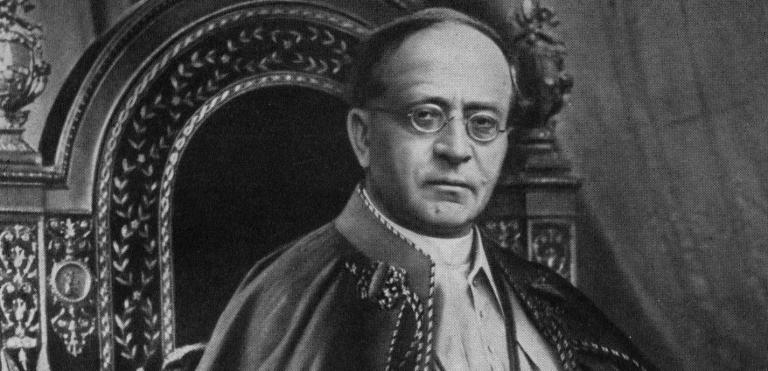
Pius XI, who called social justice a “firmly established” teaching of the Church
On February 13, I posted an article about a meme you will still find on the Lepanto Institute’s Facebook page. The meme makes the intellectually lax claim that Judas is the “patron saint of social justice.” (The actual patron saint of social justice, Mary Pezzulo points out, is St. Martin de Porres.)
I pointed out in my earlier post—and I will repeat below—that social justice is long-established Catholic doctrine. The Church goes as far as to call it one of the non-negotiables. To somehow try to connect it to Judas is contrary to Catholic thinking.
I removed the post after Michael Hichborn, who I take to be the one who created the meme, posted the following comment:
You say that you are defending social justice as a Catholic teaching while also understanding that there is a distinction between true and false social justice. Had you bothered to understand, rather than accuse, it wouldn’t have taken you long to realize that the social justice intended in the meme is the false kind.
Okay. I have no real reason to doubt this, and thus my removal of a post that bore as its (somewhat hyperbolic) title “Lepanto Institute Abandons Catholicism.” And yet Mr. Hichborn’s meme remains as it was, with no clarification as to what he means by “social justice.”
If the meme promoted confusion rather than clarity before, it promotes confusion rather than clarity still. I understand that nuance is not in the nature of a meme, but that is what a lede is for. Or perhaps social justice is too complex and serious a topic to reduce to a meme.
If Mr. Hichborn finds himself at odds with someone’s false understanding of social justice, then he needs to clarify how he is using the term and how that differs from social justice as the Church understands it. He has not done so.
***
The closest Mr. Hichborn comes is when he says that Judas “elevated social action (service to the poor) above adoration and service to God.” He is attempting to exegete John 12:1-8, in which Mary of Bethany (the sister of Lazarus) anoints Jesus with spikenard and Judas objects: “Why was this ointment not sold for three hundred denarii and given to the poor?”
There are three deficiencies in Mr. Hichborn’s exegesis.
First, he misses the point of the story, which is not that Judas somehow put service to the poor at some heightened level of importance above the worship we owe God. Verse 6, which Mr. Hichborn does not mention, clarifies. “This [Judas] said,” John writes, “not that he cared for the poor but because he was a thief, and as he had the money box he used to take what was put into it.”
Judas does not want to give the money to the poor; he wants to keep it for himself and pretend he gave it to the poor. He does not practice social justice here at all.
The second problem is that thievery from the poor does not match any definition of social justice, true or false, that I know. If Mr. Hichborn thinks it does, he needs to point us to who defines it in any such way. And even there is such a definition floating around somewhere, Mr. Hichborn does not say: Judas is the patron saint of social justice because he stole from the poor. He says: Judas is the patron saint of social justice because he thought service to the poor was more important than worship of God. These are two separate things.
If someone claims to advocate social justice, however defined, but in reality diverts money meant for the poor to his own use, isn’t that in fact a betrayal of social justice?
Third and finally, to posit that “service to the poor” and “worship of God” are different things, or that they are in conflict with each other, is to make a false dichotomy. Service to the poor is worship of God. We can not rend them in twain.
Jesus says, “Whatever you do for the least of these you do for me” (Matt. 25:40).
St. John Chrysostom says, “If you cannot find Christ in the beggar at the Church door, you will not find him in the chalice.”
Far from telling us that social justice is foreign to the true worship of God, a legacy of Judas Iscariot’s betrayal of Christ, the Congregation for the Doctrine of the Faith names it as one of the non-negotiables. (And you thought there were only five, didn’t you? There are more.)
According to the CDF, social justice is a “moral principle that do[es] not admit of exception.” We may not blithely brush it aside.
***
But what is it—in the Church’s understanding? According to the Catechism (§1928), “Society ensures social justice when it provides the conditions that allow associations or individuals to obtain what is their due, according to their nature and their vocation. The CCC goes on.
Social justice can be obtained only in respecting the transcendent dignity of man. …
Respect for the human person entails respect for the rights that flow from his dignity as a creature. These rights are prior to society and must be recognized by it.
The Catechism goes on to say (§1931) that it is the Church’s duty to tell people about these rights.
But what are they?
The Compendium of the Social Doctrine of the Church goes into much detail on this point. Here are a few.
- The right to life. This is “the first among all rights and the condition for all other rights of the person.” (CSD 552)
- The right to religious freedom. “The dignity of the person and the very nature of the quest for God require that all men and women should be free from every constraint in the area of religion.” (CSD 421)
- The right to work. “Work is a good belonging to all people and must be made available to all who are capable of engaging in it. “Full employment” therefore remains a mandatory objective for every economic system oriented towards justice and the common good.” (CSD 288)
- A just wage. “They commit grave injustice who refuse to pay a just wage or who do not give it in due time and in proportion to the work done” (CSD 302).
- Income equity. “An equitable distribution of income is to be sought on the basis of criteria not merely of commutative justice but also of social justice that is, considering, beyond the objective value of the work rendered, the human dignity of the subjects who perform it. Authentic economic well-being is pursued also by means of suitable social policies for the redistribution of income which, taking general conditions into account, look at merit as well as at the need of each citizen.” (CSD 303)
- The right to strike. “The Church’s social doctrine recognizes the legitimacy of striking “when it cannot be avoided, or at least when it is necessary to obtain a proportionate benefit,” when every other method for the resolution of disputes has been ineffectual.” (CSD 304)
- The right to organize unions. “Such organizations, while pursuing their specific purpose with regard to the common good, are a positive influence for social order and solidarity, and are therefore an indispensable element of social life.” (CSD 304)
The Compendium discusses many others.
- Food and drinkable water.
- Housing.
- Freedom from genocide.
- Freedom from slavery.
- One’s own cultural heritage.
- Conscience.
- Truth.
- Self-defense.
- Social Security.
- A pension.
- A safe working environment.
***
In Quadragesimo Anno, Pope Pius XI describes social justice, broadly, as “the norms of the common good” (58). He says it is a “lofty and noble principle” (88). It is consistent with “the mind of the Church” (126).
All that said, it is, at best, misleading for the Lepanto Insitute to lead others into the belief that those who advocate for social justice have Judas as their patron saint and put less importance on our duty to worship God. At worst, it causes confusion and scandal. It needlessly casts Catholic social justice advocates in a negative light they do not merit. At a minimimum, a clarification is in order. How is the term being used? Social justice in what sense?
That service to the poor is different from worship to God, that it has it place only to a point, is not what the Church teaches. It is not Catholicism.
The popes from Leo XIII forward have writen a great number of encyclicals explaining social justice. They have said that it is a right of all human beings which may not be ignored.
Do not listen to the Lepanto Institute. Listen to the Church. Listen to all her teaching.
***
Catechism of the Catholic Church
Compendium of the Social Doctrine of the Church


Browse Our Archives
Select a Category Abortion About Me Answers for Calvinists Answers to Media Fictions Answers to Objections Anti-Catholicism Apologetics Apostolic Succession Atonement Authority of the Church Baptism Benedictines Biblical Exegesis Blogging Book Reviews Books & Writing &c. Calvin's Institutes Capital Punishment Catholic Church Chastity Christology Church Fathers Church Social Doctrine Confession Contraception Conversion Stories Crusades Debates Depression & Suicide Deuterocanon Development of Doctrine Ecumenism English Language Eucharistic Adoration Exorcism Extra Ecclesiam Fisks & Rebuttals Freedom of Religion Freedom of Speech Fundamentalism Gender Politics Gender Theory Good Works Homosexuality Humor Idolatry Immaculate Conception In the News Inquisition ISIS Islam Just for Fun Just War Justification LCWR Limbo Liturgical Abuse Liturgical Year Magisterium Marriage and Family Mary Mortal Sin New Evangelization NFP Papacy Papal Documents Papal Infallibility Personal Narrative Politics Pope Francis Pope Francis Derangement Syndrome Population Control Praying to the "Dead" Priesthood Primacy of Peter Protestant Denominations Purgatory Radical Islam Radical Traditionalists Real Presence Right to Conscience RIght to Life Saints Same-Sex "Marriage" Seven Quick Takes Social Justice Social Media Sola Scriptura Spirit of Vatican II SSPX The Eucharist The Mass The Resurrection Traditionalism Vatican II Year of Mercy
Select a Month August 2019 July 2019 June 2019 May 2019 November 2018 October 2018 August 2018 July 2018 June 2018 April 2018 November 2017 October 2017 September 2017 May 2017 April 2017 March 2017 February 2017 November 2016 October 2016 September 2016 August 2016 July 2016 June 2016 May 2016 April 2016 March 2016 February 2016 January 2016 December 2015 November 2015 October 2015 September 2015 July 2015 June 2015 May 2015 April 2015 March 2015 February 2015 January 2015 December 2014 September 2014 August 2014 July 2014 June 2014 May 2014 April 2014 March 2014 February 2014 January 2014 December 2013 November 2013 October 2013 May 2013 April 2013 February 2013 January 2013
Follow Us!
TAKE THE
Religious Wisdom Quiz
I denounced Israel's opulent lifestyle—those who lie on beds of ivory and dine on choice lambs. What were they at ease in?
Select your answer to see how you score.
Their wealth Zion Their palaces Their security
Related posts from To Give a Defense
Does the Mass crucify Jesus another time? Part...

The condition of migrants is a pro-life issue,...

The desperate need love and mercy, not judgment.

How much does God hate lying? (Proverbs 6:16-19)
TRENDING AT PATHEOS Catholic

Rejecting Doom: Christian Hope And Human Action
Christianity is a religion of hope. We are to have hope and...

It’s What Comes From Within Which Matters
One of the most difficult things for us to understand is why...

Why I Choose the Eucharist Over the Sermon
Choose the Eucharist, Not the Sermon What are we supposed to get...

5 Design Elements Found in Spiritually Rooted Homes
Putting Spirituality Into Home Decor Our homes are more than our living...

Credo: A Story of God Told with the...
About 10 years ago, I began to imagine a personal "Credo" that...

The Anatomy of Divine Revelation in Catholic Thought
The claim that God has made Himself known to human beings is...
view all Catholic blogs
Ad-Free & Subscriber Log-In Subscription Support
- About Us
- 2026 Calendar
- Videos
- Podcasts
- Library of World Religions
- Faith In Media Tracker
- Advertise With Us
- Write for Us
- Privacy Policy
- Terms of Service
- Do Not Sell My Data
- Contact Us
- Radiant Digital
- Manage Newsletter Subscriptions
- Unsubscribe From Notifications
- Sitemap
Copyright 2008-2026, Patheos. All rights reserved.
Subscription Support Ad-Free & Subscriber Log-In
Follow Patheos