
BuddhistCatholicContemplativeEvangelicalGeneral ChristianHinduJewishLatter-day SaintMuslimNew VisionsProgressive Christian
Beliefs
- Buddhist
- Catholic
- Contemplative
- Evangelical
- General Christian
- Hindu
- Jewish
- Latter-day Saint
- More Voices
- Muslim
- New Visions
- Pagan
- Progressive Christian
Topics
- Religion News
- Food and Religion
- Sports and Religion
- Religious Art
- Religious Music and Entertainment
- Religious Events
- History and Religion
- Style and Religion
- Politics and Religion
- Women in Religion
- Recreation Outdoors and Religion
- Business Finance and Religion
- Careers Workplace and Religion
- Education and Religion
- Family Parenting and Religion
- Health Fitness and Religion
- Home and Religion
- Relationships and Religion
- Technology and Religion
- Travel and Religion
Columnists
- Buddhist Columnists
- Business Finance and Religion Columnists
- Careers Workplace and Religion Columnists
- Catholic Columnists
- Contemplative Columnists
- Education and Religion Columnists
- Evangelists Columnists
- Family Parenting and Religion Columnists
- General Christian Columnists
- Health Fitness and Religion Columnists
- Hindu Columnists
- History and Religion Columnists
- Home and Religion Columnists
- Jewish Columnists
- More Voices Columnists
- Latter Day Columnists
- Muslim Columnists
- New Visions Columnists
- Nonreligious Columnists
- Pagan Columnists
- Politics and Religion Columnists
- Progressive Columnists
- Recreation Outdoors and Religion Columnists
- Relationships and Religion Columnists
- Religion News Columnists
- Religious Art Columnists
- Religious Events Columnists
- Religious Music and Entertainment Columnists
- Sports and Religion Columnists
- Style and Religion Columnists
- Technology and Religion Columnists
- Travel and Religion Columnists
- Women in Religion Columnists
Resource Library
- 2026 Calendar
- Library of World Religions
- The 100 Most Holy Places on Earth
- Patheos Answers
- Podcasts
- Videos
- Faith Leaders Database
- Anglican Episcopalian
- Bahai
- Baptist
- Buddhism
- Christianity
- Confucianism
- Eastern Orthodoxy
- Hinduism
- Holiness and Pentecostal
- ISKCON
- Islam
- Judaism
- Lutheran
- Methodist
- The Church of Jesus Christ of Latter-day Saints
- New Age
- Paganism
- Presbytarian and Reformed
- Protestantism
- Religion Behind the Scenes
- Roman Catholic
- Scientology
- Shia Islam
- Sikhism
- Sufism
- Sunni Islam
- Taoism
- Zen
- See all religions
Research Tools
 Ad-Free & Subscriber Log-In Subscription Support
Ad-Free & Subscriber Log-In Subscription Support
Follow Patheos 

- Trending:
- Forgiveness
- |
- Marriage
- |
- Consciousness
- |
- Death Penalty
- |
- Election
- |
- Halloween
 To Give a Defense
- Home
- Catholic
- John Bugay’s Eisegetical Creativity
John Bugay’s Eisegetical Creativity
Last updated on: March 4, 2018 at 12:28 am by Scott Eric Alt
John Bugay’s Eisegetical Creativity 2018-03-04T00:28:08-04:00 Scott Eric Alt
Patheos Explore the world's faith through different perspectives on religion and spirituality! Patheos has the views of the prevalent religions and spiritualities of the world.
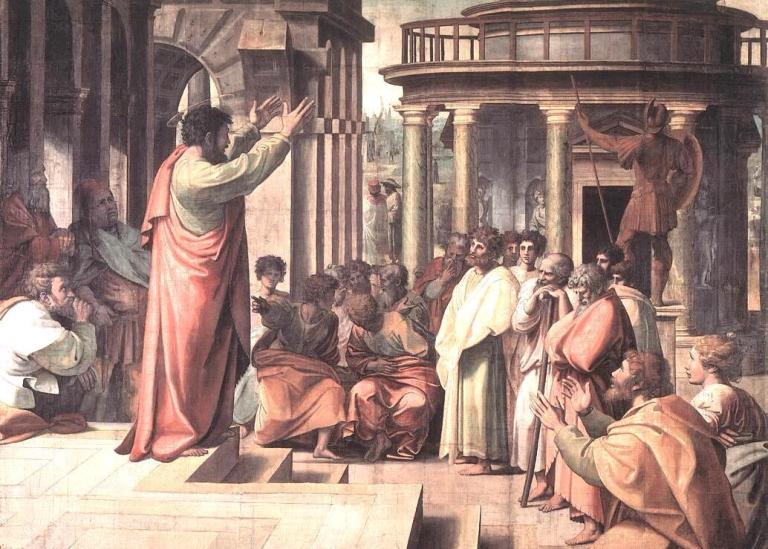
St. Paul preaching in Athens (Raphael, 1515)
The best argument that Catholic apologists have against sola scriptura is that it is self-refuting. If the Bible alone contains all that is required for faith and practice, and sola scriptura is required for faith and practice, then why is sola scriptura not to be found there? Search as long as you may please, you will not find it. Protestants know that they have a difficulty here. They know that, in order to defend sola scriptura, they must do so from the only source of doctrine to which they point. They must tell us which verse teaches sola scriptura. (Just one verse will do.) If they can’t, then sola scriptura fails its own test.
DR.* JAMES WHITE’S BLUFF
At times, full of sweat, they tire of the ceaseless hunt and try to bluff their way into the shade. I grant them their cleverness in doing so. They need it; the hunt is long and the time short before the great and fearsome Day of the Lord. Among all such bluffers, the cleverest in my view is Dr.* James R. White (Th.D., D.Min., etc., etc.), of Alpha & Omega Sophistries. In a 1997 debate with Gerry Matatics, when pressed on whether the apostles practiced sola scriptura, Dr.* White replied: “I have said over and over and over again that sola scriptura is a doctrine that speaks to the normative condition of the church, not to times of enscripturation.” In a recent debate with Catholic apologist William Albrecht, Dr.* White’s prime toady, the glib and anonymous TurretinFan, used similar words, though he at least spared us the syllables and was terse. As he put it, “Sola scriptura is what we do to the Bible once we have the Bible.”
In other words—to put it all in plain words—here is what they ask us to believe: The apostles don’t need to have have practiced it; nor did they need to tell us about it. Their silence may mean much to Rome, but it means nothing to us. Sola scriptura is a self-evident first principle of the church. It exists outside of Scripture and is brought to Scripture. After the apostles died, it somehow was just there, obvious to all, until Rome added the doctrines of men. It describes the very nature of a finished canon, even though it is not articulated in the canon. Because the Bible is, sola scriptura is.
In his book The Roman Catholic Controversy,
The doctrine of sola scriptura is based on the nature of the Scriptures as the Word of God. There can be no understanding of the sufficiency of Scripture apart from an understanding of the true origin and resultant nature of Scripture. (62)
Thus once again: It is the nature of what the Scriptures are (the Word of God) more than what the Scriptures say, that binds Christians to the doctrine of sola scriptura.
Now, this is clever, and at first glance can be convincing. But it fails to answer one key question: How do we know that the Bible alone is the Word of God? Dr.* White just assumes that it is, a priori. But he gives no reason why we shouldn’t believe that the Word of God might also exist elsewhere—say, in the Church (cf. 1 Tim. 3:15). So at bottom, all this is nothing more than a brave attempt to distract from the inability to defend the doctrine of sola scriptura from the only source of doctrine to which the Protestant points. If you can’t defend sola scriptura biblically, attempt to defend it existentially: That’s the ploy.
I will have more to say about this later, in a detailed critique of Dr.* White’s two chapters on sola scriptura in The Roman Catholic Controversy. For now, I want just to look at three of the common texts that do get cited in defense of sola scriptura and show why they do not prove what Protestants claim they do. I will then turn to the polemical rogue Mr. John Bugay, to whom I have already replied on this topic (here and here). Mr. Bugay, who is known for his powers of invention, tries to find the doctrine in three new texts that I would not have thought of in any fantasia, be it ever so wild. These are also worth looking at, for they are—once more—a lesson in the extremes to which some Protestant apologists will go when trapped in a corner but unwilling to abandon their error.
ACTS 17:11: THE NOBLE BEREANS
The three most often-cited proof-texts for sola scriptura are Acts 17:11, 2 Tim. 3:16-17, and Rev. 22:18-19. I shall take them in order. Here is Acts 17:11:
These [the Bereans] were more noble than those in Thessalonica, in that they received the word with all readiness of mind, and searched the scriptures daily, whether those things were so.
The argument is that the Bereans, via the Scriptures, sought to validate the truth of what St. Paul’s taught them. That is to say, the Scriptures are the sole standard of proof to establish right doctrine. Because the Bereans held Paul to a biblical proof, they were “more noble” than the rest.
But is this really what we should conclude from this text? To answer that question, we need to consider what the Bereans wanted to confirm when they “searched the scriptures daily.” We find out by checking a few verses earlier, in Acts 17:2-3:
And Paul, as his manner was, went in unto them, and three sabbath days reasoned with them out of the scriptures, opening and alleging, that Christ must needs have suffered, and risen again from the dead; and that this Jesus, whom I preach unto you, is Christ.
Now, the scriptures that Paul uses here, to “reason with them,” are the Old Testament. There was no New Testament yet. And what he “reasons,” put simply, is that Christ is the fulfillment of the Old Testament prophecy. Christ is the Messiah foretold. But to determine whether or not that was so, where else should the Bereans have gone except the scriptures? If Paul was arguing “out of the scriptures,” it would have been very odd for the Bereans to have looked at some other text to confirm the exegesis. The scriptures were alone relevant to the question they were trying to answer. Acts 17 describes a particular occasion of biblical exegesis, not a general principle of biblical sufficiency. If Paul had said that Jesus was the fulfillment of Plato’s Republic, a wise Berean would have been foolish to have searched the scriptures. He’d have searched the Republic. But one could hardly derive a principle of sola Republica from that. Acts simply does not say what the Protestant wants it to.
2 timothy 3:16-17: all scripture is given
But what about 2 Timothy 3:16-17? The Protestant apologist believes he has a more open-and-shut case here; indeed, it features prominently in The Roman Catholic Controversy (pp. 62-67). Let’s look.
All scripture is given by inspiration of God, and is profitable for doctrine, for reproof, for correction, for instruction in righteousness: That the man of God may be perfect, thoroughly furnished unto all good works.
It certainly sounds—if you take a surface-level view of biblical exegesis—like the Protestant apologist does have an open-and-shut case here. Scripture makes the “man of God … perfect [and] thoroughly furnished.” As Dr.* White put it in his debate with Mr. Matatics, “That’s what a rule of faith is.” But a more careful look at this text will reveal several problems.
The first is that Paul says that “all scripture is given by inspiration of God.” That’s different, is it not, from saying that only scripture is so given. Any course in Logic 101 will teach you that you can’t derive an only statement from an all statement. It’s a faulty syllogism, along the lines of saying that if all apples are fruit, therefore only apples are fruit.
The second problem is that nowhere does Paul say that scripture is sufficient, which is what sola scriptura would claim. It does say that all scripture is profitable, but that’s not the same thing. If I have a hardware store, it may very well be that my sale of nails has made me a profit. But that does not mean that nails alone are sufficient to keep my store in business. I also require the sale of other goods.
The final problem is that Paul says that scripture makes the man of God “thoroughly furnished unto all good works.” Apart from the oddity of the Protestant apologist praising works is the fact that Paul does not tell Timothy that scripture thoroughly furnishes the man of God unto all correct doctrine. That’s different.
In short, we see here again that the Protestant apologist tries to make a text of scripture say more than it says. He looks at 1 Timothy 3:16-17 and asks it to support a doctrine larger than the scope of its words will bear.
revelation 22:18-19: do not add or subtract
But what about Revelation 22:18-19? For here St. John announces a curse on anyone who adds or subtracts, thus:
For I testify unto every man that heareth the words of the prophecy of this book, If any man shall add unto these things, God shall add unto him the plagues that are written in this book; and if any man shall take away from the words of the book of this prophecy, God shall take away his part out of the book of life, and out of the holy city, and from the things which are written in this book.
Strong words indeed. But again, as elsewhere, the Protestant apologist reads more into the text than is there. The blessing and the curse apply only to “the words of this book”—only to Revelation. John mentions no curse on those who add to or take away from Galatians or Luke or Job or Tobit. (Would that he had said Tobit.) If this text proves a sola of any kind, it proves solus Apocalypsis, and I doubt any Protestant would advocate that. Not even Harold Camping is that mad, and he makes Mr. Bugay look like the pith and sum of coherence. It is also worth noting that, even if the text does teach sola scriptura, the curse for removing books should make any Protestant gaze upon his 66-book canon with fear and trembling.
luke 16:29: listen to moses and the prophets
Enter the polemical rogue Mr. John Bugay. Mr. Bugay very kindly referred me to a blog post he wrote in response to something Dr. Michael Liccione had said, at Called to Communion, in the combox of Joshua Lim’s conversion story. (Dr. Liccione seems to be his white whale. The discussion starts at comment 275.) The reason I want to discuss Mr. Bugay’s blog post from last June is in part because he sent it screaming into my inbox, but also because it contains three verses which I confess I had never heard used to support sola scriptura. These impress me if for no reason other than the evidence they give of the amazing eisegetical creativity of Mr. Bugay. The polemical rogue has deft powers of invention. The verses in question are Luke 16:29, and both Ps. 16:5 and Ps. 119:105, which can be discussed together.
Luke 16:29 reads, “They have Moses and the prophets; let them hear them.” By citing this text, Mr. Bugay means for us to believe that Jesus is appealing to an interpretive paradigm by which “Moses and the prophets” are the standard for establishing a doctrinal point. But we need to back up a little bit in order to understand the context in which Jesus says these words, because the polemical rogue gives no hint of that.
At this point in Luke’s gospel, Jesus is telling the parable of the rich man and Lazarus. Lazarus, the beggar who had lain outside the rich man’s gate, begging for food but receiving none, has died and gone to his eternal reward. The rich man has also died, and ends up in Hades. From Hades, he can see Lazarus in glory, and he begs Abraham (who stands beside Lazarus) to send someone to the rest of his brothers (who are still alive) to warn them what they need to do to avoid such torment. Abraham suggests that Lazarus’s brothers should “listen to Moses and the prophets.” The implication of this statement—which Jesus later points out—is that if Lazarus’s brothers aren’t persuaded by Moses and the prophets to repent, neither are they going to be persuaded by anything else, not even someone coming back from the dead.
The key thing to notice here, however, is that that Christ is telling us about repentance, not doctrine. His subject is not the rule of faith. This is, after all, a line of dialogue in a parable. The point of the story is that once you shut your ears to Moses and the prophets, you necessarily shut your ears to any other reason to believe. Now, that hardly establishes a principle of biblical exclusivity; it affirms, even if implicitly, that other reasons to repent (such as witnessing a miracle) count. It is not that Scripture alone brings one to repentance; but rather, that rejection of Scripture precludes repentance. Christ is not telling us about the nature of scripture; he is telling us about the obstinacy of human beings in rejecting God.
Mr. Bugay’s attempt to use Luke 16:29 to establish sola scriptura is creative. I praise his pluck if not his care. For as with all the other texts, a careful look at context and wording makes it clear that Mr. Bugay is reading into the verse a doctrine that is not to be found there. He does not read Luke 16:29 and say, “Oh, my ears and whiskers! sola scriptura!” No. Rather, he presumes the gold is there before he opens the first page, then plows through the Bible with a divining rod. His whole body shakes about with histrionic fervor.
psalms 16 & 119: thy word a lamp to my feet
Psalm 16:5 and 119:105 can be viewed together, because they each say the same thing. Psalm 16:5 reads, “The Lord is the portion of mine inheritance and of my cup; thou maintainest my lot.” Psalm 119:105 reads, “Thy word is a lamp unto my feet and a light unto my path.” Some translations of Psalm 16:5, in Lutheresque fashion, include the word “alone” to read, “The Lord alone is the portion of mine inheritance.” Is is not a question worth quibbling over; even if one concedes that the word should be there, the verse is not talking about the Bible but about God. Is Mr. Bugay confusing the two? Is God a book? I gladly affirm that God inspired the Scripture, but I never before heard it suggested that God is the Scripture. As far as Psalm 119:105, it certainly praises God’s word, but nowhere does it state a principle of exclusivity, nor does Mr. Bugay explain why God’s word is to be limited to the Bible. Like Dr.* White, he assumes it a priori, but nowhere does the verse state any such thing.
I admire Mr. Bugay his creativity, but I can’t say much for his exegesis. He even claims he can find sola scriptura in Eden, where not only was there no scripture but there was no writing. Eve did not hold open a scroll before the serpent and say, “Here in the book it is writ.” I could more easily claim that Adam and Eve had oral tradition. And incidentally, it wasn’t the oral tradition that failed, but the fact that Eve disobeyed it.
Sola scriptura is not in the Bible. What proponents must do—what they can only do—is to take some text that speaks well of scripture, no matter how generally, and try to derive from that some principle of exclusivity. The problem is, Catholics do not reject a high doctrine of Scripture. We embrace the texts that Protestants cite. But you cannot prove exclusivity from them. Protestant apologists make the same error when they cite the Church Fathers: They find a verse praising the scriptures, or proving some point from them, and then immediately claim to have proven exclusivity. They haven’t. Until the Protestant apologist can demonstrate how such-and-such a verse proves exclusivity, sola scriptura continues to fail its own test.
***
If you like the content on this blog, your generous gift to the author helps to keep it active. I remember all my supporters in my Mass intentions each week.
Previous Post
January 10, 2013
Thoughts on Bishop Fellay and the Ugliness of Schism
Next Post
January 13, 2013 Remember Your Baptism
Browse Our Archives
Select a Category Abortion About Me Answers for Calvinists Answers to Media Fictions Answers to Objections Anti-Catholicism Apologetics Apostolic Succession Atonement Authority of the Church Baptism Benedictines Biblical Exegesis Blogging Book Reviews Books & Writing &c. Calvin's Institutes Capital Punishment Catholic Church Chastity Christology Church Fathers Church Social Doctrine Confession Contraception Conversion Stories Crusades Debates Depression & Suicide Deuterocanon Development of Doctrine Ecumenism English Language Eucharistic Adoration Exorcism Extra Ecclesiam Fisks & Rebuttals Freedom of Religion Freedom of Speech Fundamentalism Gender Politics Gender Theory Good Works Homosexuality Humor Idolatry Immaculate Conception In the News Inquisition ISIS Islam Just for Fun Just War Justification LCWR Limbo Liturgical Abuse Liturgical Year Magisterium Marriage and Family Mary Mortal Sin New Evangelization NFP Papacy Papal Documents Papal Infallibility Personal Narrative Politics Pope Francis Pope Francis Derangement Syndrome Population Control Praying to the "Dead" Priesthood Primacy of Peter Protestant Denominations Purgatory Radical Islam Radical Traditionalists Real Presence Right to Conscience RIght to Life Saints Same-Sex "Marriage" Seven Quick Takes Social Justice Social Media Sola Scriptura Spirit of Vatican II SSPX The Eucharist The Mass The Resurrection Traditionalism Vatican II Year of Mercy
Select a Month August 2019 July 2019 June 2019 May 2019 November 2018 October 2018 August 2018 July 2018 June 2018 April 2018 November 2017 October 2017 September 2017 May 2017 April 2017 March 2017 February 2017 November 2016 October 2016 September 2016 August 2016 July 2016 June 2016 May 2016 April 2016 March 2016 February 2016 January 2016 December 2015 November 2015 October 2015 September 2015 July 2015 June 2015 May 2015 April 2015 March 2015 February 2015 January 2015 December 2014 September 2014 August 2014 July 2014 June 2014 May 2014 April 2014 March 2014 February 2014 January 2014 December 2013 November 2013 October 2013 May 2013 April 2013 February 2013 January 2013
Follow Us!
TAKE THE
Religious Wisdom Quiz
Proverbs 24:27 advises to "put your outdoor work in order" before what?
Select your answer to see how you score.
Building a house Getting married Going to war Seeking a teacher
Related posts from To Give a Defense
Does the Mass crucify Jesus another time? Part...
Does the Mass "banish the remembrance of Christ's...
How much does God hate lying? (Proverbs 6:16-19)
Don't Cite Leviticus 18 If You're Going to...
TRENDING AT PATHEOS Catholic

Rejecting Doom: Christian Hope And Human Action
Christianity is a religion of hope. We are to have hope and...

It’s What Comes From Within Which Matters
One of the most difficult things for us to understand is why...

Why I Choose the Eucharist Over the Sermon
Choose the Eucharist, Not the Sermon What are we supposed to get...

5 Design Elements Found in Spiritually Rooted Homes
Putting Spirituality Into Home Decor Our homes are more than our living...

Credo: A Story of God Told with the...
About 10 years ago, I began to imagine a personal "Credo" that...

The Anatomy of Divine Revelation in Catholic Thought
The claim that God has made Himself known to human beings is...
view all Catholic blogs
Ad-Free & Subscriber Log-In Subscription Support
- About Us
- 2026 Calendar
- Videos
- Podcasts
- Library of World Religions
- Faith In Media Tracker
- Advertise With Us
- Write for Us
- Privacy Policy
- Terms of Service
- Do Not Sell My Data
- Contact Us
- Radiant Digital
- Manage Newsletter Subscriptions
- Unsubscribe From Notifications
- Sitemap
Copyright 2008-2026, Patheos. All rights reserved.
Subscription Support Ad-Free & Subscriber Log-In
Follow Patheos