
BuddhistCatholicContemplativeEvangelicalGeneral ChristianHinduJewishLatter-day SaintMuslimNew VisionsProgressive Christian
Beliefs
- Buddhist
- Catholic
- Contemplative
- Evangelical
- General Christian
- Hindu
- Jewish
- Latter-day Saint
- More Voices
- Muslim
- New Visions
- Pagan
- Progressive Christian
Topics
- Religion News
- Food and Religion
- Sports and Religion
- Religious Art
- Religious Music and Entertainment
- Religious Events
- History and Religion
- Style and Religion
- Politics and Religion
- Women in Religion
- Recreation Outdoors and Religion
- Business Finance and Religion
- Careers Workplace and Religion
- Education and Religion
- Family Parenting and Religion
- Health Fitness and Religion
- Home and Religion
- Relationships and Religion
- Technology and Religion
- Travel and Religion
Columnists
- Buddhist Columnists
- Business Finance and Religion Columnists
- Careers Workplace and Religion Columnists
- Catholic Columnists
- Contemplative Columnists
- Education and Religion Columnists
- Evangelists Columnists
- Family Parenting and Religion Columnists
- General Christian Columnists
- Health Fitness and Religion Columnists
- Hindu Columnists
- History and Religion Columnists
- Home and Religion Columnists
- Jewish Columnists
- More Voices Columnists
- Latter Day Columnists
- Muslim Columnists
- New Visions Columnists
- Nonreligious Columnists
- Pagan Columnists
- Politics and Religion Columnists
- Progressive Columnists
- Recreation Outdoors and Religion Columnists
- Relationships and Religion Columnists
- Religion News Columnists
- Religious Art Columnists
- Religious Events Columnists
- Religious Music and Entertainment Columnists
- Sports and Religion Columnists
- Style and Religion Columnists
- Technology and Religion Columnists
- Travel and Religion Columnists
- Women in Religion Columnists
Resource Library
- 2026 Calendar
- Library of World Religions
- The 100 Most Holy Places on Earth
- Patheos Answers
- Podcasts
- Videos
- Faith Leaders Database
- Anglican Episcopalian
- Bahai
- Baptist
- Buddhism
- Christianity
- Confucianism
- Eastern Orthodoxy
- Hinduism
- Holiness and Pentecostal
- ISKCON
- Islam
- Judaism
- Lutheran
- Methodist
- The Church of Jesus Christ of Latter-day Saints
- New Age
- Paganism
- Presbytarian and Reformed
- Protestantism
- Religion Behind the Scenes
- Roman Catholic
- Scientology
- Shia Islam
- Sikhism
- Sufism
- Sunni Islam
- Taoism
- Zen
- See all religions
Research Tools
 Ad-Free & Subscriber Log-In Subscription Support
Ad-Free & Subscriber Log-In Subscription Support
Follow Patheos 

- Trending:
- Forgiveness
- |
- Marriage
- |
- Consciousness
- |
- Death Penalty
- |
- Election
- |
- Halloween
 To Give a Defense
- Home
- Catholic
- I See Men as Trees Walking Part III: The Allegory of Fear
I See Men as Trees Walking Part III: The Allegory of Fear
Last updated on: March 13, 2017 at 10:25 pm by Scott Eric Alt
I See Men as Trees Walking Part III: The Allegory of Fear 2017-03-13T22:25:15-04:00 Scott Eric Alt
Patheos Explore the world's faith through different perspectives on religion and spirituality! Patheos has the views of the prevalent religions and spiritualities of the world.
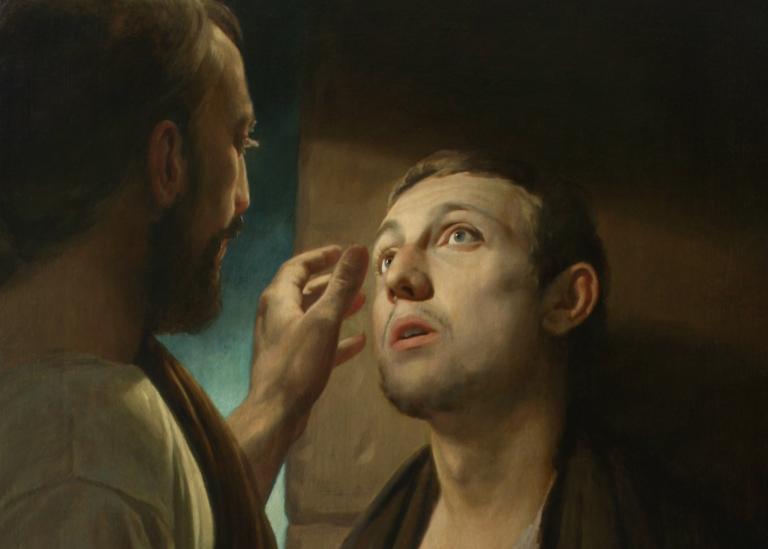
Andrey Mironov, “Christ and the Pauper,” 2009 (Creative Commons)

A favorite scene in Franco Zeffirelli’s Jesus of Nazareth involves Christ’s healing of a blind man, played by Renato Rascel, near the pool of Siloam. This is not the same blind man, of Bethsaida, whom he had healed in the Gospel of Mark. This particular healing takes place in Jerusalem; St. John records the story in chapter 9 of his gospel.
As he passed by, he saw a man blind from his birth. And his disciples asked him, “Rabbi, who sinned, this man or his parents, that he was born blind?” Jesus answered, “It was not that this man sinned, or his parents, but that the works of God might be made manifest in him. We must work the works of him who sent me, while it is day; night comes, when no one can work. As long as I am in the world, I am the light of the world.” As he said this, he spat on the ground and made clay of the spittle and annointed the man’s eyes with the clay, saying to him, “Go, wash in the pool of Siloam” (which means Sent). So he went and washed and came back seeing*.*
i.
The Pharisees, who always seem to be close by at such moments, quickly learn of the healing. They decide to open an investigation into the matter, and thus question the man regarding how he got his sight back. There is a faction among the Pharisees, which insists that Christ “is not from God, for he does not keep the sabbath.” One member of the faction demands that the formerly-blind man tell them his own opinion of Jesus. “He is a prophet!” the man says. The Pharisees next question the man’s parents, who in their turn respond that their son is of age and can speak for himself. John explains this refusal to answer by explaining that the man’s parents were aware of certain threats involving the excommunication of anyone confessing that Jesus was the Christ foretold by the prophets.
Turning to the formerly blind man, one Pharisee demands: “Give God the praise. We know that this man”—meaning Jesus—“is a sinner.” To whom the formerly blind, cutting to the heart of the question, says: “Whether he is a sinner, I do not know; one thing I know, that though I was blind, now I see” (John 9:1-25).
The writer and English teacher in me admires St. John for all these wonderful narrative details. It is details of the kind above that make him a worthy patron saint for writers. By contrast, details make St. Mark—who wrote his compositions the night before they were due—break out in a cold sweat. But screenwriter Anthony Burgess (who, interestingly, also wrote the novel A Clockwork Orange) adds an additional detail that is not in the gospel account. In the screenplay, when Jesus begins to anoint the blind man’s eyes with the sacrament he had made out of clay and spit, the blind man shouts at him to stop. “No, don’t!” he cries. “Leave my eyes alone! I don’t want you to touch them! No, don’t touch my eyes! You are hurting me!! They’re burning. What have you done to them?”
You … are … hurting … me! This detail is not in the gospel account, but Burgess’s poetic license gets it exactly right. Earlier in the scene, when Jesus first notices the blind man—before the crowd drags him to Jesus to be healed—he had been panhandling for help. “Alms! Please, help for the poor blind man!” he says. He is perfectly willing to receive help in the form of charity of this kind. But when given the chance to actually be able to see, he resists, and complains that Christ’s method of healing him hurts. His encounter with Christ is threatening to his blind and smaller world, to which he had his own favorite method of adaptation.
But now a wonderful thing happens. At Christ’s instructions, the man goes to wash his eyes in the pool of Siloam. He towels his face, and then the camera switches to the blind man’s point of view; what we the audience see is what he sees as he opens his eyes. First, darkness. But then, a few, darkened ripples of waters; and a hint of sparkle; and then, suddenly, an amazing flash of sparkle, and so much light—as if the light is coming from the water. “As long as I am in the world,” Jesus said, This sparkle of light on the ripples of water in Siloam is what it means—not merely to see for the first time, but to see Christ for the first time. The blind man, once upset and protesting that he was being hurt, is now amazed and grateful as he looks around says: “I can see! I can see you, and you! Brothers, I can see! I am not blind anymore!” “Now I know,” he says, “what it means to see”—to see not just light, or people, or things, but to see Christ and know who he is.
He searches for the man who has healed him. When he finds him, Jesus asks him, “Do you believe in the Son of Man?”
“Who is he, Master, that I may believe in him?”
“You’re seeing him. It is he that is speaking to you.”
“I believe, Lord.”
ii.
Immediately the Pharisees, who always seem to be close by at such moments, show up and protest that the man had only been pretending to be blind so that he could earn his living begging for alms. Further, they demand that Jesus explain himself. (Who is he, after all, to show up the Pharisees?)
Jesus answers only: “I came into this world to give sight to those who can not see, and to take away sight from those who can.”
“What do you mean by that?” demands one Pharisee. “That we who are righteous are blind?”
“If you were blind, you would be without sin,” Jesus says. “But since you say, ‘We see,’ your sin remains.”
This requires some unpacking. For the discussion has turned from the subject of physical blindness to that of spiritual blindness. Self-righteousness, according to what Jesus says here, is the primary sin of the Pharisees. They insist that they “see”: that they are righteous, and therefore that they are apt to judge the sins of others. According to Christ, however, who sees through their guise, the Pharisees would be righteous only if they were blind. In other words, only a true inability to differentiate right from wrong excuses an individual from moral culpability. Since the Pharisees, however—by their own testimony—can see, they are without excuse. But Christ is the light of the world. When you see him, you can no longer pretend excuses. In such a manner, Christ gives us our sight back. He shows us where we have failed. He allows us to see the truth, and the truth is himself. That knowledge alone is the path to our sight and our healing. But it can hurt.
iii.
In a thought experiment in Book VII of The Republic, Plato—through the dialogic voice of his teacher Socrates—presents for our consideration a group of individuals who have been chained up in a cave their whole lives, unable to see anything but what is on the wall in front of them. Behind them is a fire, and the fire projects shadows onto the wall. They are the shadows of marionettes who are being manipulated out of sight. As for the prisoners, all they have been able to see, their whole lives, are these shadows. They are reality; nothing else exists. The prisoners cannot discern the cause of the shadows, and the question is open whether they are even capable of imagining a world other than the one they are thus able to perceive.
Socrates asks: What would happen if somehow one of the prisoners were to be released from his chains, and was thereafter able to discern, not only the cause of the shadows, and the nature of his former imprisonment, but also the reality of the rest of the world outside the cave:
Wouldn’t he be struck blind and try to turn his gaze back toward the shadows, as toward what he can see clearly and hold to be real? What if someone forcibly dragged such a man upward, out of the cave. Wouldn’t the man be angry at the one doing this to him? And if dragged all the way out into the sunlight, wouldn’t he be distressed and unable to see even one of the things now said to be true because he was blinded by the light? (516b-c).
One is reminded of the blind man in Jesus of Nazareth, who protests: “You are hurting me!” One is reminded, further, of the patients described by Annie Dillard in Pilgrim at Tinker Creek, who when receiving their sight back wanted to tear their eyes out or otherwise revert to their former blind state, because of the distressing experience of agnosia. Socrates does understand that the individual in this thought experiment would be able to acclimate himself—gradually. But then he turns to Glaucon to ask a further hypothetical.
Suppose that this man, now acclimated, now enlightened by the truth of things, were to return to the cave in an attempt to free the others and bring them to the same knowledge he himself had attained. Socrates and Glaucon both reach the same conclusion: Those still in the cave would consider, possibly, that the freed man’s eyes had somehow been corrupted. It is dangerous to go outside the cave and see whatever is out there; it is much safer to remain chained up. If, however, the former prisoner were to attempt to forcibly free those still in their chains, possibly he would be putting his own life in danger. For the remaining prisoners would be afraid of freedom and knowledge. They would be afraid of what they didn’t understand and didn’t know.
iv.
I am interested in these two stories for what they have to tell us about fear. But I am interested in them, too, for what they tell us about the encounter with Christ and the encounter with truth. They are, of course, the same encounter. But Socrates had it only partially right. Some will resist the truth out of fear; some, in fact, will resist it violently. We see those people every day. Others will complain about how much the truth of Christ hurts—at least for a while. And others will tear off their chains at the first opportunity and rush into the sun. We see those people every day too.
Who were you when you first encountered Christ? Or are you still resisting? How many people do you know who seem to enjoy being sick or miserable? Such people do exist. Such people seem to be the kind who wouldn’t know what to do with themselves if they were healthy or happy. One can speculate until the sun goes down what rationale lies behind such psychology. Maybe they would rather not have to do for themselves. Maybe they would no longer be able to construct their mental lives around the knowledge that other people feel sorry for them. Maybe they’re addicted to complaining, and can’t imagine—if the cause for complaint were taken away—what else there might possibly be to talk about. But at the back of it all is fear.
And perfect love casts out fear (1 John 4:18). But St. John develops that thought much more fully:
There is no fear in love, but perfect love casts out fear. For fear has to do with punishment, and he who fears is not perfected in love*.*
When Christ comes to us, he does not come for the sake of punishment; he comes to perfect us in love. It is we who cry out, “You are hurting me.” We can be so comfortable in our fear. But what I detect, in both the blind man of Jerusalem—at least, in the beginning—and in the hypothetical prisoners in Plato’s cave, is fear also of truth. We can be so comfortable in our ignorance. We can become comfortable with lies—including, and perhaps especially, the lies we tell ourselves.
Christ wants to throw that all away. He wants our perfection—our physical perfection, our intellectual perfection, our moral perfection. But we have to let him. We can only cry out for so long, “You are hurting me,” before the realization must dawn on us that we are hurting ourselves by our resistance to Christ.
What I find, upon rereading these stories, is that each one of us is called to determine who is it that we want to be. Do you want to be the blind man, crying out against the possibility of healing, “You are hurting me.” Yes, you might get hurt for a while. Or do you want to be the blind man dazzled by the sparkle of water on the pool of Siloam? Do you want to be the people chained in the cave, afraid of what’s on the outside, protesting in anger against the man who would set you free? Or do you want to be the free man, who rushes in to save his friends—knowing that they might turn on him and hurt him, but also knowing that the truth he has discovered cannot be kept to himself.
The answer to those questions might be found in the answer to this one: Who are you when you encounter Christ?
***
If you like the content on this blog, your generous gift to the author helps to keep it active. I remember all my supporters in my Mass intentions each week.
Previous Post
January 13, 2013
Remember Your Baptism
Next Post
January 15, 2013 Questions for a Reformed Apologist
Browse Our Archives
Select a Category Abortion About Me Answers for Calvinists Answers to Media Fictions Answers to Objections Anti-Catholicism Apologetics Apostolic Succession Atonement Authority of the Church Baptism Benedictines Biblical Exegesis Blogging Book Reviews Books & Writing &c. Calvin's Institutes Capital Punishment Catholic Church Chastity Christology Church Fathers Church Social Doctrine Confession Contraception Conversion Stories Crusades Debates Depression & Suicide Deuterocanon Development of Doctrine Ecumenism English Language Eucharistic Adoration Exorcism Extra Ecclesiam Fisks & Rebuttals Freedom of Religion Freedom of Speech Fundamentalism Gender Politics Gender Theory Good Works Homosexuality Humor Idolatry Immaculate Conception In the News Inquisition ISIS Islam Just for Fun Just War Justification LCWR Limbo Liturgical Abuse Liturgical Year Magisterium Marriage and Family Mary Mortal Sin New Evangelization NFP Papacy Papal Documents Papal Infallibility Personal Narrative Politics Pope Francis Pope Francis Derangement Syndrome Population Control Praying to the "Dead" Priesthood Primacy of Peter Protestant Denominations Purgatory Radical Islam Radical Traditionalists Real Presence Right to Conscience RIght to Life Saints Same-Sex "Marriage" Seven Quick Takes Social Justice Social Media Sola Scriptura Spirit of Vatican II SSPX The Eucharist The Mass The Resurrection Traditionalism Vatican II Year of Mercy
Select a Month August 2019 July 2019 June 2019 May 2019 November 2018 October 2018 August 2018 July 2018 June 2018 April 2018 November 2017 October 2017 September 2017 May 2017 April 2017 March 2017 February 2017 November 2016 October 2016 September 2016 August 2016 July 2016 June 2016 May 2016 April 2016 March 2016 February 2016 January 2016 December 2015 November 2015 October 2015 September 2015 July 2015 June 2015 May 2015 April 2015 March 2015 February 2015 January 2015 December 2014 September 2014 August 2014 July 2014 June 2014 May 2014 April 2014 March 2014 February 2014 January 2014 December 2013 November 2013 October 2013 May 2013 April 2013 February 2013 January 2013
Follow Us!
TAKE THE
Religious Wisdom Quiz
What Christian group refers to their main worship service as "Mass"?
Select your answer to see how you score.
Presbyterians Catholics Baptists Methodists
Related posts from To Give a Defense

A Poem for My Stillborn Daughter, Caitlyn
I See Men as Trees Walking Part II:...
I See Men as Trees Walking Part I:...
United to the Suffering of Mary
TRENDING AT PATHEOS Catholic

Rejecting Doom: Christian Hope And Human Action
Christianity is a religion of hope. We are to have hope and...

It’s What Comes From Within Which Matters
One of the most difficult things for us to understand is why...

Why I Choose the Eucharist Over the Sermon
Choose the Eucharist, Not the Sermon What are we supposed to get...

5 Design Elements Found in Spiritually Rooted Homes
Putting Spirituality Into Home Decor Our homes are more than our living...

Credo: A Story of God Told with the...
About 10 years ago, I began to imagine a personal "Credo" that...

The Anatomy of Divine Revelation in Catholic Thought
The claim that God has made Himself known to human beings is...
view all Catholic blogs
Ad-Free & Subscriber Log-In Subscription Support
- About Us
- 2026 Calendar
- Videos
- Podcasts
- Library of World Religions
- Faith In Media Tracker
- Advertise With Us
- Write for Us
- Privacy Policy
- Terms of Service
- Do Not Sell My Data
- Contact Us
- Radiant Digital
- Manage Newsletter Subscriptions
- Unsubscribe From Notifications
- Sitemap
Copyright 2008-2026, Patheos. All rights reserved.
Subscription Support Ad-Free & Subscriber Log-In
Follow Patheos