
BuddhistCatholicContemplativeEvangelicalGeneral ChristianHinduJewishLatter-day SaintMuslimNew VisionsProgressive Christian
Beliefs
- Buddhist
- Catholic
- Contemplative
- Evangelical
- General Christian
- Hindu
- Jewish
- Latter-day Saint
- More Voices
- Muslim
- New Visions
- Pagan
- Progressive Christian
Topics
- Religion News
- Food and Religion
- Sports and Religion
- Religious Art
- Religious Music and Entertainment
- Religious Events
- History and Religion
- Style and Religion
- Politics and Religion
- Women in Religion
- Recreation Outdoors and Religion
- Business Finance and Religion
- Careers Workplace and Religion
- Education and Religion
- Family Parenting and Religion
- Health Fitness and Religion
- Home and Religion
- Relationships and Religion
- Technology and Religion
- Travel and Religion
Columnists
- Buddhist Columnists
- Business Finance and Religion Columnists
- Careers Workplace and Religion Columnists
- Catholic Columnists
- Contemplative Columnists
- Education and Religion Columnists
- Evangelists Columnists
- Family Parenting and Religion Columnists
- General Christian Columnists
- Health Fitness and Religion Columnists
- Hindu Columnists
- History and Religion Columnists
- Home and Religion Columnists
- Jewish Columnists
- More Voices Columnists
- Latter Day Columnists
- Muslim Columnists
- New Visions Columnists
- Nonreligious Columnists
- Pagan Columnists
- Politics and Religion Columnists
- Progressive Columnists
- Recreation Outdoors and Religion Columnists
- Relationships and Religion Columnists
- Religion News Columnists
- Religious Art Columnists
- Religious Events Columnists
- Religious Music and Entertainment Columnists
- Sports and Religion Columnists
- Style and Religion Columnists
- Technology and Religion Columnists
- Travel and Religion Columnists
- Women in Religion Columnists
Resource Library
- 2026 Calendar
- Library of World Religions
- The 100 Most Holy Places on Earth
- Patheos Answers
- Podcasts
- Videos
- Faith Leaders Database
- Anglican Episcopalian
- Bahai
- Baptist
- Buddhism
- Christianity
- Confucianism
- Eastern Orthodoxy
- Hinduism
- Holiness and Pentecostal
- ISKCON
- Islam
- Judaism
- Lutheran
- Methodist
- The Church of Jesus Christ of Latter-day Saints
- New Age
- Paganism
- Presbytarian and Reformed
- Protestantism
- Religion Behind the Scenes
- Roman Catholic
- Scientology
- Shia Islam
- Sikhism
- Sufism
- Sunni Islam
- Taoism
- Zen
- See all religions
Research Tools
 Ad-Free & Subscriber Log-In Subscription Support
Ad-Free & Subscriber Log-In Subscription Support
Follow Patheos 

- Trending:
- Forgiveness
- |
- Marriage
- |
- Consciousness
- |
- Death Penalty
- |
- Election
- |
- Halloween
 To Give a Defense
- Home
- Catholic
- Gendering God to Suit an Agenda: A Response to Mark Sameth
Gendering God to Suit an Agenda: A Response to Mark Sameth
Last updated on: March 11, 2018 at 3:15 pm by Scott Eric Alt
Gendering God to Suit an Agenda: A Response to Mark Sameth 2018-03-11T15:15:56-04:00 Scott Eric Alt
Patheos Explore the world's faith through different perspectives on religion and spirituality! Patheos has the views of the prevalent religions and spiritualities of the world.
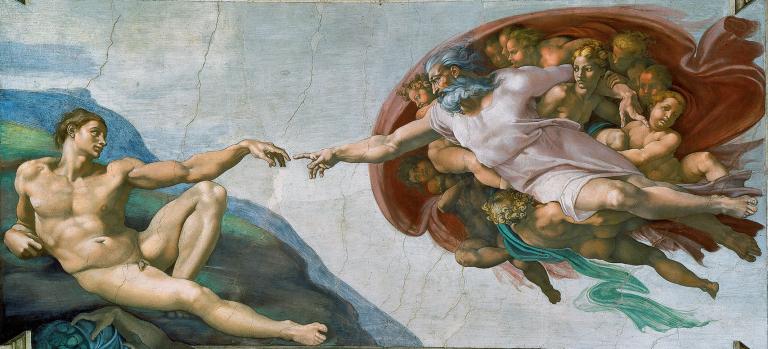
Michaelangelo, “Creation of Adam”
At the New York Times, Rabbi Mark Sameth asks pertly: “Is God Transgender?”
Here’s the short answer: No. God has neither sex nor gender. The former is a biological construct, created by God; and the latter is a linguistic construct, created by man. (See what I did there?) God, being transcendent, is outside both. You can’t gender God.
But Sameth attempts to do just that, which is why a longer answer is required here. After some introductory paragraphs involving a cousin who had sex-reassignment surgery, he turns to a few biblical texts in order to posit the existence of an “elastic view of gender” in the Hebrew Bible.
I’m a rabbi, and so I’m particularly saddened whenever religious arguments are brought in to defend social prejudices—as they often are in the discussion about transgender rights. In fact, the Hebrew Bible, when read in its original language, offers a highly elastic view of gender. And I do mean highly elastic: In Gen. 3:12, Eve is referred to as “he.” In Gen. 9:21, after the flood, Noah repairs to “her” tent. Gen. 24:16 refers to Rebecca as a “young man.” And Gen. 1:27 refers to Adam as “them.”
(I’m a bit confused, as an aside, by Sameth’s appeal to “transgender rights.” That’s a separate question from the gender of God or the concept of gender fluidity, which his article is ostensibly about. What does Sameth mean by “transgender rights,” and how is it relevant here? Maybe I’m being picky.)
That aside, in one sense Sameth is right. The Hebrew Bible does “offer a highly elastic view of gender”—if the word is understood properly, as a reference to grammar. But that is not how Sameth uses the word. He uses it to mean either one’s biological sex or a psychological construct about one’s sexual identity. And that’s where his argument breaks down.
Take, for example, his claim about Gen. 3:12, in which the author presumably refers to Eve as “he.” The Hebrew, transliterated, reads: “hā’ēs min-lî nātenāh hî immādî nātattāh ‘ašer hā’iššāh hā’ādām wayyōmer.” (“And the man said, The woman whom thou gavest to be with me, she gave me of the tree, and I did eat.”)
Sameth’s contention that the author calls Eve “he” is based on the Hebrew pronoun “hī.” You can check out all 314 of its uses in the Old Testament here. But according to Strong’s, “hī” (also hu) could mean “he,” “she,” or “it.” It was a flexible pronoun. It is even used as a reflexive pronoun (e.g., Lev. 6:9) or relative pronoun (e.g., Num. 5:18).
So yes, gender is elastic in Hebrew—the Hebrew language. This is a grammatical point only, and it is improper to extrapolate from that to speculate about Hebrew views of biology, psychology, or theology.
With regard to the other verses Sameth mentions:
- I can not tell from Strong’s how “āholōh” in Gen. 9:12 (not to mention Gen. 12:8 and Gen. 35:21) is supposed to mean “her tent” as opposed to “his tent.” The initial letter is a pronoun reference, but like the earlier one, it can be used as any of several grammatical genders, depending on context. This does not tell us that “gender” (psychological sense) is fluid, only that language is fluid.
- The Hebrew word “hanna,” in Gen. 24:16 appears to always mean “young woman” or “damsel,” not “young man” as Sameth claims. (See also, among many other passages, Gen. 24:14, Gen. 24:28, Gen. 24:55, Gen. 34:3, Gen. 34:12.) At least, I can find nowhere it does mean “young man.” Where in the Hebrew Bible is there a passage where “hanna” (or a related word) is used in reference to a biological male? There isn’t one. (Cite the text, if I be wrong.)
- “Ōtām” in Gen. 1:27 does mean “them,” but the reference here not to Adam specifically but to the human species (“male and female he created them”). The reference is to Adam and Eve. (The Hebrew word “adam” means “man,” as in the human species, but it also is the proper name of Adam, the first male. It is important to distinguish.)
***
But Sameth attempts to throw other examples in front of the New York Times’ readers’ unsuspecting and uncritical eyes.
In Est. 2:7, Mordecai is pictured as nursing his niece Esther. In a similar way, in Isa. 49:23, the future kings of Israel are prophesied to be “nursing kings.”
Okay. Let’s look at these texts. Est. 2:7 tells us, “And he”—i.e., Mordecai—“brought up Hadassah, that is, Esther, his uncle’s daughter: for she had neither father nor mother, and the maid was fair and beautiful; whom Mordecai, when her father and mother were dead, took for his own daughter.”
The key word is the one translated “brought up.” The Hebrew is “ōmen.” A more striking example, which Sameth does not mention, is “hā’ōmen,” in Num. 11:12. “Have I conceived all this people? have I begotten them, that thou shouldest say unto me, Carry them in thy bosom, as a nursing father beareth the sucking child, unto the land which thou swarest unto their fathers?”
A nursing father bearing a sucking child? To be sure, this is arresting, but the real question is what to make of it. (And, just as importantly, what not to make of it).
In Numbers 11, during a particularly trying time in the journey from Egypt to the Promised Land, when the Hebrews are being once again rebellious, Moses decides to vent his frustration with God. He says to God, in so many words, “Why me? Look at how unsuited I am for this.” The “nursing father” who “beareth the sucking child” helps to underscore, by way of analogy, how inappropriate Moses thinks it is to put such a burden on him. Have I conceived this people? Moses asks. Am I a nursing father? In context, this image is right precisely because it is wrong.
In a related way, the word reappears in Esther when the author says that Hadassah, lacking both her parents, has to be raised by Mordecai. It is not there because the author means us to suppose that Mordecai has breasts, but because in a symbolic way he provides Hadassah with what she lacks in the absence of a mother. He nurses her, not by giving her suck, but by caring for her and raising her into a woman.
To use this passage as though sheds any light at all on our contemporary notion of what it means to be “transgender” is a wild abuse of the text.
Isa. 49:23, which Sameth also cites, reads: “And kings shall be thy nursing fathers, and their queens thy nursing mothers.” That too is a striking image, but again it is important not to read too much into it. By no means should we suppose that Isaiah is prophesying that the future kings of Israel will have breasts, or that even the queens will literally suckle the Israelites. The word “nurse” is not literal; it is analogy, it is metaphor. Sameth disregards the author’s rhetorical figure in order to force Isaiah’s prophecy to fit his notion of “gender fluidity.” In this way too he abuses the text.
***
At this point, Sameth tells us what he thinks we should make of it all.
Why would the Bible do this? These aren’t typos. In the ancient world, well-expressed gender fluidity was the mark of a civilized person. Such a person was considered more “godlike.”
Well, “gender fluidity” is a misnomer here, if all he means is that sexual stereotypes and “gender roles” weren’t such as they are in Western culture. There’s no reason for us to expect that they would be. It was a different age and culture. And God, being neither male nor female, would incorporate the stereotypical “characteristics” of both. That does not mean God is “transgender” or “gender fluid.” He is, rather, transcendent of all categories.)
Sameth continues.
In Ancient Mesopotamia and Egypt, the gods were thought of as gender-fluid, and human beings were considered reflections of the gods. The Israelite ideal of the “nursing king” seems to have been based on a real person: a woman by the name of Hatshepsut who, after the death of her husband, Thutmose II, donned a false beard and ascended the throne to become one of Egypt’s greatest pharaohs.
Well, that’s a … stretch. What evidence does Sameth have that Isaiah borrowed from this historical example? If he has any, he does not mention it.
Rabbi Sameth: It’s a metaphor. It’s a figure of speech. That’s all. Let’s stop there. Isaiah wasn’t prophesying that Israel’s future kings would be women dressed up as men. And as for Hatshepsut, that example tells us a lot more about patriarchy in ancient Egypt than it does about “gender” in the current, hijacked usage of the word.
Sameth has more.
The Israelites took the transgender trope from their surrounding cultures [There was no “transgender trope,” to judge by the highly cursory and questionable evidence Sameth provides.] and wove it into their own sacred scripture. The four-Hebrew-letter name of God, which scholars refer to as the Tetragrammaton, YHWH, was probably not pronounced “Jehovah” or “Yahweh,” as some have guessed. The Israelite priests would have read the letters in reverse as Hu/Hi — in other words, the hidden name of God was Hebrew for “He/She.” Counter to everything we grew up believing, the God of Israel — the God of the three monotheistic, Abrahamic religions to which fully half the people on the planet today belong — was understood by its earliest worshipers to be a dual-gendered deity.
Not dual-gendered, Rabbi Sameth: non-gendered. God is not both male and female; he is neither male nor female. Pronouns, of course, do have gender—for gender, properly, is a grammatical construct—but it behooves us to not get excited and jiggly and read our agendas into the fact that some pronoun needs to be applied to God. That a pronoun has gender should not lead us to suspect that God has a gender, or multiple genders, or is transgendered, or is gender fluid, or whatever else your agenda compels you to want to say about God. God is transcendent.
But Sameth, in his haste to urge a particular ideology of “gender” upon us, misrepresents both the nature of God as well as the nature of human language.
***

Next Post

August 15, 2016 Here's Your Chance to Convince Me to Vote Trump
Browse Our Archives
Select a Category Abortion About Me Answers for Calvinists Answers to Media Fictions Answers to Objections Anti-Catholicism Apologetics Apostolic Succession Atonement Authority of the Church Baptism Benedictines Biblical Exegesis Blogging Book Reviews Books & Writing &c. Calvin's Institutes Capital Punishment Catholic Church Chastity Christology Church Fathers Church Social Doctrine Confession Contraception Conversion Stories Crusades Debates Depression & Suicide Deuterocanon Development of Doctrine Ecumenism English Language Eucharistic Adoration Exorcism Extra Ecclesiam Fisks & Rebuttals Freedom of Religion Freedom of Speech Fundamentalism Gender Politics Gender Theory Good Works Homosexuality Humor Idolatry Immaculate Conception In the News Inquisition ISIS Islam Just for Fun Just War Justification LCWR Limbo Liturgical Abuse Liturgical Year Magisterium Marriage and Family Mary Mortal Sin New Evangelization NFP Papacy Papal Documents Papal Infallibility Personal Narrative Politics Pope Francis Pope Francis Derangement Syndrome Population Control Praying to the "Dead" Priesthood Primacy of Peter Protestant Denominations Purgatory Radical Islam Radical Traditionalists Real Presence Right to Conscience RIght to Life Saints Same-Sex "Marriage" Seven Quick Takes Social Justice Social Media Sola Scriptura Spirit of Vatican II SSPX The Eucharist The Mass The Resurrection Traditionalism Vatican II Year of Mercy
Select a Month August 2019 July 2019 June 2019 May 2019 November 2018 October 2018 August 2018 July 2018 June 2018 April 2018 November 2017 October 2017 September 2017 May 2017 April 2017 March 2017 February 2017 November 2016 October 2016 September 2016 August 2016 July 2016 June 2016 May 2016 April 2016 March 2016 February 2016 January 2016 December 2015 November 2015 October 2015 September 2015 July 2015 June 2015 May 2015 April 2015 March 2015 February 2015 January 2015 December 2014 September 2014 August 2014 July 2014 June 2014 May 2014 April 2014 March 2014 February 2014 January 2014 December 2013 November 2013 October 2013 May 2013 April 2013 February 2013 January 2013
Follow Us!
TAKE THE
Religious Wisdom Quiz
What is the "denarius" Jesus used in teaching about taxes?
Select your answer to see how you score.
A robe A temple offering A Roman coin A loaf of bread
Related posts from To Give a Defense
Does the Mass crucify Jesus another time? Part...

How much does God hate lying? (Proverbs 6:16-19)
Don't Cite Leviticus 18 If You're Going to...
TRENDING AT PATHEOS Catholic

Rejecting Doom: Christian Hope And Human Action
Christianity is a religion of hope. We are to have hope and...

It’s What Comes From Within Which Matters
One of the most difficult things for us to understand is why...

Why I Choose the Eucharist Over the Sermon
Choose the Eucharist, Not the Sermon What are we supposed to get...

5 Design Elements Found in Spiritually Rooted Homes
Putting Spirituality Into Home Decor Our homes are more than our living...

Credo: A Story of God Told with the...
About 10 years ago, I began to imagine a personal "Credo" that...

The Anatomy of Divine Revelation in Catholic Thought
The claim that God has made Himself known to human beings is...
view all Catholic blogs
Ad-Free & Subscriber Log-In Subscription Support
- About Us
- 2026 Calendar
- Videos
- Podcasts
- Library of World Religions
- Faith In Media Tracker
- Advertise With Us
- Write for Us
- Privacy Policy
- Terms of Service
- Do Not Sell My Data
- Contact Us
- Radiant Digital
- Manage Newsletter Subscriptions
- Unsubscribe From Notifications
- Sitemap
Copyright 2008-2026, Patheos. All rights reserved.
Subscription Support Ad-Free & Subscriber Log-In
Follow Patheos