
BuddhistCatholicContemplativeEvangelicalGeneral ChristianHinduJewishLatter-day SaintMuslimNew VisionsProgressive Christian
Beliefs
- Buddhist
- Catholic
- Contemplative
- Evangelical
- General Christian
- Hindu
- Jewish
- Latter-day Saint
- More Voices
- Muslim
- New Visions
- Pagan
- Progressive Christian
Topics
- Religion News
- Food and Religion
- Sports and Religion
- Religious Art
- Religious Music and Entertainment
- Religious Events
- History and Religion
- Style and Religion
- Politics and Religion
- Women in Religion
- Recreation Outdoors and Religion
- Business Finance and Religion
- Careers Workplace and Religion
- Education and Religion
- Family Parenting and Religion
- Health Fitness and Religion
- Home and Religion
- Relationships and Religion
- Technology and Religion
- Travel and Religion
Columnists
- Buddhist Columnists
- Business Finance and Religion Columnists
- Careers Workplace and Religion Columnists
- Catholic Columnists
- Contemplative Columnists
- Education and Religion Columnists
- Evangelists Columnists
- Family Parenting and Religion Columnists
- General Christian Columnists
- Health Fitness and Religion Columnists
- Hindu Columnists
- History and Religion Columnists
- Home and Religion Columnists
- Jewish Columnists
- More Voices Columnists
- Latter Day Columnists
- Muslim Columnists
- New Visions Columnists
- Nonreligious Columnists
- Pagan Columnists
- Politics and Religion Columnists
- Progressive Columnists
- Recreation Outdoors and Religion Columnists
- Relationships and Religion Columnists
- Religion News Columnists
- Religious Art Columnists
- Religious Events Columnists
- Religious Music and Entertainment Columnists
- Sports and Religion Columnists
- Style and Religion Columnists
- Technology and Religion Columnists
- Travel and Religion Columnists
- Women in Religion Columnists
Resource Library
- 2026 Calendar
- Library of World Religions
- The 100 Most Holy Places on Earth
- Patheos Answers
- Podcasts
- Videos
- Faith Leaders Database
- Anglican Episcopalian
- Bahai
- Baptist
- Buddhism
- Christianity
- Confucianism
- Eastern Orthodoxy
- Hinduism
- Holiness and Pentecostal
- ISKCON
- Islam
- Judaism
- Lutheran
- Methodist
- The Church of Jesus Christ of Latter-day Saints
- New Age
- Paganism
- Presbytarian and Reformed
- Protestantism
- Religion Behind the Scenes
- Roman Catholic
- Scientology
- Shia Islam
- Sikhism
- Sufism
- Sunni Islam
- Taoism
- Zen
- See all religions
Research Tools
 Ad-Free & Subscriber Log-In Subscription Support
Ad-Free & Subscriber Log-In Subscription Support
Follow Patheos 

- Trending:
- Forgiveness
- |
- Marriage
- |
- Consciousness
- |
- Death Penalty
- |
- Election
- |
- Halloween
 To Give a Defense
- Home
- Catholic
- Forgive Me Father, For I Smashed a Brick Against My Face
Forgive Me Father, For I Smashed a Brick Against My Face
Last updated on: March 9, 2017 at 5:13 pm by Scott Eric Alt
Forgive Me Father, For I Smashed a Brick Against My Face 2017-03-09T17:13:28-04:00 Scott Eric Alt
Patheos Explore the world's faith through different perspectives on religion and spirituality! Patheos has the views of the prevalent religions and spiritualities of the world.
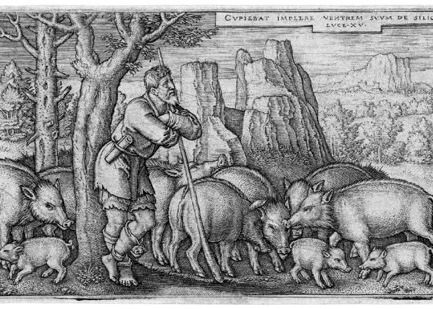
Sebald Beham, “The Prodigal Son as a Swineherd” (1538)
Notwithstanding the seal of the confessional, I often think my own confessions should be filmed for nothing other than the hilarity.
I. AN ALPHABET OF PRIESTS
“You’re back?” Fr. Anin says. (I prefer the face-to-face confession because I’m not cowardly and I prefer to know, from the priest’s face, what thickness of ice I stand on.)
“It has been two weeks since my last confession.”
“As long as that!”
“The just man falls seven times a day, Father.”
“Ah. I’m in for a long one.”
Fr. Bnin is not prone to tweak me with the acid of Fr. Anin. I like Fr. Bnin; the joy of the Lord is his strength. Once, when I was in the middle of my enumeration—I have done x and y and z—I stopped, and with great animation said, “Fr., I confess these same sins every week!” and then continued with the enumeration.
At the end of it, Fr. Bnin said, “Well, do you want others?”
I should be so lucky as to confess to Fr. Bnin every time—a saintly man, and a philosophical. I am not always that lucky, although I try. I have the Confession times memorized for the entire Archdiocese of Cincinnati, and I have a developed sense of which priest to go to on which occasion. No, Fr. Cnin is too hard on commandment x; best to go to Fr. Dnin at St. Enin for that one. Fr. Dnin has sympathy for people who have failed at commandment x. But he tends to be harsh on commandment y, so if I commit that one I’ll go to Fr. Fnin at St. Gnin.
This strategy has worked for me, and I can feel routine and complacent every time I enter and leave the confessional, as though it’s an errand to the grocery store. Which is how I prefer it.
But sometimes I’m stuck with Fr. Hnin. Fr. Hnin will listen to me with an odd combination of tolerance and an expression that might be translated, Just stop going on and on about it.
“Bless me, Fr., for I have sinned. It has been two weeks since my last confession. I have sinned against commandments x, y, and z—of course, with commandment x, I notice that the times I’m most prone to fall into that are a, b, and c, but I used to think it was d, e, and f, although I’m not sure whether g, h, and i, of course j and k—“
Fr. Hnin will listen to this until I get to the end of the alphabet, and charitably not even search around for a noose. And then he’ll speak, and with much weight and gravitas say:
“Well, I think your biggest sin is, you think too much.”
II. THE METAPHOR OF MORTAL SIN
What I have found, from listening to how some Protestants talk about sin and confession, is a persistent lack of understanding of what the sacrament is, and an even more deep-rooted lack of understanding of what mortal sin is and why it matters.
When I was growing up, I always heard this about Catholics: “They sin all week and then go to Confession.” The implication being, Confession gives Catholics a license to do whatever they want. Go in, come out, say three Hail Marys, go right back to the brothel.
This idea kept me looking askance at Catholics for years, but it’s a bad misunderstanding of the Sacrament. There must be true contrition and firm purpose of amendment. Without these, Confession is of no avail, no matter how much of the heart the priest pronouncing absolution is incapable of peering into.
An even more peculiar misunderstanding is the way some Protestants think of mortal sin as a sort of invisible snare that sneaks up on you, and grabs you by the leg, and pulls you down to Hell, without you being able to do anything about it. Anti-Catholic flame-thrower John MacArthur describes Catholics as constantly living under “the threat of mortal sin, which throws you back out of the Kingdom.”
Dr. MacArthur almost personifies Mortal Sin, as though it were a wild beast, more powerful than you, lurking in the shadows, and the Catholic constantly has to walk with slow and soft steps. All the action is on the part of Mortal Sin; it throws you. You were doing nothing but innocently walking in the woods, feeling secure with all your accumulation of vile works.
Many Protestants forget, as Dr. MacArthur does, that mortal sin is a freely-chosen act. It is objective; it is something you do, not something that happens to you. I think that Dr. MacArthur can describe mortal sin the way he does because his Calvinism prevents him from conceiving the possiblity of sufficient freedom of the will. He cannot conceive of a conscious act by which you can lose your salvation. Once you’re saved, according to Calvinism, you can never lose your salvation. It is impossible.
So he describes mortal sin as though it is a brick that suddenly falls out of the sky onto your head. But that is not what mortal sin is. Mortal sin is when, of your own free will, you pick up the brick and smash it against your face.
Now, when you smash a brick against your face, there are two things that could happen next.
You could say, “That was a bloody stupid thing to do. Let me get myself to the hospital. I’m not going to try that again.”
Or you could say, “That felt good. Let me do that again.”
And so you keep smashing bricks against your face until you are a wretched disfigurement, but you have to keep smashing them more frequently and more frequently, because at least that way you can remind yourself that you feel something.
And what that leads to is the state of mind that says, “Oh, I can’t take any antiseptic right now, that would hurt too much.” You are so deluded, and brain-damaged by bricks, that you prefer the hurt of the brick to the hurt of the antiseptic.
Or you shop around for the antiseptic that hurts the least. You take it home, you dilute it with water, and a little more water, and a little more, and a little more, and a little more, and then you say, “That was a nice relaxing bath.”
And then you pick up the brick and smash your face again.
That’s mortal sin.
III. THE ANTISEPTIC OF CONFESSION
A rough and seemingly endless stretch of time can lead one to search about for bricks. It has seemed as though, for all this year, I could not get through the first hour of the day without wanting to smash a brick against my face.
I don’t want to think about this too much.
If sin hurts God, and sin hurts others, sin also hurts ourselves. We are made in the image of God, and when we smash our face with a brick, we disfigure the image of God. I like the picture, above, of the Prodigal Son, by Sebald Beham; I like it because it is a picture of suffering, and yet the Prodigal Son is not suffering because he’s a poor swineherd. He’s suffering because he’s remembering the riches of what he rejected.
I like the picture because I know the look, and I know the feeling: I didn’t have to become this.
I argue with Protestants—some of whom are family, and I love them very much—about the Sacrament of Confession. I try to correct their misunderstandings.
No, I will say, Confession is not meant to be something you just do as a routine, and then go back to smashing bricks against your face. Confession is not meant to be about finding the priest who will go easy on you with a penance and not say mean things. It’s not about priest-shopping. You have to be truly penitent. You have to have a firm purpose of amendment. Otherwise, you are misusing the Sacrament and it is of no effect.
But what have I done, from Fr. Anin to Fr. Znin? Let me not go to Fr. Inin at St. Jnin, he’s too surly. I’ll go to Fr. Knin at St. Lnin; he’s half-deaf and will never know what he’s absolving.
But no. There is only one thing that can help if you’ve been smashing bricks against your face for a whole year. Or more. It is to look at yourself in a mirror and say, “I’m a bloody awful wretched disfigured mess.”
It is to throw the brick away and get yourself some very strong, very astringent, and very healing antiseptic. Does a priest who’s surly hurt worse than a brick?
It is to say, “I have sinned against heaven and against you.”
And with some time, and with some penance, and the Eucharist, and returning to Confession (yes, go back, and go back, and go back), you will find that the face in the mirror looks less and less like the face of a disfigured monster and more and more like the face of a man.
So after this long and rough and seemingly endless stretch of time I will get myself up and I will return.
And I will not run a circuit through the Archdiocese, but go to my own parish, where there’s a lot of holiness, and long lines at Confession, and three confessionals, and who you get is who you get and probably who you need at the time.
And I will go in before the priest, and I will say, “Forgive me, Father, for I smashed a brick against my face.”
***
If you like the content on this blog, your generous gift to the author helps to keep it active. I remember all my supporters in my Mass intentions each week.

Browse Our Archives
Select a Category Abortion About Me Answers for Calvinists Answers to Media Fictions Answers to Objections Anti-Catholicism Apologetics Apostolic Succession Atonement Authority of the Church Baptism Benedictines Biblical Exegesis Blogging Book Reviews Books & Writing &c. Calvin's Institutes Capital Punishment Catholic Church Chastity Christology Church Fathers Church Social Doctrine Confession Contraception Conversion Stories Crusades Debates Depression & Suicide Deuterocanon Development of Doctrine Ecumenism English Language Eucharistic Adoration Exorcism Extra Ecclesiam Fisks & Rebuttals Freedom of Religion Freedom of Speech Fundamentalism Gender Politics Gender Theory Good Works Homosexuality Humor Idolatry Immaculate Conception In the News Inquisition ISIS Islam Just for Fun Just War Justification LCWR Limbo Liturgical Abuse Liturgical Year Magisterium Marriage and Family Mary Mortal Sin New Evangelization NFP Papacy Papal Documents Papal Infallibility Personal Narrative Politics Pope Francis Pope Francis Derangement Syndrome Population Control Praying to the "Dead" Priesthood Primacy of Peter Protestant Denominations Purgatory Radical Islam Radical Traditionalists Real Presence Right to Conscience RIght to Life Saints Same-Sex "Marriage" Seven Quick Takes Social Justice Social Media Sola Scriptura Spirit of Vatican II SSPX The Eucharist The Mass The Resurrection Traditionalism Vatican II Year of Mercy
Select a Month August 2019 July 2019 June 2019 May 2019 November 2018 October 2018 August 2018 July 2018 June 2018 April 2018 November 2017 October 2017 September 2017 May 2017 April 2017 March 2017 February 2017 November 2016 October 2016 September 2016 August 2016 July 2016 June 2016 May 2016 April 2016 March 2016 February 2016 January 2016 December 2015 November 2015 October 2015 September 2015 July 2015 June 2015 May 2015 April 2015 March 2015 February 2015 January 2015 December 2014 September 2014 August 2014 July 2014 June 2014 May 2014 April 2014 March 2014 February 2014 January 2014 December 2013 November 2013 October 2013 May 2013 April 2013 February 2013 January 2013
Follow Us!
TAKE THE
Religious Wisdom Quiz
How many books of the Bible are named after women?
Select your answer to see how you score.
3 2 4 1
Related posts from To Give a Defense
Does the Mass "banish the remembrance of Christ's...
Priests Can't Forgive Sins! Only God! Answers to...

Dear James White: Thanks for the Applause. You...
Calvinist Blogger Reads James; Discovers That We Must...
TRENDING AT PATHEOS Catholic

Creation, Preservation, and Teleology in Catholic Theology
As I write this, it is very early Monday morning. Like millions...

The Parable Of The Sower And The Word...
One of Christ’s most famous parables is that of the sower who...

Rejecting Doom: Christian Hope And Human Action
Christianity is a religion of hope. We are to have hope and...

Why I Choose the Eucharist Over the Sermon
Choose the Eucharist, Not the Sermon What are we supposed to get...

5 Design Elements Found in Spiritually Rooted Homes
Putting Spirituality Into Home Decor Our homes are more than our living...

Credo: A Story of God Told with the...
About 10 years ago, I began to imagine a personal "Credo" that...
view all Catholic blogs
Ad-Free & Subscriber Log-In Subscription Support
- About Us
- 2026 Calendar
- Videos
- Podcasts
- Library of World Religions
- Faith In Media Tracker
- Advertise With Us
- Write for Us
- Privacy Policy
- Terms of Service
- Do Not Sell My Data
- Contact Us
- Radiant Digital
- Manage Newsletter Subscriptions
- Unsubscribe From Notifications
- Sitemap
Copyright 2008-2026, Patheos. All rights reserved.
Subscription Support Ad-Free & Subscriber Log-In
Follow Patheos