
BuddhistCatholicContemplativeEvangelicalGeneral ChristianHinduJewishLatter-day SaintMuslimNew VisionsProgressive Christian
Beliefs
- Buddhist
- Catholic
- Contemplative
- Evangelical
- General Christian
- Hindu
- Jewish
- Latter-day Saint
- More Voices
- Muslim
- New Visions
- Pagan
- Progressive Christian
Topics
- Religion News
- Food and Religion
- Sports and Religion
- Religious Art
- Religious Music and Entertainment
- Religious Events
- History and Religion
- Style and Religion
- Politics and Religion
- Women in Religion
- Recreation Outdoors and Religion
- Business Finance and Religion
- Careers Workplace and Religion
- Education and Religion
- Family Parenting and Religion
- Health Fitness and Religion
- Home and Religion
- Relationships and Religion
- Technology and Religion
- Travel and Religion
Columnists
- Buddhist Columnists
- Business Finance and Religion Columnists
- Careers Workplace and Religion Columnists
- Catholic Columnists
- Contemplative Columnists
- Education and Religion Columnists
- Evangelists Columnists
- Family Parenting and Religion Columnists
- General Christian Columnists
- Health Fitness and Religion Columnists
- Hindu Columnists
- History and Religion Columnists
- Home and Religion Columnists
- Jewish Columnists
- More Voices Columnists
- Latter Day Columnists
- Muslim Columnists
- New Visions Columnists
- Nonreligious Columnists
- Pagan Columnists
- Politics and Religion Columnists
- Progressive Columnists
- Recreation Outdoors and Religion Columnists
- Relationships and Religion Columnists
- Religion News Columnists
- Religious Art Columnists
- Religious Events Columnists
- Religious Music and Entertainment Columnists
- Sports and Religion Columnists
- Style and Religion Columnists
- Technology and Religion Columnists
- Travel and Religion Columnists
- Women in Religion Columnists
Resource Library
- 2026 Calendar
- Library of World Religions
- The 100 Most Holy Places on Earth
- Patheos Answers
- Podcasts
- Videos
- Faith Leaders Database
- Anglican Episcopalian
- Bahai
- Baptist
- Buddhism
- Christianity
- Confucianism
- Eastern Orthodoxy
- Hinduism
- Holiness and Pentecostal
- ISKCON
- Islam
- Judaism
- Lutheran
- Methodist
- The Church of Jesus Christ of Latter-day Saints
- New Age
- Paganism
- Presbytarian and Reformed
- Protestantism
- Religion Behind the Scenes
- Roman Catholic
- Scientology
- Shia Islam
- Sikhism
- Sufism
- Sunni Islam
- Taoism
- Zen
- See all religions
Research Tools
 Ad-Free & Subscriber Log-In Subscription Support
Ad-Free & Subscriber Log-In Subscription Support
Follow Patheos 

- Trending:
- Forgiveness
- |
- Marriage
- |
- Consciousness
- |
- Death Penalty
- |
- Election
- |
- Halloween
 To Give a Defense
- Home
- Catholic
- Does the Mass “banish the remembrance of Christ’s death”? Part 3 of a series on John Calvin’s Institutes IV.18.
Does the Mass “banish the remembrance of Christ’s death”? Part 3 of a series on John Calvin’s Institutes IV.18.
Last updated on: July 6, 2019 at 9:57 pm by Scott Eric Alt
Does the Mass “banish the remembrance of Christ’s death”? Part 3 of a series on John Calvin’s Institutes IV.18. 2019-07-06T21:57:43-04:00 Scott Eric Alt
Patheos Explore the world's faith through different perspectives on religion and spirituality! Patheos has the views of the prevalent religions and spiritualities of the world.
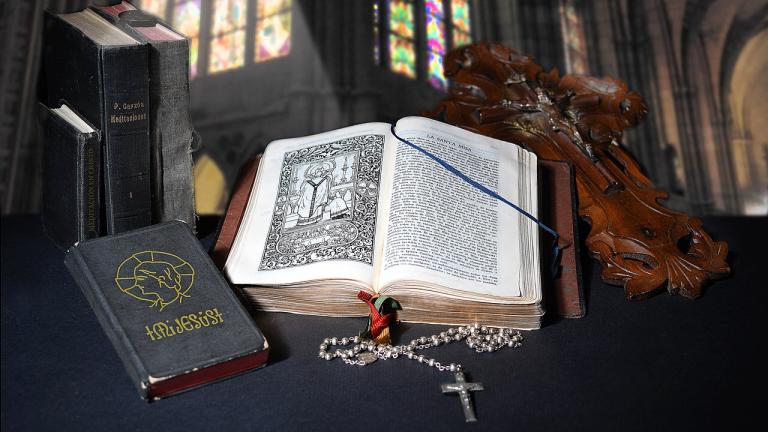
Image via Pixabay
Note. This is a long-awaited continuation of a series that I began in December 2014 on John Calvin’s claims about the Mass in Institutes of the Christian Religion. You can find Part 1 here and Part 2 here.
Calvin made wild claims; but he got people to believe them, even today, which is wilder. This one–the Mass banishes the remembrance of Christ’s death!—is easily disproven for anyone who bothers to read the text of the liturgy. (Or even: for anyone who walks into a Catholic church and bothers to look at the crucifix or the Stations of the Cross.) Perhaps people are lazy and just take deceivers like Calvin at their word; I don’t know. But there’s a funny little part of the Mass called the Words of Institution. These were known as part of the Mass at least as early as Cyril of Jerusalem (4th century A.D.), if we may judge by his Catechetical Lectures.
Take this, all of you, and eat of it: for this is my body which will be given up for you. Take this, all of you, and drink from it: for this is the chalice of my blood, the blood of the new and eternal covenant, which will be poured out for you and for many for the forgiveness of sins. Do this in memory of me.
Luther told us to sin boldly, and Calvin sure lies boldly when he says the Mass has banished what it instructs the priest to say at every Mass: We’re doing this to remember Christ’s death.
Now, if the Roman missal said something like, “Don’t speak of that inconvenient episode on Calvary; we should all forget that. Make like this is a cocktail party. Do this in remembrance of last night’s revels, and let us quaff another,” Calvin may have had a point. But sadly, the priest at every Mass quotes from 1 Cor. 11:23-25.
Calvin writes:
I now come to the third part of the mass, in regard to which, we are to explain how it obliterates the true and only death of Christ, and drives it from the memory of men.
Was Calvin senile? Did he suffer schizophrenia? I must ask. At Mass, the priest says, now, you know, we’re doing this in memory of Christ’s death. And Calvin hears that and says, “Oh, this is obliteration! If you keep telling us to remember Christ’s death, no one will ever remember Christ’s death. It won’t occur to them. Catholics everywhere say to me, ‘You mean Christ died?'”
Perhaps even Calvin thinks he needs to explain himself lest he be thought a fool:
Now, what is the mass but a new and altogether different testament? [That is to say, “another gospel.”] What? Does not each mass promise a new forgiveness of sins, a new purchase of righteousness, so that now there are as many testaments as there are masses? Therefore, let Christ come again, and, by another death, make this new testament; or rather, by innumerable deaths, ratify the innumerable testaments of the mass.
So let me unpack this hysteria for you. Calvin’s trying some sleight-of-hand here. He has in mind the teaching that Christ’s death was a once-for-all sacrifice for sin. And that’s true enough; it comes from Heb. 10:10: “We are sanctified through the offering of the body of Jesus Christ once for all.”
So far so good. But Calvin vaults off and claims that each Mass is somehow a new forgiveness for sins and therefore not at all the same death of Christ that happened on Calvary. The Mass banishes the memory of that sacrifice, and replaces it with this brand new bastard sacrifice. The Mass sacrifices Christ, not once for all, but once and once again. And I’ll concede this much to Calvin: If he were right, it would indeed be an “impious and accursed dogma.”
But is he right?
•••
The first point to make is that this is not what Catholics confess—that the Mass is a re-sacrifice of Christ, or that a re-sacrifice is even necessary. Calvin published the Institutes in Latin in 1536, French in 1540, and definitive editions came out in 1559 and 1560. Concurrent with this, the Church had convened the Council of Trent in order to answer the claims of the Reformers. And here you may read what Trent had to say about the sacrifice of the Mass.
- In Chapter 1, Trent says that the “memory” of Christ’s sacrifice—you know, the one on Calvary—must “remain even unto the end of the world.”
There is no “banishing” the “memory” of anything, according to Trent. And indeed, if this were a new death, a new sacrifice, one could hardly speak of it in terms of “remembrance” at all.
- Canon 4 says that Christ’s sacrifice was “consummated” on the Cross. If it was “consummated” there, the Church can hardly teach that it happens all over again at every Mass.
The Eucharist begins with the priest recalling the night that Jesus was betrayed. This is to draw our minds to that night, that death, that sacrifice, and no other. Otherwise why speak of it at all? Why use the word “remembrance,” if you’re doing something new?
Thus the very words the Church uses in the Mass (and at the Council of Trent) belie the claims Calvin makes.
•••
The second point to make is that Calvin mixes up time with eternity. Lots of people do this, so Calvin shouldn’t feel too bad about it, wherever he might be.
When Hebrews 10:10 describes the crucifixion of Christ as a “once for all” sacrifice, it is speaking from the point of view of eternity. In one act, Christ died for all sins that would ever be committed by everyone who would ever live (and everyone who had ever lived, hitherto). He did it one time and need not do it again.
But Christ is eternal with the Father. He is outside time. Past, present, and future are all “now” to him. That is not so for you, not so for me, and not so for anyone else. Between last Mass and next Mass, I have sinned again. You have too.
Trent speaks to this when it says that the “salutary virtue” of Christ’s death must “be applied to the remission of those sins which we daily commit.”
If it were not so—if I did not require continual forgiveness for the sins which I continually commit; if I get forgiven in advance, then there’s really no need for me to try to reform my life, is there? Everything I will do is already covered; I can go out and wreak bloody vengeance in the street; once saved, always saved.
But no.
Christ’s death is one; and Trent says it. The bloody sacrifice was “once to be accomplished on the cross.” But it still needs to be applied to this moment, and to that moment. Because we live out redemption in time. From God’s perspective it is once-for-all; from my perspective, it is a process. That is why St. Paul says to work out your salvation.
•••
Calvin has an even wilder claim, if you can believe it; which is this: “If Christ is sacrificed at each mass, he must be cruelly slain every moment in a thousand places.”
I really must ask whether Calvin understood the omnipresence of God. Christ is, at this very moment, in Geneva, Switzerland; and he is also, at this very moment, in Alberta, Canada; and in Cairo. He is even, hard as it may be to fathom, in Washington, D.C. But I’m not speaking of four different Christs. And likewise, if the sacrifice of Christ occurs at Mass in St. Patrick’s Cathedral in New York, and at the same time in St. Peter’s Basilica, these are not two Christs or two sacrifices but one Christ and the same once for all sacrifice. If you can accept the former, the latter shouldn’t need to cause you difficulties.
What happened on Calvary in 33 A.D. is made present in 2019 at Mass. That is, in fact, precisely what the word “remember” means: to call up again. If I remember the days of my youth, I am not creating a different childhood. I am making my one childhood present for me today.
Far from the Mass “banishing the remembrance of Christ’s death,” the remembrance of Christ’s death is what the Mass is.
Previous Post

July 2, 2019
The condition of migrants is a pro-life issue, Fr. Pavone.

Browse Our Archives
Select a Category Abortion About Me Answers for Calvinists Answers to Media Fictions Answers to Objections Anti-Catholicism Apologetics Apostolic Succession Atonement Authority of the Church Baptism Benedictines Biblical Exegesis Blogging Book Reviews Books & Writing &c. Calvin's Institutes Capital Punishment Catholic Church Chastity Christology Church Fathers Church Social Doctrine Confession Contraception Conversion Stories Crusades Debates Depression & Suicide Deuterocanon Development of Doctrine Ecumenism English Language Eucharistic Adoration Exorcism Extra Ecclesiam Fisks & Rebuttals Freedom of Religion Freedom of Speech Fundamentalism Gender Politics Gender Theory Good Works Homosexuality Humor Idolatry Immaculate Conception In the News Inquisition ISIS Islam Just for Fun Just War Justification LCWR Limbo Liturgical Abuse Liturgical Year Magisterium Marriage and Family Mary Mortal Sin New Evangelization NFP Papacy Papal Documents Papal Infallibility Personal Narrative Politics Pope Francis Pope Francis Derangement Syndrome Population Control Praying to the "Dead" Priesthood Primacy of Peter Protestant Denominations Purgatory Radical Islam Radical Traditionalists Real Presence Right to Conscience RIght to Life Saints Same-Sex "Marriage" Seven Quick Takes Social Justice Social Media Sola Scriptura Spirit of Vatican II SSPX The Eucharist The Mass The Resurrection Traditionalism Vatican II Year of Mercy
Select a Month August 2019 July 2019 June 2019 May 2019 November 2018 October 2018 August 2018 July 2018 June 2018 April 2018 November 2017 October 2017 September 2017 May 2017 April 2017 March 2017 February 2017 November 2016 October 2016 September 2016 August 2016 July 2016 June 2016 May 2016 April 2016 March 2016 February 2016 January 2016 December 2015 November 2015 October 2015 September 2015 July 2015 June 2015 May 2015 April 2015 March 2015 February 2015 January 2015 December 2014 September 2014 August 2014 July 2014 June 2014 May 2014 April 2014 March 2014 February 2014 January 2014 December 2013 November 2013 October 2013 May 2013 April 2013 February 2013 January 2013
Follow Us!
TAKE THE
Religious Wisdom Quiz
Which Christian tradition is known for ornate mosaics and icons in their churches?
Select your answer to see how you score.
Baptist Adventist Orthodox Presbyterian
Related posts from To Give a Defense
"Not Infallible" does not mean "Contains Errors."
Steve Hays posits false dichotomy between authority and...

Do Catholics think God owes them a debt?...

Protestant asks: When would Catholics know they're in...
TRENDING AT PATHEOS Catholic

Creation, Preservation, and Teleology in Catholic Theology
As I write this, it is very early Monday morning. Like millions...

The Parable Of The Sower And The Word...
One of Christ’s most famous parables is that of the sower who...

Rejecting Doom: Christian Hope And Human Action
Christianity is a religion of hope. We are to have hope and...

Why I Choose the Eucharist Over the Sermon
Choose the Eucharist, Not the Sermon What are we supposed to get...

5 Design Elements Found in Spiritually Rooted Homes
Putting Spirituality Into Home Decor Our homes are more than our living...

Credo: A Story of God Told with the...
About 10 years ago, I began to imagine a personal "Credo" that...
view all Catholic blogs
Ad-Free & Subscriber Log-In Subscription Support
- About Us
- 2026 Calendar
- Videos
- Podcasts
- Library of World Religions
- Faith In Media Tracker
- Advertise With Us
- Write for Us
- Privacy Policy
- Terms of Service
- Do Not Sell My Data
- Contact Us
- Radiant Digital
- Manage Newsletter Subscriptions
- Unsubscribe From Notifications
- Sitemap
Copyright 2008-2026, Patheos. All rights reserved.
Subscription Support Ad-Free & Subscriber Log-In
Follow Patheos