
BuddhistCatholicContemplativeEvangelicalGeneral ChristianHinduJewishLatter-day SaintMuslimNew VisionsProgressive Christian
Beliefs
- Buddhist
- Catholic
- Contemplative
- Evangelical
- General Christian
- Hindu
- Jewish
- Latter-day Saint
- More Voices
- Muslim
- New Visions
- Pagan
- Progressive Christian
Topics
- Religion News
- Food and Religion
- Sports and Religion
- Religious Art
- Religious Music and Entertainment
- Religious Events
- History and Religion
- Style and Religion
- Politics and Religion
- Women in Religion
- Recreation Outdoors and Religion
- Business Finance and Religion
- Careers Workplace and Religion
- Education and Religion
- Family Parenting and Religion
- Health Fitness and Religion
- Home and Religion
- Relationships and Religion
- Technology and Religion
- Travel and Religion
Columnists
- Buddhist Columnists
- Business Finance and Religion Columnists
- Careers Workplace and Religion Columnists
- Catholic Columnists
- Contemplative Columnists
- Education and Religion Columnists
- Evangelists Columnists
- Family Parenting and Religion Columnists
- General Christian Columnists
- Health Fitness and Religion Columnists
- Hindu Columnists
- History and Religion Columnists
- Home and Religion Columnists
- Jewish Columnists
- More Voices Columnists
- Latter Day Columnists
- Muslim Columnists
- New Visions Columnists
- Nonreligious Columnists
- Pagan Columnists
- Politics and Religion Columnists
- Progressive Columnists
- Recreation Outdoors and Religion Columnists
- Relationships and Religion Columnists
- Religion News Columnists
- Religious Art Columnists
- Religious Events Columnists
- Religious Music and Entertainment Columnists
- Sports and Religion Columnists
- Style and Religion Columnists
- Technology and Religion Columnists
- Travel and Religion Columnists
- Women in Religion Columnists
Resource Library
- 2026 Calendar
- Library of World Religions
- The 100 Most Holy Places on Earth
- Patheos Answers
- Podcasts
- Videos
- Faith Leaders Database
- Anglican Episcopalian
- Bahai
- Baptist
- Buddhism
- Christianity
- Confucianism
- Eastern Orthodoxy
- Hinduism
- Holiness and Pentecostal
- ISKCON
- Islam
- Judaism
- Lutheran
- Methodist
- The Church of Jesus Christ of Latter-day Saints
- New Age
- Paganism
- Presbytarian and Reformed
- Protestantism
- Religion Behind the Scenes
- Roman Catholic
- Scientology
- Shia Islam
- Sikhism
- Sufism
- Sunni Islam
- Taoism
- Zen
- See all religions
Research Tools
 Ad-Free & Subscriber Log-In Subscription Support
Ad-Free & Subscriber Log-In Subscription Support
Follow Patheos 

- Trending:
- Forgiveness
- |
- Marriage
- |
- Consciousness
- |
- Death Penalty
- |
- Election
- |
- Halloween
 To Give a Defense
- Home
- Catholic
- A Reader Says 1 Cor. 11:28-29 Does Not Bar Grave Sinners from the Eucharist
A Reader Says 1 Cor. 11:28-29 Does Not Bar Grave Sinners from the Eucharist
Last updated on: March 4, 2018 at 11:18 pm by Scott Eric Alt
A Reader Says 1 Cor. 11:28-29 Does Not Bar Grave Sinners from the Eucharist 2018-03-04T23:18:31-04:00 Scott Eric Alt
Patheos Explore the world's faith through different perspectives on religion and spirituality! Patheos has the views of the prevalent religions and spiritualities of the world.
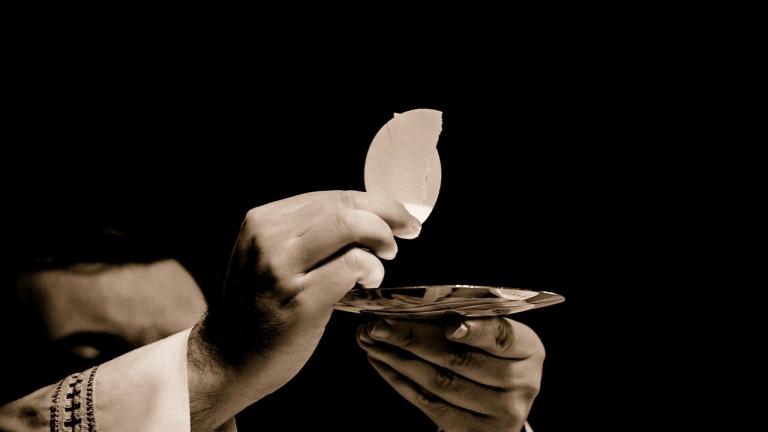
Image via Pixabay
In his first letter to the Corinthians, chapter 11, St. Paul tells us why it is so important to have a proper disposition before we receive the Eucharist. In verse 18, he begins by rebuking the Corinthians for their “divisions” and “factions.” (The more things change.) He also condemns some abuses that crept into the common meal prior to the Eucharist. The rich, who could bring a large share of food and drink, ended up gorging themselves to the disadvantage of the poor, who were not able to bring much. As a result, according to Paul, “one [man] is hungry and another is drunk.” “Do you despise the Church of God,” he asks, “and humiliate those who have nothing?” (The more things change.) Paul has to remind the Corinthians that, in receiving the Eucharist at Mass, they “proclaim the Lord’s death until He comes.”
Whoever, therefore, eats the bread or drinks the cup of the Lord in an unworthy manner will be guilty of profaning the body and blood of the Lord. Let a man examine himself, and so eat of the bread and drink of the cup.
The Church tells us that these words bar a person guilty of any mortal sin from receiving the body and blood of Christ. Gluttony, drunkenness, and stealing from the poor are not the only ones. We read in the Catechism §1385:
To respond to this invitation we must prepare ourselves for so great and so holy a moment. St. Paul urges us to examine our conscience: “Whoever, therefore, eats the bread or drinks the cup of the Lord in an unworthy manner will be guilty of profaning the body and blood of the Lord. Let a man examine himself, and so eat of the bread and drink of the cup. For any one who eats and drinks without discerning the body eats and drinks judgment upon himself.” Anyone conscious of a grave sin must receive the sacrament of Reconciliation before coming to communion.
But according to one reader, this is an illicit addition to Paul’s meaning.
When St Paul spoke of examining conscience and discerning the body he was talking about paying attention to what was taking place and why they were gathering, backed up by his earlier context of not sharing food and getting drunk. It didn’t imply anything to do with the current concept of grave sin and lack of confession as a barrier, it was just about examining motives for why they were partaking in the communal meal and making sure they were correct.
Now, that exegesis is just strange. No other way to put it.
One glaring problem with it is that it unnecessarily limits St. Paul’s general principle about the right disposition to receive the body and blood of Christ to the specific mortal sins he happens to be rebuking at the moment. There’s no warrant for that. In verse 28, Paul says whoever receives the Eucharist “in an unworthy manner” is guilty of the crucifixion itself. He has turned, in his discussion, from the specific abuse to the general principle.
And one does not have to look very far to find out that Christians from the very beginning understood St. Paul’s words in the wery same way the Catechism does. Just turn to the first-century Didache:
But every Lord’s day gather yourselves together, and break bread, and give thanksgiving after having confessed your transgressions, that your sacrifice may be pure. [The Didache also has Malachi 1:11 in mind here.] But let no one that is at variance with his fellow come together with you, until they be reconciled, that your sacrifice may not be profaned. For this is that which was spoken by the Lord: In every place and time offer to me a pure sacrifice; for I am a great King, says the Lord, and my name is wonderful among the nations.
The Didache certainly did imagine that Paul’s words had something to do with “the current concept of grave sin and lack of confession as a barrier.” The Didache recognizes that a state of sin “profanes” the Eucharist. You must confess first.
There is no earlier source than the Didache for the practice of the Church at the earliest time. If the Church “added” to Paul’s meaning, it certainly did so very early. It added to it so early, in fact, that there is no earlier record of anyone understanding Paul’s words in a different way.
But two later authorities—St. Cyprian and St. John Chrysostom—reiterate what we read in the Didache.
Here is St. Cyprian, writing in A.D. 251. Commenting on 1 Corinthians 11, he says:
All these warnings being scorned and contemned—before their sin is expiated, before confession has been made of their crime, before their conscience has been purged by sacrifice and by the hand of the priest, before the offense of an angry and threatening Lord has been appeased, violence is done to His body and blood; and they sin now against their Lord more with their hand and mouth than when they denied their Lord.
Those who eat this bread and drink this cup “before their conscience has been purged” do “violence” do Christ’s body and blood, just as Paul had said. They are guilty of the crucifixion. According to St. Cyprian, yes, you do have to go to Confession first and rid yourself of mortal sin. To not do so is an additional, and even graver, sin.
And here is St. John Chrysostom, writing in the 4th century. He too says what the Didache says. In his Homily 28 on 1 Corinthians, he writes:
Since if even that kind of banquet which the senses take cognizance of cannot be partaken of by us when feverish and full of bad humors, without risk of perishing: much more is it unlawful for us to touch this Table with profane lusts, which are more grievous than fevers. Now when I say profane lusts, I mean both those of the body, and of money, and of anger, and of malice, and, in a word, all that are profane. [Any mortal sin bars you from communion.] And it becomes him that approaches, first to empty himself of all these things [i.e., through confession.] and so to touch that pure sacrifice.
The Church’s understanding of Paul’s words—that mortal sin bars you from the Eucharist, unless you confess and receive absolution—is not some later invention. It dates back to the Didache, and it has remained to this day.
***
If you like the content on this blog, your generous gift to the author helps to keep it active. I remember all my supporters in my Mass intentions each week.
Previous Post

April 25, 2017
Trump Contracepts Promise to Little Sisters of the Poor
Next Post
May 3, 2017 Salvation History According to Donald Trump
Browse Our Archives
Select a Category Abortion About Me Answers for Calvinists Answers to Media Fictions Answers to Objections Anti-Catholicism Apologetics Apostolic Succession Atonement Authority of the Church Baptism Benedictines Biblical Exegesis Blogging Book Reviews Books & Writing &c. Calvin's Institutes Capital Punishment Catholic Church Chastity Christology Church Fathers Church Social Doctrine Confession Contraception Conversion Stories Crusades Debates Depression & Suicide Deuterocanon Development of Doctrine Ecumenism English Language Eucharistic Adoration Exorcism Extra Ecclesiam Fisks & Rebuttals Freedom of Religion Freedom of Speech Fundamentalism Gender Politics Gender Theory Good Works Homosexuality Humor Idolatry Immaculate Conception In the News Inquisition ISIS Islam Just for Fun Just War Justification LCWR Limbo Liturgical Abuse Liturgical Year Magisterium Marriage and Family Mary Mortal Sin New Evangelization NFP Papacy Papal Documents Papal Infallibility Personal Narrative Politics Pope Francis Pope Francis Derangement Syndrome Population Control Praying to the "Dead" Priesthood Primacy of Peter Protestant Denominations Purgatory Radical Islam Radical Traditionalists Real Presence Right to Conscience RIght to Life Saints Same-Sex "Marriage" Seven Quick Takes Social Justice Social Media Sola Scriptura Spirit of Vatican II SSPX The Eucharist The Mass The Resurrection Traditionalism Vatican II Year of Mercy
Select a Month August 2019 July 2019 June 2019 May 2019 November 2018 October 2018 August 2018 July 2018 June 2018 April 2018 November 2017 October 2017 September 2017 May 2017 April 2017 March 2017 February 2017 November 2016 October 2016 September 2016 August 2016 July 2016 June 2016 May 2016 April 2016 March 2016 February 2016 January 2016 December 2015 November 2015 October 2015 September 2015 July 2015 June 2015 May 2015 April 2015 March 2015 February 2015 January 2015 December 2014 September 2014 August 2014 July 2014 June 2014 May 2014 April 2014 March 2014 February 2014 January 2014 December 2013 November 2013 October 2013 May 2013 April 2013 February 2013 January 2013
Follow Us!
TAKE THE
Religious Wisdom Quiz
In Revelation, what do the four living creatures say day and night without ceasing?
Select your answer to see how you score.
Worthy is the Lamb Holy, holy, holy is the Lord God Almighty Blessing and honor and glory Come, Lord Jesus
Related posts from To Give a Defense
Does the Mass crucify Jesus another time? Part...
How much does God hate lying? (Proverbs 6:16-19)
Don't Cite Leviticus 18 If You're Going to...
TRENDING AT PATHEOS Catholic

Rejecting Doom: Christian Hope And Human Action
Christianity is a religion of hope. We are to have hope and...

It’s What Comes From Within Which Matters
One of the most difficult things for us to understand is why...

Why I Choose the Eucharist Over the Sermon
Choose the Eucharist, Not the Sermon What are we supposed to get...

5 Design Elements Found in Spiritually Rooted Homes
Putting Spirituality Into Home Decor Our homes are more than our living...

Credo: A Story of God Told with the...
About 10 years ago, I began to imagine a personal "Credo" that...

The Anatomy of Divine Revelation in Catholic Thought
The claim that God has made Himself known to human beings is...
view all Catholic blogs
Ad-Free & Subscriber Log-In Subscription Support
- About Us
- 2026 Calendar
- Videos
- Podcasts
- Library of World Religions
- Faith In Media Tracker
- Advertise With Us
- Write for Us
- Privacy Policy
- Terms of Service
- Do Not Sell My Data
- Contact Us
- Radiant Digital
- Manage Newsletter Subscriptions
- Unsubscribe From Notifications
- Sitemap
Copyright 2008-2026, Patheos. All rights reserved.
Subscription Support Ad-Free & Subscriber Log-In
Follow Patheos