
BuddhistCatholicContemplativeEvangelicalGeneral ChristianHinduJewishLatter-day SaintMuslimNew VisionsProgressive Christian
Beliefs
- Buddhist
- Catholic
- Contemplative
- Evangelical
- General Christian
- Hindu
- Jewish
- Latter-day Saint
- More Voices
- Muslim
- New Visions
- Pagan
- Progressive Christian
Topics
- Religion News
- Food and Religion
- Sports and Religion
- Religious Art
- Religious Music and Entertainment
- Religious Events
- History and Religion
- Style and Religion
- Politics and Religion
- Women in Religion
- Recreation Outdoors and Religion
- Business Finance and Religion
- Careers Workplace and Religion
- Education and Religion
- Family Parenting and Religion
- Health Fitness and Religion
- Home and Religion
- Relationships and Religion
- Technology and Religion
- Travel and Religion
Columnists
- Buddhist Columnists
- Business Finance and Religion Columnists
- Careers Workplace and Religion Columnists
- Catholic Columnists
- Contemplative Columnists
- Education and Religion Columnists
- Evangelists Columnists
- Family Parenting and Religion Columnists
- General Christian Columnists
- Health Fitness and Religion Columnists
- Hindu Columnists
- History and Religion Columnists
- Home and Religion Columnists
- Jewish Columnists
- More Voices Columnists
- Latter Day Columnists
- Muslim Columnists
- New Visions Columnists
- Nonreligious Columnists
- Pagan Columnists
- Politics and Religion Columnists
- Progressive Columnists
- Recreation Outdoors and Religion Columnists
- Relationships and Religion Columnists
- Religion News Columnists
- Religious Art Columnists
- Religious Events Columnists
- Religious Music and Entertainment Columnists
- Sports and Religion Columnists
- Style and Religion Columnists
- Technology and Religion Columnists
- Travel and Religion Columnists
- Women in Religion Columnists
Resource Library
- 2026 Calendar
- Library of World Religions
- The 100 Most Holy Places on Earth
- Patheos Answers
- Podcasts
- Videos
- Faith Leaders Database
- Anglican Episcopalian
- Bahai
- Baptist
- Buddhism
- Christianity
- Confucianism
- Eastern Orthodoxy
- Hinduism
- Holiness and Pentecostal
- ISKCON
- Islam
- Judaism
- Lutheran
- Methodist
- The Church of Jesus Christ of Latter-day Saints
- New Age
- Paganism
- Presbytarian and Reformed
- Protestantism
- Religion Behind the Scenes
- Roman Catholic
- Scientology
- Shia Islam
- Sikhism
- Sufism
- Sunni Islam
- Taoism
- Zen
- See all religions
Research Tools
 Ad-Free & Subscriber Log-In Subscription Support
Ad-Free & Subscriber Log-In Subscription Support
Follow Patheos 

- Trending:
- Forgiveness
- |
- Marriage
- |
- Consciousness
- |
- Death Penalty
- |
- Election
- |
- Halloween
 To Give a Defense
- Home
- Catholic
- Do Catholics think God owes them a debt? Part 6 of a response to John Calvin’s Institutes IV.18.
Do Catholics think God owes them a debt? Part 6 of a response to John Calvin’s Institutes IV.18.
Last updated on: August 10, 2019 at 5:47 pm by Scott Eric Alt
Do Catholics think God owes them a debt? Part 6 of a response to John Calvin’s Institutes IV.18. 2019-08-10T17:47:26-04:00 Scott Eric Alt
Patheos Explore the world's faith through different perspectives on religion and spirituality! Patheos has the views of the prevalent religions and spiritualities of the world.
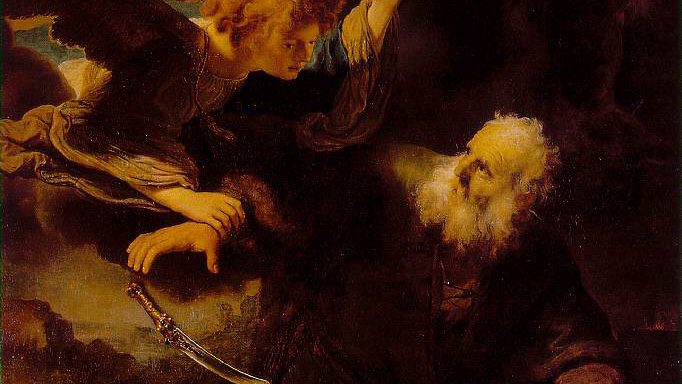
Rembrandt, “The Sacrifice of Isaac”
When John Calvin reaches the “crowning point” of his rant against the “popish Mass,” he becomes truly incoherent. (As though he were not already the source and summit of incoherence.) But here’s Calvin’s “crowning point”: “[T]he sacred Supper [i.e., the Eucharist], on which the Lord left the memorial of his passion formed and engraved, was taken away, hidden, and destroyed, when the Mass was erected.”
Jeepers, it was? So if I am to take Calvin at his plain word here (for why shouldn’t I?), the Church has taken the Eucharist clean away. The Church has hidden the Eucharist. The Church has in fact destroyed the Eucharist! We call it “the source and summit of the Christian life” (for look, here are those very words in the Catechism 1324). We call it “the sum and summary of our faith” (CCC 1327). But according to Calvin, we destroyed the Eucharist and we’re keeping the destruction hidden away, so no one finds out what the Eucharist even is. St. Catherine of Siena never heard of it. #Sad.
But Calvin, as he is wont to do, has bashed us over the head with absurd hyperbole, only to instantly retreat into nuance. “While the supper itself,” he says, “is a gift of God, which was to be received with thanksgiving”—[I pause here to mention that “thanksgiving” is, of course, what the word “Eucharist” means.]—“the sacrifice of the mass pretends to give a price to God to be received as satisfaction.”
I’m already lost. Aren’t sacrifice and thanksgiving the same thing? But allow me to back up yet a while. The Mass is Christ’s atoning sacrifice on Calvary; they are not two different things. Calvin does agree that the crucifixion was a sacrifice? Does he not? He says so himself in §3: Christ “offered himself in sacrifice.” And he quotes Hebrews 9:26: Christ “put away sin by the sacrifice of himself.”
Now, I’ve already shown that the Mass is the very same sacrifice as the sacrifice on Calvary. The Church affirms this time and oft. But if it’s a sacrifice at all, it’s got to be in satisfaction for something; and Hebrews 9:26 tells us that it’s a satisfaction for sin.
The Mass and Calvary are the same: Acting in persona Christi, the priest offers Christ to the Father as a satisfaction for sin. Does Calvin claim that Calvary was not a satisfaction for sin? Does Calvin claim that the cross was not a sacrifice? That is strange. Let us not repeat ourselves here and say, “Oh, but the Mass is something else”; been there, refuted that. (I link again, dear reader, lest you missed it before.)
Calvin, however, tries to rend the sacrifice of Christ with the gift of God which we are to receive with thanksgiving, as though these things are also different. But Christ’s self-sacrifice to the Father is God’s gift to us. There’s no difference between the sacrifice and the gift. There’s no difference between satisfaction and Eucharist. We don’t go to Mass with dejected looks or something because we got a gloomy sacrifice to do, we must make heavy restitution. No.
Now, it is a sacrifice. The Catechism tells us of the Mass:
- 1330: “It completes and surpasses all the sacrifices of the Old Covenant.”
- 1353: It is Christ’s “sacrifice offered on the cross once for all.”
- 1357: It is “the memorial of his sacrifice.”
- 1359: It is a “sacrifice of praise in thanksgiving.”
Oh, wait. “Praise in thanksgiving,” did you say? Right. Let me stop on this point. Did you know that the expression “sacrifice of praise” and “sacrifice of thanksgiving” are biblical? Did Calvin? Watch now:
- Hebrews 13:15: “By him therefore let us offer the sacrifice of praise to God continually.” [So sacrifice is something we’re supposed to offer? And we’re supposed to do it “continually”? And the sacrifice and the praise are the same thing? Interesting.]
- Psalm 116:17: “I will offer to thee the sacrifice of thanksgiving, and will call upon the name of the Lord.”
Calvin tries very hard to separate sacrifice from praise and thanksgiving, but he’s kicking against the goads and had better watch what he’s about lest he wreck his foot. And now let us return to the Catechism, because it also calls the Eucharist a thanksgiving, again and again:
- 1358. “We must consider the Eucharist as thanksgiving and praise to the Father.”
- 1359. The Eucharist is a “sacrifice of praise in thanksgiving for the work of creation.”
When Calvin says that the Church has hidden away and destroyed the Lord’s Supper, he means that it has hidden away thanksgiving in preference to sacrifice. But that’s an odd claim given that the Bible and the Catechism speak of thanksgiving as sacrifice, and given that the very word “Eucharist” means—no, not sacrifice, but thanksgiving.
“As widely as giving differs from receiving,” Calvin says, “does sacrifice differ from the sacrament of the Supper.” No; in fact, sacrifice and thanksgiving are one and the same: The Catechism tells us this, and the Bible tells us this. Accusation is confession, and Calvin does more rending than the Church does.
•••
But stay a moment, because now Calvin gets genuinely weird. “Herein,” he says, “does the wretched ingratitude of man appear,– that when the liberality of the divine goodness ought to have been recognised, and thanks returned [That’s what the Mass does: recognize the divine goodness and give thanks.], he makes God to be his debtor.”
Did you follow that? Calvin’s complaint hitherto has been this: Those poor Catholics think they still have to sacrifice to God. Jesus already did that; why are you still trying to make satisfaction? #Sad! But now he turns around and says we think God needs to make satisfaction to us. Is this coherent? Am I missing something? And people say Pope Francis is confusing!
But if we read further in the hope that it will abate our perplexity, we will be much disappointed, for Calvin helps not at all. Instead he makes a reshash of dumb claims long since refuted:
“The sacrament promised, that by the death of Christ we were not only restored to life once, but constantly quickened, because all the parts of our salvation were then completed. The sacrifice of the mass uses a very different language–viz. that Christ must be sacrificed daily, in order that he may lend something to us.”
But wait. Stop here. Even if this were true, if God “lends” us “something,” aren’t we supposed to pay him back? So that makes us God’s debtor, not God our debtor. Which is it, Johnny?
But Calvin doesn’t help us with our perplexity any more now than he has hitherto. Rather than do that, he abruptly changes the subject and waxes bitter about private masses. So with his incoherence remaining, we can shut the door on Calvin.
Previous Post

August 5, 2019
Protestant asks: When would Catholics know they're in a false Church?
Next Post

August 10, 2019 Steve Hays posits false dichotomy between authority and reason.
Browse Our Archives
Select a Category Abortion About Me Answers for Calvinists Answers to Media Fictions Answers to Objections Anti-Catholicism Apologetics Apostolic Succession Atonement Authority of the Church Baptism Benedictines Biblical Exegesis Blogging Book Reviews Books & Writing &c. Calvin's Institutes Capital Punishment Catholic Church Chastity Christology Church Fathers Church Social Doctrine Confession Contraception Conversion Stories Crusades Debates Depression & Suicide Deuterocanon Development of Doctrine Ecumenism English Language Eucharistic Adoration Exorcism Extra Ecclesiam Fisks & Rebuttals Freedom of Religion Freedom of Speech Fundamentalism Gender Politics Gender Theory Good Works Homosexuality Humor Idolatry Immaculate Conception In the News Inquisition ISIS Islam Just for Fun Just War Justification LCWR Limbo Liturgical Abuse Liturgical Year Magisterium Marriage and Family Mary Mortal Sin New Evangelization NFP Papacy Papal Documents Papal Infallibility Personal Narrative Politics Pope Francis Pope Francis Derangement Syndrome Population Control Praying to the "Dead" Priesthood Primacy of Peter Protestant Denominations Purgatory Radical Islam Radical Traditionalists Real Presence Right to Conscience RIght to Life Saints Same-Sex "Marriage" Seven Quick Takes Social Justice Social Media Sola Scriptura Spirit of Vatican II SSPX The Eucharist The Mass The Resurrection Traditionalism Vatican II Year of Mercy
Select a Month August 2019 July 2019 June 2019 May 2019 November 2018 October 2018 August 2018 July 2018 June 2018 April 2018 November 2017 October 2017 September 2017 May 2017 April 2017 March 2017 February 2017 November 2016 October 2016 September 2016 August 2016 July 2016 June 2016 May 2016 April 2016 March 2016 February 2016 January 2016 December 2015 November 2015 October 2015 September 2015 July 2015 June 2015 May 2015 April 2015 March 2015 February 2015 January 2015 December 2014 September 2014 August 2014 July 2014 June 2014 May 2014 April 2014 March 2014 February 2014 January 2014 December 2013 November 2013 October 2013 May 2013 April 2013 February 2013 January 2013
Follow Us!
TAKE THE
Religious Wisdom Quiz
Who said: "You are a chosen people, a royal priesthood, a holy nation, God's special possession"?
Select your answer to see how you score.
Peter Moses Paul James
Related posts from To Give a Defense
"Not Infallible" does not mean "Contains Errors."
Steve Hays posits false dichotomy between authority and...

Protestant asks: When would Catholics know they're in...

Of course the Church can ordain women.
TRENDING AT PATHEOS Catholic

Rejecting Doom: Christian Hope And Human Action
Christianity is a religion of hope. We are to have hope and...

It’s What Comes From Within Which Matters
One of the most difficult things for us to understand is why...

Why I Choose the Eucharist Over the Sermon
Choose the Eucharist, Not the Sermon What are we supposed to get...

5 Design Elements Found in Spiritually Rooted Homes
Putting Spirituality Into Home Decor Our homes are more than our living...

Credo: A Story of God Told with the...
About 10 years ago, I began to imagine a personal "Credo" that...

The Anatomy of Divine Revelation in Catholic Thought
The claim that God has made Himself known to human beings is...
view all Catholic blogs
Ad-Free & Subscriber Log-In Subscription Support
- About Us
- 2026 Calendar
- Videos
- Podcasts
- Library of World Religions
- Faith In Media Tracker
- Advertise With Us
- Write for Us
- Privacy Policy
- Terms of Service
- Do Not Sell My Data
- Contact Us
- Radiant Digital
- Manage Newsletter Subscriptions
- Unsubscribe From Notifications
- Sitemap
Copyright 2008-2026, Patheos. All rights reserved.
Subscription Support Ad-Free & Subscriber Log-In
Follow Patheos