
BuddhistCatholicContemplativeEvangelicalGeneral ChristianHinduJewishLatter-day SaintMuslimNew VisionsProgressive Christian
Beliefs
- Buddhist
- Catholic
- Contemplative
- Evangelical
- General Christian
- Hindu
- Jewish
- Latter-day Saint
- More Voices
- Muslim
- New Visions
- Pagan
- Progressive Christian
Topics
- Religion News
- Food and Religion
- Sports and Religion
- Religious Art
- Religious Music and Entertainment
- Religious Events
- History and Religion
- Style and Religion
- Politics and Religion
- Women in Religion
- Recreation Outdoors and Religion
- Business Finance and Religion
- Careers Workplace and Religion
- Education and Religion
- Family Parenting and Religion
- Health Fitness and Religion
- Home and Religion
- Relationships and Religion
- Technology and Religion
- Travel and Religion
Columnists
- Buddhist Columnists
- Business Finance and Religion Columnists
- Careers Workplace and Religion Columnists
- Catholic Columnists
- Contemplative Columnists
- Education and Religion Columnists
- Evangelists Columnists
- Family Parenting and Religion Columnists
- General Christian Columnists
- Health Fitness and Religion Columnists
- Hindu Columnists
- History and Religion Columnists
- Home and Religion Columnists
- Jewish Columnists
- More Voices Columnists
- Latter Day Columnists
- Muslim Columnists
- New Visions Columnists
- Nonreligious Columnists
- Pagan Columnists
- Politics and Religion Columnists
- Progressive Columnists
- Recreation Outdoors and Religion Columnists
- Relationships and Religion Columnists
- Religion News Columnists
- Religious Art Columnists
- Religious Events Columnists
- Religious Music and Entertainment Columnists
- Sports and Religion Columnists
- Style and Religion Columnists
- Technology and Religion Columnists
- Travel and Religion Columnists
- Women in Religion Columnists
Resource Library
- 2026 Calendar
- Library of World Religions
- The 100 Most Holy Places on Earth
- Patheos Answers
- Podcasts
- Videos
- Faith Leaders Database
- Anglican Episcopalian
- Bahai
- Baptist
- Buddhism
- Christianity
- Confucianism
- Eastern Orthodoxy
- Hinduism
- Holiness and Pentecostal
- ISKCON
- Islam
- Judaism
- Lutheran
- Methodist
- The Church of Jesus Christ of Latter-day Saints
- New Age
- Paganism
- Presbytarian and Reformed
- Protestantism
- Religion Behind the Scenes
- Roman Catholic
- Scientology
- Shia Islam
- Sikhism
- Sufism
- Sunni Islam
- Taoism
- Zen
- See all religions
Research Tools
 Ad-Free & Subscriber Log-In Subscription Support
Ad-Free & Subscriber Log-In Subscription Support
Follow Patheos 

- Trending:
- Forgiveness
- |
- Marriage
- |
- Consciousness
- |
- Death Penalty
- |
- Election
- |
- Halloween
 To Give a Defense
- Home
- Catholic
- Dissenting From the Magisterium Causes Great Spiritual Harm
Dissenting From the Magisterium Causes Great Spiritual Harm
Last updated on: March 10, 2018 at 3:40 pm by Scott Eric Alt
Dissenting From the Magisterium Causes Great Spiritual Harm 2018-03-10T15:40:48-04:00 Scott Eric Alt
Patheos Explore the world's faith through different perspectives on religion and spirituality! Patheos has the views of the prevalent religions and spiritualities of the world.
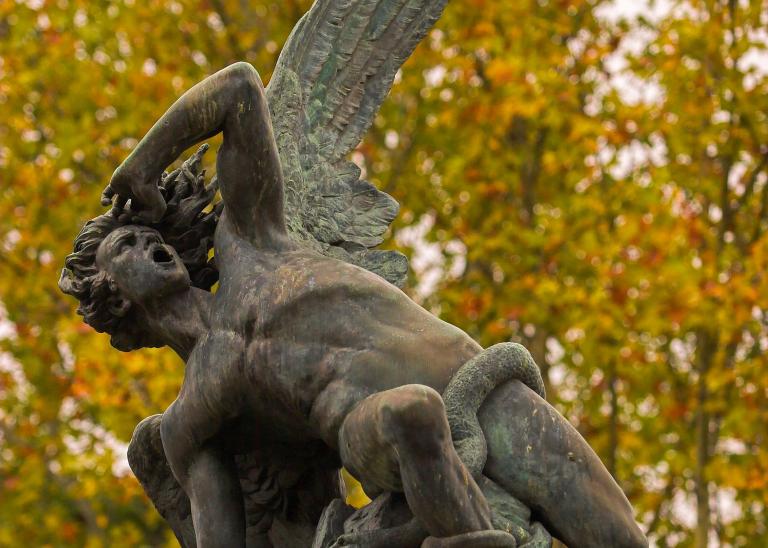
Ricardo Bellver, “The Fallen Angel” (1854). Image via Creative Commons.

In Donum Veritatis, the CDF lists several forms dissent against the Magisterium might take. (This is the fourth post in an ongoing discussion. The first is here; the second, here; the third, here. You can read the original post that prompted this discussion here.)
“Dissent,” the CDF clarifies, is different from “personal difficulties.” One must distinguish. You can work through a personal difficult; dissent is active rebellion. “Spiritual harm” results from dissent. There are five kinds.
First, Philosophical liberalism. “Freedom of thought,” the CDF says, “comes to oppose the authority of tradition which is considered a cause of servitude.” Those who hold this idea think that fealty is slavery. To dissent is to be free.
A teaching handed on and generally received is a priori suspect and its truth contested. Ultimately, freedom of judgment understood in this way is more important than the truth itself.
But true freedom is the freedom to seek the truth. It is not freedom from the truth. To be free from truth is to be free from God.
Second, Manipulation of public opinion. The mass media can exert a “pressure to conform.” Its narratives assume a “normative value; the world demands the Church conform to those narratives rather than to the truth.
The view is particularly promoted that the Church should only express her judgment on those issues which public opinion considers important and then only by way of agreeing with it. The Magisterium, for example, could intervene in economic or social questions but ought to leave matters of conjugal and family morality to individual judgment.
Or, contrariwise, some say that the Church should stay out of economics and instead worry about saving souls. Judge Napolitano once lashed out at Pope Francis on these grounds. The judge was upset with Evangelii Gaudium and Laudato Si, and was using his media platform to encourage dissent.
Those who subscribe to this form of dissent want to be affirmed rather than taught.
Third, Acceptance of only infallible teachings. This is a big one. This is an argument I encounter very frequently, and it is what prompted me to write my original post in this series.
More frequently, it is asserted that the theologian is not bound to adhere to any Magisterial teaching unless it is infallible. Thus a kind of theological positivism is adopted, according to which, doctrines proposed without exercise of the charism of infallibility are said to have no obligatory character about them, leaving the individual completely at liberty to adhere to them or not.
This is the kind of dissent that most interests me presently. (For it is dissent, according to the CDF.) Those who make this claim might make it in a few different ways.
- They might say that the Magisterial texts constitute a “debatable theology.”
- They might say there is no such thing as a “normative” theology. A person can favor any which one he likes.
In all of this, the CDF is most worried about a “parallel magisterium.” Theological pluralism is only legitimate to the extent that the unity of the faith remains. Christ does transcend all categories of thought. But
[t]his cannot mean that it is possible to accept conclusions contrary to that mystery and it certainly does not put into question the truth of those assertions by which the Magisterium has declared itself.
The Church has its authority to teach from God. (Matt. 16:18; John 16:13; 1 Tim. 3:15; John 21:15). Dissent from the Church can lead to “spiritual harm,” according to the CDF, because it leads to “contempt for true authority.”
Indeed, when you dissent, you set yourself up as your own authority. You reject the Holy Spirit who guides the Church; the Holy Spirit does not guide you.
Fourth, Argumentum ad populum. This is a false appeal to the sensus fidei. According to the CDF, the sensus fidei is not just the opinions of the faithful.
The sense of the faith is a property of theological faith; and, as God’s gift which enables one to adhere personally to the Truth, it cannot err. This personal faith is also the faith of the Church since God has given guardianship of the Word to the Church. Consequently, what the believer believes is what the Church believes. The “sensus fidei” implies then by its nature a profound agreement of spirit and heart with the Church, “sentire cum Ecclesia”.
The sensus fidei, like conscience, must be formed by the Church’s teaching, not in dissent from it. A person can err; the Church can not.
Not all the ideas which circulate among the People of God are compatible with the faith. This is all the more so given that people can be swayed by a public opinion influenced by modern communications media. Not without reason did the Second Vatican Council emphasize the indissoluble bond between the “sensus fidei” and the guidance of God’s People by the magisterium of the Pastors. These two realities cannot be separated.
There is no freedom, the CDF stresses, apart from “unity in truth” and “fidelity to the faith.” There is no freedom in dissent.
The freedom of the act of faith cannot justify a right to dissent. In fact this freedom does not indicate at all freedom with regard to the truth but signifies the free self-determination of the person in conformity with his moral obligation to accept the truth.
Dissent from the Magisterium is spiritually harmful because it alienates a person from the truth. To be alienated from the truth is to be alienated from God, who has entrusted the truth to the Church. The Church, Paul writes to Timothy, is the “pillar and ground of truth.”
Dissent, the CDF says, “fails to recognize the nature and mission of the Church which has received from the Lord the task to proclaim the truth of salvation to all men.”
Fifth, the Magisterium of Conscience. Not even conscience justifies dissent. A conscience must be followed, but it must also be formed. “Conscience is not an independent and infallible faculty.” (That’s important.) “It is an act of moral judgement regarding a responsible choice.”
Setting up a supreme magisterium of conscience in opposition to the magisterium of the Church means adopting a principle of free examination incompatible with the economy of Revelation.
And to do that breaks one’s “bond with Christ.”
To succumb to the temptation of dissent, on the other hand, is to allow the ‘leaven of infidelity to the Holy Spirit’ to start to work.
Dissent is a “leaven of infidelity” to God.
***
Previous Post
March 22, 2017
Don't Believe This Fake Pius IX Quotation on a Pope Teaching Heresy
Next Post
March 28, 2017 Cardinal Burke Can't "Correct" the Pope, But the Pope Can Correct Burke
Browse Our Archives
Select a Category Abortion About Me Answers for Calvinists Answers to Media Fictions Answers to Objections Anti-Catholicism Apologetics Apostolic Succession Atonement Authority of the Church Baptism Benedictines Biblical Exegesis Blogging Book Reviews Books & Writing &c. Calvin's Institutes Capital Punishment Catholic Church Chastity Christology Church Fathers Church Social Doctrine Confession Contraception Conversion Stories Crusades Debates Depression & Suicide Deuterocanon Development of Doctrine Ecumenism English Language Eucharistic Adoration Exorcism Extra Ecclesiam Fisks & Rebuttals Freedom of Religion Freedom of Speech Fundamentalism Gender Politics Gender Theory Good Works Homosexuality Humor Idolatry Immaculate Conception In the News Inquisition ISIS Islam Just for Fun Just War Justification LCWR Limbo Liturgical Abuse Liturgical Year Magisterium Marriage and Family Mary Mortal Sin New Evangelization NFP Papacy Papal Documents Papal Infallibility Personal Narrative Politics Pope Francis Pope Francis Derangement Syndrome Population Control Praying to the "Dead" Priesthood Primacy of Peter Protestant Denominations Purgatory Radical Islam Radical Traditionalists Real Presence Right to Conscience RIght to Life Saints Same-Sex "Marriage" Seven Quick Takes Social Justice Social Media Sola Scriptura Spirit of Vatican II SSPX The Eucharist The Mass The Resurrection Traditionalism Vatican II Year of Mercy
Select a Month August 2019 July 2019 June 2019 May 2019 November 2018 October 2018 August 2018 July 2018 June 2018 April 2018 November 2017 October 2017 September 2017 May 2017 April 2017 March 2017 February 2017 November 2016 October 2016 September 2016 August 2016 July 2016 June 2016 May 2016 April 2016 March 2016 February 2016 January 2016 December 2015 November 2015 October 2015 September 2015 July 2015 June 2015 May 2015 April 2015 March 2015 February 2015 January 2015 December 2014 September 2014 August 2014 July 2014 June 2014 May 2014 April 2014 March 2014 February 2014 January 2014 December 2013 November 2013 October 2013 May 2013 April 2013 February 2013 January 2013
Follow Us!
TAKE THE
Religious Wisdom Quiz
How should Christians respond to insults?
Select your answer to see how you score.
Insult in return Fight back Ignore always Bless those who curse you
Related posts from To Give a Defense

Infallibility is true, but (almost) useless. With some...
Pope Francis Derangement Syndrome Vol. XX: Death Penalty...
Yes, Virginia, The Catechism is a Magisterial Document

"Ultramontanism" and a Supposed Conflict Between Pope Francis...
TRENDING AT PATHEOS Catholic

Rejecting Doom: Christian Hope And Human Action
Christianity is a religion of hope. We are to have hope and...

It’s What Comes From Within Which Matters
One of the most difficult things for us to understand is why...

Why I Choose the Eucharist Over the Sermon
Choose the Eucharist, Not the Sermon What are we supposed to get...

5 Design Elements Found in Spiritually Rooted Homes
Putting Spirituality Into Home Decor Our homes are more than our living...

Credo: A Story of God Told with the...
About 10 years ago, I began to imagine a personal "Credo" that...

The Anatomy of Divine Revelation in Catholic Thought
The claim that God has made Himself known to human beings is...
view all Catholic blogs
Ad-Free & Subscriber Log-In Subscription Support
- About Us
- 2026 Calendar
- Videos
- Podcasts
- Library of World Religions
- Faith In Media Tracker
- Advertise With Us
- Write for Us
- Privacy Policy
- Terms of Service
- Do Not Sell My Data
- Contact Us
- Radiant Digital
- Manage Newsletter Subscriptions
- Unsubscribe From Notifications
- Sitemap
Copyright 2008-2026, Patheos. All rights reserved.
Subscription Support Ad-Free & Subscriber Log-In
Follow Patheos