
BuddhistCatholicContemplativeEvangelicalGeneral ChristianHinduJewishLatter-day SaintMuslimNew VisionsProgressive Christian
Beliefs
- Buddhist
- Catholic
- Contemplative
- Evangelical
- General Christian
- Hindu
- Jewish
- Latter-day Saint
- More Voices
- Muslim
- New Visions
- Pagan
- Progressive Christian
Topics
- Religion News
- Food and Religion
- Sports and Religion
- Religious Art
- Religious Music and Entertainment
- Religious Events
- History and Religion
- Style and Religion
- Politics and Religion
- Women in Religion
- Recreation Outdoors and Religion
- Business Finance and Religion
- Careers Workplace and Religion
- Education and Religion
- Family Parenting and Religion
- Health Fitness and Religion
- Home and Religion
- Relationships and Religion
- Technology and Religion
- Travel and Religion
Columnists
- Buddhist Columnists
- Business Finance and Religion Columnists
- Careers Workplace and Religion Columnists
- Catholic Columnists
- Contemplative Columnists
- Education and Religion Columnists
- Evangelists Columnists
- Family Parenting and Religion Columnists
- General Christian Columnists
- Health Fitness and Religion Columnists
- Hindu Columnists
- History and Religion Columnists
- Home and Religion Columnists
- Jewish Columnists
- More Voices Columnists
- Latter Day Columnists
- Muslim Columnists
- New Visions Columnists
- Nonreligious Columnists
- Pagan Columnists
- Politics and Religion Columnists
- Progressive Columnists
- Recreation Outdoors and Religion Columnists
- Relationships and Religion Columnists
- Religion News Columnists
- Religious Art Columnists
- Religious Events Columnists
- Religious Music and Entertainment Columnists
- Sports and Religion Columnists
- Style and Religion Columnists
- Technology and Religion Columnists
- Travel and Religion Columnists
- Women in Religion Columnists
Resource Library
- 2026 Calendar
- Library of World Religions
- The 100 Most Holy Places on Earth
- Patheos Answers
- Podcasts
- Videos
- Faith Leaders Database
- Anglican Episcopalian
- Bahai
- Baptist
- Buddhism
- Christianity
- Confucianism
- Eastern Orthodoxy
- Hinduism
- Holiness and Pentecostal
- ISKCON
- Islam
- Judaism
- Lutheran
- Methodist
- The Church of Jesus Christ of Latter-day Saints
- New Age
- Paganism
- Presbytarian and Reformed
- Protestantism
- Religion Behind the Scenes
- Roman Catholic
- Scientology
- Shia Islam
- Sikhism
- Sufism
- Sunni Islam
- Taoism
- Zen
- See all religions
Research Tools
 Ad-Free & Subscriber Log-In Subscription Support
Ad-Free & Subscriber Log-In Subscription Support
Follow Patheos 

- Trending:
- Forgiveness
- |
- Marriage
- |
- Consciousness
- |
- Death Penalty
- |
- Election
- |
- Halloween
 To Give a Defense
- Home
- Catholic
- Did Adam & Eve Practice Sola Scriptura?
Did Adam & Eve Practice Sola Scriptura?
Last updated on: February 25, 2018 at 5:27 pm by Scott Eric Alt
Did Adam & Eve Practice Sola Scriptura? 2018-02-25T17:27:14-04:00 Scott Eric Alt
Patheos Explore the world's faith through different perspectives on religion and spirituality! Patheos has the views of the prevalent religions and spiritualities of the world.
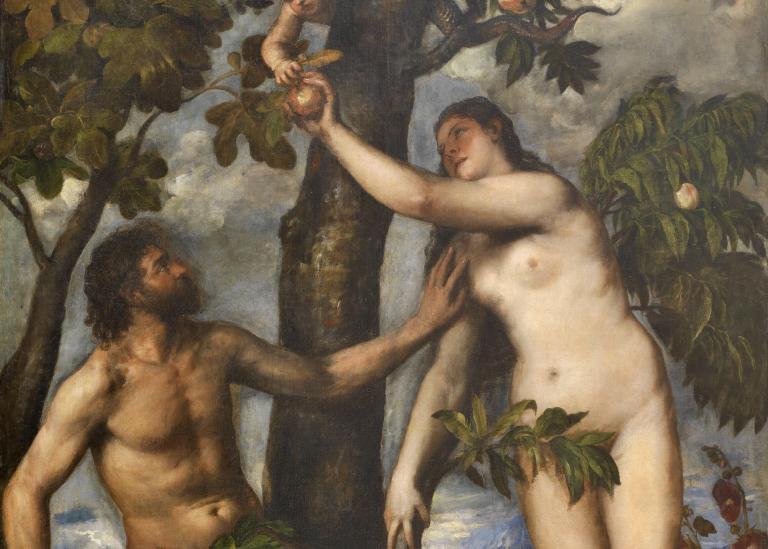
Titian, “The Fall of Man,” ca. 1550
Unusual as the question may sound, no less a personage than the polemical rogue John Bugay makes that wery claim here. The title of this blog article (for the man does not quit but grows more wild) is “The First Adam, Sola Scriptura, and His Commission as King, Priest, and Protestant.” Yes, dear reader, it would seem that Adam was a Protestant. Did you know that? I sure didn’t. But it’s remarkable what you’ll learn on Failablogue. (Mr. Bugay calls it Triablogue, which I think is optimistic.)
MR. JOHN BUGAY: POLEMICAL ROGUE AND THEOLOGICAL HIGH-JUMP CHAMPION
Now, what Mr. Bugay seems to be up to this time is to wring wet and curious claims out of a sponge of a book by G.K. Beale called A New Testament Biblical Theology. In the passage at hand, Mr. Beale discusses the first commission of God to Adam, immediately after the Creation. Adam’s kingship over creation, he says, is “part of a functional definition of the divine image in which Adam was made.” To put that in plainer English, Adam, who made to reflect God’s image, was also made to reflect God’s character in “moral attributes such as righteousness, knowledge, holiness, justice, love, faithfulness, and integrity.” Thus, as Mr. Beale understands it, Adam was a “primordial priest.” And his priesthood, Mr. Beale says, depended upon obedience to God.
So far so good. But from the starting point of these relatively dry, academic, and innocuous passages, the gymnastic Mr. Bugay proceeds to leap a thousand miles to arrive here:
Roman Catholics are fond of asking, “Where is Sola Scriptura in the Bible? The first instance of it is right here, at the beginning, establishing the principle from the start. Adam and Eve had a word from God (though no “infallible canon”), and they were simply expected to understand and obey. … There is no provision for an “infallible interpreter” at this point.
Really, one wonders where to begin. Let me see if I have this right. Adam and Eve did not have an infallible canon—or any canon—but they did have sola scriptura. Can I ask anyone who understands that to please explain? Can I also ask Mr. Bugay how he derives sola scriptura from our duty to obey the commandments of God? I assume that this skilled Olympic athlete can give a straightforward answer, since he’s the one who’s making the leap—I’m just lost on the chain of reasoning that leads him from the one to the other. No, I would not accuse you of non sequitur, Mr. Bugay, for that would be libel; but can you help me, good sir? Catholicism does deny sola scriptura—well, you know this—but it still says that we must obey what God says. Being a Catholic, I tend to think of those two things as distinct. Perhaps, Mr. Bugay, you can explain it to me in a way I can understand. My mind may just be less profound than your own, my legs less Olympic and apt to pole vault into orbit.
I am also curious—I just ask questions; I seek only to be taught here—why Mr. Bugay takes the pains he does to point out that God made “no provision for an ‘infallible interpreter.'” Why would Adam and Eve have needed one? The polemical rogue seems to forget (I am bold) that he’s writing about the condition of mankind before the Fall. Adam and Eve were created in the image of God and without stain of sin. Their reason was uncorrupted. The fallibility of human reason is a condition of the Fall, not a description of Adam and Eve before the Fall. There was “no provision for an ‘infallible interpreter'” because Adam and Eve did not need one. They were incapable of error (I mean intellectual error). They sinned, yes; because they had free will, they disobeyed. But not because they were confused about what God required. Mr. John Bugay confuses Adam and Eve with—Mr. John Bugay!
Returning to Beale, Mr. Bugay quotes this passage:
When confronted by the satanic serpent, Adam’s wife responds by quoting Gen 2:16-17 but changes the wording in at least three major places (Gen. 3:2-3). It is possible that the changes are incidental and are a mere paraphrase . … It is more likely, however, that she either failed to remember God’s word accurately or intentionally changed it for her own purposes.
Well, okay, let us look at this. That Eve “changes the wording” when quoting God to the serpent is not all that original an observation. Some, like Coffman, take the view that Eve has sinned already. As for Beale, he finds her changes minor enough that the change may have been “incidental” and “paraphrase,” though he thinks it likelier that she did so by design, “for her own purposes.” But he does not know for sure.
I would point out, though—Mr. Beale does not tell us this, unless Mr. Bugay leaves that part out (and it would not be all that shocking if he had)—that Eve’s change makes God’s commandment more strict, not less. God told Adam and Eve not to eat of the tree of the knowledge of good and evil (Gen. 2:17). When explaining these words to the serpent, Eve added the restriction that she and Adam not even touch the tree. That was not part of God’s command (Gen. 3:3). But no less a Reformed authority than Gill says that the idea that Eve had already sinned is “not sufficiently proved” and that not touching the tree was implied. Thus whether Eve failed to remember with precision what God said, or whether she was intentionally changing his words, she was not giving herself a license to disobey God. If anything, she was setting up an additional safeguard—as though to avoid an occasion of sin. Indeed, Eve’s addition sounds more like an act of prudence than it sounds like she was playing fast and loose with God’s words.
WHEREIN I SUGGEST THAT MR. BUGAY COME BACK DOWN TO EARTH AND READ A LITTLE JOHN HENRY NEWMAN
No such thoughts as these, however, prevent Mr. Bugay from making the very astonishing claim that Eve is engaging in “the very first instance of ‘the development of doctrine.'” Honestly, when one reads such words as these, the first impulse is to have a good laugh and then turn on the TV. That is mad. That is the kind of nonsense that gets spewed when a desperate Protestant is trying to be clever. He ends up being too clever by half.
Does Mr. Bugay know what the development of doctrine is? Does he? The development of doctrine does not mean disobeying commandments. (He needs to be told this.) The Church does not say, “You may commit adultery now.” She does not say, “Go, and sin boldly.” She does not say, “Faith alone will save you.” That would be a “development of doctrine” to protest. But if Mr. Bugay had bothered to read John Henry Newman’s On the Development of Christian Doctrine, even once, he might have a better idea what he’s talking about. No, don’t tell me you’ve read it, sir; for look you: Newman was attempting to describe how certain dogmas had become more explicit over time—such as the Doctrine of the Trinity. In his Introduction [read it here], he explains the necessity for such development in these words:
From the nature of the human mind, time is necessary for the full comprehension and perfection of great ideas; and that the highest and most wonderful truths, though communicated to the world once for all by inspired teachers, could not be comprehended all at once by the recipients, but, as being received and transmitted by minds not inspired and through media which were human, <strong”>have required only the longer time and deeper thought for their full elucidation. This may be called the Theory Development of Doctrine.”
Now, it is important to understand that Newman is referring here to “the nature of the human mind” after the Fall. His words have no application to Adam and Eve in Eden. But the corrupted, and fallible, human mind that exists after the Fall does need time to comprehend the fullness of God’s revelation. God reveals himself slowly; and even after revelation, human comprehension is slow. It takes centuries; sometimes millennia. Christ, after all, says, “I have yet many things to say unto you, but ye cannot bear them now. Howbeit when he, the Spirit of truth, is come, he will guide you into all truth.” (John 16:12-13a). Christ is describing a process; which, as the Catholic Church understands, necessarily develops over time. And the process occurs through the Church; to her, God gives the infallibility necessary to ensure the propagation of the truth and the unity of the faith.
The Second Vatican Council explains further, in Dei Verbum 8 (a text which Mr. Bugay also can not have read):
The tradition which comes from the apostles develops in the Church with the help of the Holy Spirit. For there is a growth in the understanding of the realities and the words which have been handed down. This happens through the contemplation and study made by believers, who treasure these things in their hearts, through a penetrating understanding of the spiritual realities which they experience, and through the preaching of those who have received through episcopal succession the sure gift of truth. For, as the centuries succeed one another, the Church constantly moves forward toward the fullness of divine truth until the words of God reach their complete fulfillment in her.
Again, this is a description of God’s truth being revealed through time. It is not a description of rebellion against God. The Church does not say, “In the fulness of time, we threw out those pesky seven books and ten commandments.” If Mr. Bugay had bothered to read and understand either Newman or the Second Vatican Council, he would never attempt to describe Eve’s disobedience as a “development of doctrine.” That’s how fools and blind men talk. The Church tells us what its doctrines mean; Pope John B. does not. If he wants to critique the development of doctrine, good. Let him. But he should critique what the doctrine really says, and not a phantasm that he himself made up. I hold it not honesty for him to thus set it down.
The notion that Adam and Eve were Protestants practicing sola scriptura, until Eve ruined it all with her Catholic development of doctrine, tells us only how cosmically high a Reformed apologist is willing to vault in the effort to justify his continued schism.
***
If you like the content on this blog, your generous gift to the author helps to keep it active. I remember all my supporters in my Mass intentions each week.
Previous Post
January 7, 2013
I See Men as Trees Walking Part II: A Capacity for Wonder
Next Post
January 10, 2013 Thoughts on Bishop Fellay and the Ugliness of Schism
Browse Our Archives
Select a Category Abortion About Me Answers for Calvinists Answers to Media Fictions Answers to Objections Anti-Catholicism Apologetics Apostolic Succession Atonement Authority of the Church Baptism Benedictines Biblical Exegesis Blogging Book Reviews Books & Writing &c. Calvin's Institutes Capital Punishment Catholic Church Chastity Christology Church Fathers Church Social Doctrine Confession Contraception Conversion Stories Crusades Debates Depression & Suicide Deuterocanon Development of Doctrine Ecumenism English Language Eucharistic Adoration Exorcism Extra Ecclesiam Fisks & Rebuttals Freedom of Religion Freedom of Speech Fundamentalism Gender Politics Gender Theory Good Works Homosexuality Humor Idolatry Immaculate Conception In the News Inquisition ISIS Islam Just for Fun Just War Justification LCWR Limbo Liturgical Abuse Liturgical Year Magisterium Marriage and Family Mary Mortal Sin New Evangelization NFP Papacy Papal Documents Papal Infallibility Personal Narrative Politics Pope Francis Pope Francis Derangement Syndrome Population Control Praying to the "Dead" Priesthood Primacy of Peter Protestant Denominations Purgatory Radical Islam Radical Traditionalists Real Presence Right to Conscience RIght to Life Saints Same-Sex "Marriage" Seven Quick Takes Social Justice Social Media Sola Scriptura Spirit of Vatican II SSPX The Eucharist The Mass The Resurrection Traditionalism Vatican II Year of Mercy
Select a Month August 2019 July 2019 June 2019 May 2019 November 2018 October 2018 August 2018 July 2018 June 2018 April 2018 November 2017 October 2017 September 2017 May 2017 April 2017 March 2017 February 2017 November 2016 October 2016 September 2016 August 2016 July 2016 June 2016 May 2016 April 2016 March 2016 February 2016 January 2016 December 2015 November 2015 October 2015 September 2015 July 2015 June 2015 May 2015 April 2015 March 2015 February 2015 January 2015 December 2014 September 2014 August 2014 July 2014 June 2014 May 2014 April 2014 March 2014 February 2014 January 2014 December 2013 November 2013 October 2013 May 2013 April 2013 February 2013 January 2013
Follow Us!
TAKE THE
Religious Wisdom Quiz
Who was Rebekah's father?
Select your answer to see how you score.
Abraham Terah Bethuel Laban
Related posts from To Give a Defense
Does the Mass crucify Jesus another time? Part...
Does the Mass "banish the remembrance of Christ's...
How much does God hate lying? (Proverbs 6:16-19)
Don't Cite Leviticus 18 If You're Going to...
TRENDING AT PATHEOS Catholic

Rejecting Doom: Christian Hope And Human Action
Christianity is a religion of hope. We are to have hope and...

It’s What Comes From Within Which Matters
One of the most difficult things for us to understand is why...

Why I Choose the Eucharist Over the Sermon
Choose the Eucharist, Not the Sermon What are we supposed to get...

5 Design Elements Found in Spiritually Rooted Homes
Putting Spirituality Into Home Decor Our homes are more than our living...

Credo: A Story of God Told with the...
About 10 years ago, I began to imagine a personal "Credo" that...

The Anatomy of Divine Revelation in Catholic Thought
The claim that God has made Himself known to human beings is...
view all Catholic blogs
Ad-Free & Subscriber Log-In Subscription Support
- About Us
- 2026 Calendar
- Videos
- Podcasts
- Library of World Religions
- Faith In Media Tracker
- Advertise With Us
- Write for Us
- Privacy Policy
- Terms of Service
- Do Not Sell My Data
- Contact Us
- Radiant Digital
- Manage Newsletter Subscriptions
- Unsubscribe From Notifications
- Sitemap
Copyright 2008-2026, Patheos. All rights reserved.
Subscription Support Ad-Free & Subscriber Log-In
Follow Patheos