
BuddhistCatholicContemplativeEvangelicalGeneral ChristianHinduJewishLatter-day SaintMuslimNew VisionsProgressive Christian
Beliefs
- Buddhist
- Catholic
- Contemplative
- Evangelical
- General Christian
- Hindu
- Jewish
- Latter-day Saint
- More Voices
- Muslim
- New Visions
- Pagan
- Progressive Christian
Topics
- Religion News
- Food and Religion
- Sports and Religion
- Religious Art
- Religious Music and Entertainment
- Religious Events
- History and Religion
- Style and Religion
- Politics and Religion
- Women in Religion
- Recreation Outdoors and Religion
- Business Finance and Religion
- Careers Workplace and Religion
- Education and Religion
- Family Parenting and Religion
- Health Fitness and Religion
- Home and Religion
- Relationships and Religion
- Technology and Religion
- Travel and Religion
Columnists
- Buddhist Columnists
- Business Finance and Religion Columnists
- Careers Workplace and Religion Columnists
- Catholic Columnists
- Contemplative Columnists
- Education and Religion Columnists
- Evangelists Columnists
- Family Parenting and Religion Columnists
- General Christian Columnists
- Health Fitness and Religion Columnists
- Hindu Columnists
- History and Religion Columnists
- Home and Religion Columnists
- Jewish Columnists
- More Voices Columnists
- Latter Day Columnists
- Muslim Columnists
- New Visions Columnists
- Nonreligious Columnists
- Pagan Columnists
- Politics and Religion Columnists
- Progressive Columnists
- Recreation Outdoors and Religion Columnists
- Relationships and Religion Columnists
- Religion News Columnists
- Religious Art Columnists
- Religious Events Columnists
- Religious Music and Entertainment Columnists
- Sports and Religion Columnists
- Style and Religion Columnists
- Technology and Religion Columnists
- Travel and Religion Columnists
- Women in Religion Columnists
Resource Library
- 2026 Calendar
- Library of World Religions
- The 100 Most Holy Places on Earth
- Patheos Answers
- Podcasts
- Videos
- Faith Leaders Database
- Anglican Episcopalian
- Bahai
- Baptist
- Buddhism
- Christianity
- Confucianism
- Eastern Orthodoxy
- Hinduism
- Holiness and Pentecostal
- ISKCON
- Islam
- Judaism
- Lutheran
- Methodist
- The Church of Jesus Christ of Latter-day Saints
- New Age
- Paganism
- Presbytarian and Reformed
- Protestantism
- Religion Behind the Scenes
- Roman Catholic
- Scientology
- Shia Islam
- Sikhism
- Sufism
- Sunni Islam
- Taoism
- Zen
- See all religions
Research Tools
 Ad-Free & Subscriber Log-In Subscription Support
Ad-Free & Subscriber Log-In Subscription Support
Follow Patheos 

- Trending:
- Forgiveness
- |
- Marriage
- |
- Consciousness
- |
- Death Penalty
- |
- Election
- |
- Halloween
 To Give a Defense
- Home
- Catholic
- Of Course You Have Religious Freedom. Except When the State Says You Don’t: Deconstructing the Absolute Statism of Combox Junkie Doug Indeap, If That Is His Name.
Of Course You Have Religious Freedom. Except When the State Says You Don’t: Deconstructing the Absolute Statism of Combox Junkie Doug Indeap, If That Is His Name.
Last updated on: March 9, 2017 at 5:48 pm by Scott Eric Alt
Of Course You Have Religious Freedom. Except When the State Says You Don’t: Deconstructing the Absolute Statism of Combox Junkie Doug Indeap, If That Is His Name. 2017-03-09T17:48:25-04:00 Scott Eric Alt
Patheos Explore the world's faith through different perspectives on religion and spirituality! Patheos has the views of the prevalent religions and spiritualities of the world.
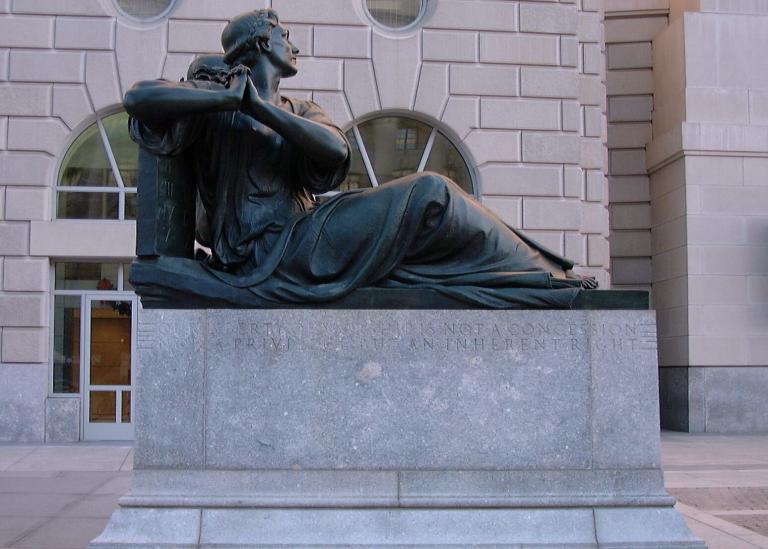
Oscar Straus Memorial in Washington, DC, honoring the right to worship (Photo credit: David Ball, Creative Commons)
Doug Indeap is, I think, a lawyer. (Or is his real name David Ivester? [1] See here, where the picture identifies him as “David Ivester,” but where he’s addressed at the bottom of the page as “Mr. Indeap.” [2] See here, where both names appear throughout the combox. [3] See, finally, my own earlier post here, where the same pic that identifies him as “David Ivester” on the first link identifies him as “Doug Indeap” in my own combox.)
Be all that as it may, if you go to the search engines and look for “Doug Indeap,” you might have a hard time figuring out where or what his practice is. I don’t doubt that he has one. (David Ivester is an environmental, not a Constitutional, lawyer.) But if the pages and pages of returns from Google are any indication, his alter ego Doug Indeap spends a profuse volume of time trolling Catholic and conservative blogs and using the comboxes to instruct us all in his own firm belief in statism and, in particular, a squeezingly cramped and claustrophobic interpretation of first amendment religious freedom. His view of religious freedom can be summed up simply: Of course you have religious freedom. Except when the state says you don’t. As an indication of how remarkably prolific his combox trolling has been, I present—for the wonder and stupefaction of readers—a (partial) list of all the blogs on which Mr. Indeap has made known his elevated views, his existence, and his possibly fictitious name.
The Archdiocese of Washington.
Stand Up for Religious Freedom.
Return to Rome, Frank Beckwith’s blog on Patheos.
Bernard Goldberg.com, in an article by Burt Prelutsky.
The People’s Guide to the US Constitution.
The National Organization for Marriage.
I could have expanded this list over several volumes of printed text until I had a veritable Encyclopedia Brittanica of trolling. You will find pages and pages of these hits, if you but do a Google search for Mr. Indeap’s name. Prepare to be astonied.
My point in all this is not to prove Mr. Indeap’s prolixity, or to expose his weird doppleganger tendencies, or to revisit the discussions about religious freedom that have already occurred on other blogs, but instead to address the statist assumptions he gave vent to, this past weekend, in my own combox, on this post. The post had to do with the firing of Catholic school gym teacher Carla Hale by the Diocese of Columbus, Ohio, after the bishop learned she was living in a “spousal relationship” with another woman. In particular, I wrote the article to defend Bishop Campbell against the threat of a lawsuit for violating anti-discrimination laws. My argument was, and is, that the state can make any such law it feels necessary—with respect to secular institutions. But it is overstepping its first amendment limits if it believes it may apply those laws to religious institutions whose moral views happen to conflict with a secular state.
ii. The backwards thinking of mr. indeap
On this point, Mr. Indeap felt it necessary to instruct me on a particular legal theory of the first amendment.
Confronted by questions about the government requiring or prohibiting something that conflicts with someone’s faith, the courts have generally ruled that under the Constitution the government cannot enact laws specifically aimed at a particular religion … but can enact laws generally applicable to everyone.


The logic, if such there be, seems to be to cramp first amendment protection to the mere assurance that a particular religion is not targeted by laws that apply only to itself. In other words, the state can not force the Catholic Church to pay for birth control unless it forces everyone else to as well. Then, all bets are off. But that would reduce religious freedom to the level of meaninglessness. Presumably the state could prohibit church attendance if it prohibited it to all religions equally—just as long as it doesn’t prohibit only Catholics, or only Baptists, from going to church.
Lying at the back of this seemingly careful—-if I may say so, lawyerly—distinction is a desire to give religious freedom as narrow and negative a construction as possible. In the Founders’ view, religion is a positive value to the health of a free people, and the point of the First Amendment is to give religion latitude and limit the state. In the new, statist view, religion is a nuisance to be swatted at, and the point of the First Amendment is merely to keep the swatters inside the foul lines. Religion, not the state, is limited; a religion is protected only from being specifically targeted. Thus is religion co-opted by “law” into a statist, secular culture, and has no defense against a government that is hostile, not to some particular religion, but to all religion. It has no defense against a government that wants to make the whole of society secular, that wants to secularize all religions equally. In that sort of statist world, by Mr. Indeap’s own admission, “conscientious objectors” are not to be tolerated.
Mr. Indeap continues.
Ultimately, the government must be able to enforce the law, and it cannot always conform every law to the myriad and sometimes conflicting religious beliefs of everyone. Otherwise, if each of us could opt out of this or that law with the excuse that our religion requires or allows it, the government and the rule of law could hardly operate*.*
Note once more that the state is made the arbiter of the highest good, and the oppositions of religion are described as an “excuse.” The assumption lying behind this idea is that the “law” is a reflection, not of any particular moral good, but rather of whatever the state wants to do. The government exists to “enforce” the law (i.e., its own will), and the highest objective is the “operation” of the will of the state. Church folk are an inconvenience; they hinder to the smooth operation of the state’s will. In the first paragraph of his second comment, Mr. Indeap admits as much.
I understand and heartily agree [Lip service.] that the First Amendment guarantees individual freedom to exercise one’s religion. My point [Here comes the qualification; watch.] is that that freedom (like most) is not absolute. The law limits it.
Mr. Indeap, you have it backward. The purpose of the law is not to limit the First Amendment; rather, the purpose of the First Amendment is to limit the law. But I hope the reader has noticed, throughout this discussion, how Mr. Indeap has been discussing religious freedom, not in the context of the First Amendment, but rather in the context of case law. He doesn’t say, “The First Amendment says”; or, “the Founding Fathers intended”; but rather, “the courts have ruled,” or “the law has said.” One of the reasons the First Amendment exists (and it is not the only reason, but it is one of the greatest) is because of the limiting tendency the existence of a religious people puts upon the state. Religion is one of the greatest checks to an out-of-control, secular state. Religion is a guarantor of freedom, because its ultimate end is the Good, rather than power for its own sake. When religion is limited, the power of the state necessarily becomes absolute. Mr. Indeap seems to like that idea, but the Founding Fathers hated it. It is not the purpose of the state to limit religion; it is the purpose of religion to limit the state.
iii. mr. indeap waves his arms
Mr. Indeap goes on in his second comment to discuss the HHS mandate. (Though what the HHS mandate has to do with the situation in Columbus, I leave it to him to explain.) He has a particularly egregious condescension toward its opponents.
Notwithstanding the arm waving about religious liberty, the health care law does not force employers to act contrary to their consciences.
[Oh. So the mandate is not mandatory. Got that? Good. I am glad you do; for I sure don’t; though I have tried hard to find out.]
Under the law, employers have the option of not providing health plans and simply paying assessments to the government.
[Oh. Well, that does explain it! What a great lover of religious liberty is our Lord Caesar Obama! He graciously allows religious employers the freedom to choose between acting contrary to their consciences and going broke. He’s a real Wilberforce.]
Unless one supposes that the employers’ religion forbids payment of money to government [See how the issue is being manipulated here?] the law does not compel them to act contrary to their beliefs.
Some nonetheless have continued complaining … but [this is] a gripe common to many taxpayers—who don’t much like paying taxes and who object to this or that action the government may take with the benefit of “their” tax dollars.
[Love the insidious use of scare quotes! The prolix Mr. Indeap doesn’t really believe that the fruits of my labor belong to me; instead, they belong to the state, and the only question is how much of those fruits the government permits me, in its vast charity, to retain.]
In any event,those complaining made enough of a stink that the government relented. [Untrue. That was a ruse.]
… Nonetheless, some continue to complain, fretting that somehow services they dislike will get paid for and somehow they will be complicit in that. They evidently believe that when they spend a dollar and it thus becomes the property of others, they nonetheless should have some say in how others later spend that dollar.
(A parenthetical note here. The first paragraph of the above diatribe is a favorite of Mr. Indeap’s, judging by how often he has used it, in one form or another, in his extensive combox activities. You’ll find the same paragraph, nearly word-for-word, on all of these blogs, too.
The Progressive Catholic Voice.
Heartland News. (as “David Ivester”!)
Stand Up for Religious Freedom.
The National Catholic Register.
Political Ravings of a Madman.
Again, this is a charitably partial list.)
iv. the stink that mr. indeap makes
But to return. Other sites—such as Crisis Magazine in the link above—have done a fine job in pointing out how the HHS “compromise” was a ruse, and I’m not going to add to what others have already said. What I want to point out here are two things, apart from Mr. Doug “Doppleganger” Indeap’s habitual cut-and-paste plagiarism of himself in comboxes all across the vast and various fruited plain. The first is the visceral condescension toward Catholics and other opponents of the HHS mandate. Their objections, in Mr. Indeap’s view—far from being legitimate and grounded in serious conviction about the moral law—amount to nothing more than “arm waving” (his favorite expression), “complaining,” “griping,” “making a stink,” and “fretting.” That sort of attitude is very dangerous toward religious liberty; it looks upon religious people as troublemakers and inconveniences to the smooth machine of state power and state control.
I also want to point out the difference between the “assessments” that religious employers might be forced to pay, and what Mr. Indeap describes as “spending” a dollar. Starbucks supports same-sex “marriage,” which I oppose. From time to time, however—because I like Starbucks—I will buy a cup of coffee there. I do so knowing that the money I pay for the coffee might often go to support causes I am against. But that is very different from the state telling me that I am obligated to pay for the “wedding” of a same-sex couple, and that I am certainly free to opt out if I choose, but I would have to pay a fine. In the former case, I am spending my own money out of my own liberty. In the latter, I am having my money confiscated from me by force. In such a way does the state try to persecute and control the religious—by threatening to tax or fine their businesses out of existence, and thus ruin their very livelihoods.
It has happened before. It was how the state of England persecuted Catholics during the Recusancy.
The bottom line in all of this, however, is that Mr. Indeap does not seem to like the First Amendment very much. He condescends to it, but in the end what he says amounts to what I have stated in the title: Of course you have religious freedom. Except when the state says you don’t. That is the attitude, the philosophy, that we face; and which we must peacefully but firmly oppose.
***
If you like the content on this blog, your generous gift to the author helps to keep it active. I remember all my supporters in my Mass intentions each week.
Previous Post

April 25, 2013
In Defense of Bishop Campbell


Browse Our Archives
Select a Category Abortion About Me Answers for Calvinists Answers to Media Fictions Answers to Objections Anti-Catholicism Apologetics Apostolic Succession Atonement Authority of the Church Baptism Benedictines Biblical Exegesis Blogging Book Reviews Books & Writing &c. Calvin's Institutes Capital Punishment Catholic Church Chastity Christology Church Fathers Church Social Doctrine Confession Contraception Conversion Stories Crusades Debates Depression & Suicide Deuterocanon Development of Doctrine Ecumenism English Language Eucharistic Adoration Exorcism Extra Ecclesiam Fisks & Rebuttals Freedom of Religion Freedom of Speech Fundamentalism Gender Politics Gender Theory Good Works Homosexuality Humor Idolatry Immaculate Conception In the News Inquisition ISIS Islam Just for Fun Just War Justification LCWR Limbo Liturgical Abuse Liturgical Year Magisterium Marriage and Family Mary Mortal Sin New Evangelization NFP Papacy Papal Documents Papal Infallibility Personal Narrative Politics Pope Francis Pope Francis Derangement Syndrome Population Control Praying to the "Dead" Priesthood Primacy of Peter Protestant Denominations Purgatory Radical Islam Radical Traditionalists Real Presence Right to Conscience RIght to Life Saints Same-Sex "Marriage" Seven Quick Takes Social Justice Social Media Sola Scriptura Spirit of Vatican II SSPX The Eucharist The Mass The Resurrection Traditionalism Vatican II Year of Mercy
Select a Month August 2019 July 2019 June 2019 May 2019 November 2018 October 2018 August 2018 July 2018 June 2018 April 2018 November 2017 October 2017 September 2017 May 2017 April 2017 March 2017 February 2017 November 2016 October 2016 September 2016 August 2016 July 2016 June 2016 May 2016 April 2016 March 2016 February 2016 January 2016 December 2015 November 2015 October 2015 September 2015 July 2015 June 2015 May 2015 April 2015 March 2015 February 2015 January 2015 December 2014 September 2014 August 2014 July 2014 June 2014 May 2014 April 2014 March 2014 February 2014 January 2014 December 2013 November 2013 October 2013 May 2013 April 2013 February 2013 January 2013
Follow Us!
TAKE THE
Religious Wisdom Quiz
What did Paul say was the purpose of the Law?
Select your answer to see how you score.
To lead us to Christ To keep order To separate Israel from the nations To make us righteous
Related posts from To Give a Defense

Gendering God to Suit an Agenda: A Response...

LGBT Groups Lament Pope's "Dangerous Ignorance" on Gender...

Still Say The Orlando Shooting Was About Radical...
Frank Bruni, of New York Times, Hectors Christians:...
TRENDING AT PATHEOS Catholic

Rejecting Doom: Christian Hope And Human Action
Christianity is a religion of hope. We are to have hope and...

It’s What Comes From Within Which Matters
One of the most difficult things for us to understand is why...

Why I Choose the Eucharist Over the Sermon
Choose the Eucharist, Not the Sermon What are we supposed to get...

5 Design Elements Found in Spiritually Rooted Homes
Putting Spirituality Into Home Decor Our homes are more than our living...

Credo: A Story of God Told with the...
About 10 years ago, I began to imagine a personal "Credo" that...

The Anatomy of Divine Revelation in Catholic Thought
The claim that God has made Himself known to human beings is...
view all Catholic blogs
Ad-Free & Subscriber Log-In Subscription Support
- About Us
- 2026 Calendar
- Videos
- Podcasts
- Library of World Religions
- Faith In Media Tracker
- Advertise With Us
- Write for Us
- Privacy Policy
- Terms of Service
- Do Not Sell My Data
- Contact Us
- Radiant Digital
- Manage Newsletter Subscriptions
- Unsubscribe From Notifications
- Sitemap
Copyright 2008-2026, Patheos. All rights reserved.
Subscription Support Ad-Free & Subscriber Log-In
Follow Patheos