
BuddhistCatholicContemplativeEvangelicalGeneral ChristianHinduJewishLatter-day SaintMuslimNew VisionsProgressive Christian
Beliefs
- Buddhist
- Catholic
- Contemplative
- Evangelical
- General Christian
- Hindu
- Jewish
- Latter-day Saint
- More Voices
- Muslim
- New Visions
- Pagan
- Progressive Christian
Topics
- Religion News
- Food and Religion
- Sports and Religion
- Religious Art
- Religious Music and Entertainment
- Religious Events
- History and Religion
- Style and Religion
- Politics and Religion
- Women in Religion
- Recreation Outdoors and Religion
- Business Finance and Religion
- Careers Workplace and Religion
- Education and Religion
- Family Parenting and Religion
- Health Fitness and Religion
- Home and Religion
- Relationships and Religion
- Technology and Religion
- Travel and Religion
Columnists
- Buddhist Columnists
- Business Finance and Religion Columnists
- Careers Workplace and Religion Columnists
- Catholic Columnists
- Contemplative Columnists
- Education and Religion Columnists
- Evangelists Columnists
- Family Parenting and Religion Columnists
- General Christian Columnists
- Health Fitness and Religion Columnists
- Hindu Columnists
- History and Religion Columnists
- Home and Religion Columnists
- Jewish Columnists
- More Voices Columnists
- Latter Day Columnists
- Muslim Columnists
- New Visions Columnists
- Nonreligious Columnists
- Pagan Columnists
- Politics and Religion Columnists
- Progressive Columnists
- Recreation Outdoors and Religion Columnists
- Relationships and Religion Columnists
- Religion News Columnists
- Religious Art Columnists
- Religious Events Columnists
- Religious Music and Entertainment Columnists
- Sports and Religion Columnists
- Style and Religion Columnists
- Technology and Religion Columnists
- Travel and Religion Columnists
- Women in Religion Columnists
Resource Library
- 2026 Calendar
- Library of World Religions
- The 100 Most Holy Places on Earth
- Patheos Answers
- Podcasts
- Videos
- Faith Leaders Database
- Anglican Episcopalian
- Bahai
- Baptist
- Buddhism
- Christianity
- Confucianism
- Eastern Orthodoxy
- Hinduism
- Holiness and Pentecostal
- ISKCON
- Islam
- Judaism
- Lutheran
- Methodist
- The Church of Jesus Christ of Latter-day Saints
- New Age
- Paganism
- Presbytarian and Reformed
- Protestantism
- Religion Behind the Scenes
- Roman Catholic
- Scientology
- Shia Islam
- Sikhism
- Sufism
- Sunni Islam
- Taoism
- Zen
- See all religions
Research Tools
 Ad-Free & Subscriber Log-In Subscription Support
Ad-Free & Subscriber Log-In Subscription Support
Follow Patheos 

- Trending:
- Forgiveness
- |
- Marriage
- |
- Consciousness
- |
- Death Penalty
- |
- Election
- |
- Halloween
 To Give a Defense
- Home
- Catholic
- Close Reading the Pope on Martin Luther
Close Reading the Pope on Martin Luther
Last updated on: March 6, 2018 at 11:14 pm by Scott Eric Alt
Close Reading the Pope on Martin Luther 2018-03-06T23:14:37-04:00 Scott Eric Alt
Patheos Explore the world's faith through different perspectives on religion and spirituality! Patheos has the views of the prevalent religions and spiritualities of the world.
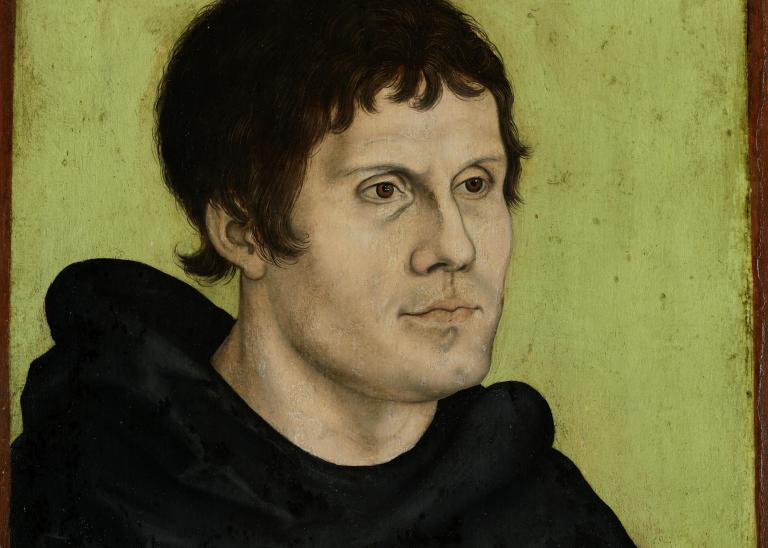
Martin Luther by Lucas Cranach the Elder
Let us do that thing that the blogging Catholic must sometimes do, which is to parse a difficult passage from one of the pope’s innumerable interviews. This, again, was his interview last June as he winged his way back to Rome from Armenia. A reporter said, “Hey! That Martin Luther guy. You can rehabilitate him, right? Perhaps lift his excommunication? What say you?” It was an insane question. Martin Luther’s excommunication ended in 1546 when he died.
Now, I have been told, since my last post: “Well, you know, the pope, he only meant to say Luther was not altogether wrong. Luther was right at first. Especially he was right that justification begins with God’s initiative alone.”
So I go through the pope’s words to see. (And here I mean the pope’s words up in the clouds, somewhere between Armenia and Rome.)
I think that the intentions of Martin Luther were not mistaken. He was a reformer. Perhaps some methods were not correct. But in that time, if we read the story of the Pastor, a German Lutheran who then converted when he saw reality – he became Catholic – in that time, the Church was not exactly a model to imitate. There was corruption in the Church, there was worldliness, attachment to money, to power…and this he protested.
Okay, fair enough. Yes, there’s always corruption somewhere. Men are not angels. I imagine the pope is thinking of things like Luther being troubled by the abuse of indulgences. Indulgences themselves were not wrong, but in the fulness of time indulgences came to be attached to the giving of alms. That’s a good practice. But the rich, having more money to give alms than the poor, were able to obtain more indulgences. There was an inequity in that. Though not the intention, the effect was that the rich could “buy their way into heaven,” as it were. And the Church reformed this practice during the Counter Reformation.
But if this is where Pope Francis is thinking, “Martin Luther was initially right and concerned with the good,” it has nothing to do with the doctrine of justification.
We read on.
Then he was intelligent and took some steps forward justifying, and because he did this. [I have no clue. This is incoherent to me.] And today Lutherans and Catholics, Protestants, all of us agree on the doctrine of justification.
No we don’t. There are no longer any divisions to speak of regarding justification, among Catholics and “Protestants”? Your Holiness: Do you realize how many sects of Protestants there are? One can’t find agreement among Protestants on justification, let alone between Protestants in the aggregate and Catholics.
Now, note: The pope does not qualify these words in the least. He does not say “Catholics and Protestants can find some common ground on justification.” To be sure, we do. But “all of us agree”? The pope does not say, “There is common ground to build on.” He says, “all of us agree.” I don’t think so.
We read on.
On this point [i.e., justification], which is very important, he did not err. [Yes he did.] He made a medicine for the Church, but then this medicine consolidated into a state of things, into a state of a discipline, into a way of believing, into a way of doing, into a liturgical way and he wasn’t alone; there was Zwingli, there was Calvin, each one of them different, and behind them were who?
Again, the pope qualifies nothing when he says that Luther “did not err.” Absolute statement. He does not say, “Luther got some things right”; he says, “Luther did not err.” Well, no: The Council of Trent and Leo X in Exsurge Domine say he did.
And I’m not really sure what the pope is tring to say when he veers back into that long discussion about a “medicine for the church” that “consolidated into a state of things,” “a way of believing,” a “liturgical way.” I mean: Say what? Frankly, I think the pope is free associating, but I can’t discern any meaning.
We read on.
Principals! We must put ourselves in the story of that time. It’s a story that’s not easy to understand, not easy. [The pope’s “not easy to understand” just now.] Then things went forward, and today the dialogue is very good. That document of justification I think is one of the richest ecumenical documents in the world, one in most agreement. But there are divisions, and these also depend on the Churches.
So the pope acknowledges “divisions,” but he seems to have in mind (when we read what is next) ecclesial divisions in Christian communion, not divisions in doctrine.
In Buenos Aires there were two Lutheran churches, and one thought in one way and the other…even in the same Lutheran church there was no unity; but they respected each other, they loved each other, and the difference is perhaps what hurt all of us so badly and today we seek to take up the path of encountering each other after 500 years.
So the pope has shifted ideas again, and is now speaking in very general terms about the problem of Christian division. Again, this is ecclesial division, not doctrinal division, so one can not point to these words and claim that the pope does concede disagreement on justification.
The pope ends with a general injunction that we all pray for one another. That’s a good idea, but it doesn’t take away his two errors: (1) That Catholics and Protestants agree on justification; (2) That Martin Luther was “not in error.”
***
The pope spoke about Luther again on October 31. Here’s the key paragraph:
The spiritual experience of Martin Luther challenges us to remember that apart from God we can do nothing. “How can I get a propitious God?” This is the question that haunted Luther. In effect, the question of a just relationship with God is the decisive question for our lives. As we know, Luther encountered that propitious God in the Good News of Jesus, incarnate, dead and risen. With the concept “by grace alone”, he reminds us that God always takes the initiative, prior to any human response, even as he seeks to awaken that response. The doctrine of justification thus expresses the essence of human existence before God.
Fortunately there are no errors in what the pope says here. But I must point out that the problem with Luther is not “by grace alone” but “through faith alone.” That was the problem. “By grace alone” is not all that Luther said, and if you miss the rest then you miss what made Luther Luther, and a key (false) doctrine that drove the Reformation 500 years ago.
It is true that “God always takes the initiative, prior to any human response,” but why do I need Martin Luther to remind me of this? The Arminians call it “prevenient grace” (I was raised United Methodist and still love that term), but the concept is also in the Bible.
- John 6:44: “No man can come to me, except the Father which hath sent me draw him: and I will raise him up at the last day.
- 1 John 4:19: “We love him, because he first loved us.
It is taught by the Council of Trent. (Not because Trent was conceding anything to Luther, but because it was affirming what the Church had always taught.)
It is furthermore declared that in adults the beginning of that justification must proceed from the predisposing grace of God through Jesus Christ, that is, from His vocation, whereby, without any merits on their part, they are called; that they who by sin had been cut off from God, may be disposed through His quickening and helping grace to convert themselves to their own justification [But now watch what follows.] by freely assenting to and cooperating with that grace; so that, while God touches the heart of man through the illumination of the Holy Ghost, man himself neither does absolutely nothing while receiving that inspiration, since he can also reject it, nor yet is he able by his own free will and without the grace of God to move himself to justice in His sight.
The key thing about Luther is not that he affirmed the first but that he denied the second. Luther taught the bondage of the will, even after initial justification. He taught that it was by faith alone, even after prevenient grace.
Moreover, prevenient grace is taught by Aquinas and by Augustine. So I don’t need Luther to remind me of what I can read in Trent and Augustine and Aquinas. Luther was Luther not because of where he agreed with Catholicism but because of where he disagreed.
I do sympathize with the pope’s desire for Christian unity—I have that same desire. But unity can not come at the expense of truth or of covering over real differences between Catholics and Protestants. While there is much common ground, and while our view of Luther personally should rightly be charitable and forgiving, we can not deny his errors, which Protestants today still accept.
***
Previous Post
April 5, 2017
Pope Francis Is Wrong About Luther and Justification
Next Post
April 6, 2017 About that Syllabus of Errors....Guess What Else Pius IX Condemned?
Browse Our Archives
Select a Category Abortion About Me Answers for Calvinists Answers to Media Fictions Answers to Objections Anti-Catholicism Apologetics Apostolic Succession Atonement Authority of the Church Baptism Benedictines Biblical Exegesis Blogging Book Reviews Books & Writing &c. Calvin's Institutes Capital Punishment Catholic Church Chastity Christology Church Fathers Church Social Doctrine Confession Contraception Conversion Stories Crusades Debates Depression & Suicide Deuterocanon Development of Doctrine Ecumenism English Language Eucharistic Adoration Exorcism Extra Ecclesiam Fisks & Rebuttals Freedom of Religion Freedom of Speech Fundamentalism Gender Politics Gender Theory Good Works Homosexuality Humor Idolatry Immaculate Conception In the News Inquisition ISIS Islam Just for Fun Just War Justification LCWR Limbo Liturgical Abuse Liturgical Year Magisterium Marriage and Family Mary Mortal Sin New Evangelization NFP Papacy Papal Documents Papal Infallibility Personal Narrative Politics Pope Francis Pope Francis Derangement Syndrome Population Control Praying to the "Dead" Priesthood Primacy of Peter Protestant Denominations Purgatory Radical Islam Radical Traditionalists Real Presence Right to Conscience RIght to Life Saints Same-Sex "Marriage" Seven Quick Takes Social Justice Social Media Sola Scriptura Spirit of Vatican II SSPX The Eucharist The Mass The Resurrection Traditionalism Vatican II Year of Mercy
Select a Month August 2019 July 2019 June 2019 May 2019 November 2018 October 2018 August 2018 July 2018 June 2018 April 2018 November 2017 October 2017 September 2017 May 2017 April 2017 March 2017 February 2017 November 2016 October 2016 September 2016 August 2016 July 2016 June 2016 May 2016 April 2016 March 2016 February 2016 January 2016 December 2015 November 2015 October 2015 September 2015 July 2015 June 2015 May 2015 April 2015 March 2015 February 2015 January 2015 December 2014 September 2014 August 2014 July 2014 June 2014 May 2014 April 2014 March 2014 February 2014 January 2014 December 2013 November 2013 October 2013 May 2013 April 2013 February 2013 January 2013
Follow Us!
TAKE THE
Religious Wisdom Quiz
Who was Boaz's mother?
Select your answer to see how you score.
Sarah Rahab Naomi Ruth
Related posts from To Give a Defense

Documentation of Taylor Marshall's attacks on Pope Francis...
Do Catholics think they can save themselves? Part...

Crisis!!! Plays Benedict vs. Francis on Amoris Laetitia
If Pope Francis Resigns, It Will Not Be...
TRENDING AT PATHEOS Catholic

Rejecting Doom: Christian Hope And Human Action
Christianity is a religion of hope. We are to have hope and...

It’s What Comes From Within Which Matters
One of the most difficult things for us to understand is why...

Why I Choose the Eucharist Over the Sermon
Choose the Eucharist, Not the Sermon What are we supposed to get...

5 Design Elements Found in Spiritually Rooted Homes
Putting Spirituality Into Home Decor Our homes are more than our living...

Credo: A Story of God Told with the...
About 10 years ago, I began to imagine a personal "Credo" that...

The Anatomy of Divine Revelation in Catholic Thought
The claim that God has made Himself known to human beings is...
view all Catholic blogs
Ad-Free & Subscriber Log-In Subscription Support
- About Us
- 2026 Calendar
- Videos
- Podcasts
- Library of World Religions
- Faith In Media Tracker
- Advertise With Us
- Write for Us
- Privacy Policy
- Terms of Service
- Do Not Sell My Data
- Contact Us
- Radiant Digital
- Manage Newsletter Subscriptions
- Unsubscribe From Notifications
- Sitemap
Copyright 2008-2026, Patheos. All rights reserved.
Subscription Support Ad-Free & Subscriber Log-In
Follow Patheos