
BuddhistCatholicContemplativeEvangelicalGeneral ChristianHinduJewishLatter-day SaintMuslimNew VisionsProgressive Christian
Beliefs
- Buddhist
- Catholic
- Contemplative
- Evangelical
- General Christian
- Hindu
- Jewish
- Latter-day Saint
- More Voices
- Muslim
- New Visions
- Pagan
- Progressive Christian
Topics
- Religion News
- Food and Religion
- Sports and Religion
- Religious Art
- Religious Music and Entertainment
- Religious Events
- History and Religion
- Style and Religion
- Politics and Religion
- Women in Religion
- Recreation Outdoors and Religion
- Business Finance and Religion
- Careers Workplace and Religion
- Education and Religion
- Family Parenting and Religion
- Health Fitness and Religion
- Home and Religion
- Relationships and Religion
- Technology and Religion
- Travel and Religion
Columnists
- Buddhist Columnists
- Business Finance and Religion Columnists
- Careers Workplace and Religion Columnists
- Catholic Columnists
- Contemplative Columnists
- Education and Religion Columnists
- Evangelists Columnists
- Family Parenting and Religion Columnists
- General Christian Columnists
- Health Fitness and Religion Columnists
- Hindu Columnists
- History and Religion Columnists
- Home and Religion Columnists
- Jewish Columnists
- More Voices Columnists
- Latter Day Columnists
- Muslim Columnists
- New Visions Columnists
- Nonreligious Columnists
- Pagan Columnists
- Politics and Religion Columnists
- Progressive Columnists
- Recreation Outdoors and Religion Columnists
- Relationships and Religion Columnists
- Religion News Columnists
- Religious Art Columnists
- Religious Events Columnists
- Religious Music and Entertainment Columnists
- Sports and Religion Columnists
- Style and Religion Columnists
- Technology and Religion Columnists
- Travel and Religion Columnists
- Women in Religion Columnists
Resource Library
- 2026 Calendar
- Library of World Religions
- The 100 Most Holy Places on Earth
- Patheos Answers
- Podcasts
- Videos
- Faith Leaders Database
- Anglican Episcopalian
- Bahai
- Baptist
- Buddhism
- Christianity
- Confucianism
- Eastern Orthodoxy
- Hinduism
- Holiness and Pentecostal
- ISKCON
- Islam
- Judaism
- Lutheran
- Methodist
- The Church of Jesus Christ of Latter-day Saints
- New Age
- Paganism
- Presbytarian and Reformed
- Protestantism
- Religion Behind the Scenes
- Roman Catholic
- Scientology
- Shia Islam
- Sikhism
- Sufism
- Sunni Islam
- Taoism
- Zen
- See all religions
Research Tools
 Ad-Free & Subscriber Log-In Subscription Support
Ad-Free & Subscriber Log-In Subscription Support
Follow Patheos 

- Trending:
- Forgiveness
- |
- Marriage
- |
- Consciousness
- |
- Death Penalty
- |
- Election
- |
- Halloween
 To Give a Defense
- Home
- Catholic
- Catholics Pray to Dead Saints! Answers to Common Objections I Seriatim.
Catholics Pray to Dead Saints! Answers to Common Objections I Seriatim.
Last updated on: July 8, 2018 at 12:21 pm by Scott Eric Alt
Catholics Pray to Dead Saints! Answers to Common Objections I Seriatim. 2018-07-08T12:21:58-04:00 Scott Eric Alt
Patheos Explore the world's faith through different perspectives on religion and spirituality! Patheos has the views of the prevalent religions and spiritualities of the world.
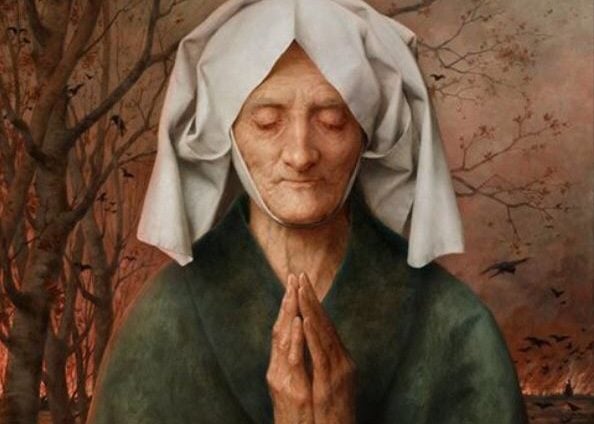
“Old Flanders” by Theophile Lybaert (1915)
So there I was, innocently minding my own business, when someone hands me the following “I love you but let me attack you” piece of anti-Catholicism.
I love you sister and I’m sorry that you think I’m persecuting you because I’m not. I never once judged or condemned you. I was exposing the false church itself and now I will talk about a few reasons why it is blasphemous. [But he’s not “judging” or “condemning.”] I can confidently say that because they go against what God says in the Bible. First thing would be praying to dead saints, this is idolatry since prayer is a form of worship. The definition of prayer is: “a solemn request for help or expression of thanks addressed to God or an object of worship.” Praying to Mary is also idolatry for the same reason.
Second reason is priests somehow being able to forgive us of our sins even though they’re human just like us? Only God can forgive sin.
Another reason is the Catholic doctrine concerning communion. It is supposed to be done purely has a symbol or metaphor of the body and blood of Christ. However in Catholic mass before everyone participates in the communion, the priests conduct a ritual that they call transubstantiation. They believe this ritual/prayer turns the bread and wine into Christ’s literal body and blood which is not true and this is cannabilistic in nature. Yes I know that it’s still bread and wine, but the intention of eating his literal body and blood is there in that person’s heart which makes it sinful in nature. Same idea applies to how Jesus says that even if you look at someone with lust in your heart, it is the same as actually committing the physical act of adultery.
Another reason is His Catholic priests are called “father.” Why is this wrong? Matthew Chapter 23 has the answer: (Matthew 23:8-10) But you, do not be called ‘Rabbi’; for One is your Teacher, the Christ, and you are all brethren. Do not call anyone on earth your father; for One is your Father, He who is in heaven. And do not be called teachers; for One is your Teacher, the Christ.
Another reason is because they baptize infants. In the Bible, water baptism is a conscious act of faith that someone does when they accept Jesus Christ as their savior. An infant is not old enough to have the mental capacity to accept Jesus Christ by their own free will. Also in the Bible, water baptism is always done with the new born again believer being fully submerged under the water (this is a symbol of your death and resurrection through Christ).
The Bible never mentions purgatory ever yet Catholic doctrine teaches there is such a place.
Lastly, the origin of the Catholic church comes from the Roman Emporer Constantine. The empire started to crumble so he tried to unify the pagans and Christians in the empire by his “Christianization” of pagan beliefs which is what gave birth to the Catholic church. Christians who read and knew their Bibles rejected the Catholic church because of these reasons that I have talked about. A famous believer who did this later down the road was Martin Luther.
This person, who is full of love and does not wish to condemn, not at all, no, ended with a warning that you can’t drink from the cup of the Lord and the cup of devils, and linked to the credible source gotquestions.org.
(By the way, is it also your experience that people like the one I quote above do not so much have a discussion as a food-throwing party? What I mean is, they can’t just talk about one question at a time; they throw everything on the table at the wall, all at once, to see what sticks as it were? Or to try to overwhelm you with seventy-five different claims at once? It takes about 300 words to make all these claims, and maybe about 300 pages to clear away all the errors. Just an observation.)
But here are seven to get us started. In spite of the fact that objections like these have been answered to death, in Christianity, the dead rise; and I thought it might be useful to have a single place where they are all taken up again, one per blog article; so that you, dear reader, can post links around the internet when some long-refuted claim comes back to life.
***
So what about this “Catholics pray to dead saints” claim?
Well, the answer really does depend on how you define pray. Our interlocutor—let us call him Mr. Y—does attempt to take up this important point.
The definition of prayer is: “a solemn request for help or expression of thanks addressed to God or an object of worship.”
Right. You can find that wery definition here. The problem is, the definition is incomplete. According to Oxford Dictionaries Dot Com, this is the definition “in U.S. English.” Perhaps Mr. Y thinks that English is only spoken in the United States.
But no. Merriam Webster is more complete. To “pray” also means “to make a request.” Dictionary.com has the same: “to make an ernest petition to a person.” And Cambridge Dictionary defines it: “a forceful way of saying please.”
Even the original source, Oxford Dictionaries, says that the word “pray” derives from the Latin precarius, which means “to make a request.” And you can find this usage of pray—to make a request independent of worship or whom you are addressing—all over the place. You can find it in Shakespeare:
I pray you, in your letters, / When you shall these unlucky deeds relate, / Speak of me as I am. (Othello V.ii.356-358)
I pray you, do not fall in love with me / For I am falser than vows made in wine. (As You Like It III.v.81-82)
Speak the speech, I pray you, as I pronounced it to you, trippingly on the tongue. (Hamlet III.ii.1-2).
And you may multiply these examples with little effort. Indeed, the word “prithee,” also common in Shakespeare, is a contraction of “I pray thee.”
So yes, Catholics do “pray to dead saints.” (Though we would object to describing them as “dead.” That’s another article.) If by pray you mean no more than “make a request,” that’s exactly what we do when we pray to saints. We ask them to obtain something for us.
And of course, what we do obtain in this way comes not from the saints themselves, but from God. It is no different than if I were to ask my mother to pray for me. If God answers this prayer, God answered it, not my mother. I can use all the help I can get, including from an intercessor.
That’s the sense of “praying to saints.” We believe them to be intercessors; we do not believe them to be divine.
So I pray you, stop it with that false charge.
***
This series will continue each Sunday on the blog.
Previous Post

April 24, 2018
Fr. Peter West, You Must Leave Banished by Mark Shea
Browse Our Archives
Select a Category Abortion About Me Answers for Calvinists Answers to Media Fictions Answers to Objections Anti-Catholicism Apologetics Apostolic Succession Atonement Authority of the Church Baptism Benedictines Biblical Exegesis Blogging Book Reviews Books & Writing &c. Calvin's Institutes Capital Punishment Catholic Church Chastity Christology Church Fathers Church Social Doctrine Confession Contraception Conversion Stories Crusades Debates Depression & Suicide Deuterocanon Development of Doctrine Ecumenism English Language Eucharistic Adoration Exorcism Extra Ecclesiam Fisks & Rebuttals Freedom of Religion Freedom of Speech Fundamentalism Gender Politics Gender Theory Good Works Homosexuality Humor Idolatry Immaculate Conception In the News Inquisition ISIS Islam Just for Fun Just War Justification LCWR Limbo Liturgical Abuse Liturgical Year Magisterium Marriage and Family Mary Mortal Sin New Evangelization NFP Papacy Papal Documents Papal Infallibility Personal Narrative Politics Pope Francis Pope Francis Derangement Syndrome Population Control Praying to the "Dead" Priesthood Primacy of Peter Protestant Denominations Purgatory Radical Islam Radical Traditionalists Real Presence Right to Conscience RIght to Life Saints Same-Sex "Marriage" Seven Quick Takes Social Justice Social Media Sola Scriptura Spirit of Vatican II SSPX The Eucharist The Mass The Resurrection Traditionalism Vatican II Year of Mercy
Select a Month August 2019 July 2019 June 2019 May 2019 November 2018 October 2018 August 2018 July 2018 June 2018 April 2018 November 2017 October 2017 September 2017 May 2017 April 2017 March 2017 February 2017 November 2016 October 2016 September 2016 August 2016 July 2016 June 2016 May 2016 April 2016 March 2016 February 2016 January 2016 December 2015 November 2015 October 2015 September 2015 July 2015 June 2015 May 2015 April 2015 March 2015 February 2015 January 2015 December 2014 September 2014 August 2014 July 2014 June 2014 May 2014 April 2014 March 2014 February 2014 January 2014 December 2013 November 2013 October 2013 May 2013 April 2013 February 2013 January 2013
Follow Us!
TAKE THE
Religious Wisdom Quiz
What was Paul’s profession before becoming an apostle?
Select your answer to see how you score.
Fisherman Tax Collector Tentmaker Carpenter
Related posts from To Give a Defense
Infant Baptism is Not in the Bible! Answers...
The Bible Says Call No Man Father! Answers...
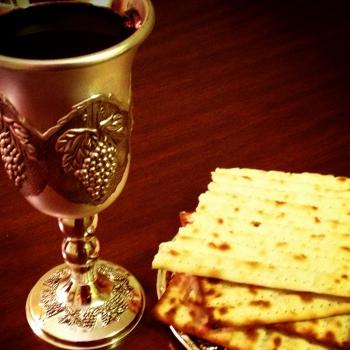
Communion is Only a Symbol! Answers to Common...
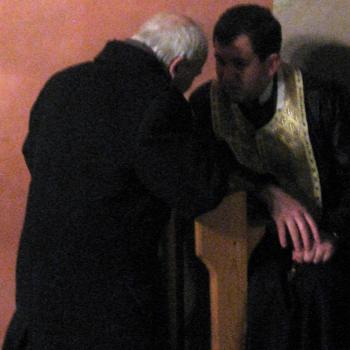
Priests Can't Forgive Sins! Only God! Answers to...
TRENDING AT PATHEOS Catholic

Rejecting Doom: Christian Hope And Human Action
Christianity is a religion of hope. We are to have hope and...

It’s What Comes From Within Which Matters
One of the most difficult things for us to understand is why...

Why I Choose the Eucharist Over the Sermon
Choose the Eucharist, Not the Sermon What are we supposed to get...

5 Design Elements Found in Spiritually Rooted Homes
Putting Spirituality Into Home Decor Our homes are more than our living...

Credo: A Story of God Told with the...
About 10 years ago, I began to imagine a personal "Credo" that...

The Anatomy of Divine Revelation in Catholic Thought
The claim that God has made Himself known to human beings is...
view all Catholic blogs
Ad-Free & Subscriber Log-In Subscription Support
- About Us
- 2026 Calendar
- Videos
- Podcasts
- Library of World Religions
- Faith In Media Tracker
- Advertise With Us
- Write for Us
- Privacy Policy
- Terms of Service
- Do Not Sell My Data
- Contact Us
- Radiant Digital
- Manage Newsletter Subscriptions
- Unsubscribe From Notifications
- Sitemap
Copyright 2008-2026, Patheos. All rights reserved.
Subscription Support Ad-Free & Subscriber Log-In
Follow Patheos