
BuddhistCatholicContemplativeEvangelicalGeneral ChristianHinduJewishLatter-day SaintMuslimNew VisionsProgressive Christian
Beliefs
- Buddhist
- Catholic
- Contemplative
- Evangelical
- General Christian
- Hindu
- Jewish
- Latter-day Saint
- More Voices
- Muslim
- New Visions
- Pagan
- Progressive Christian
Topics
- Religion News
- Food and Religion
- Sports and Religion
- Religious Art
- Religious Music and Entertainment
- Religious Events
- History and Religion
- Style and Religion
- Politics and Religion
- Women in Religion
- Recreation Outdoors and Religion
- Business Finance and Religion
- Careers Workplace and Religion
- Education and Religion
- Family Parenting and Religion
- Health Fitness and Religion
- Home and Religion
- Relationships and Religion
- Technology and Religion
- Travel and Religion
Columnists
- Buddhist Columnists
- Business Finance and Religion Columnists
- Careers Workplace and Religion Columnists
- Catholic Columnists
- Contemplative Columnists
- Education and Religion Columnists
- Evangelists Columnists
- Family Parenting and Religion Columnists
- General Christian Columnists
- Health Fitness and Religion Columnists
- Hindu Columnists
- History and Religion Columnists
- Home and Religion Columnists
- Jewish Columnists
- More Voices Columnists
- Latter Day Columnists
- Muslim Columnists
- New Visions Columnists
- Nonreligious Columnists
- Pagan Columnists
- Politics and Religion Columnists
- Progressive Columnists
- Recreation Outdoors and Religion Columnists
- Relationships and Religion Columnists
- Religion News Columnists
- Religious Art Columnists
- Religious Events Columnists
- Religious Music and Entertainment Columnists
- Sports and Religion Columnists
- Style and Religion Columnists
- Technology and Religion Columnists
- Travel and Religion Columnists
- Women in Religion Columnists
Resource Library
- 2026 Calendar
- Library of World Religions
- The 100 Most Holy Places on Earth
- Patheos Answers
- Podcasts
- Videos
- Faith Leaders Database
- Anglican Episcopalian
- Bahai
- Baptist
- Buddhism
- Christianity
- Confucianism
- Eastern Orthodoxy
- Hinduism
- Holiness and Pentecostal
- ISKCON
- Islam
- Judaism
- Lutheran
- Methodist
- The Church of Jesus Christ of Latter-day Saints
- New Age
- Paganism
- Presbytarian and Reformed
- Protestantism
- Religion Behind the Scenes
- Roman Catholic
- Scientology
- Shia Islam
- Sikhism
- Sufism
- Sunni Islam
- Taoism
- Zen
- See all religions
Research Tools
 Ad-Free & Subscriber Log-In Subscription Support
Ad-Free & Subscriber Log-In Subscription Support
Follow Patheos 

- Trending:
- Forgiveness
- |
- Marriage
- |
- Consciousness
- |
- Death Penalty
- |
- Election
- |
- Halloween
 Science On Religion
- Home
- More Voices
- Religion News
- The Natural History of Music
The Natural History of Music
Last updated on: August 31, 2022 at 4:02 pm by Connor Wood
The Natural History of Music 2022-08-31T16:02:13-04:00 Connor Wood
Patheos Explore the world's faith through different perspectives on religion and spirituality! Patheos has the views of the prevalent religions and spiritualities of the world.
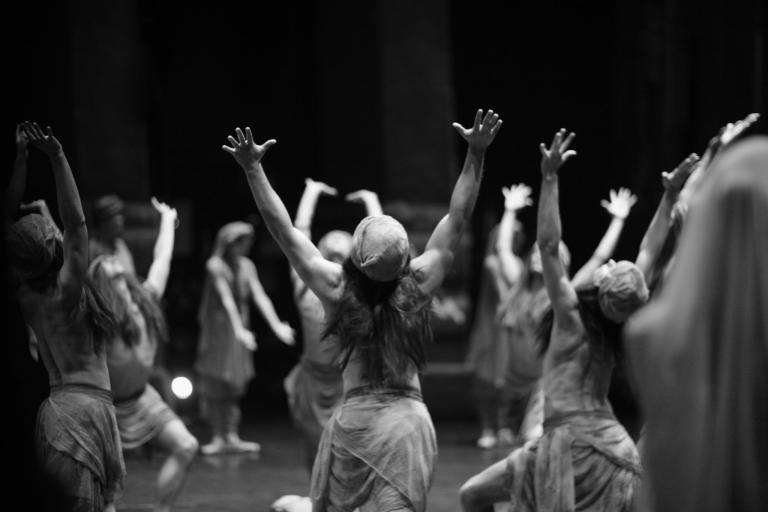 I’m teaching a course on the evolution of music through Scholarium in January and February. Or, more accurately, I’m teaching about the origins of human rhythm — our unique ability to “keep together in time.” Have you ever seen a group of dogs pounding their paws in rhythm on the pavement, jamming out together? No, because they lack the kind of brain you need to be able move your body in time to an audio rhythm. Why would humans have these skills while other animals don’t? The course I’m teaching, “A Natural History of Music,” will drill down into this question using anthropology, cognitive science, neuroscience, comparative biology, and even philosophy. It’s aimed at anyone interested in music, human evolution, cognitive science, or ritual.
Interestingly, most of the other animals who can keep a beat are birds. (Check out some of the excellent YouTube videos of the famous dancing cockatoo Snowball to see more about this.) In many ways, birds’ brains are more functionally similar to human brains than those of our closest evolutionary relatives, the great apes — chimpanzees, bonobos, gorillas, and baboons. For example, many birds mate semi-monogamously and for life.* Humans, like these birds, are largely a pair-bonding species (with some polygamous tendencies). But chimpanzees males attempt to mate with as many of the females in their band as they can, while trying to prevent the other males from doing the same. Exclusive pair-bonding is nonexistent.
And none of the other great apes can dance, at least not rhythmically. Chimpanzees sometimes do what researchers call “rain dances,” wherein they jump up and down and get excited at the approach of rain (or waterfalls), but this jumping isn’t rhythmically entrained. That is, the chimps don’t move in time with each other. Similarly, chimps sometimes occasionally beat on hollow logs, making a resonant, drum-like noise, but these displays rarely make a regular rhythm. Some chimpanzees and other simians can tap their fingers in time with recorded beats, sort of. But they’re not very good at it compared with humans.
The Musical Animal
Humans, on the other hand, start trying to bounce in time with music in early infancy. By the time we’re three or four, we can clap in time to a beat far better than any other great ape.** Unlike chimpanzees or other nonhuman primates, then, we seem to be strongly motivated to partake in music. Neuroimaging studies show strong activation of the brain’s reward centers when we listen to music, while syncronizing with others — clapping or drumming in time to a shared beat — triggers social bonding and cooperation (usually).
Why are birds more humanlike than chimps when it comes to music? Some researchers think the connection may be that both humans and many birds — especially songbirds and the parrot family — are vocal learners. Just as humans don’t come out the womb knowing how to speak English or Mandarin or Basque, songbirds hatch without knowing their species’ unique songs. They have to go through a period of listening to adult birds, imitating and practicing their songs until they master them.
Vocal learning, in turn, requires rich connections between the audio and motor parts of the brain. In vocal learners, the brain’s reward system is also oriented toward social learning and imitation, which may make it easier for individuals to track each other’s actions and — potentially — to entrain to a shared rhythm.
The problem with the vocal-learning hypothesis is that at least one sea lion has been taught to “dance” (vigorously bob her head) to human music. (Extremely entertaining video here.) As far as we know, sea lions aren’t vocal learners. They’re very social and gregarious, but then so are chimpanzees. So Ronan (the name of the dancing sea lion) seems to throw a wrench in the theory of vocal learning as far as explaining why some animals, but not others, can keep a beat.†
Music and Social Structure
One way to better understand where music came from, evolutionarily speaking, is to examine what function music and dancing play in human life. One recent pair of scholarly articles argued, respectively, that either music bonds people or serves as a signal of preexistent bonding. In both cases, music is important for socializing.
This may help explain why, although some birds and other animals can learn to dance, humans everywhere do learn it. Parrots and cockatoos don’t make rhythmic dance music in the wild. Most don’t even seem that interested in music in captivity — only a few, like Snowball, seem driven to “groove.” (Although the number of YouTube videos of dancing parrots is growing.)
By contrast, as we’ve already mentioned, nearly all humans seem to come into the world predisposed to learn to dance and make music. And humans live in large, complicated social groups — even more complicated and multilevel than those of parrots. Unlike parrots, we give our groups names, from the “bear clan” all the way up to “the United Kingdom,” using symbols from unique face painting to national flags to reify those groups (that is, make them seem more real).
It may be that something about über-complex human social groups created an evolutionary need for a new method of social bonding, and music filled that need.
Music and Ritual
In “A Natural History of Music,” we’ll be exploring this relationship between symbols, human sociality, and music, covering the neuroscience behind rhythmic entrainment, and diving into the effects of music on social relationships and the brain. We’ll also look at the role of music in ritual — the “basic human act,” in anthropologist Roy Rappaport’s words. After all, religious and civic rites of all kinds nearly always include music — and sometimes dancing.
Class on Zoom will meet six times: each Wednesday at 6:30pm Boston time, from January 5th through February 9th. Tuition is USD $120.00 for the whole course, which works out to $20.00 per meeting, or about $13.00 per hour of class time. (By comparison, online classes through a name-brand university might run you between $100-$200 per hour, plus fees.)
Classes will feature about an hour of lecture with visuals and a half-hour of group conversation, Q&A, and breakout sessions. Optional readings will help you consolidate and build on your knowledge between meetings.
From my humble point of view, “A Natural History of Music” is a darn good chance to learn about human nature from both scientific and philosophical angles at the same time, right from the mouth of an expert in evolutionary anthropology. Who can also talk philosophy.
Not a bad way to start the new year. Sign up here.
______
*I say “semi-”monogamously because many pair-bonding birds have been known to cheat on each other, like Jersey Shore characters, despite remaining bonded. Nature is full of drama, isn’t it?
** With the exception of many Protestants.
† As I’ve written here before, one similarity between sea lions, birds, and humans is that all three live in more three-dimensional natural environments than chimps do. It may be that auditory signaling is particularly important for animals that need to communicate with each other in three dimensions (back/forward and left/right, as well as up/down), and the resultant brain wiring makes rhythmic entrainment easier. We’ll talk about this in the course. Which, by the way, you can sign up for here.
More Voices
Religious Music & Entertainment
Previous Post

October 15, 2021
Geophysicist Dorian Abbot Loses MIT Lecture Thanks to Twitter Mob
Next Post

December 30, 2021 More Signal, Less Noise
Browse Our Archives
Select a Category Atheism Cognitive Science of Religion Costly investment theory Cultural psychology Editorial Evolution Evolution of Religion Evolution of religion series Evolutionary psychology Ideology and religion Modeling Religion Project Modern culture and religion Most Popular Practice of science Religion and education Religion and ethics Religion and health Religion and perception Religion and prejudice Religious violence Religious ways of thinking Science and religion Scientific study of religion Secularization Spirituality Uncategorized
Select a Month July 2022 February 2022 December 2021 October 2021 August 2021 July 2021 June 2021 May 2021 April 2021 March 2021 February 2021 January 2021 December 2020 November 2020 October 2020 September 2020 August 2020 July 2020 June 2020 May 2020 April 2020 March 2020 February 2020 January 2020 November 2019 October 2019 September 2019 August 2019 July 2019 June 2019 May 2019 April 2019 March 2019 February 2019 January 2019 December 2018 November 2018 October 2018 September 2018 August 2018 July 2018 June 2018 May 2018 April 2018 March 2018 February 2018 January 2018 December 2017 November 2017 October 2017 September 2017 August 2017 July 2017 June 2017 May 2017 April 2017 March 2017 February 2017 January 2017 December 2016 November 2016 September 2016 August 2016 June 2016 April 2016 March 2016 February 2016 January 2016 November 2015 October 2015 September 2015 August 2015 July 2015 June 2015 May 2015 April 2015 March 2015 February 2015 January 2015 December 2014 November 2014 October 2014 September 2014 August 2014 July 2014 June 2014 May 2014 April 2014 March 2014 February 2014 January 2014 December 2013 November 2013 October 2013 September 2013 August 2013 July 2013 June 2013 May 2013 April 2013 March 2013 February 2013 January 2013 December 2012 November 2012 October 2012 September 2012 August 2012 July 2012 June 2012 May 2012 April 2012 March 2012 February 2012
Follow Us!
TAKE THE
Religious Wisdom Quiz
Which mountain did this Abraham's near-sacrifice event occur on?
Select your answer to see how you score.
Mount Ararat Mount Carmel Mount Moriah Mount Sinai
Related posts from Science On Religion

Why Rites of Passage Are Painful


Faith and the Evolutionary Predicament

The Catholic Latin Mass is a Strong Credibility-Enhancing...
TRENDING AT PATHEOS Religion News

Catholic Integralists believe that religious values – specifically Christian ones – should...

Electing A Virtuous President Would Make Immunity Irrelevant
Presidential immunity can bring with it many risks. So how can we...

Why The Olympic Games Are A ‘Civil Religious’...
Sporting events form a vital space where Americans display their 'civil religious...

After more than a decade of news, research updates, and insights on...

Q: Why do Southern Baptists and like-minded Protestants...
THE RELIGION GUY’S ANSWER: Why? Simple. Because they believe that’s what the...

THE QUESTION: Is gambling evil? THE RELIGION GUY’S ANSWER: Analysts anticipate a...
view all Religion News blogs
Ad-Free & Subscriber Log-In Subscription Support
- About Us
- 2026 Calendar
- Videos
- Podcasts
- Library of World Religions
- Faith In Media Tracker
- Advertise With Us
- Write for Us
- Privacy Policy
- Terms of Service
- Do Not Sell My Data
- Contact Us
- Radiant Digital
- Manage Newsletter Subscriptions
- Unsubscribe From Notifications
- Sitemap
Copyright 2008-2026, Patheos. All rights reserved.
Subscription Support Ad-Free & Subscriber Log-In
Follow Patheos