
BuddhistCatholicContemplativeEvangelicalGeneral ChristianHinduJewishLatter-day SaintMuslimNew VisionsProgressive Christian
Beliefs
- Buddhist
- Catholic
- Contemplative
- Evangelical
- General Christian
- Hindu
- Jewish
- Latter-day Saint
- More Voices
- Muslim
- New Visions
- Pagan
- Progressive Christian
Topics
- Religion News
- Food and Religion
- Sports and Religion
- Religious Art
- Religious Music and Entertainment
- Religious Events
- History and Religion
- Style and Religion
- Politics and Religion
- Women in Religion
- Recreation Outdoors and Religion
- Business Finance and Religion
- Careers Workplace and Religion
- Education and Religion
- Family Parenting and Religion
- Health Fitness and Religion
- Home and Religion
- Relationships and Religion
- Technology and Religion
- Travel and Religion
Columnists
- Buddhist Columnists
- Business Finance and Religion Columnists
- Careers Workplace and Religion Columnists
- Catholic Columnists
- Contemplative Columnists
- Education and Religion Columnists
- Evangelists Columnists
- Family Parenting and Religion Columnists
- General Christian Columnists
- Health Fitness and Religion Columnists
- Hindu Columnists
- History and Religion Columnists
- Home and Religion Columnists
- Jewish Columnists
- More Voices Columnists
- Latter Day Columnists
- Muslim Columnists
- New Visions Columnists
- Nonreligious Columnists
- Pagan Columnists
- Politics and Religion Columnists
- Progressive Columnists
- Recreation Outdoors and Religion Columnists
- Relationships and Religion Columnists
- Religion News Columnists
- Religious Art Columnists
- Religious Events Columnists
- Religious Music and Entertainment Columnists
- Sports and Religion Columnists
- Style and Religion Columnists
- Technology and Religion Columnists
- Travel and Religion Columnists
- Women in Religion Columnists
Resource Library
- 2026 Calendar
- Library of World Religions
- The 100 Most Holy Places on Earth
- Patheos Answers
- Podcasts
- Videos
- Faith Leaders Database
- Anglican Episcopalian
- Bahai
- Baptist
- Buddhism
- Christianity
- Confucianism
- Eastern Orthodoxy
- Hinduism
- Holiness and Pentecostal
- ISKCON
- Islam
- Judaism
- Lutheran
- Methodist
- The Church of Jesus Christ of Latter-day Saints
- New Age
- Paganism
- Presbytarian and Reformed
- Protestantism
- Religion Behind the Scenes
- Roman Catholic
- Scientology
- Shia Islam
- Sikhism
- Sufism
- Sunni Islam
- Taoism
- Zen
- See all religions
Research Tools
 Ad-Free & Subscriber Log-In Subscription Support
Ad-Free & Subscriber Log-In Subscription Support
Follow Patheos 

- Trending:
- Forgiveness
- |
- Marriage
- |
- Consciousness
- |
- Death Penalty
- |
- Election
- |
- Halloween
 Science On Religion
- Home
- Religion News
- The Catholic Latin Mass is a Strong Credibility-Enhancing Display
The Catholic Latin Mass is a Strong Credibility-Enhancing Display
Last updated on: July 31, 2021 at 4:54 pm by Connor Wood
The Catholic Latin Mass is a Strong Credibility-Enhancing Display 2021-07-31T16:54:44-04:00 Connor Wood
Patheos Explore the world's faith through different perspectives on religion and spirituality! Patheos has the views of the prevalent religions and spiritualities of the world.
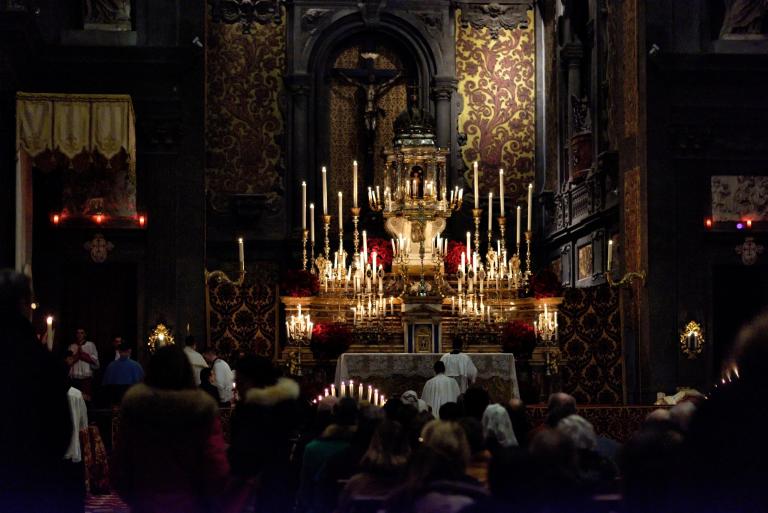 If you inhabit the modern world, you might be forgiven for not understanding ritual. For many moderns, in fact, the very word “ritual” evokes something dark and irrational — secret acts performed in darkness for nefarious ends. (Run a Google image search for “ritual” to see what I mean.) This popular association between ritual and spookiness, including occultism, is almost certainly the product of age-old anti-Catholic prejudices in English-speaking cultures. But even some Catholics get weirded out by ritual: in a surprise move, Pope Francis recently laid heavy new restrictions on the summit of Roman Catholic ritualism, the Tridentine Latin mass. From the viewpoint of cultural evolution, the resulting firestorm of controversy may help illuminate why so many people don’t believe what their churches teach.
It’s a plain fact, after all, that many people ignore the standard doctrines of their religions. Take “Cafeteria Catholics,” who pick some Catholic teachings to believe while rejecting all the others. Officially, the Church teaches transubstantiation, the doctrine that the bread and wine of Communion literally become the real body and blood of Christ during mass. The Church also forbids contraception and expects all members to go to formal confession at least once a year. But in reality, only about one-third of American Catholics believe in transubstantiation. The overwhelming majority — around 90% — accept and use contraception, while only a quarter go to confession annually if at all.
But are today’s cafeteria Catholics really so noteworthy? My colleague Dimitris Xygalatas, an anthropologist at the University of Connecticut, has argued that they’re not, seeing them instead as merely just another illustration of the “religious congruence fallacy:” the questionable expectation that believers’ actions and beliefs match the doctrines of their faiths. For instance, Christian doctrine teaches that God exists outside of time and so can be everywhere at once. But in lab studies, professing Christians can’t help thinking of God as acting sequentially, focusing on one task at a time. Maybe cafeteria Catholicism is just another example of the normal “theological incorrectness” that we find in all religions.
The Midcentury Shift in Faith
However, there’s good reason to think that Catholics weren’t always quite as indifferent to Church teachings as they are today. Remember the old stereotype about big Catholic families? Well, there used to be something to it: in the mid-20th century, Catholic families were on average 20% larger than Protestant families. Not coincidentally, during this era only 30% of Catholics — and only around 22% of those who attended mass regularly — reported using birth control. The difference in size between Catholic and Protestant families suggests that Catholics weren’t lying about their avoidance of contraceptives.
However, obedience to Church teaching started to plummet soon afterward. By 1965, a full 44% of frequent attendees at mass had used birth control, compared with a remarkable 74% of Catholics who attended mass less frequently. By the 1980s, majorities of Catholics rejected belief in transubstantiation as well.
Church attendance by Catholics has followed similar trends. Gallup recently reported that
In 1955, practicing Catholics of all age groups largely complied with their faith’s weekly mass obligation. At that time, roughly three in four Catholics, regardless of their age, said they had attended church in the past week. This began to change in the 1960s, however, as young Catholics became increasingly less likely to attend. The decline accelerated through the 1970s and has since continued at a slower pace.
So what happened in the 1960s? Why did Catholics, who had previously been much more religiously strict than American Protestants, suddenly start selectively ignoring the teachings of their own faith?
This is an interesting question in the analysis of religion, and any good answer is sure to be complex. For one thing, modern life in general makes it difficult to believe in traditional religious beliefs. The sociologist Peter Berger called this process secularization, referring to the growth of many different, competing worldview options, which together gradually undermine the plausibility of any one religious worldview. In secularization, people might retain their old religious identities, without putting much stock in their doctrines or even attending services.
In America, this process has affected Catholicism just as much as other traditions. We might, then, credibly chalk up at least some of cafeteria Catholicism to secularization, plain and simple.
Vatican II as a Catalyst for Change
But significant changes to Catholic liturgy and practices also took place during that same time period. The Second Vatican Council, which concluded in 1965, aimed to improve ecumenical relationships between Roman Catholics and other Christians, while bringing the Church into closer harmony with the modern societies where its churches were lodged.
Among the most significant changes were that mass was no longer celebrated by default in the traditional Latin, but rather in vernacular languages such as English, Spanish, or Tagalog (the lingua franca of the Philippines). Catholic worship often became less ornate, with more focus on readings and sermons, and less on the ritualistic aspects of the service. Priests now faced the people rather than the altar. And the traditional Friday fast — when Catholics worldwide were long accustomed to abstaining from meat — was quietly deemphasized. Instead, many bishops and priests encouraged their flocks to do good works on Friday instead.
After Vatican II, the traditional mass in Latin disappeared from the vast majority of Catholic parishes, though a few idiosyncratic priests and arch-conservatives (who tended to, er, reject the new teachings quite strongly) carried on the old rite semi-licitly. But in 2008, the now-retired Pope Benedict announced a new allowance for priests to perform the old Latin mass. Parishes dedicated to the traditional rite started opening up, and enthusiasts began to gather. Many were no longer the old guard of reactionaries but younger Catholics with families. Adherents — even those weirded out by the conservative insularity of many Latin mass communities — claimed to love the solemnity, beauty, and mysteriousness of the Latin mass. In other words, they loved the ritualism.
Challenging the universal applicability of the religious congruence fallacy, Latin mass adherents are much, much more in line with the official teachings of the Church than other Catholics. In a 2018 survey of more than 1300 Catholic respondents, only 2% of those who attended Latin mass services claimed to approve of contraception, while a full 98% regularly went to confession. This probably wasn’t just empty posturing: the average number of children per woman was nearly 60% higher among Latin mass attendees than among regular mass attendees. Latin mass enthusiasts also overwhelmingly (99%) reported going to mass weekly, compared to only 22% of their counterparts.
Whether or not you agree with their highly conservative views, it seems clear that Latin mass attendees are, objectively, much more closely aligned with official Church teaching than most other Catholics are. Cafeteria Catholics they’re not. Why would this be?
Latin Mass as a Credibility-Enhancing Display
It might not be so surprising that super-ritualistic worship might coincide with firm adherence to official teachings. The anthropologist Joseph Henrich has argued that many religious rituals serve as Credibility-Enhancing Displays (CREDs), which lead people to assign a higher probability to cultural claims that can’t easily be empirically validated. Henrich illustrates this principle with an unusual example: poisonous mushrooms. Let’s say that you’re too young or inexperienced to know which mushrooms are poisonous and which are tasty. If an elder in your tribe claims “these little blue mushrooms are good to eat,” you’d be wise to be skeptical — unless he eats them himself. You only believe him when he puts his money where his mouth is.*
Similarly, rituals can serve to show that performers really believe in the strange claims of their faiths. Take the doctrine of transubstantiation. Behind all the archaic Aristotelian terminology, this doctrine simply proposes the more primary and religiously important idea that God is somehow really “present” in the Eucharist (the consecrated bread and wine) in a condensed, special way. Sure, God is “present” everywhere and in all things, but in some mysterious way he’s particularly present in the Eucharist.
If you really believed this, then you’d probably be inclined to treat Communion with reverence. Conspicuous reverence. By contrast, if you thought that the doctrine of the Real Presence was just a metaphor or a symbolic way of speaking, you might treat the ceremony more lightly. Accordingly, many Protestant denominations put on much less ornate Communion services than Catholics traditionally did, since most Protestant denominations explicitly teach that God is not actually “present” in the bread and wine. Instead, Communion is just a symbolic memorial, not a material incarnation.
But although modern Catholicism still officially teaches the doctrine of the Real Presence, its newer rituals are often reminiscent of Protestantism in form. For example, the modern mass emphasizes the verbal, rational communication of ideas (hence the use of the vernacular) and ethics more, and formalized actions and taboos less, than the old rite typically did. Of course, we’re talking about a spectrum: Catholicism is still, well, Catholic. It’s just not quite as exotic, from a Protestant point of view, as it once was.
However, in some important ways this state of affairs presents a mismatch between what Catholicism explicitly teaches and what its rituals implicitly teach. It’s possible that the weekly mass has become a poor CRED, or a CRUD — “Credibility-Undermining Display” — for the doctrine of transubstantiation. After all, if Catholic priests actually believed that Christ was really, literally present in the bread and wine, wouldn’t they treat the Eucharist like something that was charged, even dangerous? Two generations of Catholics have now grown up attending masses that sometimes seem, in nonverbal ways, to send the message that the Eucharist is just a symbol after all. It’s not surprising that most of them have come to believe what the ritual implies rather than what the doctrine teaches. This is just “actions speak louder than words” applied to religion.
By contrast, Latin mass ceremonies are famously ornate, filled with gravitas, and even nakedly anachronistic. The music is typically Gregorian chant rather than guitar-driven praise music. Thick clouds of incense billow away into the rafters. And the priest makes a big deal of the consecration.
It’s all a bit more compatible, in a CREDs-like way, with the doctrine that God is making an in-person appearance. Participants observing the proceedings may be more likely to implicitly judge that the priest really believes in the Real Presence. And if he does, why shouldn’t they, too? In this way, the Latin mass might just be an exceptionally strong CRED.
Costly Signaling and Selection Effects
At the same time, we can’t ignore selection effects — conservative Catholics might be self-selecting into Latin mass parishes, helping explaining the unique profile of those communities. That is, it might not be that Latin mass is creating more people who believe in official Catholic teachings. Rather, the small minority of Catholics who do believe the teachings might simply be migrating to the Latin mass, creating a doctrinally and ritually unique subcultural space within the broader Church.
But in social phenomena, causation is rarely linear. Things happen in feedback loops. So while it’s undoubtedly true that Catholic traditionalists are more likely than others to start attending the Latin mass, Latin mass parishes are also places where conservative beliefs are normative and expectations are strict. If you didn’t dress conservatively or go to confession regularly, you’d stick out like a sore thumb. If you weren’t already theologically conservative when you started attending, you’d likely either eventually become more conservative or drift back out the door.
In this way, Latin mass parishes are examples of costly signaling in ritual. Barriers to entry are high. Rituals are time-consuming and demanding. As I’ve written here before, costly signaling may explain why more demanding religious groups tend to grow more rapidly than less-strict groups. By ensuring that only the most committed want to join, costly communities maintain a higher average level of investment. Members are therefore more likely to stay within the fold, which offers a high concentration of CREDs — actions taken by others, especially those in authority, that indicate strong belief. The cultural world becomes strongly self-reinforcing.
Anti-Ritualism and Religious Cleansing
The Latin mass crowd is controversial, not least because it attracts some serious cranks. It’s so controversial, in fact, that the Pope himself just made it much harder to celebrate the Latin mass, requiring every priest who wants to say it to get his bishop’s explicit permission, while banning the Latin mass from parish church buildings. Pope Francis is an ardent defender of the Vatican II reforms, and likely sees the growth of the Latin mass’s popularity as a threat to that reforming vision.
Which, of course, it is. The Vatican II reforms were in many ways a quintessential example of anti-ritualism in religion. Anti-ritualism as an ideological theme appears again and again in the history of religions, taking a few reliable forms. It emphasizes the explicit and verbal rather than the implicit and enactive; it prioritizes universal ethics rather than particularistic rules and taboos; it highlights the individual over the communal; and it often expresses hostility to images and icons.
The Protestant Reformation was the paradigmatic example of anti-ritualism in Christianity, but it wasn’t alone in history. In the 8th and 9th centuries, outbreaks of iconoclasm broke out in the Byzantine Empire, leading to the wholesale destruction of Eastern Orthodox icons and statues across the eastern Mediterranean. In India, the advent of Buddhism in the 4th century BCE was an expression of anti-ritualism in reaction to the excesses of Vedic Hinduism. Wahhabism is an exceptionally anti-ritualistic strain of modern Islam. And in our era, Vatican II was the product of an anti-ritualistic strain within Catholicism.
The underlying impulse behind anti-ritualism is one of cleansing. Religious traditions inevitably build up hierarchies, rituals, accretions over time. Reformers come along and try to reduce things back to their basics, re-focusing the tradition on the essential teachings of the faith. Those teachings are necessarily verbal, so the reforming spirit is highly focused on explicit, discursive communication, but suspicious of the context-rich, implicit messaging found in ritual. Breaking up images, as in iconoclasm, aims to free the mind from accrued, unnecessary traditions, re-focusing it instead on immaterial, spiritual principles. (The same impetus also helps explain Protestants’ decision to change Communion from a material incarnation of God into a symbolic — that is, immaterial and spiritual — memorial.)
But ritual is also often the best tool for sending clear messages about extra-empirical claims, for showing others than one really believes in them. CREDs require actions, not words. Ergo, no religion can do without ritual in the long run.
In the meanwhile, the strange saga of the Latin mass adds a new layer of complexity to the religious congruence fallacy. It’s true that many, probably most, religious believers don’t believe or act the way their traditions officially tell them to. But there are some contexts — high-CRED contexts, we’ll call them — where this rule seems muted, even disconfirmed. Regardless how out-of-touch the beliefs of people in high-CRED contexts might seem, paying close attention to them offers crucial insight into how religion and culture work across time.
_______
*Incidentally, nearly this exact scenario just happened to me. The recent drought in California apparently being due to Massachusetts hogging all the rain in North America, lots of mushrooms have sprung up around my neighborhood. Last week, my next-door neighbor walked up and enthusiastically offered me a vibrantly colored, foraged wild mushroom called “chicken of the woods.” Seeing that he had eaten a hefty serving of it the day before and was still walking around looking hearty, I took him at his word that it was safe, and sautéd up the fungus with butter. It tasted great. So far, I have not died. Let’s hear it for CREDs!
credibility-enhancing displays
Previous Post

June 14, 2021
Music and Dance in Human Evolution
Next Post
August 31, 2021 Faith and the Evolutionary Predicament
Browse Our Archives
Select a Category Atheism Cognitive Science of Religion Costly investment theory Cultural psychology Editorial Evolution Evolution of Religion Evolution of religion series Evolutionary psychology Ideology and religion Modeling Religion Project Modern culture and religion Most Popular Practice of science Religion and education Religion and ethics Religion and health Religion and perception Religion and prejudice Religious violence Religious ways of thinking Science and religion Scientific study of religion Secularization Spirituality Uncategorized
Select a Month July 2022 February 2022 December 2021 October 2021 August 2021 July 2021 June 2021 May 2021 April 2021 March 2021 February 2021 January 2021 December 2020 November 2020 October 2020 September 2020 August 2020 July 2020 June 2020 May 2020 April 2020 March 2020 February 2020 January 2020 November 2019 October 2019 September 2019 August 2019 July 2019 June 2019 May 2019 April 2019 March 2019 February 2019 January 2019 December 2018 November 2018 October 2018 September 2018 August 2018 July 2018 June 2018 May 2018 April 2018 March 2018 February 2018 January 2018 December 2017 November 2017 October 2017 September 2017 August 2017 July 2017 June 2017 May 2017 April 2017 March 2017 February 2017 January 2017 December 2016 November 2016 September 2016 August 2016 June 2016 April 2016 March 2016 February 2016 January 2016 November 2015 October 2015 September 2015 August 2015 July 2015 June 2015 May 2015 April 2015 March 2015 February 2015 January 2015 December 2014 November 2014 October 2014 September 2014 August 2014 July 2014 June 2014 May 2014 April 2014 March 2014 February 2014 January 2014 December 2013 November 2013 October 2013 September 2013 August 2013 July 2013 June 2013 May 2013 April 2013 March 2013 February 2013 January 2013 December 2012 November 2012 October 2012 September 2012 August 2012 July 2012 June 2012 May 2012 April 2012 March 2012 February 2012
Follow Us!
TAKE THE
Religious Wisdom Quiz
In Philippians, Paul says to work out your salvation with what?
Select your answer to see how you score.
Fear and trembling Joy and thanksgiving Faith and obedience Prayer and fasting
Related posts from Science On Religion

Why Rites of Passage Are Painful



TRENDING AT PATHEOS Religion News

Catholic Integralists believe that religious values – specifically Christian ones – should...

Electing A Virtuous President Would Make Immunity Irrelevant
Presidential immunity can bring with it many risks. So how can we...

Why The Olympic Games Are A ‘Civil Religious’...
Sporting events form a vital space where Americans display their 'civil religious...

After more than a decade of news, research updates, and insights on...

Q: Why do Southern Baptists and like-minded Protestants...
THE RELIGION GUY’S ANSWER: Why? Simple. Because they believe that’s what the...

THE QUESTION: Is gambling evil? THE RELIGION GUY’S ANSWER: Analysts anticipate a...
view all Religion News blogs
Ad-Free & Subscriber Log-In Subscription Support
- About Us
- 2026 Calendar
- Videos
- Podcasts
- Library of World Religions
- Faith In Media Tracker
- Advertise With Us
- Write for Us
- Privacy Policy
- Terms of Service
- Do Not Sell My Data
- Contact Us
- Radiant Digital
- Manage Newsletter Subscriptions
- Unsubscribe From Notifications
- Sitemap
Copyright 2008-2026, Patheos. All rights reserved.
Subscription Support Ad-Free & Subscriber Log-In
Follow Patheos