
BuddhistCatholicContemplativeEvangelicalGeneral ChristianHinduJewishLatter-day SaintMuslimNew VisionsProgressive Christian
Beliefs
- Buddhist
- Catholic
- Contemplative
- Evangelical
- General Christian
- Hindu
- Jewish
- Latter-day Saint
- More Voices
- Muslim
- New Visions
- Pagan
- Progressive Christian
Topics
- Religion News
- Food and Religion
- Sports and Religion
- Religious Art
- Religious Music and Entertainment
- Religious Events
- History and Religion
- Style and Religion
- Politics and Religion
- Women in Religion
- Recreation Outdoors and Religion
- Business Finance and Religion
- Careers Workplace and Religion
- Education and Religion
- Family Parenting and Religion
- Health Fitness and Religion
- Home and Religion
- Relationships and Religion
- Technology and Religion
- Travel and Religion
Columnists
- Buddhist Columnists
- Business Finance and Religion Columnists
- Careers Workplace and Religion Columnists
- Catholic Columnists
- Contemplative Columnists
- Education and Religion Columnists
- Evangelists Columnists
- Family Parenting and Religion Columnists
- General Christian Columnists
- Health Fitness and Religion Columnists
- Hindu Columnists
- History and Religion Columnists
- Home and Religion Columnists
- Jewish Columnists
- More Voices Columnists
- Latter Day Columnists
- Muslim Columnists
- New Visions Columnists
- Nonreligious Columnists
- Pagan Columnists
- Politics and Religion Columnists
- Progressive Columnists
- Recreation Outdoors and Religion Columnists
- Relationships and Religion Columnists
- Religion News Columnists
- Religious Art Columnists
- Religious Events Columnists
- Religious Music and Entertainment Columnists
- Sports and Religion Columnists
- Style and Religion Columnists
- Technology and Religion Columnists
- Travel and Religion Columnists
- Women in Religion Columnists
Resource Library
- 2026 Calendar
- Library of World Religions
- The 100 Most Holy Places on Earth
- Patheos Answers
- Podcasts
- Videos
- Faith Leaders Database
- Anglican Episcopalian
- Bahai
- Baptist
- Buddhism
- Christianity
- Confucianism
- Eastern Orthodoxy
- Hinduism
- Holiness and Pentecostal
- ISKCON
- Islam
- Judaism
- Lutheran
- Methodist
- The Church of Jesus Christ of Latter-day Saints
- New Age
- Paganism
- Presbytarian and Reformed
- Protestantism
- Religion Behind the Scenes
- Roman Catholic
- Scientology
- Shia Islam
- Sikhism
- Sufism
- Sunni Islam
- Taoism
- Zen
- See all religions
Research Tools
 Ad-Free & Subscriber Log-In Subscription Support
Ad-Free & Subscriber Log-In Subscription Support
Follow Patheos 

- Trending:
- Forgiveness
- |
- Marriage
- |
- Consciousness
- |
- Death Penalty
- |
- Election
- |
- Halloween
 Science On Religion
- Home
- Religion News
- The Coronavirus Outbreak Shows the Dangers of Social Hypercoherence
The Coronavirus Outbreak Shows the Dangers of Social Hypercoherence
Last updated on: March 10, 2020 at 5:04 pm by Connor Wood
The Coronavirus Outbreak Shows the Dangers of Social Hypercoherence 2020-03-10T17:04:50-04:00 Connor Wood
Patheos Explore the world's faith through different perspectives on religion and spirituality! Patheos has the views of the prevalent religions and spiritualities of the world.
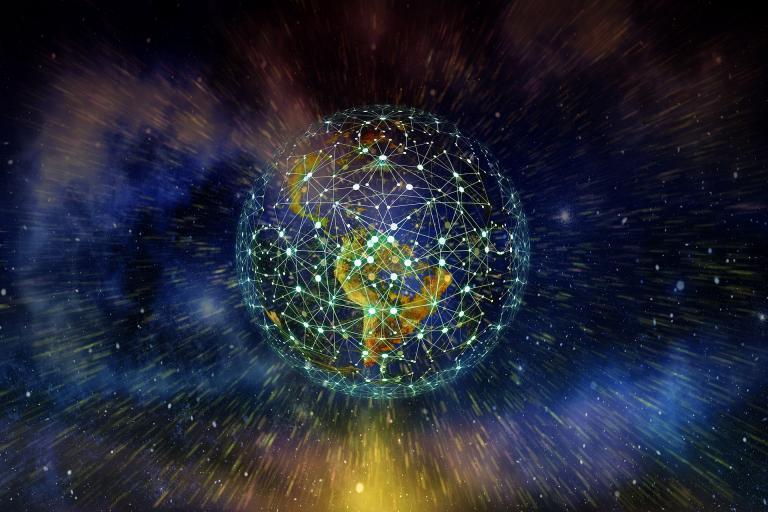 Globalization: it may be a 2000s buzzword, but it’s brought the world many benefits. Our consumer goods are cheaper than ever before. Surging industrialization has lifted billions worldwide out of grinding poverty. For a while, you could even get Starbucks in the very heart of Beijing’s Forbidden City (if that’s what you were into). But the last few years have also taught us that globalization isn’t an unalloyed good. One unique danger it poses is hypercoherence, or maladaptive syncing between independent parts of a complex system. With the rapid spread of the COVID-19 coronavirus around the world – and its risks for the global economy – we’re seeing firsthand some of the dangers of social hypercoherence.
Before mid-2015, it might have seemed that a fully connected and integrated world system was the ultimate safe bet. For well-to-do people living in hubs like Boston, London, or San Francisco, the world economy was humming, trade was prospering, and exotic destinations (Bali, anyone?) were only a quick flight away. A few quick taps on a delivery app could produce mouth-watering cuisines from just about any culinary region in the world on your doorstep in minutes. What wasn’t to love?
The first big threat to this cozily connected, cosmopolitan global culture came from populism, both of the left-wing and the right-wing varieties. In particular, with the stunning “Leave” vote during the UK’s Brexit referendum and the election of Donald Trump – Donald Trump! – to the presidency of the US, the structural integrity of the hyperconnected global system looked newly precarious. Borders started going up where previously they’d been coming down. Tariffs were adding friction to international trade, and resistance to mass immigration seemed to squirm out of the woodwork. We were going backwards, not forwards (if you were the sort of person who saw globalization as the inevitable future).
Globalizers have been fighting this battle ever since, hoping to beat back the tide of nationalism and protectionism so they can get back to the business of knitting the world ever closer together. They saw the populists voters’ disdain for global hyperconnection as a problem of external resistance, not a problem internal to globalization itself. But now, the appearance of a potential pandemic – facilitated by fast and easy travel – is revealing intrinsic problems within the process of globalization itself, in at least two ways.
Intrinsic Problems with Hypercoherence
First, the coronavirus outbreak is driving home that super-permeable boundaries between countries means more traffic of all kinds – both good and bad. If highly mobile PhDs can move quickly around the world to take tech jobs in Singapore and Silicon Valley at will, then pathogens, weapons, and drugs can skip merrily across borders too. So can other kinds of risk: the remarkable integration of financial systems helped allow the 2008 crisis to metastasize quickly across the globe, throwing the world into a near-catastrophic economic tailspin. Both metaphorically and literally, when one part gets a sniffle, all the other parts get colds.
The second problem is that our globalized economy is optimized for extreme efficiency. That sounds like a good thing, right? Nobody likes inefficiency. The very word conjures up unpleasant images of grimy Soviet citizens waiting for hours in lines to get forms signed at sclerotic bureaucracies. But in complex systems, more efficiency often means less resilience.
Take the globalized trade networks of the 21st century, where long, just-in-time supply chains allow companies to near-precisely sync their manufacturing orders with consumer demand. This “lean” model of manufacturing helps companies reduce warehouse storage costs, minimize unsold merchandise, and – theoretically – pivot nimbly in response to market conditions. But this just-in-time strategy also means there’s little margin for error. If one factory or one shipping route gets knocked offline, the whole thing goes kaput – and there’s often precious little stored-up inventory to cushion the blow.
In a the hyper-efficient globalized economy, manufacturing, farming, and production get very specialized, too. Farms in California’s Central Valley produce 80% of the world’s entire almond supply. Global corporations such as Sony often rely on factories in a single region for key parts. This geographic specialization helps companies take advantage of economies of scale, exploiting concentrated expertise and skills while minimizing redundancy. But it means that the global economy is riddled with potentially critical failure points.
For example, in 2011, the Fukushima earthquake and resultant tsunami in Japan ruined a small handful factories that manufactured videotape used for television recording. In the kind of dumbfounding oversight that appears in Douglas Adams novels, it turned out that these factories produced nearly all the world’s supply of that kind of tape. The entire television broadcast industry went into a panic. An article from that year in The Nation pointed out that this kind of specialization unmasks the
highly dangerous side of globalization, the flip side of a hyper-efficient global supply chain. When one link in that chain is broken, there is no fallback.…An accident or political problem in any number of countries may deny us not just iPhones but food, medicine or critical machinery.
Coronavirus and Over-Optimization
So, by minimizing redundancy and concentrating manufacturing where and when it’s needed, our tightly coupled, hyper-efficient world economic system delivers more profits for businesses and cheaper goods for consumers. But it’s potentially very fragile, precisely because it’s so tightly integrated and efficient: a single natural disaster or terrorist attack can knock out critical supply chains in ways that reverberate through the entire system.
This year, with the sudden coronavirus outbreak beginning in China, the American health care industry is learning that lesson the hard way. The US is facing a critical shortage of face masks, for example, because most masks are made in Chinese regions shuttered by coronavirus quarantines. The few remaining mask manufacturers in the United States can’t keep up with demand.
These two intrinsic weaknesses in the globalized world system – the permeability of borders to risks and the fragility of super-specialized, far-flung supply chains – illustrate a third, higher-level concern: it’s dangerous to optimize complex systems for narrow conditions.
The world economic system is currently very good at extracting value from every link in the chain of production and delivery. But – to make a controversial claim – its structure and fine-tuning are adapted for a rare and probably temporary situation: the domination of the world system by one extremely powerful nation.
For decades, the United States has subsidized globalization by taking on massive trade deficits and pouring trillions into its navy – by far the world’s most powerful – whose operations help keep trade lanes open, tamp down regional conflicts, and fight international piracy. Having a global policeman is sometimes inconvenient and often galling. But it does keep shipping costs down.
When the US loses its appetite for leading the globalized world system – as Trump’s election showed that it may already be – the favorable conditions that sustain fragile, hypercoherent supply chains may very well be in trouble. We’re talking about a system with intentionally narrow margins, after all. If shipping costs rise a mere 5% or warfare between regional powers puts even a small dent in global demand – to pick just two very likely scenarios in a post-US world order – the system might find itself struggling.
Ecosystem Resilience and Raccoons
Think of it in terms of evolution and ecosystems. Some animals, like raccoons, can eat nearly anything. Thanks to their flexibility, the little bandits can live just about anywhere, in cities or in woods, in warm climates or cold ones. If a disease comes and wipes out one source of food, they can switch to another. This flexibility makes raccoons a “generalist species.”
By contrast, koalas – though much more appealing to wildlife photographers – eat almost nothing but eucalyptus. They’re highly specialized for one particular niche. If something were to happen to the eucalyptus in Oceania, koalas would have no fallback. Bye-bye, koalas.
Fortunately, even the recent wildfires in Australia haven’t seriously threatened the existence of eucalyptus forests, so koalas are hanging on for now. But we are seeing signs of threat to the specialized conditions that sustain the globalized system, which is similarly – if ironically – highly specialized for a single set of conditions.
To take the ecosystem metaphor further, imagine that koalas were somehow a keystone species in the entire global food chain. As soon as the eucalyptus equivalent of Dutch elm disease struck, the world’s indispensable species would die off. Animals of all kinds, all over the world, would start starving.
Fortunately, koalas are not, in fact, a keystone species for the entire world (unlike oceanic planktons). It wouldn’t make much sense to rest the entire world ecosystem on a specialist species that can only thrive within very narrow parameters. Yet this is essentially what globalization is: a humongous system that’s highly adapted for, and dependent on, a unique and fragile set of circumstances.
Resilience in Social Systems
To sum up: social hypercoherence means that goods, people, and capital can flow without much impediment, but it also makes it difficult to sequester risks. And paradoxically, as the global system grows more interconnected and diversely linked overall, its individual components become more and more narrowly specialized. This combination of totalizing interconnection and rigid hyper-specialization heightens the risk of cascading failures throughout the system. Even a moderate disruption to a critical supply chain or region could send the entire globalized economy reeling – as we’re seeing now with factory shutdowns and quarantines in East Asia.
The opposite of fragility in a complex system is resilience. But resilient social systems don’t flatter the sensibilities of economists or efficiency consultants. Redundancy, compartmentalization, and built-in buffers – including even inconvenient lags and delays – help system withstand shocks or perturbations. But redundancy and information lags are, by definition, not efficient. Compartmentalization (tariffs, for example) introduces friction into the system, slowing things down and increasing transaction costs. Yet these inefficiencies also slow the spread of dangers, making risks more manageable.
None of this means that efficiency is bad, or that globalization has been a worthless bust. I, personally, have benefitted enormously from globalization – especially in the form of travel, from international conferences to years living abroad in Germany and Korea. My work benefits from regular, relatively hassle-free contact with collaborators and peer researchers and scholars all over the world. There are many good things about a more interconnected globe. But there’s too much of a good thing.
The coronavirus scare may turn out to be a dodged bullet, or it could still metastasize into a nightmarish pandemic. Either way, it’s exposed weaknesses in the globalized economic system that, we were told, was going to permanently define the 21st century. A tightly coupled, hypercoherent world system, highly optimized for unusual conditions, is inherently fragile. A slightly less efficient, more humble, and more loosely coupled world may be less fun for globetrotting academics or city-dwelling foodies. But it would probably be a lot more robust in the face of dangers – which would make for more total fun over the long haul. Whether we’ll take voluntary steps to create such a world is anybody’s guess. The coronavirus outbreak is just a reminder that the risks are there in any case, waiting for us.
____
Image credit: Gerd Altmann from Pixaby.
Previous Post

February 21, 2020
Will Cognitive Gadgets Replace Evolutionary Psychology?
Next Post

March 21, 2020 Scientific Conflict About the Coronavirus Lockdown
Browse Our Archives
Select a Category Atheism Cognitive Science of Religion Costly investment theory Cultural psychology Editorial Evolution Evolution of Religion Evolution of religion series Evolutionary psychology Ideology and religion Modeling Religion Project Modern culture and religion Most Popular Practice of science Religion and education Religion and ethics Religion and health Religion and perception Religion and prejudice Religious violence Religious ways of thinking Science and religion Scientific study of religion Secularization Spirituality Uncategorized
Select a Month July 2022 February 2022 December 2021 October 2021 August 2021 July 2021 June 2021 May 2021 April 2021 March 2021 February 2021 January 2021 December 2020 November 2020 October 2020 September 2020 August 2020 July 2020 June 2020 May 2020 April 2020 March 2020 February 2020 January 2020 November 2019 October 2019 September 2019 August 2019 July 2019 June 2019 May 2019 April 2019 March 2019 February 2019 January 2019 December 2018 November 2018 October 2018 September 2018 August 2018 July 2018 June 2018 May 2018 April 2018 March 2018 February 2018 January 2018 December 2017 November 2017 October 2017 September 2017 August 2017 July 2017 June 2017 May 2017 April 2017 March 2017 February 2017 January 2017 December 2016 November 2016 September 2016 August 2016 June 2016 April 2016 March 2016 February 2016 January 2016 November 2015 October 2015 September 2015 August 2015 July 2015 June 2015 May 2015 April 2015 March 2015 February 2015 January 2015 December 2014 November 2014 October 2014 September 2014 August 2014 July 2014 June 2014 May 2014 April 2014 March 2014 February 2014 January 2014 December 2013 November 2013 October 2013 September 2013 August 2013 July 2013 June 2013 May 2013 April 2013 March 2013 February 2013 January 2013 December 2012 November 2012 October 2012 September 2012 August 2012 July 2012 June 2012 May 2012 April 2012 March 2012 February 2012
Follow Us!
TAKE THE
Religious Wisdom Quiz
I am a ladder reaching to heaven with angels ascending and descending. What am I?
Select your answer to see how you score.
Jacob's ladder Heaven's gate A vision The way to God
Related posts from Science On Religion




Geophysicist Dorian Abbot Loses MIT Lecture Thanks to...
TRENDING AT PATHEOS Religion News

Catholic Integralists believe that religious values – specifically Christian ones – should...

Electing A Virtuous President Would Make Immunity Irrelevant
Presidential immunity can bring with it many risks. So how can we...

Why The Olympic Games Are A ‘Civil Religious’...
Sporting events form a vital space where Americans display their 'civil religious...

After more than a decade of news, research updates, and insights on...

Q: Why do Southern Baptists and like-minded Protestants...
THE RELIGION GUY’S ANSWER: Why? Simple. Because they believe that’s what the...

THE QUESTION: Is gambling evil? THE RELIGION GUY’S ANSWER: Analysts anticipate a...
view all Religion News blogs
Ad-Free & Subscriber Log-In Subscription Support
- About Us
- 2026 Calendar
- Videos
- Podcasts
- Library of World Religions
- Faith In Media Tracker
- Advertise With Us
- Write for Us
- Privacy Policy
- Terms of Service
- Do Not Sell My Data
- Contact Us
- Radiant Digital
- Manage Newsletter Subscriptions
- Unsubscribe From Notifications
- Sitemap
Copyright 2008-2026, Patheos. All rights reserved.
Subscription Support Ad-Free & Subscriber Log-In
Follow Patheos