
BuddhistCatholicContemplativeEvangelicalGeneral ChristianHinduJewishLatter-day SaintMuslimNew VisionsProgressive Christian
Beliefs
- Buddhist
- Catholic
- Contemplative
- Evangelical
- General Christian
- Hindu
- Jewish
- Latter-day Saint
- More Voices
- Muslim
- New Visions
- Pagan
- Progressive Christian
Topics
- Religion News
- Food and Religion
- Sports and Religion
- Religious Art
- Religious Music and Entertainment
- Religious Events
- History and Religion
- Style and Religion
- Politics and Religion
- Women in Religion
- Recreation Outdoors and Religion
- Business Finance and Religion
- Careers Workplace and Religion
- Education and Religion
- Family Parenting and Religion
- Health Fitness and Religion
- Home and Religion
- Relationships and Religion
- Technology and Religion
- Travel and Religion
Columnists
- Buddhist Columnists
- Business Finance and Religion Columnists
- Careers Workplace and Religion Columnists
- Catholic Columnists
- Contemplative Columnists
- Education and Religion Columnists
- Evangelists Columnists
- Family Parenting and Religion Columnists
- General Christian Columnists
- Health Fitness and Religion Columnists
- Hindu Columnists
- History and Religion Columnists
- Home and Religion Columnists
- Jewish Columnists
- More Voices Columnists
- Latter Day Columnists
- Muslim Columnists
- New Visions Columnists
- Nonreligious Columnists
- Pagan Columnists
- Politics and Religion Columnists
- Progressive Columnists
- Recreation Outdoors and Religion Columnists
- Relationships and Religion Columnists
- Religion News Columnists
- Religious Art Columnists
- Religious Events Columnists
- Religious Music and Entertainment Columnists
- Sports and Religion Columnists
- Style and Religion Columnists
- Technology and Religion Columnists
- Travel and Religion Columnists
- Women in Religion Columnists
Resource Library
- 2026 Calendar
- Library of World Religions
- The 100 Most Holy Places on Earth
- Patheos Answers
- Podcasts
- Videos
- Faith Leaders Database
- Anglican Episcopalian
- Bahai
- Baptist
- Buddhism
- Christianity
- Confucianism
- Eastern Orthodoxy
- Hinduism
- Holiness and Pentecostal
- ISKCON
- Islam
- Judaism
- Lutheran
- Methodist
- The Church of Jesus Christ of Latter-day Saints
- New Age
- Paganism
- Presbytarian and Reformed
- Protestantism
- Religion Behind the Scenes
- Roman Catholic
- Scientology
- Shia Islam
- Sikhism
- Sufism
- Sunni Islam
- Taoism
- Zen
- See all religions
Research Tools
 Ad-Free & Subscriber Log-In Subscription Support
Ad-Free & Subscriber Log-In Subscription Support
Follow Patheos 

- Trending:
- Forgiveness
- |
- Marriage
- |
- Consciousness
- |
- Death Penalty
- |
- Election
- |
- Halloween
 Science On Religion
- Home
- Religion News
- Is Ritual a Tool for Resilience?
Is Ritual a Tool for Resilience?
Last updated on: May 10, 2019 at 12:20 pm by Connor Wood
Is Ritual a Tool for Resilience? 2019-05-10T12:20:45-04:00 Connor Wood
Patheos Explore the world's faith through different perspectives on religion and spirituality! Patheos has the views of the prevalent religions and spiritualities of the world.
 I’m an alumnus at Sinai and Synapses, a New York-based organization that brings together scholars and religious professionals to study problems related to religion and science. Last week I traveled to New York for an alumni meeting, bringing together current and past fellows for conversation, presentations, and lectures. Our topics of discussion ranged from astrophysics and special relativity to science journalism and education. My own talk and workshop were on a topic I’ve been kicking around for a while: the relationship between religion, ritual, and cultural resilience. Specifically, I explored whether cultural ritual and non-empirical beliefs may be under-appreciated ways of dampening our exploitation of natural resources, by lessening the efficiency of our human economies.
The word “resilience” is used in a lot of different ways. In psychology, it refers to individuals’ ability to respond adaptively to stressors – to bounce back from setbacks, traumas, or negative events. In environmental science, by contrast, the ecologist C.S. Holling famously described resilience in terms of adaptive flexibility in complex natural systems. In my work on religion and cultural resilience, I have in mind something closer to Holling’s view. Instead of focusing on the ability of social systems to “bounce back” and return to previous states, I’m interested in the ways that they change in order to keep persisting.
Resilience vs. Stability
Let me explain. Resilience might sound like a synonym for “stability,” but Holling distinguished the two. For him, highly stable systems were those in which key variables stayed within fairly narrow parameters over time. If the ratio of predators to prey in a certain ecosystem is always 1:5, that ecosystem would be stable. A resilient system, though, probably isn’t always a stable one. Rather, resilient systems can exhibit large changes in quantitative relationships: the ratio between predators and prey is 1:3 one year, while the next it’s 1:15.
These large quantitative shifts in the key system variables actually make the system more robust. Why? They enable it to make nonlinear jumps between different (relatively) stable configurations. Having different potential zones of stability, in turn, makes it possible for the system as a whole to survive a greater variety of shocks and stressors. Paraphrasing the pioneering ecologist Lawrence Slobodkin, Holling wrote that
evolution is like a game, but a distinctive one in which the only payoff is to stay in the game. Therefore, a major strategy…is not one maximizing either efficiency or a particular reward, but one which allows persistence by maintaining flexibility above all else…The more homogeneous the environment in space and time, the more likely is the system to have low fluctuations and low resilience.
Efficiency, then, is often the enemy of resilience. A recent article in the Harvard Business Review, entitled “The High Price of Efficiency,” helps illustrate why in economic terms. In our contemporary, 21st-century economy, businesses prize efficiency above nearly all else. Efficiency means low waste and minimal “friction.” It means exploiting economies of scale and reducing regulatory barriers. These phrases probably all sound great to many habitual readers of the Harvard Business Review, but the article’s author, Roger L. Martin, cautions that too much efficiency in business can lead to monopolies and economic monocultures, which are intrinsically vulnerable to shocks:
A superefficient dominant model elevates the risk of catastrophic failure. More than 80% of all almonds are now grown in California – so one extreme local weather event or one pernicious virus could destroy most of the world’s production.
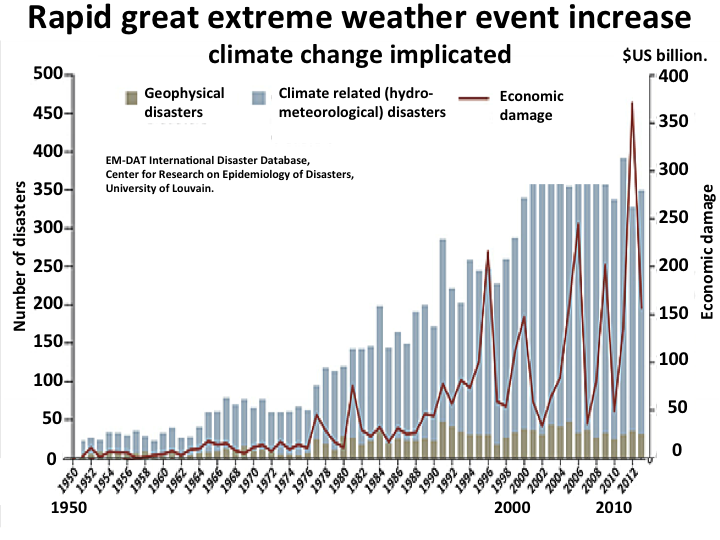
Scary, isn’t it? Especially given that extreme weather events are, uh, not becoming less common these days. Martin goes on:
In our quest to make our systems more efficient, we have driven out all friction. It is as if we have tried to create a perfectly clean room, eradicating all the microbes therein. Things go well until a new microbe enters – wreaking havoc on the now-defenseless inhabitants.
A classic example of an economic monoculture is midcentury Detroit. Here was a very large city – at its peak, the fifth-largest in the U.S. – almost entirely dominated by a single industry, automobile manufacturing. When hard times came for car manufacturers, the entire city suffered. It didn’t have any alternative industries to turn to. There wasn’t much adaptive flexibility in the system. Partially as a result, Detroit’s population cratered, and much of the city is now vacant, weeded lots.* Colloquially, this is the risk of putting all your eggs in one basket.
Friction vs. Efficiency
An antidote to efficiency, according to Martin, is friction. Friction refers to the elements of a system that prevent it from narrowly maximizing only a single variable. It often takes the form of negative feedback loops – forces that dynamically balance different variables against one another, preventing any one of them from straying too far outside set parameters.
In a forest ecosystem, for instance, the population of predators is bounded by the the population of prey. Predators naturally want to eat as much prey as they can, but if they’re too successful at hunting, then the population of prey will dwindle to the point where it can’t support them anymore. Then, the predator population declines in response.
This is friction. The predators want to maximize the amount of fresh meat they eat. But they can’t. The system won’t let them.
Human relationships are rich with sources of friction. For example, if you’re married, you know that you can’t just narrowly focus on one single thing you want from the other person. Whether it’s sex or emotional support or money or whatever, the nature of marriage is such that different interests are balanced in tension against each other. So if you want, say, sex, you can’t just demand sex. You have to stay in touch emotionally. You have to plan date nights. You have to do nice things for one another that seem, on the surface, completely unrelated to sex.
These relational requirements are propped up around the desire for sex, tempering and often putting brakes on its immediate satisfaction. What would happen if those sources of friction weren’t there? Well, the entire relationship might quickly become centered on just that single need, becoming the equivalent of a monoculture. Here, again, the relationship would become massively less resilient. (This is an understatement.)
In a resilient relationship, there are a lot of working parts, goals, and patterns. This variability enables the relationship to change and adjust to different stresses. When one spouse gets sick, sex might take a backseat while other ways of relating – bedside caring, watching comedy shows together, etc. – are temporarily prioritized.
By contrast, a relationship built on one thing only is, by definition, not capable of adjusting to circumstances where that thing isn’t available. It’s all-or-nothing. So if you’re hoping to efficiently maximize a certain core payoff of a relationship – reducing or eliminating any friction that hampers the most direct possible route to getting what you want – you could be setting up the conditions for relational dysfunction or even collapse.
Ritual and Religion: About as Efficient as an Italian Bureaucracy
Psychologists and other social scientists describe ritual as “goal-demoted.” This is a jargony way of saying that it’s often not clear at all, from the outside, what performers of a ritual are actually trying to accomplish. A good example is communion or eucharist among liturgical Christians. It seems to be sort of a meal, but not really. Nobody eats enough to get physically satisfied. The priest carries out all kinds of motions and recites phrases that have no obvious physical effect. What on earth is going on?

Well, among many other things, ritual is a source of friction against efficiently satisfying fundamental priorities. Even a quick and perfunctory ritual like saying grace before a meal puts a kind of behavioral check on the most basic reason for sitting down at the table in the first place: to get the nutrition into our bodies. The ritual seems to actually get in the way of achieving the practical goal at hand.
Similarly, weddings cost a lot of money and demand a lot of emotional and other kinds of investment. For what? To make sex and procreation possible? Well, no, because those things are perfectly physically possible without marriage. Rather, the wedding ritual historically put up an impractical barrier against the speedy (read: efficient) satisfaction of exactly those goals.
So, by demoting practical goals, rituals introduce (apparent) inefficiency and friction into social systems in a particular way. They make it difficult to rush directly to the consummation of discrete appetites or utilitarian goals. They introduce redundancy and complexity into human affairs, which often frustrates our immediate desires but, potentially, may increase the robustness and resilience of our relationships over the long term by preventing domination by single-issue, utilitarian priorities.
Again, look at marriage. If you have a lot of little shared rituals – regular date nights, shared nighttime routines, regular religious attendance – then the fabric of your relationship has certain redundancies and checks built into it. These rituals aren’t efficient. They don’t connect practical means and ends in linear chains. Instead, they ensure that, say, if one aspect of your relationship suffers or is temporarily unavailable, other core processes will continue and can even be ratcheted up to compensate. Your relationship may not be stable, but it’ll be resilient.
Ecology
Let’s zoom out. The story of industrial society is one of increasing efficiency, in terms of maximizing economic outputs and exploiting resources. It’s also a story of decreasing friction and redundancy in the form of fewer and less stable traditions. In other words, it’s a story of secularization. Put crudely, as inhabitants of industrializing societies abandoned their inefficient and “goal-demoted” traditions, they liberated themselves to focus more efficiently and effectively on productive pursuits. Technological and scientific innovation flowered.
So critics of religion are, in many ways, correct to complain that religion and conservatism encourage conformity and suppress innovation. That’s sort of the point. But here’s the thing: before the innovation explosion of the last two centuries, we didn’t have a climate crisis, a million species going extinct, or a hole in ozone layer. We didn’t have mass deforestation in Brazil, nor did we have gajillions of tons of plastic fouling up every cubic centimeter of the ocean.
Of course, we didn’t have a life expectancy in the high 70s, vaccinations against measles and polio, or the Green Revolution in agriculture, either. Nor did we have footprints on the moon or general anesthesia. So let’s not get too dewy-eyed about the pre-industrial past. But the terrible fact is that the very processes of efficient technological advancement that produced the bountiful fruits of the Industrial Age also made our social and ecological systems massively more unstable and lacking in resilience, by maximizing economic extraction over countless other variables.
Now we’re aware of the massive environmental damage we’ve caused. Many keen-minded thinkers argue that technological advancement, having caused the problem, can solve it too. We can innovate our way out of the ecological crisis, they insist. Alternative energy solutions, desalination plants, and biodegradable plastics will allow us to carry on our industrialized way of life without making such a mess of things environmentally.
These dreams of technological progress mostly assume that our primary civilizational goal will remain the same: namely, maximizing the efficiency with which we can carry out productive economic activity. “Efficiency” itself is even an environmentalist buzzword: think about the upper middle-class cachet of energy-efficient homes, efficient cars, efficient appliances.
But it probably won’t be like that. In order to balance a runaway system, you can’t just accelerate its runaway trends. You fight a fire by dampening it – literally. So what would dampen, rather than accelerate, the runaway cycle of efficiency and innovation?
The answer, as unpleasant as it might sound, may be to divert energy away from economic and technological activity. I think we should take seriously the possibility that traditional ritual behaviors are inherent sources of corrective or negative feedback in social systems that otherwise tend toward runaway compounding cycles. Again, think about how inefficient religious traditions are. Fasting all through Ramadan is not efficient. It makes people sluggish and hypoglycemic. Jewish High Holidays aren’t efficient, with all their hours at temple and fasting and breast-beating. Religious buildings aren’t efficient: look at all the unnecessary decorations, stained glass, turrets, steeples, and carvings!

What’s more, when humans partake of ritual behaviors simply because they believe it’s important to do so, they force social and behavioral variables to return to certain set points at regular intervals, regardless of whatever else might be happening. Did the summer crops fail? You hold the harvest festival anyway. Did a tornado come through town? You take a few hours off from cleaning up to attend Sunday services. Are you feeling elated that your political candidate won? You still go to temple on Friday night. And so on.
(This aspect of ritual can sometimes take remarkable forms. Many Jews in Nazi concentration camps continued to hold prayer services even in the face of near-certain demise. By contrast, it often also doesn’t work like this. Many people only go to religious services a couple of times a year, and reluctantly at that. But when ritual is truly adhered to, as it is by the most committed members of any congregation or community, it tends to have this unvarying, steady character, which works to dampen or correct other feedback loops in the social system.)
Resilience and Conservative Loops
A half-century ago, the anthropologist and cyberneticist Gregory Bateson drew a similar connection between conservative behavior and certain kinds of systemic resilience:
when we talk about the processes of civilization, or evaluate human behavior, human organization, or any biological system, we are concerned with self-corrective systems. Basically these systems are always conservative of something.
In other words, a system that attempts to maximizes its own survival over all other variables is self-corrective. This definition echoes Roger L. Martin’s concept of resilience. Bateson further warned that
in a balanced ecological system…any monkeying with the system is likely to disrupt the equilibrium. Then the exponential curves start to appear. Some plant will become a weed, some creatures will be exterminated, and the system as a balanced system is likely to fall to pieces.
We certainly live in an ecological system that’s no longer balanced, and many people who study the environment are warning that it’s threatening to fall to pieces. Our social systems aren’t looking quite as robust as they did a few years ago, either. The efficient maximization of economic growth and innovation has probably contributed to both of these problems.
The solution may be, as Martin recommends, a reduced emphasis on efficiency – and an increase in resilience. I don’t know whether ritual really could produce this change. But it seems to have many of the right characteristics: a self-corrective periodic looping structure, massive redundancy, and a dampening effect on practical efficiency. The problem is that resilience, while appealing to modern minds as a concept, is often highly unattractive to those same minds in the flesh. We’re taught to value economic and practical efficiency from our earliest years. Our highest-paid and most prestigious fellow citizens work in buildings that are the epitome of sleek functionality. We think of, say, village festivals and old religious rituals as out-of-date and quaint, if not illiberal and irrational.

So talking up the value of inefficiency and ritual to modern people, especially successful modern people – those with graduate degrees and glass-walled condos and passports full of stamps – is an uphill battle. Such people are the prime beneficiaries of our culture of efficient resource extraction, efficient production, and hyper-efficient mobility. But at some point, we will need friction to make a comeback. Ritual may be a way of introducing useful friction into human social systems voluntarily. The “voluntary” part seems a lot more desirable than the alternative.
_____
I recorded a podcast with other Sinai and Synapses fellows on this topic while in New York last week. Stay tuned. I’ll post it when it goes live, probably sometime in the early summer.
Also, in the workshop on this topic, other Sinai and Synapses fellows pointed out that ritual also produces efficiency, in the sense that it can streamline social interactions and increase people’s ability to predict each other’s behavior. Which is a good point. I hope to return to this topic as I keep thinking about it, but for now I’ll just emphasize that I think ritual produces friction against economic efficiency specifically.
_____
* Racism, especially including redlining – the refusal by real estate agents to sell houses to black families in desirable neighborhoods – has also been a major contributor to Detroit’s problems, since it fomented racial resentments and produced large pockets of concentrated poverty. Again, though, this is an example of a system’s resilience being impaired by a certain kind of efficiency: specifically, white families’ monopolization of desirable real estate, for the sake of maximizing their own wealth and stability. In other words, whites worked to remove any barriers, or friction, against the maximum possible extraction of wealth – a single, narrow variable – from the complex urban ecosystem around them.
Previous Post

April 4, 2019
Catholic Marriage Rules May Explain Why Western Societies are So WEIRD
Next Post

May 28, 2019 Did Big Gods Come Before or After Big Societies?
Browse Our Archives
Select a Category Atheism Cognitive Science of Religion Costly investment theory Cultural psychology Editorial Evolution Evolution of Religion Evolution of religion series Evolutionary psychology Ideology and religion Modeling Religion Project Modern culture and religion Most Popular Practice of science Religion and education Religion and ethics Religion and health Religion and perception Religion and prejudice Religious violence Religious ways of thinking Science and religion Scientific study of religion Secularization Spirituality Uncategorized
Select a Month July 2022 February 2022 December 2021 October 2021 August 2021 July 2021 June 2021 May 2021 April 2021 March 2021 February 2021 January 2021 December 2020 November 2020 October 2020 September 2020 August 2020 July 2020 June 2020 May 2020 April 2020 March 2020 February 2020 January 2020 November 2019 October 2019 September 2019 August 2019 July 2019 June 2019 May 2019 April 2019 March 2019 February 2019 January 2019 December 2018 November 2018 October 2018 September 2018 August 2018 July 2018 June 2018 May 2018 April 2018 March 2018 February 2018 January 2018 December 2017 November 2017 October 2017 September 2017 August 2017 July 2017 June 2017 May 2017 April 2017 March 2017 February 2017 January 2017 December 2016 November 2016 September 2016 August 2016 June 2016 April 2016 March 2016 February 2016 January 2016 November 2015 October 2015 September 2015 August 2015 July 2015 June 2015 May 2015 April 2015 March 2015 February 2015 January 2015 December 2014 November 2014 October 2014 September 2014 August 2014 July 2014 June 2014 May 2014 April 2014 March 2014 February 2014 January 2014 December 2013 November 2013 October 2013 September 2013 August 2013 July 2013 June 2013 May 2013 April 2013 March 2013 February 2013 January 2013 December 2012 November 2012 October 2012 September 2012 August 2012 July 2012 June 2012 May 2012 April 2012 March 2012 February 2012
Follow Us!
TAKE THE
Religious Wisdom Quiz
Which prophet was told not to marry or have children as a sign?
Select your answer to see how you score.
Isaiah Ezra Micah Jeremiah
Related posts from Science On Religion

Why Rites of Passage Are Painful



Geophysicist Dorian Abbot Loses MIT Lecture Thanks to...
TRENDING AT PATHEOS Religion News

Catholic Integralists believe that religious values – specifically Christian ones – should...

Electing A Virtuous President Would Make Immunity Irrelevant
Presidential immunity can bring with it many risks. So how can we...

Why The Olympic Games Are A ‘Civil Religious’...
Sporting events form a vital space where Americans display their 'civil religious...

After more than a decade of news, research updates, and insights on...

Q: Why do Southern Baptists and like-minded Protestants...
THE RELIGION GUY’S ANSWER: Why? Simple. Because they believe that’s what the...

THE QUESTION: Is gambling evil? THE RELIGION GUY’S ANSWER: Analysts anticipate a...
view all Religion News blogs
Ad-Free & Subscriber Log-In Subscription Support
- About Us
- 2026 Calendar
- Videos
- Podcasts
- Library of World Religions
- Faith In Media Tracker
- Advertise With Us
- Write for Us
- Privacy Policy
- Terms of Service
- Do Not Sell My Data
- Contact Us
- Radiant Digital
- Manage Newsletter Subscriptions
- Unsubscribe From Notifications
- Sitemap
Copyright 2008-2026, Patheos. All rights reserved.
Subscription Support Ad-Free & Subscriber Log-In
Follow Patheos