
BuddhistCatholicContemplativeEvangelicalGeneral ChristianHinduJewishLatter-day SaintMuslimNew VisionsProgressive Christian
Beliefs
- Buddhist
- Catholic
- Contemplative
- Evangelical
- General Christian
- Hindu
- Jewish
- Latter-day Saint
- More Voices
- Muslim
- New Visions
- Pagan
- Progressive Christian
Topics
- Religion News
- Food and Religion
- Sports and Religion
- Religious Art
- Religious Music and Entertainment
- Religious Events
- History and Religion
- Style and Religion
- Politics and Religion
- Women in Religion
- Recreation Outdoors and Religion
- Business Finance and Religion
- Careers Workplace and Religion
- Education and Religion
- Family Parenting and Religion
- Health Fitness and Religion
- Home and Religion
- Relationships and Religion
- Technology and Religion
- Travel and Religion
Columnists
- Buddhist Columnists
- Business Finance and Religion Columnists
- Careers Workplace and Religion Columnists
- Catholic Columnists
- Contemplative Columnists
- Education and Religion Columnists
- Evangelists Columnists
- Family Parenting and Religion Columnists
- General Christian Columnists
- Health Fitness and Religion Columnists
- Hindu Columnists
- History and Religion Columnists
- Home and Religion Columnists
- Jewish Columnists
- More Voices Columnists
- Latter Day Columnists
- Muslim Columnists
- New Visions Columnists
- Nonreligious Columnists
- Pagan Columnists
- Politics and Religion Columnists
- Progressive Columnists
- Recreation Outdoors and Religion Columnists
- Relationships and Religion Columnists
- Religion News Columnists
- Religious Art Columnists
- Religious Events Columnists
- Religious Music and Entertainment Columnists
- Sports and Religion Columnists
- Style and Religion Columnists
- Technology and Religion Columnists
- Travel and Religion Columnists
- Women in Religion Columnists
Resource Library
- 2026 Calendar
- Library of World Religions
- The 100 Most Holy Places on Earth
- Patheos Answers
- Podcasts
- Videos
- Faith Leaders Database
- Anglican Episcopalian
- Bahai
- Baptist
- Buddhism
- Christianity
- Confucianism
- Eastern Orthodoxy
- Hinduism
- Holiness and Pentecostal
- ISKCON
- Islam
- Judaism
- Lutheran
- Methodist
- The Church of Jesus Christ of Latter-day Saints
- New Age
- Paganism
- Presbytarian and Reformed
- Protestantism
- Religion Behind the Scenes
- Roman Catholic
- Scientology
- Shia Islam
- Sikhism
- Sufism
- Sunni Islam
- Taoism
- Zen
- See all religions
Research Tools
 Ad-Free & Subscriber Log-In Subscription Support
Ad-Free & Subscriber Log-In Subscription Support
Follow Patheos 

- Trending:
- Forgiveness
- |
- Marriage
- |
- Consciousness
- |
- Death Penalty
- |
- Election
- |
- Halloween
 Science On Religion
- Home
- Religion News
- Why symbols matter for homo sapiens
Why symbols matter for homo sapiens
Last updated on: February 18, 2016 at 3:26 pm by Connor Wood
Why symbols matter for homo sapiens 2016-02-18T15:26:33-05:00 Connor Wood
Patheos Explore the world's faith through different perspectives on religion and spirituality! Patheos has the views of the prevalent religions and spiritualities of the world.
Connor Wood

If you’re an American under thirty with a college education (or are getting one), there’s a decent chance that you’re a fan of Bernie Sanders. The gruff Vermonter has been galvanizing Democratic enthusiasm with his fiery promises to take on big banks, socialize healthcare, and make college education free. Sanders’ vision of America is much closer to the democratic socialism of Denmark than to traditional American individualism. This inspiring vision also evokes an age-old problem: how to motivate collective action. Sanders envisions significant contributions from every American going into a collective pot, which in turn provides universal services. Research has shown us, though, that in order for such immense collective investment to work, people need to feel emotional buy-in – not just to the practical benefits they’ll be getting, but to the collective itself as an ideal. Hence, the people who want the United States to unify and follow the democratic socialist vision should be the most patriotic of all. But they’re not – and that’s a problem.
It’s no secret that the age groups most likely to support Sanders – especially Millennials – are less patriotic, on average, than the generations before them. But this trend extends to the local level, too. Among my Facebook friends, the most vocal supporters of Bernie Sanders are disproportionately those who are are quick to re-share any link that contains something highly critical of the United States: imperialism, economic injustice, ‘Murica memes. Meanwhile, the folks who post nice things about America are a completely different set of people. There’s not a lot of overlap.
Sure, this is anecdotal, but I think it’s diagnostic. Sanders is explicitly running as an anti-establishment candidate,* which means that he’s attracting people who (quite reasonably) feel discouraged and upset by the way things are. And since the Establishment is inextricable, in many people’s minds, from classic symbols of Americanness like the flag or the national anthem, the most disenchanted people naturally feel skeeved out by those very symbols. The logic looks like this:
Premise 1: Patriotic expressions support the status quo.
Premise 2: The status quo is evil.
Conclusion: Patriotic expressions are bad news.
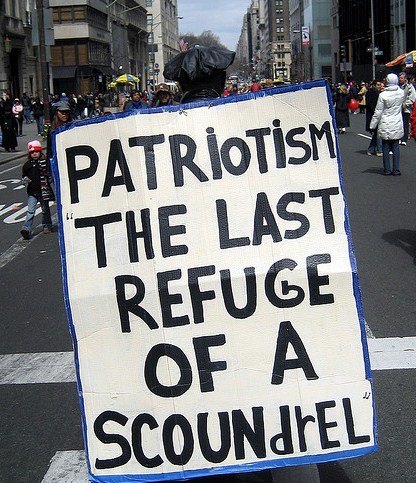
But like so many of the syllogisms we base our lives on, this one has problems. Patriotic expressions aren’t supposed to mean unqualified support for the status quo. They’re supposed to be engines for producing social consensus. When you look at a flag, no one is forcing you think only of bad things, like Vietnamese napalm bombings and soaring economic inequality. Those are factual entries in the American history books, yes. And they are very bad. *Über-*bad. But national symbols are about ideals. And ideals are useful things. They motivate sacrifice, and inspire a willingness to contribute to the collective.

Hmmm…sounds like exactly what Sanders supporters would need if they wanted, say, to get 330 million people onboard for a huge shared investment that would require tons of across-the-board buy-in. But right now, it seems that the people who want the highest level of shared collective investment are, paradoxically, the very same people who most dislike those symbols. This is a problem.
Asabiya: Arabic for getting it done, together
Cultural evolution researcher Peter Turchin uses an Arabic term, asabiya, to refer to the collective loyalty and willingness to cooperate for the common good that characterizes successful nations. If a tribe has asabiya, its members will be willing to step in and make sacrifices to keep things going. Such a tribe stands a good chance of surviving when trouble strikes. But if a tribe doesn’t have asabiya, its members will only feel loyalty because they’re getting something from it. This tribe will be in a pretty rough position when its luck turns – its members will abandon it.
So in order to survive, countries need to evoke affective – that is, emotional – loyalty. They need asabiya. As moral psychologist Jonathan Haidt has written extensively, humans aren’t purely rational creatures. We don’t make decisions based on detached cost-benefit analyses, no matter how much economists insist that we do. We’re emotional animals. And thanks to millennia of evolution, we’re capable of feeling emotional commitments not only to other individuals, but to groups.
In fact, if you’re looking for a single feature of humanity that most distinguishes us from other apes, our emotional “groupishness” would be a good candidate. Chimpanzees live in groups, but humans symbolize our tribes. We rally around our flags, national anthems, religious totems. These are the tools that make our commitments seem real, that forge collective identities rich with asabiya.
This is species-typical behavior. Humans do this all around the world. For the United States, it’s the bald eagle, images of mountains and prairie, or Lady Liberty. For Great Britain it’s Queen Elizabeth, the hills of the Lake District, or the age-old customs of afternoon tea and feeling insecure about social class. Of course, these aren’t exhaustive lists – in fact, a person’s loyalty to her country usually emerges from a whole bundle of associations and symbols.
The key point is, the more positive a person feels about these symbols, the more willing she’ll probably be to make sacrifices for the nation or tribe. It’s like a wedding ring. A guy who takes his wedding band off before he goes out to a bar while on a business trip is probably not going to take his wedding vows that seriously. On the other hand, a person who feels strongly about his wedding ring is more likely to abide by the commitments it symbolizes. In other words, there is a nontrivial connection between 1:) a person’s affective response to a symbol and 2:) that person’s likelihood of following through on the social obligations that symbol refers to.
That is, symbols matter. They provide real information about which relationships we’re committed to and which ones we’re indifferent toward.
Got it? Good.
And so symbols of patriotism are actually crucial, practically speaking, when it comes to mustering popular support for big, collective efforts. If you want to get an entire country to rally behind a big new project, you need to inspire some sense of positive emotional commitment, not just to the project, but to the collective, the tribe itself. People need to feel like they are contributing to their extended family when they pitch in for the nation.
This is hundreds of thousands of years of evolution talking. You want lots of collective investment in the tribe? Then you need a tight and cohesive tribe. You want a tight and cohesive tribe? You need serious, committed investment in the symbols of the tribe, so that other people can see that you mean business. If those symbols seem contaminated by bad associations, like war or imperialism, then start using them differently. Take back the symbols of patriotism from the jingoes. We’re symbol-using animals. That’s how it works.
I’m not arguing for or against Bernie Sanders’s vision. My point is about the semiotics of civic life. If you support Sanders, great – but if you want massive collective investment in and benefits from the United States, then you’d darn well better learn how to wield the symbols of America effectively, without cynicism. Otherwise, you’re asking the tribe to provide benefits without demonstrating that you’re committed all-in. And in the ancestral past, that was a losing strategy. And by “ancestral past,” I mean right up to last week. So don’t be too cool to be a patriot – especially if you’re asking the country to make a huge collective investment. Trust me: you’ll be glad you learned to be a symbol-user.
_____
* It’s funny how often this works in the United States. It makes you wonder – if everyone is anti-establishment, where is the establishment, anyway? Behind the couch? Topeka?
Previous Post

January 21, 2016
Think the Muslim world needs to "reform?" Think again
Next Post
February 23, 2016 No space for God of the gaps
Browse Our Archives
Select a Category Atheism Cognitive Science of Religion Costly investment theory Cultural psychology Editorial Evolution Evolution of Religion Evolution of religion series Evolutionary psychology Ideology and religion Modeling Religion Project Modern culture and religion Most Popular Practice of science Religion and education Religion and ethics Religion and health Religion and perception Religion and prejudice Religious violence Religious ways of thinking Science and religion Scientific study of religion Secularization Spirituality Uncategorized
Select a Month July 2022 February 2022 December 2021 October 2021 August 2021 July 2021 June 2021 May 2021 April 2021 March 2021 February 2021 January 2021 December 2020 November 2020 October 2020 September 2020 August 2020 July 2020 June 2020 May 2020 April 2020 March 2020 February 2020 January 2020 November 2019 October 2019 September 2019 August 2019 July 2019 June 2019 May 2019 April 2019 March 2019 February 2019 January 2019 December 2018 November 2018 October 2018 September 2018 August 2018 July 2018 June 2018 May 2018 April 2018 March 2018 February 2018 January 2018 December 2017 November 2017 October 2017 September 2017 August 2017 July 2017 June 2017 May 2017 April 2017 March 2017 February 2017 January 2017 December 2016 November 2016 September 2016 August 2016 June 2016 April 2016 March 2016 February 2016 January 2016 November 2015 October 2015 September 2015 August 2015 July 2015 June 2015 May 2015 April 2015 March 2015 February 2015 January 2015 December 2014 November 2014 October 2014 September 2014 August 2014 July 2014 June 2014 May 2014 April 2014 March 2014 February 2014 January 2014 December 2013 November 2013 October 2013 September 2013 August 2013 July 2013 June 2013 May 2013 April 2013 March 2013 February 2013 January 2013 December 2012 November 2012 October 2012 September 2012 August 2012 July 2012 June 2012 May 2012 April 2012 March 2012 February 2012
Follow Us!
TAKE THE
Religious Wisdom Quiz
Which king of Judah burned the scroll of Jeremiah's prophecy?
Select your answer to see how you score.
Jehoiakim Hezekiah Josiah Zedekiah
Related posts from Science On Religion




Geophysicist Dorian Abbot Loses MIT Lecture Thanks to...
TRENDING AT PATHEOS Religion News

Catholic Integralists believe that religious values – specifically Christian ones – should...

Electing A Virtuous President Would Make Immunity Irrelevant
Presidential immunity can bring with it many risks. So how can we...

Why The Olympic Games Are A ‘Civil Religious’...
Sporting events form a vital space where Americans display their 'civil religious...

After more than a decade of news, research updates, and insights on...

Q: Why do Southern Baptists and like-minded Protestants...
THE RELIGION GUY’S ANSWER: Why? Simple. Because they believe that’s what the...

THE QUESTION: Is gambling evil? THE RELIGION GUY’S ANSWER: Analysts anticipate a...
view all Religion News blogs
Ad-Free & Subscriber Log-In Subscription Support
- About Us
- 2026 Calendar
- Videos
- Podcasts
- Library of World Religions
- Faith In Media Tracker
- Advertise With Us
- Write for Us
- Privacy Policy
- Terms of Service
- Do Not Sell My Data
- Contact Us
- Radiant Digital
- Manage Newsletter Subscriptions
- Unsubscribe From Notifications
- Sitemap
Copyright 2008-2026, Patheos. All rights reserved.
Subscription Support Ad-Free & Subscriber Log-In
Follow Patheos