
BuddhistCatholicContemplativeEvangelicalGeneral ChristianHinduJewishLatter-day SaintMuslimNew VisionsProgressive Christian
Beliefs
- Buddhist
- Catholic
- Contemplative
- Evangelical
- General Christian
- Hindu
- Jewish
- Latter-day Saint
- More Voices
- Muslim
- New Visions
- Pagan
- Progressive Christian
Topics
- Religion News
- Food and Religion
- Sports and Religion
- Religious Art
- Religious Music and Entertainment
- Religious Events
- History and Religion
- Style and Religion
- Politics and Religion
- Women in Religion
- Recreation Outdoors and Religion
- Business Finance and Religion
- Careers Workplace and Religion
- Education and Religion
- Family Parenting and Religion
- Health Fitness and Religion
- Home and Religion
- Relationships and Religion
- Technology and Religion
- Travel and Religion
Columnists
- Buddhist Columnists
- Business Finance and Religion Columnists
- Careers Workplace and Religion Columnists
- Catholic Columnists
- Contemplative Columnists
- Education and Religion Columnists
- Evangelists Columnists
- Family Parenting and Religion Columnists
- General Christian Columnists
- Health Fitness and Religion Columnists
- Hindu Columnists
- History and Religion Columnists
- Home and Religion Columnists
- Jewish Columnists
- More Voices Columnists
- Latter Day Columnists
- Muslim Columnists
- New Visions Columnists
- Nonreligious Columnists
- Pagan Columnists
- Politics and Religion Columnists
- Progressive Columnists
- Recreation Outdoors and Religion Columnists
- Relationships and Religion Columnists
- Religion News Columnists
- Religious Art Columnists
- Religious Events Columnists
- Religious Music and Entertainment Columnists
- Sports and Religion Columnists
- Style and Religion Columnists
- Technology and Religion Columnists
- Travel and Religion Columnists
- Women in Religion Columnists
Resource Library
- 2026 Calendar
- Library of World Religions
- The 100 Most Holy Places on Earth
- Patheos Answers
- Podcasts
- Videos
- Faith Leaders Database
- Anglican Episcopalian
- Bahai
- Baptist
- Buddhism
- Christianity
- Confucianism
- Eastern Orthodoxy
- Hinduism
- Holiness and Pentecostal
- ISKCON
- Islam
- Judaism
- Lutheran
- Methodist
- The Church of Jesus Christ of Latter-day Saints
- New Age
- Paganism
- Presbytarian and Reformed
- Protestantism
- Religion Behind the Scenes
- Roman Catholic
- Scientology
- Shia Islam
- Sikhism
- Sufism
- Sunni Islam
- Taoism
- Zen
- See all religions
Research Tools
 Ad-Free & Subscriber Log-In Subscription Support
Ad-Free & Subscriber Log-In Subscription Support
Follow Patheos 

- Trending:
- Forgiveness
- |
- Marriage
- |
- Consciousness
- |
- Death Penalty
- |
- Election
- |
- Halloween
 Science On Religion
- Home
- Religion News
- Is willpower really a finite resource?
Is willpower really a finite resource?
Last updated on: February 19, 2015 at 9:28 am by Connor Wood
Is willpower really a finite resource? 2015-02-19T09:28:43-05:00 Connor Wood
Patheos Explore the world's faith through different perspectives on religion and spirituality! Patheos has the views of the prevalent religions and spiritualities of the world.
Connor Wood

Over the past decade or so, there’s been a big groundswell in empirical research on religion. This is a good thing, because it means now we can actually point at data to answer questions about what role religion plays in culture, or whether religion is here to stay.* But just because empirical psychologists and cognitive scientists are publishing data-heavy papers on religion doesn’t mean everything they say is the gospel truth (pun intended). One recent paper shows that even our most cherished scientific conclusions can turn out to be red herrings, thanks to publication bias, cherry-picking results, and good old human error.
Self-control is a major topic of interest for scientists who study religion. High-profile studies have claimed to show that subliminal religious cues – like the word “God” flashed on a screen – can improve a person’s self-control in difficult or tedious tasks. Other studies have suggested that religion might strengthen practitioners’ self-control over time, through rituals that “exercise” our willpower.
Of course, all these claims are based on a single, hugely important premise: self-control is a finite resource. This assumption, called the “depletion model,” argues that self-control is like a muscle. Use it too much in one short period, and it gets weaker – but use it a lot over time and it gets stronger. For example, if you successfully resist the temptation of a plateful of cookies for twenty minutes straight, you might have a hard time saying “no” to clickbait links afterward. The depletion model, also known as ego depletion or the limited-resource model of self-control, is one of the most influential and celebrated theories in psychology. The original papers setting forth this idea have been cited thousands of times and replicated hundreds of times. It’s what you might call a robust effect – it persists, across studies. It’s real. You can count on it.
Or can you? Evan Carter and Michael McCullough, psychologists at the University of Miami, recently found themselves in the awkward position of being, er, unable replicate the effect. No matter how they put their experiments together, subjects weren’t showing weakened self-control after conducting willpower-draining tasks. This shouldn’t have been so hard, considering how many hundreds of psychologists have vouched for it. But it was.
WARNING – Various Statistics Terms Ahead
To figure out why, Carter and McCullough examined a meta-analysis (a quantitative review of many different studies). The meta-analysis in question, published in 2010 by another group of researchers, covered 198 different papers, and found that the self-control depletion effect was robust across studies and had a medium-ish effect size.
But there were some problems. The 198 papers showed signs of being heavily biased toward significant results. This publication bias is also called the “file drawer effect,” because negative results – which are famously difficult to get published – often languish in researchers’ file drawers. Statistically speaking, there should be some null results for every line of inquiry – even when dealing with big effects like the health impacts of smoking. Ergo: when journal databases turn up nothing but positive results for a given topic, there’s probably a file-drawer effect.
To investigate this possibility, Carter and McCullough estimated the average statistical power in the 198 studies. Using their estimate, they derived the probability that any given study would turn up positive findings. The logic is simple: strong effects are more likely to appear in any given study. If you were studying whether caffeine makes toddlers hyperactive, any randomly chosen study would be very likely to show a significant effect. But the effects of, say, decaf coffee on grownups would be more likely to remain invisible in any individual study, because the influence of wee amounts of caffeine is very subtle – even though it’s real.
Self-control depletion – according to the literature, anyway – lies somewhere between coffee and decaf. It should show up fairly regularly, but not in every study. As it turns out, 151 of the 198 studies in the meta-analysis showed significant positive effects. Given the average statistical power of those findings, Carter and McCullough calculated that the chances of so many studies achieving significance were vanishingly small, yielding an “incredibility index” of .999.† In other words, there was a 99.9% probability that there were more significant results than should be expected given the average effect size. That’s a lot of negative results stuffed in file drawers.
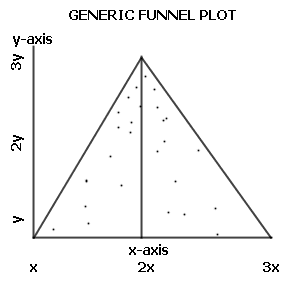
This here is a funnel plot. Points at the apex of the funnel are drawn from studies with small standard errors – which often means large sample sizes. Points at the bottom of the funnel are drawn from studies with large standard errors, and thus less precise measurements. The x-axis measures effect sizes, with positive effects on one side of the funnel and negative effects on the other. As measurement get more precise, estimates of effect size shrink. SOURCE: Wikimedia Commons. This image is in the public domain.
But this method of estimating publication bias can be cumbersome. To improve their guesses, Carter and McCullough conducted another test. They assumed that the precision of measurements should be inversely related to effect sizes. In other words, if your measurements are imprecise, you’re likely to overestimate how big the effect is. If you plot these two variables on a graph, they form a funnel, with overestimates of effect size increasing as your measures (standard error) get less precise.
Here’s the key: this funnel will be asymmetrical if there’s publication bias in the literature. Publications with null or negative findings will be missing, and so will studies with precise measurements. So if you want to estimate actual effect sizes, you need to extrapolate the values of the missing data points and add them to the plot.
This technique is called the “trim-and-fill method,” since you “trim” and “fill in” the funnel – that is, you add assumed results from hypothetical studies that have not been published – to make the graph symmetrical. Then you re-estimate effect sizes from there.
In addition to this basic technique, Carter and McCullough also conducted a modified version of the trim-and-fill method that uses statistical regression to determine whether the real-world effect size is probably zero. If it turns out not to be likely to be zero, a second regression analysis estimates the actual effect size.
In a recent meta-analysis of FDA pre-registered antidepressant studies, researchers used this same two-step method to accurately estimate effect sizes despite a huge file-drawer effect: 94 percent of the published papers showed significant positive findings, but only 51 percent of the total group of studies (including unpublished trials) attained significance*.* The published studies yielded a respectable average effect size of around .41. But using the full sample, the researchers calculated a much smaller genuine effect size of .31. Then, using the two-step trim-and-fill method, the researchers re-calculated the average effect size using only the published studies. In other words, they estimated the effects of the “missing” studies – and turned up an effect size of .29. This is, obviously, very close to .31. The upshot? The two-step trim-and-fill method – which only simulates the unpublished studies – can produce highly accurate estimates of actual effect sizes.
So what happened when Carter and McCullough applied this method to the research on self-control depletion? They estimated an actual effect size of zero. That’s right – nada. The missing studies – those null results that never got published – left a publication record so biased that the likely real-world effect was apparently negligible. But if you just scanned the psychology journals, you’d never know it.
This is an interesting case, because the self-control depletion model makes so much sense. Even Carter and McCullough admit that their own understanding of human nature leads them to believe in self-control depletion. I mean, it’s obvious: if you focus on resisting a temptation for long enough, you’ll drain your willpower and have less self-control afterwards. Right? But the evidence – if you include the data that’s rotting away in file drawers – might not support this commonsense belief.
So does Carter and McCullough’s analysis mean that self-control depletion is actually imaginary? Not necessarily. Because it matches people’s experience and fits so well with other psychological theories, researchers will be hesitant to throw it away – and that’s a good thing. If scientists tossed theories too easily, science would implode. So instead of discarding the self-control depletion model, Carter and McCullough argue forcefully for much larger studies, with more rigorous controls, to discover once and for all whether there’s actually an effect.
Since self-control is a major focus for religion researchers – Carter and McCullough themselves have published on it – their paper is more than a little unsettling for the scientific study of religion. If their results hold, many theories of religion’s influence on self-regulation may need to be seriously revised. Some may need to be scrapped altogether.
Carter and McCullough’s disquieting paper is a stark reminder that the file-drawer effect and publication bias are massive problems, especially in psychology. If researchers only publish when they get positive effects, leaving their null findings moldering in folders, then we have no idea whether the findings that splash across newspapers or find their way into textbooks are actually, you know, valid. To fix this problem, researchers should commit to publishing their null results, pre-registering experiments, and refraining from p-hacking. These new standards might require a little self-control. But if we really want to learn about these odd animals called humans, they’ll be worth it.
____
* Answer: Yep
† Yes, this is really a thing. People abbreviate it as “IC-Index.” I’d never heard of it either. You’re welcome.
____
Edit: After publishing this post, I added an example of self-control depletion and some additional terms. I woke up this morning desperately convinced that I needed to do this. Maybe one of these days I could use a vacation.
Previous Post

February 2, 2015
America's public ritual gone terribly wrong
Next Post
March 5, 2015 Michael Shermer thinks he's more moral than you
Browse Our Archives
Select a Category Atheism Cognitive Science of Religion Costly investment theory Cultural psychology Editorial Evolution Evolution of Religion Evolution of religion series Evolutionary psychology Ideology and religion Modeling Religion Project Modern culture and religion Most Popular Practice of science Religion and education Religion and ethics Religion and health Religion and perception Religion and prejudice Religious violence Religious ways of thinking Science and religion Scientific study of religion Secularization Spirituality Uncategorized
Select a Month July 2022 February 2022 December 2021 October 2021 August 2021 July 2021 June 2021 May 2021 April 2021 March 2021 February 2021 January 2021 December 2020 November 2020 October 2020 September 2020 August 2020 July 2020 June 2020 May 2020 April 2020 March 2020 February 2020 January 2020 November 2019 October 2019 September 2019 August 2019 July 2019 June 2019 May 2019 April 2019 March 2019 February 2019 January 2019 December 2018 November 2018 October 2018 September 2018 August 2018 July 2018 June 2018 May 2018 April 2018 March 2018 February 2018 January 2018 December 2017 November 2017 October 2017 September 2017 August 2017 July 2017 June 2017 May 2017 April 2017 March 2017 February 2017 January 2017 December 2016 November 2016 September 2016 August 2016 June 2016 April 2016 March 2016 February 2016 January 2016 November 2015 October 2015 September 2015 August 2015 July 2015 June 2015 May 2015 April 2015 March 2015 February 2015 January 2015 December 2014 November 2014 October 2014 September 2014 August 2014 July 2014 June 2014 May 2014 April 2014 March 2014 February 2014 January 2014 December 2013 November 2013 October 2013 September 2013 August 2013 July 2013 June 2013 May 2013 April 2013 March 2013 February 2013 January 2013 December 2012 November 2012 October 2012 September 2012 August 2012 July 2012 June 2012 May 2012 April 2012 March 2012 February 2012
Follow Us!
TAKE THE
Religious Wisdom Quiz
Who said "as for me and my house, we will serve the Lord"?
Select your answer to see how you score.
Paul Abraham Peter Joshua
Related posts from Science On Religion

Why Rites of Passage Are Painful


The Joys and Challenges of Interdisciplinary Research

Religious Experience and Homo Duplex
TRENDING AT PATHEOS Religion News

Catholic Integralists believe that religious values – specifically Christian ones – should...

Electing A Virtuous President Would Make Immunity Irrelevant
Presidential immunity can bring with it many risks. So how can we...

Why The Olympic Games Are A ‘Civil Religious’...
Sporting events form a vital space where Americans display their 'civil religious...

After more than a decade of news, research updates, and insights on...

Q: Why do Southern Baptists and like-minded Protestants...
THE RELIGION GUY’S ANSWER: Why? Simple. Because they believe that’s what the...

THE QUESTION: Is gambling evil? THE RELIGION GUY’S ANSWER: Analysts anticipate a...
view all Religion News blogs
Ad-Free & Subscriber Log-In Subscription Support
- About Us
- 2026 Calendar
- Videos
- Podcasts
- Library of World Religions
- Faith In Media Tracker
- Advertise With Us
- Write for Us
- Privacy Policy
- Terms of Service
- Do Not Sell My Data
- Contact Us
- Radiant Digital
- Manage Newsletter Subscriptions
- Unsubscribe From Notifications
- Sitemap
Copyright 2008-2026, Patheos. All rights reserved.
Subscription Support Ad-Free & Subscriber Log-In
Follow Patheos