
BuddhistCatholicContemplativeEvangelicalGeneral ChristianHinduJewishLatter-day SaintMuslimNew VisionsProgressive Christian
Beliefs
- Buddhist
- Catholic
- Contemplative
- Evangelical
- General Christian
- Hindu
- Jewish
- Latter-day Saint
- More Voices
- Muslim
- New Visions
- Pagan
- Progressive Christian
Topics
- Religion News
- Food and Religion
- Sports and Religion
- Religious Art
- Religious Music and Entertainment
- Religious Events
- History and Religion
- Style and Religion
- Politics and Religion
- Women in Religion
- Recreation Outdoors and Religion
- Business Finance and Religion
- Careers Workplace and Religion
- Education and Religion
- Family Parenting and Religion
- Health Fitness and Religion
- Home and Religion
- Relationships and Religion
- Technology and Religion
- Travel and Religion
Columnists
- Buddhist Columnists
- Business Finance and Religion Columnists
- Careers Workplace and Religion Columnists
- Catholic Columnists
- Contemplative Columnists
- Education and Religion Columnists
- Evangelists Columnists
- Family Parenting and Religion Columnists
- General Christian Columnists
- Health Fitness and Religion Columnists
- Hindu Columnists
- History and Religion Columnists
- Home and Religion Columnists
- Jewish Columnists
- More Voices Columnists
- Latter Day Columnists
- Muslim Columnists
- New Visions Columnists
- Nonreligious Columnists
- Pagan Columnists
- Politics and Religion Columnists
- Progressive Columnists
- Recreation Outdoors and Religion Columnists
- Relationships and Religion Columnists
- Religion News Columnists
- Religious Art Columnists
- Religious Events Columnists
- Religious Music and Entertainment Columnists
- Sports and Religion Columnists
- Style and Religion Columnists
- Technology and Religion Columnists
- Travel and Religion Columnists
- Women in Religion Columnists
Resource Library
- 2026 Calendar
- Library of World Religions
- The 100 Most Holy Places on Earth
- Patheos Answers
- Podcasts
- Videos
- Faith Leaders Database
- Anglican Episcopalian
- Bahai
- Baptist
- Buddhism
- Christianity
- Confucianism
- Eastern Orthodoxy
- Hinduism
- Holiness and Pentecostal
- ISKCON
- Islam
- Judaism
- Lutheran
- Methodist
- The Church of Jesus Christ of Latter-day Saints
- New Age
- Paganism
- Presbytarian and Reformed
- Protestantism
- Religion Behind the Scenes
- Roman Catholic
- Scientology
- Shia Islam
- Sikhism
- Sufism
- Sunni Islam
- Taoism
- Zen
- See all religions
Research Tools
 Ad-Free & Subscriber Log-In Subscription Support
Ad-Free & Subscriber Log-In Subscription Support
Follow Patheos 

- Trending:
- Forgiveness
- |
- Marriage
- |
- Consciousness
- |
- Death Penalty
- |
- Election
- |
- Halloween
 Science On Religion
- Home
- Religion News
- Want to understand religion? You’ve gotta have a body.
Want to understand religion? You’ve gotta have a body.
Last updated on: November 14, 2014 at 5:51 pm by Connor Wood
Want to understand religion? You’ve gotta have a body. 2014-11-14T17:51:04-05:00 Connor Wood
Patheos Explore the world's faith through different perspectives on religion and spirituality! Patheos has the views of the prevalent religions and spiritualities of the world.
Connor Wood
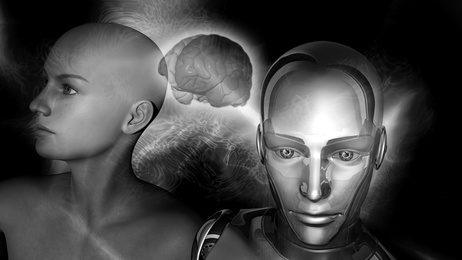
A few times a year, a group of scholars, scientists, and industry people gather in Manhattan as part of a Sinai and Synapses working group, and I’m privileged to be one of those folks. Last week, as part of a working group meeting, I and the other members of Sinai and Synapses were treated to a fascinating talk by an expert in religion and technology, Noreen Herzfeld. Herzfeld’s talk focused on bodies – on the difference between simulating cognition using abstract 0s or 1s and actually having fleshy, full-body experience of the world. I can’t think of a better angle from which to tackle questions of religion and science.
Herzfeld, a theologian and computer scientist, is an eloquent advocate of embodiment. Embodiment is a concept that has recently become quite fashionable in both religious studies and theology (which, by the way, as different fields get on about as well as hostile in-laws at a tipsy Thanksgiving). But while academic types usually use the word “fashionable” as a pejorative, this is one fashion I’m thrilled to get behind.
Embodiment refers to the idea that we humans have bodies, and that these bodies matter for how we behave and how we think. It may seem odd that such a blindingly obvious truism should get religion scholars all in a tizzy, but the fact is that most of Western culture has assumed that bodies are unimportant appendages to the mind since, well, Aristotle – who argued that the most exalted philosophy was completely disconnected from bodily or practical concerns, such as how to build a bridge or heal people. For Aristotle and most of the Western intellectual tradition since his time, bodily things have been associated with women, slaves, and the lowly. What really matters, what’s really important, are abstract, purely intellectual endeavors – unencumbered by the flesh.
This attitude – Yay intellect! Boo to bodies! – is alive and well in today’s supposedly enlightened culture, where it practically serves as the rallying motto for thousands of researchers and excitable pundits in the cognitive sciences, AI research, and the tech industries. In cognitive science and artificial intelligence research, for instance*,* symbolic or computational models of intelligence have typically dominated. These models assume that intelligence can be reduced to the pure algorithmic manipulation of abstract symbols, such as words and numbers. As the Stanford Encyclopedia of Philosophy puts it,
The last forty years have been dominated by the classical view that (at least higher) human cognition is analogous to symbolic computation in digital computers…information is represented by strings of symbols, just as we represent data in computer memory or on pieces of paper.
In this representation-based paradigm, intelligence doesn’t need a body at all in order to exist, but could be stored in a completely abstract space – such as the inside of a computer program. As Hilary Putnam put it, we could all be brains in vats!
Here’s the thing, though: symbolic approaches to artificial intelligence don’t work. Symbol-based artificial intelligence programs simply can’t learn, recognize patterns, or coordinate motion very well, for instance. Because of these failures, it’s become increasingly apparent to keen-minded AI researchers that it’s time to think beyond reducing intelligence and consciousness to symbolic algorithms.
Embodied cognition is one alternative to “the-brain-is-a-computer” models of intelligence. For embodied cognition theorists like neuroscientist Antonio Damasio, our mental processes fundamentally depend on physical processes and context. These claims are supported by experimental research that shows, for example, that it’s harder to recognize negative words when the facial muscles responsible for smiles are engaged (and more difficult to recognize positive words when we’re frowning). Damasio argues that emotional bodily states are fundamental ingredients of decision-making, and therefore central to the structure of intelligence. (His insights draw on philosopher and psychologist William James, who famously argued that changing our bodily postures – standing up straight, for example –affects our cognition.)
Embodied cognition models insist that what goes on in our muscles, our guts, and on the surface of our skin actually matters for our thinking. And the evidence is increasingly behind them. A brain in a vat would lack physical sensations. This means, for example, that it wouldn’t be able to feel fear – because fear is the tensing of the stomach muscles, the dilating of pupils, the flushing of the skin. If you’re not feeling physically tense, you’re not feeling afraid. Emotion, then, isn’t just a symbol. It’s an experience. And because emotion is absolutely indispensable to human information processing, it’s not clear that we could even call a brain in a vat “intelligent” at all, no matter how many neurons it had. This is why AI researcher and roboticist Rodney Brooks argues that only robots with fully-functional bodies could ever be intelligent: because bodies are what it takes to be conscious.
To return to Sinai and Synapses: while AI research and even cognitive science are slowly moving beyond the mind-as-computer model, our popular culture and tech worlds are stuck on it. Excitable screeds about how someday human minds will be uploaded to the Internet are published seemingly every week, even as we outsource more and more of our behavior and decisions to machines that actually are algorithm-based computational machines. Meanwhile, tech culture goofily celebrates every new gadget that transforms what used to be a complex, full-body decision into gleaming algorithmic logic.
You could call this tech-enthusiasm fundamentally a repudiation of context. Your physical and social surroundings are crucial for embodied cognition, but you can utterly ignore all that stuff if you just want to work with atomized bits of code. The fawning over abstract and the disembodied problem-solving that has characterized Western intellectual culture since Athens is actually a sort of disdain for real context. This is something to be wary of, according to Noreen Herzfeld. Technology is profoundly helpful, but without careful attention to the complexity of embodied experience, we’re in danger of over-streamlining our collective decision-making processes.
A splendidly written recent article in the New York Times Magazine offers a perfect example of why embodied learning is necessary. The process by which taxi drivers in London learn the entirety of the London street grid and all its landmarks through actually traveling the streets is so intense that their hippocampi grow to be bigger than other people’s. The ordeal is called gaining “the Knowledge.” And as GPS systems and other automatized, algorithm-based tools for navigating a city as cumbersome as London proliferate, cab drivers who have attained the Knowledge are showing why first-person, embodied knowledge is so important: they can actually maintain and synthesize more information that is relevant to particular scenarios. You want to get from Piccadilly to an obscure pub in the East End without hitting any traffic lights, and avoiding rush-hour traffic? GPS can’t help you there. But London cabbies can. They use their gut knowledge of the entirety of the city to quantifiably outperform GPS systems in real-life situations.
And of course, embodiment is crucial for understanding religion, which often makes no sense to people who only know it as a series of symbolic propositions. As Patton Dodd wrote recently for On Faith,
Belief in God involves not just your brain, but your entire body. I first found faith in a Pentecostal setting, which meant lots and lots of dancing. I later lost my faith, and when I discovered it anew, I was in a liturgical setting, which meant lots and lots of kneeling and signs-of-the-cross-ing. Either way, I was moving my body.
Patton’s observation is similar to one I heard recently from a much different source, Jay Feierman of the University of New Mexico. I saw Jay present a paper at the Society for the Scientific Study of Religion conference in Indianapolis, in which he described how the bowing and submissive bodily postures found in nearly all religions actually stimulate dopamine release – providing for intrinsic emotional rewards. Jay calls himself a committed atheist, but his third-person description of what goes on when human bodies do religious things is a useful complement to Patton’s first-person confession of embodied faith. Both agree that religious experience is something that comes from what bodies do. Noreen Herzfeld agrees, and so do I. And that goes for a tremendous amount of human life besides. If you want to understand religion, or culture, or London, you need to understand humans. And if you want to understand humans, you need to understand bodies. Our increasingly disembodied, tech-driven lives aren’t making that any easier.
Previous Post

October 29, 2014
Theology: It matters.
Next Post
December 4, 2014 A new theory for why Buddhist meditation makes us feel good
Browse Our Archives
Select a Category Atheism Cognitive Science of Religion Costly investment theory Cultural psychology Editorial Evolution Evolution of Religion Evolution of religion series Evolutionary psychology Ideology and religion Modeling Religion Project Modern culture and religion Most Popular Practice of science Religion and education Religion and ethics Religion and health Religion and perception Religion and prejudice Religious violence Religious ways of thinking Science and religion Scientific study of religion Secularization Spirituality Uncategorized
Select a Month July 2022 February 2022 December 2021 October 2021 August 2021 July 2021 June 2021 May 2021 April 2021 March 2021 February 2021 January 2021 December 2020 November 2020 October 2020 September 2020 August 2020 July 2020 June 2020 May 2020 April 2020 March 2020 February 2020 January 2020 November 2019 October 2019 September 2019 August 2019 July 2019 June 2019 May 2019 April 2019 March 2019 February 2019 January 2019 December 2018 November 2018 October 2018 September 2018 August 2018 July 2018 June 2018 May 2018 April 2018 March 2018 February 2018 January 2018 December 2017 November 2017 October 2017 September 2017 August 2017 July 2017 June 2017 May 2017 April 2017 March 2017 February 2017 January 2017 December 2016 November 2016 September 2016 August 2016 June 2016 April 2016 March 2016 February 2016 January 2016 November 2015 October 2015 September 2015 August 2015 July 2015 June 2015 May 2015 April 2015 March 2015 February 2015 January 2015 December 2014 November 2014 October 2014 September 2014 August 2014 July 2014 June 2014 May 2014 April 2014 March 2014 February 2014 January 2014 December 2013 November 2013 October 2013 September 2013 August 2013 July 2013 June 2013 May 2013 April 2013 March 2013 February 2013 January 2013 December 2012 November 2012 October 2012 September 2012 August 2012 July 2012 June 2012 May 2012 April 2012 March 2012 February 2012
Follow Us!
TAKE THE
Religious Wisdom Quiz
On which day did God create animals?
Select your answer to see how you score.
On the sixth day On the third day On the fourth day On the first day
Related posts from Science On Religion

Why Rites of Passage Are Painful



TRENDING AT PATHEOS Religion News

Catholic Integralists believe that religious values – specifically Christian ones – should...

Electing A Virtuous President Would Make Immunity Irrelevant
Presidential immunity can bring with it many risks. So how can we...

Why The Olympic Games Are A ‘Civil Religious’...
Sporting events form a vital space where Americans display their 'civil religious...

After more than a decade of news, research updates, and insights on...

Q: Why do Southern Baptists and like-minded Protestants...
THE RELIGION GUY’S ANSWER: Why? Simple. Because they believe that’s what the...

THE QUESTION: Is gambling evil? THE RELIGION GUY’S ANSWER: Analysts anticipate a...
view all Religion News blogs
Ad-Free & Subscriber Log-In Subscription Support
- About Us
- 2026 Calendar
- Videos
- Podcasts
- Library of World Religions
- Faith In Media Tracker
- Advertise With Us
- Write for Us
- Privacy Policy
- Terms of Service
- Do Not Sell My Data
- Contact Us
- Radiant Digital
- Manage Newsletter Subscriptions
- Unsubscribe From Notifications
- Sitemap
Copyright 2008-2026, Patheos. All rights reserved.
Subscription Support Ad-Free & Subscriber Log-In
Follow Patheos