
BuddhistCatholicContemplativeEvangelicalGeneral ChristianHinduJewishLatter-day SaintMuslimNew VisionsProgressive Christian
Beliefs
- Buddhist
- Catholic
- Contemplative
- Evangelical
- General Christian
- Hindu
- Jewish
- Latter-day Saint
- More Voices
- Muslim
- New Visions
- Pagan
- Progressive Christian
Topics
- Religion News
- Food and Religion
- Sports and Religion
- Religious Art
- Religious Music and Entertainment
- Religious Events
- History and Religion
- Style and Religion
- Politics and Religion
- Women in Religion
- Recreation Outdoors and Religion
- Business Finance and Religion
- Careers Workplace and Religion
- Education and Religion
- Family Parenting and Religion
- Health Fitness and Religion
- Home and Religion
- Relationships and Religion
- Technology and Religion
- Travel and Religion
Columnists
- Buddhist Columnists
- Business Finance and Religion Columnists
- Careers Workplace and Religion Columnists
- Catholic Columnists
- Contemplative Columnists
- Education and Religion Columnists
- Evangelists Columnists
- Family Parenting and Religion Columnists
- General Christian Columnists
- Health Fitness and Religion Columnists
- Hindu Columnists
- History and Religion Columnists
- Home and Religion Columnists
- Jewish Columnists
- More Voices Columnists
- Latter Day Columnists
- Muslim Columnists
- New Visions Columnists
- Nonreligious Columnists
- Pagan Columnists
- Politics and Religion Columnists
- Progressive Columnists
- Recreation Outdoors and Religion Columnists
- Relationships and Religion Columnists
- Religion News Columnists
- Religious Art Columnists
- Religious Events Columnists
- Religious Music and Entertainment Columnists
- Sports and Religion Columnists
- Style and Religion Columnists
- Technology and Religion Columnists
- Travel and Religion Columnists
- Women in Religion Columnists
Resource Library
- 2026 Calendar
- Library of World Religions
- The 100 Most Holy Places on Earth
- Patheos Answers
- Podcasts
- Videos
- Faith Leaders Database
- Anglican Episcopalian
- Bahai
- Baptist
- Buddhism
- Christianity
- Confucianism
- Eastern Orthodoxy
- Hinduism
- Holiness and Pentecostal
- ISKCON
- Islam
- Judaism
- Lutheran
- Methodist
- The Church of Jesus Christ of Latter-day Saints
- New Age
- Paganism
- Presbytarian and Reformed
- Protestantism
- Religion Behind the Scenes
- Roman Catholic
- Scientology
- Shia Islam
- Sikhism
- Sufism
- Sunni Islam
- Taoism
- Zen
- See all religions
Research Tools
 Ad-Free & Subscriber Log-In Subscription Support
Ad-Free & Subscriber Log-In Subscription Support
Follow Patheos 

- Trending:
- Forgiveness
- |
- Marriage
- |
- Consciousness
- |
- Death Penalty
- |
- Election
- |
- Halloween
 Science On Religion
- Home
- Religion News
- Entheogens may expand possible brain interconnections
Entheogens may expand possible brain interconnections
Last updated on: September 15, 2014 at 7:05 pm by Connor Wood
Entheogens may expand possible brain interconnections 2014-09-15T19:05:01-04:00 Connor Wood
Patheos Explore the world's faith through different perspectives on religion and spirituality! Patheos has the views of the prevalent religions and spiritualities of the world.
Connor Wood
In the Book of Ezekiel, the eponymous prophet witnesses fantastic, even psychedelic visions: chariots in the sky, angels, the works. (Ezekiel 37 luridly recounts, for example, that the prophet sees a valley of bones that begin to reassemble themselves as he speaks.) But Ezekiel’s visions aren’t just odd. They’re profoundly meaningful, at least for the prophet. This combination of dreamlike oddness and paradoxical meaningfulness is one of the most pervasive qualities of religious – and entheogenic – experiences across traditions. Now, new neuroimaging research may help us understand one part of this picture: how psychedelic substances relax the normal patterns of connectivity in the brain, allowing for powerfully associative mental experiences.
An international group of brain scientists and neuroimaging experts led by Enzo Tagliazucchi of Goethe University in Frankfurt, Germany, were inspired by the fact that psychedelic and dream states are both subjectively hyperassociative. That is, people under the influence of hallucinogens or deep in REM sleep often perceive sensations and ideas that would otherwise seem mutually unrelated to be meaningfully connected to each other. Calling such experiences “unconstrained cognition,” the researchers postulated that their neural underpinnings might be shifts in functional connectivity between different brain regions, as well as changes in the variability – and thus in the level of coherence – of brain activity.
Relying on functional Magnetic Resonance Imaging (fMRI) equipment, Tagliazucchi and the other researchers used Blood Oxygen Level Dependent (BOLD) scanning techniques to study how subjects reacted to hallucinogens. In two separate sessions, fifteen volunteer subjects received either a placebo or intravenous psilocybin – the active ingredient in “magic mushrooms.” Every subject received the placebo and the psilocybin once each, but whether the psilocybin was administered in session 1 or 2 was decided randomly. Thus, every subject was his or her own control.
BOLD fMRI uses the magnetic difference between oxygenated and deoxygenated blood cells to show brain researchers where the brain is hungrily sucking up the most blood. BOLD imaging techniques pick up the changes between levels of oxygen-rich and oxygen-depleted blood, which means that researchers can see where the brain responds to an intervention or stimulus – say a pinprick or a drug – regardless of whether that response takes the form of increasing or decreasing activity. The brain’s responses are extremely complex, but usually internally coherent: in response to any given stimulus, some parts of the brain will likely get excited all together, while others might simultaneously calm down in tandem. These intercorrelated regions are called networks.
In light of the extensive functional connectivity throughout the brain, Tagliazucchi and co-authors describe the brain as being a complex, self-organizing system that’s constantly teetering on the balance between chaos and order. Order comes when various regions of the brain are stably correlated with each other – that is, when the same brain networks light up or cool down at the same time. Chaos awaits when those stable patterns of order and correlation break down, allowing new, less stable or permanent patterns of coherence to arise.
So what happens when you introduce psilocybin into the mix? The researchers’ findings suggest that, on one hand, psilocybin may push many higher brain networks towards greater disorder or entropy, weakening their usually dominant patterns of coherence. However, more basic, fundamental structures may experience a reordering of coherent patterns, in some cases becoming densely interconnected. In the researchers’ words, then, while the total activity of the brain becomes less ordered during psychedelic experience, “the repertoire of possible states is enhanced.”
Specifically, Tagliazucchi and fellow researchers found that a number of “resting state networks” – brain networks that are active when the brain is not focused on a particular task or goal – showed greater decoherence during a psilocybin trip. One network in particular, the “default mode network” (made up of the medial prefrontal cortex, medial temporal lobe, posterior cingulate cortex, precuneus, and parts of the parietal cortex) showed marked decrease in low frequency signals and an increase in random signal spikes. Low frequency signals are signs of strong coherence throughout the network, so the scans indicated that the default mode network was becoming less internally coordinated with itself as the psilocybin took hold.
Deeper in the brain, however, parts of the limbic system were becoming more internally coherent, although in highly unusual patterns. Specifically, the left and right hippocampus and the left and right anterior cingulate cortex – which are normally correlated with each other in relatively simple ways – showed remarkable new patterns of intercorrelation. The researchers referred to some of these patterns as “among the most interconnected states possible.” See the visual below for an example.
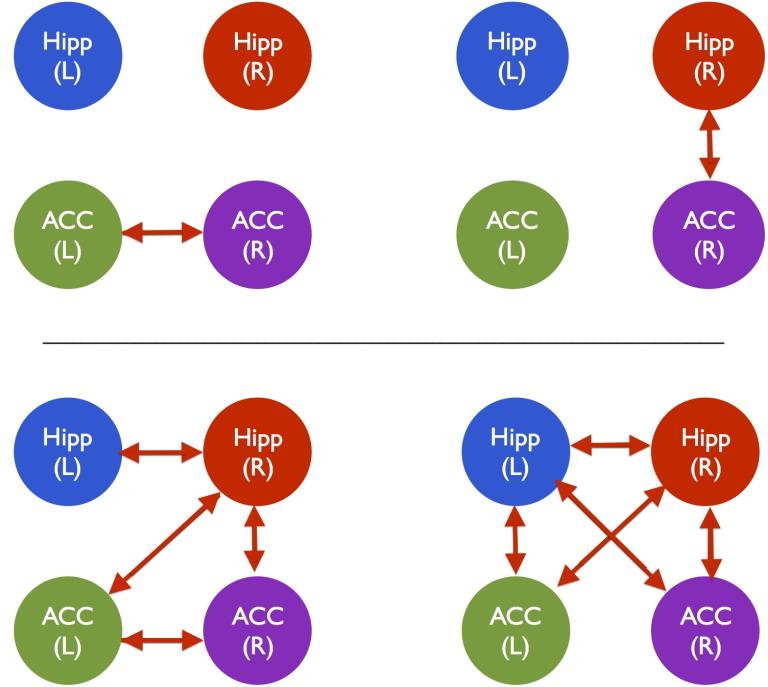
These figures show connections between the left and right hippocampus (Hipp) and the left and right anterior cingulate cortex (ACC). The top two images are common, everyday interconnection states. The bottom two are a sample of the states found only under psilocybin influence. Wow.
Under the influence of psilocybin, the normally simple patterns of coherence between these limbic brain structures gave way to some seriously complicated, almost dizzying interconnections. Interestingly, these parts of the brain are implicated in emotion processing and memory. What’s more, many other studies have found changes to the hippocampus during psychedelic and psychotic experiences. It’s possible, then, that increasing variability of connections within this region allows the brain to pump out novel associations between different memories and experiences – and to tag these associations as emotionally powerful and meaningful.
This effect may be magnified by the hallucinogen-induced suppression of the default mode network, which is a major contributor to the sense of “self” that we all experience. (The default mode network also plays a major role in social cognition – which is unsurprising, considering how much of our sense of self arises from our social contexts.) As the everyday, coherent sense of “self” fades into the background, a person under the influence of psilocybin may be able to take the novel, dizzying associations produced by her limbic brain more seriously.
This research by Tagliazucchi and fellow scientists suggests a possible mechanism by which hallucinogens allow the brain to produce rich, hyper-associative imagery that seems meaningful and profound. By releasing the everyday patterns of stable, internal coherence between different regions of the brain, psilocybin increases entropy in the brain – in the sense that normal patterns of order begin to break down. But as these stable patterns weaken, new patterns are allowed to emerge. In short, the brain trades a few highly stable states for a wild smorgasbord of novel, less stable possible ones.
Let’s go back to Ezekiel, and the millions of other individuals throughout history who have had profound religious experiences. It’s extremely unlikely that any one explanation will encompass everything we call “religious experience.” Such experiences almost certainly aren’t all identical, either subjectively or neurologically. However, Ezekiel’s prophetic visions, or Muhammad’s encounter with the angel Gabriel in the Cave of Hira, or the reveries of St. John of the Cross, have some important similarities to the unconstrained, hyper-associative reverie induced by drugs like psilocybin. Such hallucinogens are often called “entheogens’ for a reason – for their users, they appear to facilitate experiences of the divine.
It may be, then, that the dreamlike hyperreality of psychedelics is a model for the wildly associative, emotionally compelling experiences of mystics. Something similar to a psychedelic trip may have been happening in Ezekiel’s brain, allowing it to call forth powerful, emotionally evocative imagery and making it possible for him to take it completely seriously. Does this mean that mystics are all just hallucinating? Possibly. But not necessarily. They might just be looking at reality from a different perspective. Or seeing connections that other people – with their stable, everyday brains – tend to miss.
Previous Post

August 25, 2014
Do we have free will when it comes to mental illness?
Next Post
September 15, 2014 Want a meaningful life? Stay away from rich countries
Browse Our Archives
Select a Category Atheism Cognitive Science of Religion Costly investment theory Cultural psychology Editorial Evolution Evolution of Religion Evolution of religion series Evolutionary psychology Ideology and religion Modeling Religion Project Modern culture and religion Most Popular Practice of science Religion and education Religion and ethics Religion and health Religion and perception Religion and prejudice Religious violence Religious ways of thinking Science and religion Scientific study of religion Secularization Spirituality Uncategorized
Select a Month July 2022 February 2022 December 2021 October 2021 August 2021 July 2021 June 2021 May 2021 April 2021 March 2021 February 2021 January 2021 December 2020 November 2020 October 2020 September 2020 August 2020 July 2020 June 2020 May 2020 April 2020 March 2020 February 2020 January 2020 November 2019 October 2019 September 2019 August 2019 July 2019 June 2019 May 2019 April 2019 March 2019 February 2019 January 2019 December 2018 November 2018 October 2018 September 2018 August 2018 July 2018 June 2018 May 2018 April 2018 March 2018 February 2018 January 2018 December 2017 November 2017 October 2017 September 2017 August 2017 July 2017 June 2017 May 2017 April 2017 March 2017 February 2017 January 2017 December 2016 November 2016 September 2016 August 2016 June 2016 April 2016 March 2016 February 2016 January 2016 November 2015 October 2015 September 2015 August 2015 July 2015 June 2015 May 2015 April 2015 March 2015 February 2015 January 2015 December 2014 November 2014 October 2014 September 2014 August 2014 July 2014 June 2014 May 2014 April 2014 March 2014 February 2014 January 2014 December 2013 November 2013 October 2013 September 2013 August 2013 July 2013 June 2013 May 2013 April 2013 March 2013 February 2013 January 2013 December 2012 November 2012 October 2012 September 2012 August 2012 July 2012 June 2012 May 2012 April 2012 March 2012 February 2012
Follow Us!
TAKE THE
Religious Wisdom Quiz
Which king rebuilt the high places Solomon had built for foreign gods?
Select your answer to see how you score.
Hezekiah Jehu Josiah Manasseh
Related posts from Science On Religion

Why Rites of Passage Are Painful
Religious Experience and Homo Duplex

Extreme Rituals and Health: A Surprising Match

The Future of Religion: What Follows the Decline...
TRENDING AT PATHEOS Religion News

Catholic Integralists believe that religious values – specifically Christian ones – should...

Electing A Virtuous President Would Make Immunity Irrelevant
Presidential immunity can bring with it many risks. So how can we...

Why The Olympic Games Are A ‘Civil Religious’...
Sporting events form a vital space where Americans display their 'civil religious...

After more than a decade of news, research updates, and insights on...

Q: Why do Southern Baptists and like-minded Protestants...
THE RELIGION GUY’S ANSWER: Why? Simple. Because they believe that’s what the...

THE QUESTION: Is gambling evil? THE RELIGION GUY’S ANSWER: Analysts anticipate a...
view all Religion News blogs
Ad-Free & Subscriber Log-In Subscription Support
- About Us
- 2026 Calendar
- Videos
- Podcasts
- Library of World Religions
- Faith In Media Tracker
- Advertise With Us
- Write for Us
- Privacy Policy
- Terms of Service
- Do Not Sell My Data
- Contact Us
- Radiant Digital
- Manage Newsletter Subscriptions
- Unsubscribe From Notifications
- Sitemap
Copyright 2008-2026, Patheos. All rights reserved.
Subscription Support Ad-Free & Subscriber Log-In
Follow Patheos