
BuddhistCatholicContemplativeEvangelicalGeneral ChristianHinduJewishLatter-day SaintMuslimNew VisionsProgressive Christian
Beliefs
- Buddhist
- Catholic
- Contemplative
- Evangelical
- General Christian
- Hindu
- Jewish
- Latter-day Saint
- More Voices
- Muslim
- New Visions
- Pagan
- Progressive Christian
Topics
- Religion News
- Food and Religion
- Sports and Religion
- Religious Art
- Religious Music and Entertainment
- Religious Events
- History and Religion
- Style and Religion
- Politics and Religion
- Women in Religion
- Recreation Outdoors and Religion
- Business Finance and Religion
- Careers Workplace and Religion
- Education and Religion
- Family Parenting and Religion
- Health Fitness and Religion
- Home and Religion
- Relationships and Religion
- Technology and Religion
- Travel and Religion
Columnists
- Buddhist Columnists
- Business Finance and Religion Columnists
- Careers Workplace and Religion Columnists
- Catholic Columnists
- Contemplative Columnists
- Education and Religion Columnists
- Evangelists Columnists
- Family Parenting and Religion Columnists
- General Christian Columnists
- Health Fitness and Religion Columnists
- Hindu Columnists
- History and Religion Columnists
- Home and Religion Columnists
- Jewish Columnists
- More Voices Columnists
- Latter Day Columnists
- Muslim Columnists
- New Visions Columnists
- Nonreligious Columnists
- Pagan Columnists
- Politics and Religion Columnists
- Progressive Columnists
- Recreation Outdoors and Religion Columnists
- Relationships and Religion Columnists
- Religion News Columnists
- Religious Art Columnists
- Religious Events Columnists
- Religious Music and Entertainment Columnists
- Sports and Religion Columnists
- Style and Religion Columnists
- Technology and Religion Columnists
- Travel and Religion Columnists
- Women in Religion Columnists
Resource Library
- 2026 Calendar
- Library of World Religions
- The 100 Most Holy Places on Earth
- Patheos Answers
- Podcasts
- Videos
- Faith Leaders Database
- Anglican Episcopalian
- Bahai
- Baptist
- Buddhism
- Christianity
- Confucianism
- Eastern Orthodoxy
- Hinduism
- Holiness and Pentecostal
- ISKCON
- Islam
- Judaism
- Lutheran
- Methodist
- The Church of Jesus Christ of Latter-day Saints
- New Age
- Paganism
- Presbytarian and Reformed
- Protestantism
- Religion Behind the Scenes
- Roman Catholic
- Scientology
- Shia Islam
- Sikhism
- Sufism
- Sunni Islam
- Taoism
- Zen
- See all religions
Research Tools
 Ad-Free & Subscriber Log-In Subscription Support
Ad-Free & Subscriber Log-In Subscription Support
Follow Patheos 

- Trending:
- Forgiveness
- |
- Marriage
- |
- Consciousness
- |
- Death Penalty
- |
- Election
- |
- Halloween
 Science On Religion
- Home
- Religion News
- Theories of religion: The early years
Theories of religion: The early years
Last updated on: June 19, 2014 at 4:02 pm by Connor Wood
Theories of religion: The early years 2014-06-19T16:02:51-04:00 Connor Wood
Patheos Explore the world's faith through different perspectives on religion and spirituality! Patheos has the views of the prevalent religions and spiritualities of the world.
Connor Wood
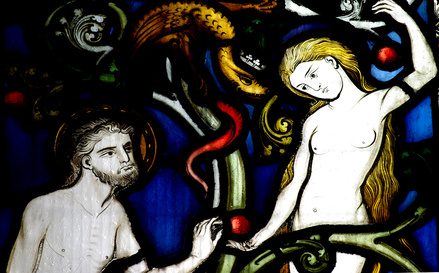
After a nice two-week break, I’m returning to my series of primers on theories of religion. This week we’re looking at three early anthropologists who believed that cultures evolve from “primitive” to “civilized” stages, and that religion is a characteristic of the earlier stages. Science and rationality (trumpet sounds!), of course, characterized the later, more advanced stages of development. Excelsior!
This post will have a lot of words like “primitive” and “savage” in it. I don’t use these words in my own work, so don’t get all huffy when you read them, all right? All right. I’m using the language of early anthropology to show the mindset and presuppositions these theorists brought to their work. At the same time, try not to dismiss everything they had to say automatically – their theories and ideas might be out of date (and, um, racist), but they helped advance the disciplines of anthropology and the study of religion, and many of their ideas are still influential today, even if they’re not accepted at face value.
E.B. Tylor
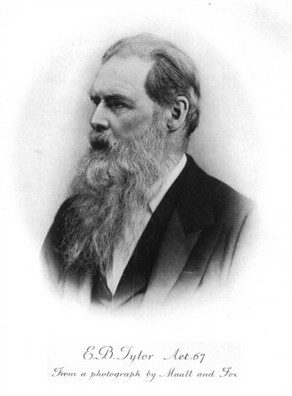
Just look at E.B. Tylor’s amazing beard. LOOK AT IT
You know how everyone (read: science writers and evolutionary psychologists) assumes that today’s hunter-gatherer cultures are basically the same as our own pre-agricultural forebears? Edward Burnett Tylor (1832-1917) is largely the reason for this. Tylor spent his entire career investigating the notion that humans inevitably progress through evolutionary stages from primitive to civilized. For Tylor, religion is an outgrowth of primitive animism, or the belief in spiritual beings. What separates civilized peoples from primitive ones is that civilized folks have transitioned away from a worldview that’s dominated by invisible spiritual beings to one that looks instead for regular physical laws and scientific explanations.
Tylor’s theory of how primitive minds develop their beliefs in spiritual beings is one that parallels many of today’s cognitive-science hypotheses: according to Tylor, people notice that they seem to have experiences of wandering around in other realms while dreaming, and this experience leads naturally to the idea that we each have a ghost or spirit that can detach from the body. This observation leads to the conclusion that life is actually rooted in a spiritual essence rather than matter. As Tylor put it:
In the first place, what is it that makes the difference between a living body and a dead one; what causes waking, sleep, trance, disease, death? In the second place, what are those human shapes which appear in dreams and visions?
Tylor believed that primitive peoples accepted their own faulty reasoning about spirits because they were incapable of properly distinguishing between subjects and objects, or between imagination and reality. But this wasn’t because primitive people were fundamentally inferior to or different from civilized folks. Instead, Tylor argued that “mankind is homogenous in nature, though placed in different grades of civilization.” Because of Tylor’s claim that people have the same kinds of minds across cultures, late 19th-century enthographers and missionaries began to think of the rituals and myths of the peoples they studied as being religious, and therefore analogous (although inferior) to Christianity.
Although Tylor’s work sounds a bit outdated (read: bigoted) to us today, it fit very neatly within the philosophical landscape of the late 19th century. Tylor was deeply influenced by the French philosopher Auguste Comte, who argued tirelessly that human culture evolved through stages.* Many very smart 19th-century people believed that evolution was a teleological, or goal-directed, process, inevitably marching from chaos to order, from primitive to civilized. Tylor believed that religion was a vestige that survived in modern times in forms such as theology and mythology, but would eventually be supplanted by science and progress.
Lucien Lévy-Bruhl
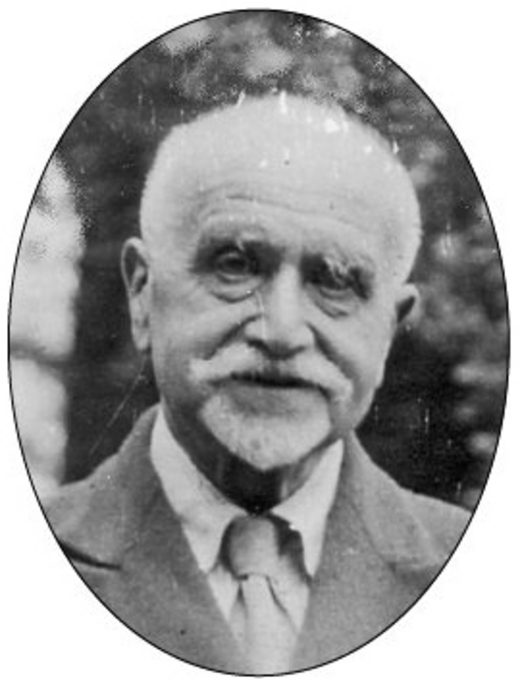
This is a nice beard, I guess, but it’s not exactly an E.B. Tylor beard.
Lucien Lévy-Bruhl (1857-1939) differed from his contemporary E.B. Tylor in several ways. First, he was French. Also, he possessed a much less impressive beard. But most importantly, Lévy-Bruhl did not believe, as Tylor did, that civilized and primitive peoples had basically the same sort of minds, just at different levels of development. On the contrary; for Lévy-Bruhl, there was a nearly impassable gap between the thought processes of civilized and uncivilized peoples, and he used this gap to explain religion.
Like Tylor, Lévy-Bruhl was influenced by Auguste Comte’s ideas about the evolution of culture, and assumed that human societies evolved teleologically through stages. But the distinctions between the cognitive habits of the early and later stages were stark indeed. For Lévy-Bruhl, what most distinguished the civilized from the primitive mentality was Aristotle’s Law of Noncontradiction, which asserts that nothing can both be true and false at the same time. (For instance, the sentence “I am in Reno and I am also in Denver” would be a violation of the Principle of Noncontradiction, because the speaker is claiming to both be in Reno and to not be in Reno simultaneously.†) This law is one of the most important logical foundations of Western thought. And Lévy-Bruhl claimed that primitives simply do not abide by it.
Instead, Lévy-Bruhl argued, primitive minds adhere to a Law of Participation, which allows them to believe that every object or entity in the world is somehow both itself and something else – something more mystical. For example, Lévy-Bruhl noted that many tribal cultures have totemic rituals, in which members of distinct groups or clans literally believe themselves to be certain kinds of animals, or to somehow participate in the animalness of their totemic beasts. In a given tribe, for instance, there might be a Bear clan and an Eagle clan and a Badger clan. Lévy-Bruhl argued that these identities are not metaphorical or poetic; instead, members of the Badger clan literally believe that they are somehow badgers. But of course they are also humans. And so voilà: the Law of Noncontradiction is violated without even a raised eyebrow. From this violation – and not from Tylor’s animistic beliefs – arises the mystical thinking and belief in invisible forces that underlie religion.
James Frazer
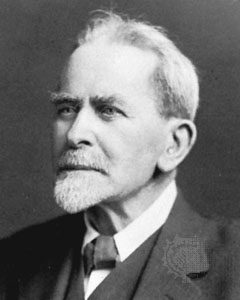
Little-known fact: The U.S. Air Force designed several high-speed stealth airplanes using Frazer’s chin as a visual reference
James G. Frazer (1854-1941), author of the anthropological classic The Golden Bough, was – and still is – the most widely influential of the three Dead White Men we’re covering today. He didn’t just give a kick-start to social anthropology and comparative ethnology; he also stamped his influence on the literature and popular culture of the 20th century, shaping the work of writers as diverse as James Joyce, Joseph Campbell, and T.S. Eliot. By attempting to show how mythology and religious ideas exhibited common patterns worldwide, he advanced the notion that civilized Europeans weren’t so different from “savages” after all, and that religions like Christianity were just unique manifestations of cross-cultural motifs – an idea that’s still popular today, especially among laypersons (and neo-Pagans).
But Frazer’s ideas about universal mythological motifs did not mean for a second that he thought primitive and civilized societies were equal. Nuh-uh. Like Tylor and Lévy-Bruhl, Frazer thought that human societies moved through evolutionary stages. Specifically, Frazer famously argued that societies moved through magic to religion and then finally on to science. Although he believed that science was the most advanced of the three stages, he was most interested in the stage he called “magic.”
For Frazer, magical thought – the most primitive stage of cultural development – is defined by the belief that the world operates according to fixed laws, and that humans can manipulate these laws to get what they want. In this sense, magic is exactly like science, right? Except that magic operates by mistaken logic and faulty assumptions – most especially, the assumption that the laws governing how things work in the world are reflections of what goes on in our minds. Specifically, Frazer famously claimed that magic was powered the Law of Similarity and the Law of Contact or Contagion. The Law of Similarity dictated that things that are similar to one another influence one another – for example, ancient Greeks ate the eggs of ravens (which are black) in order to turn their hair black. The Law of Contact stipulated that, once two things had been in contact with each other, they would continue to affect one another even after being separated. An example might be the classic idea that a bit of hair from someone’s body is still somehow mystically connected with that person.
Magic gave way to religion, Frazer believed, once people realized that their magical reasoning wasn’t getting them anywhere. In the religious stage of human development, people no longer believed that the universe operates according to strict laws; instead, they saw it as being under the influence of capricious, supernatural agents. Religion, for Frazer, was “a propitiation or conciliation of powers superior to man which are believed to direct and control the course of nature and of human life.” In other words, religion was what happened once people decided the universe was a crazy place governed by irascible, unpredictable spirits and gods instead of neat, impersonal, magical rules.
After religion came science, which returned to the magical view that the world is actually governed by fixed, discoverable laws – but this time with experimental and logical rigor, leading to the discovery of the correct laws. But Frazer believed that science might not even be the final stage, writing that
…as science has supplanted its predecessors, so it may hereafter be itself superseded by some more perfect hypothesis, perhaps by some totally different way of looking at the phenomena–of registering the shadows on the screen—of which we in this generation can form no idea.
_____
* …And eventually alienated everyone he knew by being the world’s biggest curmudgeon, but that’s another story.
† Warning: if you find yourself to both be in Reno and not be in Reno simultaneously, you may be on a drug bender
Previous Post

June 10, 2014
Why do religions tell impossible tales? A testable hypothesis
Next Post
June 28, 2014 How do we make meaning of evolution? By admitting its uncomfortable truths.
Browse Our Archives
Select a Category Atheism Cognitive Science of Religion Costly investment theory Cultural psychology Editorial Evolution Evolution of Religion Evolution of religion series Evolutionary psychology Ideology and religion Modeling Religion Project Modern culture and religion Most Popular Practice of science Religion and education Religion and ethics Religion and health Religion and perception Religion and prejudice Religious violence Religious ways of thinking Science and religion Scientific study of religion Secularization Spirituality Uncategorized
Select a Month July 2022 February 2022 December 2021 October 2021 August 2021 July 2021 June 2021 May 2021 April 2021 March 2021 February 2021 January 2021 December 2020 November 2020 October 2020 September 2020 August 2020 July 2020 June 2020 May 2020 April 2020 March 2020 February 2020 January 2020 November 2019 October 2019 September 2019 August 2019 July 2019 June 2019 May 2019 April 2019 March 2019 February 2019 January 2019 December 2018 November 2018 October 2018 September 2018 August 2018 July 2018 June 2018 May 2018 April 2018 March 2018 February 2018 January 2018 December 2017 November 2017 October 2017 September 2017 August 2017 July 2017 June 2017 May 2017 April 2017 March 2017 February 2017 January 2017 December 2016 November 2016 September 2016 August 2016 June 2016 April 2016 March 2016 February 2016 January 2016 November 2015 October 2015 September 2015 August 2015 July 2015 June 2015 May 2015 April 2015 March 2015 February 2015 January 2015 December 2014 November 2014 October 2014 September 2014 August 2014 July 2014 June 2014 May 2014 April 2014 March 2014 February 2014 January 2014 December 2013 November 2013 October 2013 September 2013 August 2013 July 2013 June 2013 May 2013 April 2013 March 2013 February 2013 January 2013 December 2012 November 2012 October 2012 September 2012 August 2012 July 2012 June 2012 May 2012 April 2012 March 2012 February 2012
Follow Us!
TAKE THE
Religious Wisdom Quiz
Who said: "Behold, I stand at the door and knock. If anyone hears My voice and opens the door, I will come in"?
Select your answer to see how you score.
Jesus (to the church in Laodicea) The Spirit John Paul
Related posts from Science On Religion

Why Rites of Passage Are Painful



TRENDING AT PATHEOS Religion News

Catholic Integralists believe that religious values – specifically Christian ones – should...

Electing A Virtuous President Would Make Immunity Irrelevant
Presidential immunity can bring with it many risks. So how can we...

Why The Olympic Games Are A ‘Civil Religious’...
Sporting events form a vital space where Americans display their 'civil religious...

After more than a decade of news, research updates, and insights on...

Q: Why do Southern Baptists and like-minded Protestants...
THE RELIGION GUY’S ANSWER: Why? Simple. Because they believe that’s what the...

THE QUESTION: Is gambling evil? THE RELIGION GUY’S ANSWER: Analysts anticipate a...
view all Religion News blogs
Ad-Free & Subscriber Log-In Subscription Support
- About Us
- 2026 Calendar
- Videos
- Podcasts
- Library of World Religions
- Faith In Media Tracker
- Advertise With Us
- Write for Us
- Privacy Policy
- Terms of Service
- Do Not Sell My Data
- Contact Us
- Radiant Digital
- Manage Newsletter Subscriptions
- Unsubscribe From Notifications
- Sitemap
Copyright 2008-2026, Patheos. All rights reserved.
Subscription Support Ad-Free & Subscriber Log-In
Follow Patheos