
BuddhistCatholicContemplativeEvangelicalGeneral ChristianHinduJewishLatter-day SaintMuslimNew VisionsProgressive Christian
Beliefs
- Buddhist
- Catholic
- Contemplative
- Evangelical
- General Christian
- Hindu
- Jewish
- Latter-day Saint
- More Voices
- Muslim
- New Visions
- Pagan
- Progressive Christian
Topics
- Religion News
- Food and Religion
- Sports and Religion
- Religious Art
- Religious Music and Entertainment
- Religious Events
- History and Religion
- Style and Religion
- Politics and Religion
- Women in Religion
- Recreation Outdoors and Religion
- Business Finance and Religion
- Careers Workplace and Religion
- Education and Religion
- Family Parenting and Religion
- Health Fitness and Religion
- Home and Religion
- Relationships and Religion
- Technology and Religion
- Travel and Religion
Columnists
- Buddhist Columnists
- Business Finance and Religion Columnists
- Careers Workplace and Religion Columnists
- Catholic Columnists
- Contemplative Columnists
- Education and Religion Columnists
- Evangelists Columnists
- Family Parenting and Religion Columnists
- General Christian Columnists
- Health Fitness and Religion Columnists
- Hindu Columnists
- History and Religion Columnists
- Home and Religion Columnists
- Jewish Columnists
- More Voices Columnists
- Latter Day Columnists
- Muslim Columnists
- New Visions Columnists
- Nonreligious Columnists
- Pagan Columnists
- Politics and Religion Columnists
- Progressive Columnists
- Recreation Outdoors and Religion Columnists
- Relationships and Religion Columnists
- Religion News Columnists
- Religious Art Columnists
- Religious Events Columnists
- Religious Music and Entertainment Columnists
- Sports and Religion Columnists
- Style and Religion Columnists
- Technology and Religion Columnists
- Travel and Religion Columnists
- Women in Religion Columnists
Resource Library
- 2026 Calendar
- Library of World Religions
- The 100 Most Holy Places on Earth
- Patheos Answers
- Podcasts
- Videos
- Faith Leaders Database
- Anglican Episcopalian
- Bahai
- Baptist
- Buddhism
- Christianity
- Confucianism
- Eastern Orthodoxy
- Hinduism
- Holiness and Pentecostal
- ISKCON
- Islam
- Judaism
- Lutheran
- Methodist
- The Church of Jesus Christ of Latter-day Saints
- New Age
- Paganism
- Presbytarian and Reformed
- Protestantism
- Religion Behind the Scenes
- Roman Catholic
- Scientology
- Shia Islam
- Sikhism
- Sufism
- Sunni Islam
- Taoism
- Zen
- See all religions
Research Tools
 Ad-Free & Subscriber Log-In Subscription Support
Ad-Free & Subscriber Log-In Subscription Support
Follow Patheos 

- Trending:
- Forgiveness
- |
- Marriage
- |
- Consciousness
- |
- Death Penalty
- |
- Election
- |
- Halloween
 Science On Religion
- Home
- Religion News
- Spirit possession: everyone’s doing it
Spirit possession: everyone’s doing it
Last updated on: December 14, 2014 at 7:14 pm by Connor Wood
Spirit possession: everyone’s doing it 2014-12-14T19:14:04-05:00 Connor Wood
Patheos Explore the world's faith through different perspectives on religion and spirituality! Patheos has the views of the prevalent religions and spiritualities of the world.
Connor Wood
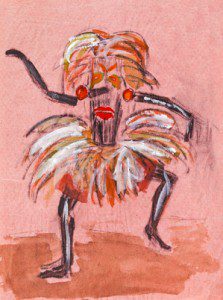
I haven’t written a post here for more than a week. This is because I have been spending all my free time, and much of my non-free time, furiously writing two articles for an encyclopedia on spirit possession. Yes – you heard that right. Possession. By spirits. The two articles (which were technically due back on, um, January 1st) are about the zar possession cult in northeast Africa and shamanism in Korea, respectively. I wrote my master’s thesis on Korean shamanism, and have had an academic and personal interest in such things ever since. But where does something as wild and spooky as spirit possession fit into religion?
First, let’s be clear about what we mean when we say “spirit possession.” In the zar cults of northeast Africa and the Arabian Peninsula, many people (nearly always women) take part in ecstatic, music-intensive ceremonies that last all night and give a number of spirits, or djinn, the chance to intentionally take possession of their very bodies. It works like this: the women go into a trance while dancing to the clamorous drums, and while they’re checked out, the spirits check in. The spirits cause the women’s bodies to move and talk in strange, foreign ways, dance in wild rhythms, and express sadnesses and pains or cravings. At the end of the night, an animal is usually sacrificed, and the next day everyone goes back to their regular lives – no longer possessed.
Similar sights can be seen all over the world. The Brazilian religion Candomblé, Haitian Vodou, and Siberian Tungus shamanism – from where we get the English word “shaman” – all feature expert practitioners intentionally opening up their bodies to inhabitation by non-human spirits. So does Korean shamanism, which is also female-dominated. Meanwhile, the historical Christian, Muslim, and Buddhist literatures are rife with accounts of demons, spirits, and djinns taking hold of people’s bodies or minds and controlling or influencing them. This is clearly a major feature of world cultures, regardless of how bizarre or crazy we Western observers might think it is.
Because spirit possession turns up so regularly in human societies across the globe, I think we have a responsibility to take it seriously and study it. Why on earth would something like this happen so frequently? What is it about human cognitive or physiological architecture that allows us, even encourages us, to feel as though we’re being taken hold of by outside forces that are different from us, that are somehow completely alien – yet capable of inhabiting us so intimately? This is a very, very interesting question.
You wouldn’t necessarily get this impression reading through the literature in religious studies or the scientific study of religion, though. As far as many scholars of religion are concerned, spirit possession and ecstatic spiritual practices like the zar cult are peripheral sideshows to the real main course of formal religious practice and sacred texts. For the most part, the only folks who really take spirit possession seriously are anthropologists – because, having actually spent large chunks of their lives hanging out with people who are not middle-class Westerners, they understand that possession and related phenomena are basic features of human existence.
The scientific study of religion also neglects spirit possession. Today, the scientific study of religion is dominated by a few basic research strands. The first of these strands, and the largest, uses the tools of social science – such as surveys, demographic analysis, and so forth – to study things like waxing and waning of American congregations or the health effects of being a faithful churchgoer. Another strand is the study of how religions grew and evolved in human history, and what roles they play in human groups. This is the line of research I spend the most time on, and the one I think has the best connection with evolutionary literature. A third strand, smaller but more focused than the others, is the cognitive science of religion, which asks how human brains give rise to abstract concepts like “gods” or “heaven.”
The astounding prevalence of spirit possession cults around the world, however, makes me think that this is not necessarily the most important question we could be asking. Cognitive scientists of religion want to know how it is that human brains give rise to the sorts of processing errors that make us believe there are such things as invisible gods or incorporeal spirits. Their approach is highly focused on information and cognition and abstract concepts.
For example, one of the most well-accepted theories in the cognitive science of religion is one I’ve written about here recently: namely, the suggestion that religion arises from the overuse of anthropomorphic cognitive programs. Our brains are hardwired to be good at dealing with other humans; a couple hundred millennia of evolution has soldered those connections deeply into our neural circuitry. A lot of evidence suggests that, because our minds are so shaped by our hyper-social evolutionary history, we’re primed to see human-like agency and intentionality in all sorts of supposedly random natural phenomena, like faces in the clouds or the shapes of leaves in the wind. Our minds, then, are preprogrammed to intuit invisible human-like agents everywhere, and to believe in gods.
But here’s the thing: the gods and spirits people encounter in spirit possession cults aren’t abstract or invisible. They take hold of people’s bodies and make them do incredible, fantastic, or dangerous things. They make themselves apparent and act in ways that are recognizable regardless of which individuals they take possession of. This, then, is not people erroneously seeing patterns in randomness, or squinting to see faces in the sky. This is flesh-and-blood people being confronted with living, alien others who intrude into humans’ bodies and bring with them spirit wisdom, difficulties, or healing.
I’m not arguing that you should believe in the objective reality of these spirits, although you certainly can if you want. What I am arguing is that these possession experiences are not easily explained by citing mere cognitive processes. The idea that religion arises from a cognitive error – our tendency to over-intuit agency in our environment – doesn’t do justice to the strangeness that is spiritual possession. And this strangeness is so ubiquitous across human cultures that, clearly, there’s something here to understand. The explanations for it are going to have to be more rigorous and multifaceted than most of the theories that currently dominate the scientific study of religion. And they’re going to have to rely on more than just cognitive misfirings.
It’s also important to realize that spirit possession isn’t even so alien in our own, Western world. The bedrock writings of Christianity, including the church fathers and the writings of the desert monks of the early centuries C.E., are chock-full of stories of spiritual possession. What we think of as the Seven Deadly Sins, for example, were originally demons – that is, distinct, spiritual beings that intruded into meditating monks’ minds from the outside and tempted them. These demons were also known, interestingly, as logismoi, or “thoughts.” But what’s fascinating is that these “thoughts” were seen as coming from the outside – they were beings who could take over a person’s mind and body if that person wasn’t careful.
Today, spirit possession doesn’t have much cachet among the educated ranks of Western societies, or among, say, mainline Protestants. But the demons haven’t gone away. Demonic possession, especially of a low-grade, non-dramatic style, is a common trope among charismatic American Christians, who often describe sins and bad habits as the work of outside beings. Meanwhile, Pentecostals and Charismatics alike experience the Holy Spirit coming into their bodies from the outside. These are experienced,bodily realities – not abstract propositional ones.
Anti-religion writers and cognitive scientists of religion alike tend to consider religion as if it were mostly sets of abstract, linguistically representable propositions, like “God exists” or “Jesus saves” or “the Flying Spaghetti Monster is real.” But spirit possession shows us that propositions don’t even come close to covering all the territory of religion. People in zar cults or leaders of Korean shamanic rituals don’t believe in spirits. They experience and embody them. If we really want to tackle the question of what religion is and why we humans have it, we have to look squarely at practices that don’t fit into our own, Western cultural schemas – because they do fit into almost everyone else’s.
______
Note – I’ve edited this post to correct the spelling of the word “Vodou” to match preferred standards.
Previous Post

January 13, 2014
My employer: The Institute for the Bio-Cultural Study of Religion
Next Post
February 4, 2014 Holden Caulfield and the Super Bowl
Browse Our Archives
Select a Category Atheism Cognitive Science of Religion Costly investment theory Cultural psychology Editorial Evolution Evolution of Religion Evolution of religion series Evolutionary psychology Ideology and religion Modeling Religion Project Modern culture and religion Most Popular Practice of science Religion and education Religion and ethics Religion and health Religion and perception Religion and prejudice Religious violence Religious ways of thinking Science and religion Scientific study of religion Secularization Spirituality Uncategorized
Select a Month July 2022 February 2022 December 2021 October 2021 August 2021 July 2021 June 2021 May 2021 April 2021 March 2021 February 2021 January 2021 December 2020 November 2020 October 2020 September 2020 August 2020 July 2020 June 2020 May 2020 April 2020 March 2020 February 2020 January 2020 November 2019 October 2019 September 2019 August 2019 July 2019 June 2019 May 2019 April 2019 March 2019 February 2019 January 2019 December 2018 November 2018 October 2018 September 2018 August 2018 July 2018 June 2018 May 2018 April 2018 March 2018 February 2018 January 2018 December 2017 November 2017 October 2017 September 2017 August 2017 July 2017 June 2017 May 2017 April 2017 March 2017 February 2017 January 2017 December 2016 November 2016 September 2016 August 2016 June 2016 April 2016 March 2016 February 2016 January 2016 November 2015 October 2015 September 2015 August 2015 July 2015 June 2015 May 2015 April 2015 March 2015 February 2015 January 2015 December 2014 November 2014 October 2014 September 2014 August 2014 July 2014 June 2014 May 2014 April 2014 March 2014 February 2014 January 2014 December 2013 November 2013 October 2013 September 2013 August 2013 July 2013 June 2013 May 2013 April 2013 March 2013 February 2013 January 2013 December 2012 November 2012 October 2012 September 2012 August 2012 July 2012 June 2012 May 2012 April 2012 March 2012 February 2012
Follow Us!
TAKE THE
Religious Wisdom Quiz
What symbol is most commonly associated with Christianity worldwide?
Select your answer to see how you score.
The cross The dove The fish The lamb
Related posts from Science On Religion

Why Rites of Passage Are Painful



TRENDING AT PATHEOS Religion News

Catholic Integralists believe that religious values – specifically Christian ones – should...

Electing A Virtuous President Would Make Immunity Irrelevant
Presidential immunity can bring with it many risks. So how can we...

Why The Olympic Games Are A ‘Civil Religious’...
Sporting events form a vital space where Americans display their 'civil religious...

After more than a decade of news, research updates, and insights on...

Q: Why do Southern Baptists and like-minded Protestants...
THE RELIGION GUY’S ANSWER: Why? Simple. Because they believe that’s what the...

THE QUESTION: Is gambling evil? THE RELIGION GUY’S ANSWER: Analysts anticipate a...
view all Religion News blogs
Ad-Free & Subscriber Log-In Subscription Support
- About Us
- 2026 Calendar
- Videos
- Podcasts
- Library of World Religions
- Faith In Media Tracker
- Advertise With Us
- Write for Us
- Privacy Policy
- Terms of Service
- Do Not Sell My Data
- Contact Us
- Radiant Digital
- Manage Newsletter Subscriptions
- Unsubscribe From Notifications
- Sitemap
Copyright 2008-2026, Patheos. All rights reserved.
Subscription Support Ad-Free & Subscriber Log-In
Follow Patheos