
BuddhistCatholicContemplativeEvangelicalGeneral ChristianHinduJewishLatter-day SaintMuslimNew VisionsProgressive Christian
Beliefs
- Buddhist
- Catholic
- Contemplative
- Evangelical
- General Christian
- Hindu
- Jewish
- Latter-day Saint
- More Voices
- Muslim
- New Visions
- Pagan
- Progressive Christian
Topics
- Religion News
- Food and Religion
- Sports and Religion
- Religious Art
- Religious Music and Entertainment
- Religious Events
- History and Religion
- Style and Religion
- Politics and Religion
- Women in Religion
- Recreation Outdoors and Religion
- Business Finance and Religion
- Careers Workplace and Religion
- Education and Religion
- Family Parenting and Religion
- Health Fitness and Religion
- Home and Religion
- Relationships and Religion
- Technology and Religion
- Travel and Religion
Columnists
- Buddhist Columnists
- Business Finance and Religion Columnists
- Careers Workplace and Religion Columnists
- Catholic Columnists
- Contemplative Columnists
- Education and Religion Columnists
- Evangelists Columnists
- Family Parenting and Religion Columnists
- General Christian Columnists
- Health Fitness and Religion Columnists
- Hindu Columnists
- History and Religion Columnists
- Home and Religion Columnists
- Jewish Columnists
- More Voices Columnists
- Latter Day Columnists
- Muslim Columnists
- New Visions Columnists
- Nonreligious Columnists
- Pagan Columnists
- Politics and Religion Columnists
- Progressive Columnists
- Recreation Outdoors and Religion Columnists
- Relationships and Religion Columnists
- Religion News Columnists
- Religious Art Columnists
- Religious Events Columnists
- Religious Music and Entertainment Columnists
- Sports and Religion Columnists
- Style and Religion Columnists
- Technology and Religion Columnists
- Travel and Religion Columnists
- Women in Religion Columnists
Resource Library
- 2026 Calendar
- Library of World Religions
- The 100 Most Holy Places on Earth
- Patheos Answers
- Podcasts
- Videos
- Faith Leaders Database
- Anglican Episcopalian
- Bahai
- Baptist
- Buddhism
- Christianity
- Confucianism
- Eastern Orthodoxy
- Hinduism
- Holiness and Pentecostal
- ISKCON
- Islam
- Judaism
- Lutheran
- Methodist
- The Church of Jesus Christ of Latter-day Saints
- New Age
- Paganism
- Presbytarian and Reformed
- Protestantism
- Religion Behind the Scenes
- Roman Catholic
- Scientology
- Shia Islam
- Sikhism
- Sufism
- Sunni Islam
- Taoism
- Zen
- See all religions
Research Tools
 Ad-Free & Subscriber Log-In Subscription Support
Ad-Free & Subscriber Log-In Subscription Support
Follow Patheos 

- Trending:
- Forgiveness
- |
- Marriage
- |
- Consciousness
- |
- Death Penalty
- |
- Election
- |
- Halloween
 Science On Religion
- Home
- Religion News
- Trust issues? The answer might be rhythm
Trust issues? The answer might be rhythm
Last updated on: October 26, 2013 at 10:38 pm by Connor Wood
Trust issues? The answer might be rhythm 2013-10-26T22:38:36-04:00 Connor Wood
Patheos Explore the world's faith through different perspectives on religion and spirituality! Patheos has the views of the prevalent religions and spiritualities of the world.
Connor Wood
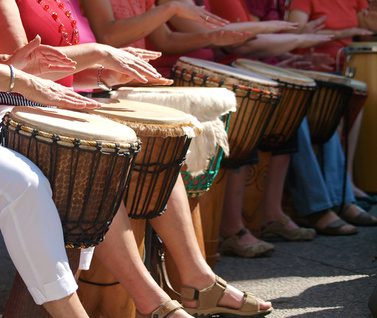
One mistaken assumption many Americans have about religion is that it’s a private affair – a certain set of beliefs that individuals either do or don’t hold in their hearts. But the reality is that throughout cultures and history, people have gathered to chant, sing, and worship in communities, from Korean Buddhist sanghas to little Protestant chapels in New England. While there are massive differences between traditions, members of nearly every religious community take part in some sort of synchrony, or shared, rhythmic action: think singing in time, or bowing simultaneously toward Mecca. And recent research from New Zealand shows that this moving or chanting in sync helps people act more generously – especially if they’ve worked hard to stay in time with each other.
Previous research had already found that synchronous bodily motion encourages prosocial – that is, generous and cooperative – behavior. In 2009, for instance, a pair of psychologists from Stanford showed that marching in tandem around a building encouraged volunteers to be far more generous to each other than did simply walking together in a group. Similarly, a team at Northeastern and Harvard Universities found that synchronous tapping led participants to feel more empathy for and offer more assistance to each other.
But not all results have been positive. One team recently found that drumming in synchrony didn’t lead to any greater generosity among Brazilian volunteers, suggesting either that the effect is culture-bound (that is, limited to only specific cultures) or that it requires specific circumstances to elicit. (Some commentators, however, have also pointed out that the Brazilian study had a small subject pool, so the negative results might be due to low statistical power.)
In the face of intriguing but not unanimous evidence, the paper a team of New Zealand researchers published in PLOS ONE this past August sheds some useful light on things. Noting that many real-world religious rituals feature shared intentionality – a collaborative effort at accomplishing a ritual goal – Paul Reddish, Ronald Fischer, and Joseph Bulbulia designed three studies to parse out the difference between pure bodily synchrony and synchrony plus shared intentions. Their hypothesis? That shared intentions would boost the generosity-enhancing effects of synchrony.
It’s important to note that the “shared intentionality” in this study wasn’t focused on anything as grandiose as building a temple or even solving a math puzzle together. That is, the participants in the three studies weren’t teaming up to accomplish specific goals outside of the rhythmic, synchronous activities themselves. Instead, for example, some groups of participants were told to work together to stay in time, while other groups were told to work together to stay out of time. In both situations, the study participants had to keep focus on one another, attending to the entire performance of the group. To that extent, they were linked as a whole. But some groups were in synchrony while others weren’t.
Meanwhile, other participants were brought into synchrony as groups by focusing on metronome beats they heard through headphones. This design parsed out group intentionality from synchrony – because each individual was listening to the same metronome beat while swinging his or her arms or body, the group itself came into sync. But even though the group was in sync, the subjects weren’t paying attention to each other, or to the group: instead, each person was focused on the individual goal of matching his or her movements to the beat in the headphones.
For the first experiment, two other conditions were used: in one, the participants heard different beats in their headphones, which put their bodily movements out of sync with one another. And in the other, participants merely watched a video of other people playing a synchrony game.
Following these group activities, subjects were then asked to play a resource-sharing game. Each participant was given five dollars and then told to decide how much to contribute to a collective pot. The amount of money in the collective pot would be doubled after the game was completed, and the resulting sum distributed evenly among all players. This game is generally assumed to measure cooperation because putting your full five dollars in the pot is a risk: it only pays off if most of the other players also decide to invest their full holdings. If you’re selfish but others are generous, you stand to benefit: after the pot is doubled, you receive whatever portion is yours, plus the five dollars you decided not to contribute to the pot.
As the researchers expected, the synchronous bodily motions had a significant impact on generosity. While only 23% of participants who had performed non-synchronous motions and 33% of the participants who’d watched a video contributed the full five dollars to their groups, a full 50% of subjects in the synchronous condition and 55% of subjects in the “shared intentionality” condition (which also included synchronous motions) opted for the full contribution.
A second study used random chanted words and a different kind of resource-sharing game, the “stag hung” game. In the stag hunt, each player is given two options. In the first option, “option X,” players receive a guaranteed payout of seven dollars. In the second option, “option Y,” players get $10 – but only if all players choose option Y. If anyone else chooses option X, players who chose option Y get nothing at all.
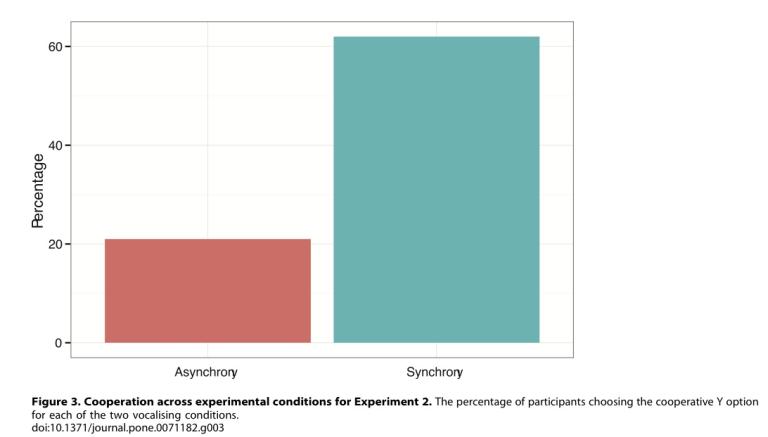
Image: PLOS ONE
In this study, the difference between chanting in rhythm and chanting out of rhythm was even more striking. Only 21% of participants in the non-synchronous chanting condition chose option Y – the more risky option that shows trust in other group members. But a full 62% of participants who’d chanted in time with one another chose risky option Y. Clearly, synchrony seemed to have an effect on participants’ willingness to trust one another (see chart above).
A final study was inspired by the fact that many rituals and dances around the world don’t feature pure synchrony, but instead require performers to act sequentially – that is, to perform in the same rhythm but out of phase with one another. (Think of ballet dancers in a line, each pirouetting right after the other: they don’t actually dance in perfect synchrony, but they do act in tandem and on the same rhythm.) Would sequential rhythmic acts have the same effects as synchronous ones?
When it came to group trust, the answer was pretty clear: no. Out of six conditions, the only condition to have a significant (and hefty!) positive effect on participants’ mutual trust was synchronous motion combined with group intentionality. When participants moved in asynchronous or merely sequential ways, they weren’t any more likely to choose the risky option Y. When participants moved in synchronous ways but only focused on their own bodies and a metronome beat, they couldn’t be bothered to trust one another. It was only when participants both moved in synchrony and focused on the goal of keeping in time with one another – not with an impersonal metronome – that their levels of trust skyrocketed. (More than 90% of subjects in the shared intention/synchrony group opted to trust their peers in the stag hunt game.)
This set of studies is a powerful addition to the research on group synchrony and cooperation, not least because it keenly distinguishes between a number of possible effects and influences. What’s more, within the constraints of its own design it falsifies a number of robust hypotheses. Does merely beating out a time together cause people to suddenly swell in generosity and trust? Not necessarily. Does moving in the same rhythm, but out of phase, have a big effect on prosociality? Apparently not. Instead, the authors show that the cooperation-boosting effects of synchronous motion – of the type found in mosques, temples, and rituals worldwide – depends on both shared goals and synced-up bodies. This is a great example of how religious practices and phenomena actually can be studied scientifically – and that we can really learn something from doing so.
Previous Post

October 18, 2013
A friendly reminder: Science isn't reality. Reality is reality.
Next Post
November 5, 2013 Russell Brand is wrong about Western religions
Browse Our Archives
Select a Category Atheism Cognitive Science of Religion Costly investment theory Cultural psychology Editorial Evolution Evolution of Religion Evolution of religion series Evolutionary psychology Ideology and religion Modeling Religion Project Modern culture and religion Most Popular Practice of science Religion and education Religion and ethics Religion and health Religion and perception Religion and prejudice Religious violence Religious ways of thinking Science and religion Scientific study of religion Secularization Spirituality Uncategorized
Select a Month July 2022 February 2022 December 2021 October 2021 August 2021 July 2021 June 2021 May 2021 April 2021 March 2021 February 2021 January 2021 December 2020 November 2020 October 2020 September 2020 August 2020 July 2020 June 2020 May 2020 April 2020 March 2020 February 2020 January 2020 November 2019 October 2019 September 2019 August 2019 July 2019 June 2019 May 2019 April 2019 March 2019 February 2019 January 2019 December 2018 November 2018 October 2018 September 2018 August 2018 July 2018 June 2018 May 2018 April 2018 March 2018 February 2018 January 2018 December 2017 November 2017 October 2017 September 2017 August 2017 July 2017 June 2017 May 2017 April 2017 March 2017 February 2017 January 2017 December 2016 November 2016 September 2016 August 2016 June 2016 April 2016 March 2016 February 2016 January 2016 November 2015 October 2015 September 2015 August 2015 July 2015 June 2015 May 2015 April 2015 March 2015 February 2015 January 2015 December 2014 November 2014 October 2014 September 2014 August 2014 July 2014 June 2014 May 2014 April 2014 March 2014 February 2014 January 2014 December 2013 November 2013 October 2013 September 2013 August 2013 July 2013 June 2013 May 2013 April 2013 March 2013 February 2013 January 2013 December 2012 November 2012 October 2012 September 2012 August 2012 July 2012 June 2012 May 2012 April 2012 March 2012 February 2012
Follow Us!
TAKE THE
Religious Wisdom Quiz
Which Orthodox celebration marks the resurrection of Christ?
Select your answer to see how you score.
Pascha Pentecost Epiphany Transfiguration
Related posts from Science On Religion

Why Rites of Passage Are Painful



The Catholic Latin Mass is a Strong Credibility-Enhancing...
TRENDING AT PATHEOS Religion News

Catholic Integralists believe that religious values – specifically Christian ones – should...

Electing A Virtuous President Would Make Immunity Irrelevant
Presidential immunity can bring with it many risks. So how can we...

Why The Olympic Games Are A ‘Civil Religious’...
Sporting events form a vital space where Americans display their 'civil religious...

After more than a decade of news, research updates, and insights on...

Q: Why do Southern Baptists and like-minded Protestants...
THE RELIGION GUY’S ANSWER: Why? Simple. Because they believe that’s what the...

THE QUESTION: Is gambling evil? THE RELIGION GUY’S ANSWER: Analysts anticipate a...
view all Religion News blogs
Ad-Free & Subscriber Log-In Subscription Support
- About Us
- 2026 Calendar
- Videos
- Podcasts
- Library of World Religions
- Faith In Media Tracker
- Advertise With Us
- Write for Us
- Privacy Policy
- Terms of Service
- Do Not Sell My Data
- Contact Us
- Radiant Digital
- Manage Newsletter Subscriptions
- Unsubscribe From Notifications
- Sitemap
Copyright 2008-2026, Patheos. All rights reserved.
Subscription Support Ad-Free & Subscriber Log-In
Follow Patheos