
BuddhistCatholicContemplativeEvangelicalGeneral ChristianHinduJewishLatter-day SaintMuslimNew VisionsProgressive Christian
Beliefs
- Buddhist
- Catholic
- Contemplative
- Evangelical
- General Christian
- Hindu
- Jewish
- Latter-day Saint
- More Voices
- Muslim
- New Visions
- Pagan
- Progressive Christian
Topics
- Religion News
- Food and Religion
- Sports and Religion
- Religious Art
- Religious Music and Entertainment
- Religious Events
- History and Religion
- Style and Religion
- Politics and Religion
- Women in Religion
- Recreation Outdoors and Religion
- Business Finance and Religion
- Careers Workplace and Religion
- Education and Religion
- Family Parenting and Religion
- Health Fitness and Religion
- Home and Religion
- Relationships and Religion
- Technology and Religion
- Travel and Religion
Columnists
- Buddhist Columnists
- Business Finance and Religion Columnists
- Careers Workplace and Religion Columnists
- Catholic Columnists
- Contemplative Columnists
- Education and Religion Columnists
- Evangelists Columnists
- Family Parenting and Religion Columnists
- General Christian Columnists
- Health Fitness and Religion Columnists
- Hindu Columnists
- History and Religion Columnists
- Home and Religion Columnists
- Jewish Columnists
- More Voices Columnists
- Latter Day Columnists
- Muslim Columnists
- New Visions Columnists
- Nonreligious Columnists
- Pagan Columnists
- Politics and Religion Columnists
- Progressive Columnists
- Recreation Outdoors and Religion Columnists
- Relationships and Religion Columnists
- Religion News Columnists
- Religious Art Columnists
- Religious Events Columnists
- Religious Music and Entertainment Columnists
- Sports and Religion Columnists
- Style and Religion Columnists
- Technology and Religion Columnists
- Travel and Religion Columnists
- Women in Religion Columnists
Resource Library
- 2026 Calendar
- Library of World Religions
- The 100 Most Holy Places on Earth
- Patheos Answers
- Podcasts
- Videos
- Faith Leaders Database
- Anglican Episcopalian
- Bahai
- Baptist
- Buddhism
- Christianity
- Confucianism
- Eastern Orthodoxy
- Hinduism
- Holiness and Pentecostal
- ISKCON
- Islam
- Judaism
- Lutheran
- Methodist
- The Church of Jesus Christ of Latter-day Saints
- New Age
- Paganism
- Presbytarian and Reformed
- Protestantism
- Religion Behind the Scenes
- Roman Catholic
- Scientology
- Shia Islam
- Sikhism
- Sufism
- Sunni Islam
- Taoism
- Zen
- See all religions
Research Tools
 Ad-Free & Subscriber Log-In Subscription Support
Ad-Free & Subscriber Log-In Subscription Support
Follow Patheos 

- Trending:
- Forgiveness
- |
- Marriage
- |
- Consciousness
- |
- Death Penalty
- |
- Election
- |
- Halloween
 Science On Religion
- Home
- Religion News
- Religion: is it always tribal?
Religion: is it always tribal?
Last updated on: July 17, 2013 at 12:13 pm by Connor Wood
Religion: is it always tribal? 2013-07-17T12:13:23-04:00 Connor Wood
Patheos Explore the world's faith through different perspectives on religion and spirituality! Patheos has the views of the prevalent religions and spiritualities of the world.

Connor Wood
It’s time to talk about a bogeyman of modern democracy: tribalism. Everyone knows that humans have given their allegiance to their own small groups – at the expense of larger groups and outsiders – since time immemorial. It’s also no secret that religion has played a central role in this process, by dividing Muslim from Christian, Protestant from Catholic, insider from outsider. The very soul of the modern Enlightenment is about overcoming this pernicious factionalism and forging one world in harmony. Unsurprisingly, then, advocates of post-tribal ethics from Jeremy Bentham to Kurt Vonnegut have been critics of religion. But the real story may be more complicated than such skeptics claim. Religions, it seems, offer tools both for creating tribes – and for expanding beyond them.
First, don’t get me wrong – ingroup/outgroup barriers are one of life’s most frustrating challenges. And tribalism is very hard to reconcile with progressive visions of a world of equality, fairness, and understanding. The moment you being to see other human beings as being somehow outside your perimeter, you can believe they’re less than human – objects to use or, worse, destroy. This dehumanizing stance is what thinkers from Kant to Martin Buber have argued is the root of sin. And, of course, being the outsider is a terrible position – as most people know who have survived the ugly gauntlet of American high school social life.
Religion, of course, has often been associated with prejudice. But in the post-Enlightenment rush to ditch everything associated with tribalism and its ugly machinations, I’m pretty sure we’ve left some very important social and emotional tools rusting on the ground behind us. All else aside, the bonds that can form between people in a small, tightly knit group are among the most intense emotional experiences many people ever have. Here’s a quote from Jason Everman, a former U.S. Army Ranger, about the experience of going into combat in Central American operation:
“The bond of locking shields with each other, working to defeat a common enemy…it’s a heightened state. Everyone looks around and you know – you know – something cool is going on here. I knew this was it. This is living.”*
Okay, maybe military tough-guy stuff isn’t your bag. But the kicker? Before joining the Army, Everman was a bassist for both Nirvana and Soundgarden. This is a man who toured with two of the biggest bands in the world; he knew what it was like to play to a sold-out venue, crowds screaming, spotlights glaring. And still he rated the experience of carrying out a dangerous, thrilling mission alongside fellow soldiers as one of the most powerful experiences of his life.
Recent research sheds light on this odd phenomenon. Military leaders and Outward Bound guides alike have long claimed that undergoing shared intense experiences creates powerful bonds between people. But this year Dmitri Xygalatas, a religion researcher at Aarhus University in Denmark, conclusively showed in a paper in Psychological Science that intense, painful rituals actually inspire people to be more generous with their groups – and even to identify with larger collectives beyond their religious affiliation.
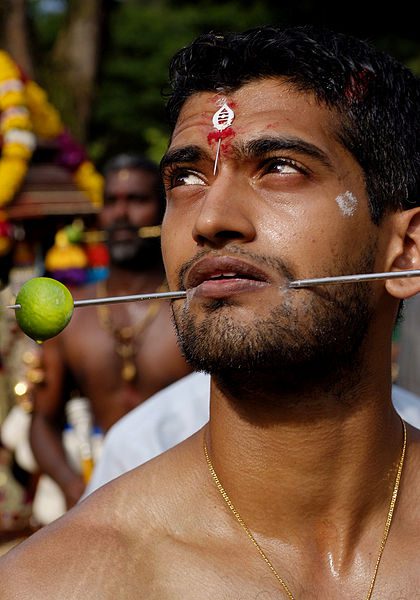
Source: Wikimedia Commons.
Along with a team of researchers from the Czech Republic and New Zealand, Xygalatas traveled to the religiously diverse island nation of Mauritius to study participants in a local Hindu celebration, Thaipusam. Thaipusam requires participants to carry out a number of different rituals, including both a low-key collective prayer and an extremely intense ceremony. The intense ceremony involves piercing the skin and cheeks with barbs, dragging carts with wires attached to hooks embedded in the skin, and climbing a mountain (see image at right). Xygalatas and his colleagues intercepted participants at the end of both rituals and asked them to fill out a short survey. The questions asked about participants’ feelings of pain and their identification with their religious group versus the broader Mauritian nationality.
After each participant filled out their surveys, they were given a significant amount of money – about two days’ wages. But before they left to go rejoin the festivities, they were offered a chance to donate some or all of the money to the local temple. The researchers measured how much each participant donated and compared that amount to which ritual they’d just completed and how much pain they said they felt.
Fascinatingly, the more pain participants said they’d experienced during the ritual, the more money they donated. In fact, the participants who reported experiencing the most pain gave away, on average, nearly all their payment, while the participants who ranked lowest on pain only gave away half. Meanwhile, participants in the low-intensity ritual gave away significantly less money than those who had participated in or observed the gruesome skin-piercing ordeal.
But perhaps most importantly, the people who took part in the bloody, painful ceremony reported feeling far more identified with Mauritius as a whole than with Hinduism. Mauritius is a diverse nation with numerous religious groups. Although Hinduism is the largest religion, only about 49% of the population are Hindus. Christianity counts about 35% of Mauritius’ inhabitants as followers, while Islam and other religions also have significant followings. Identifying as a Mauritian rather than as a Hindu, then, is actually a big deal, particularly for a committed religious believer. Something about the intense, painful ritual – exactly the kind that seems to bind soldiers and tribe members into tight groups – impelled the participating Hindus to broaden their sense of belonging.
The paper published by Xygalatas and his colleagues gives support to researchers such as Christopher Olivola and Eldar Shafir, who have also found that painful or intense rituals increase generosity. But the Mauritian findings are unique in suggesting that intense ceremonies not only boost altruism within a tribe – remember that the Thaipusan participants were donating money to their own temple – but also push participants’ sense of identity beyond the narrow tribal limits.
Or maybe these findings aren’t so shocking after all. In 2009, Case Western economist David Clingingsmith found that Muslims who had participated in the Hajj – the yearly pilgrimage to Mecca, one of the Five Pillars of Islam – afterwards tended to tone down their participation in local, parochial rituals such as using amulets and paying bridal dowries. At the same time, they increased their participation in pan-Islam practices like praying to Mecca and fasting during Ramadan. Their sense of belonging, in other words, expanded beyond their local community to encompass a broader, international community of Muslims. And what’s more, the researchers found that the Hajj pilgrimage
“increases belief in equality and harmony among ethnic groups and Islamic sects and leads to more favorable attitudes toward women, including greater acceptance of female education and employment. …Hajjis show increased belief in peace, and in equality and harmony among adherents of different religions.” (Emphasis mine.)
Wait – what’s that? Taking part in a massive, expensive trek across continents to the holy desert city of Mecca – an extreme ritual, to be sure – actually made Muslims more accepting of people of different faiths?
There appears to be a hole in the timeworn argument that religion always increases prejudice and tribalism. Frankly, I don’t think we need any more misinformation about, and dismissal of, religiosity – one of humankind’s most fundamental traits. While the tight, intense bonds of small groups can and often do exclude outsiders, they also offer powerful emotional connections that bind people to one another and give them a real sense of meaning (even for former rock stars). But beyond that, some intense rituals seem to stimulate a different reaction – a sense of belonging to a larger group.
_________
For a further look at how religions can stimulate prejudice, click here. For more on how believe in the afterlife can have exactly the opposite effect – making people less prejudiced against outsiders, click here.
_________
* Read the original New York Times article here. Seriously, it’s worth 20 minutes of your time.
Previous Post

July 9, 2013
Religion and creativity: A follow-up
Next Post
July 20, 2013 Science and humility
Browse Our Archives
Select a Category Atheism Cognitive Science of Religion Costly investment theory Cultural psychology Editorial Evolution Evolution of Religion Evolution of religion series Evolutionary psychology Ideology and religion Modeling Religion Project Modern culture and religion Most Popular Practice of science Religion and education Religion and ethics Religion and health Religion and perception Religion and prejudice Religious violence Religious ways of thinking Science and religion Scientific study of religion Secularization Spirituality Uncategorized
Select a Month July 2022 February 2022 December 2021 October 2021 August 2021 July 2021 June 2021 May 2021 April 2021 March 2021 February 2021 January 2021 December 2020 November 2020 October 2020 September 2020 August 2020 July 2020 June 2020 May 2020 April 2020 March 2020 February 2020 January 2020 November 2019 October 2019 September 2019 August 2019 July 2019 June 2019 May 2019 April 2019 March 2019 February 2019 January 2019 December 2018 November 2018 October 2018 September 2018 August 2018 July 2018 June 2018 May 2018 April 2018 March 2018 February 2018 January 2018 December 2017 November 2017 October 2017 September 2017 August 2017 July 2017 June 2017 May 2017 April 2017 March 2017 February 2017 January 2017 December 2016 November 2016 September 2016 August 2016 June 2016 April 2016 March 2016 February 2016 January 2016 November 2015 October 2015 September 2015 August 2015 July 2015 June 2015 May 2015 April 2015 March 2015 February 2015 January 2015 December 2014 November 2014 October 2014 September 2014 August 2014 July 2014 June 2014 May 2014 April 2014 March 2014 February 2014 January 2014 December 2013 November 2013 October 2013 September 2013 August 2013 July 2013 June 2013 May 2013 April 2013 March 2013 February 2013 January 2013 December 2012 November 2012 October 2012 September 2012 August 2012 July 2012 June 2012 May 2012 April 2012 March 2012 February 2012
Follow Us!
TAKE THE
Religious Wisdom Quiz
What is the largest Oriental Orthodox church by population?
Select your answer to see how you score.
Ethiopian Orthodox Armenian Apostolic Coptic Orthodox Syriac Orthodox
Related posts from Science On Religion



Geophysicist Dorian Abbot Loses MIT Lecture Thanks to...

Faith and the Evolutionary Predicament
TRENDING AT PATHEOS Religion News

Catholic Integralists believe that religious values – specifically Christian ones – should...

Electing A Virtuous President Would Make Immunity Irrelevant
Presidential immunity can bring with it many risks. So how can we...

Why The Olympic Games Are A ‘Civil Religious’...
Sporting events form a vital space where Americans display their 'civil religious...

After more than a decade of news, research updates, and insights on...

Q: Why do Southern Baptists and like-minded Protestants...
THE RELIGION GUY’S ANSWER: Why? Simple. Because they believe that’s what the...

THE QUESTION: Is gambling evil? THE RELIGION GUY’S ANSWER: Analysts anticipate a...
view all Religion News blogs
Ad-Free & Subscriber Log-In Subscription Support
- About Us
- 2026 Calendar
- Videos
- Podcasts
- Library of World Religions
- Faith In Media Tracker
- Advertise With Us
- Write for Us
- Privacy Policy
- Terms of Service
- Do Not Sell My Data
- Contact Us
- Radiant Digital
- Manage Newsletter Subscriptions
- Unsubscribe From Notifications
- Sitemap
Copyright 2008-2026, Patheos. All rights reserved.
Subscription Support Ad-Free & Subscriber Log-In
Follow Patheos