
BuddhistCatholicContemplativeEvangelicalGeneral ChristianHinduJewishLatter-day SaintMuslimNew VisionsProgressive Christian
Beliefs
- Buddhist
- Catholic
- Contemplative
- Evangelical
- General Christian
- Hindu
- Jewish
- Latter-day Saint
- More Voices
- Muslim
- New Visions
- Pagan
- Progressive Christian
Topics
- Religion News
- Food and Religion
- Sports and Religion
- Religious Art
- Religious Music and Entertainment
- Religious Events
- History and Religion
- Style and Religion
- Politics and Religion
- Women in Religion
- Recreation Outdoors and Religion
- Business Finance and Religion
- Careers Workplace and Religion
- Education and Religion
- Family Parenting and Religion
- Health Fitness and Religion
- Home and Religion
- Relationships and Religion
- Technology and Religion
- Travel and Religion
Columnists
- Buddhist Columnists
- Business Finance and Religion Columnists
- Careers Workplace and Religion Columnists
- Catholic Columnists
- Contemplative Columnists
- Education and Religion Columnists
- Evangelists Columnists
- Family Parenting and Religion Columnists
- General Christian Columnists
- Health Fitness and Religion Columnists
- Hindu Columnists
- History and Religion Columnists
- Home and Religion Columnists
- Jewish Columnists
- More Voices Columnists
- Latter Day Columnists
- Muslim Columnists
- New Visions Columnists
- Nonreligious Columnists
- Pagan Columnists
- Politics and Religion Columnists
- Progressive Columnists
- Recreation Outdoors and Religion Columnists
- Relationships and Religion Columnists
- Religion News Columnists
- Religious Art Columnists
- Religious Events Columnists
- Religious Music and Entertainment Columnists
- Sports and Religion Columnists
- Style and Religion Columnists
- Technology and Religion Columnists
- Travel and Religion Columnists
- Women in Religion Columnists
Resource Library
- 2026 Calendar
- Library of World Religions
- The 100 Most Holy Places on Earth
- Patheos Answers
- Podcasts
- Videos
- Faith Leaders Database
- Anglican Episcopalian
- Bahai
- Baptist
- Buddhism
- Christianity
- Confucianism
- Eastern Orthodoxy
- Hinduism
- Holiness and Pentecostal
- ISKCON
- Islam
- Judaism
- Lutheran
- Methodist
- The Church of Jesus Christ of Latter-day Saints
- New Age
- Paganism
- Presbytarian and Reformed
- Protestantism
- Religion Behind the Scenes
- Roman Catholic
- Scientology
- Shia Islam
- Sikhism
- Sufism
- Sunni Islam
- Taoism
- Zen
- See all religions
Research Tools
 Ad-Free & Subscriber Log-In Subscription Support
Ad-Free & Subscriber Log-In Subscription Support
Follow Patheos 

- Trending:
- Forgiveness
- |
- Marriage
- |
- Consciousness
- |
- Death Penalty
- |
- Election
- |
- Halloween
 Science On Religion
- Home
- Religion News
- The neurology of spirit writing
The neurology of spirit writing
Last updated on: June 14, 2013 at 1:46 pm by Connor Wood
The neurology of spirit writing 2013-06-14T13:46:19-04:00 Connor Wood
Patheos Explore the world's faith through different perspectives on religion and spirituality! Patheos has the views of the prevalent religions and spiritualities of the world.
Connor Wood

Mediums – people who say they can channel spirits or other supernatural beings to communicate with the living – often get a bad rap. They’re the subjects of debunking attempts, they’re accused of fraud, and most people think they’re just plain odd. But what if we deferred our judgments and tried to find out just what’s actually going on physically and neurologically in the act of channeling? A team of researchers in the US and Brazil did just that, finding that, whatever else is happening, mediums show some very unique patterns of brain activity. And even more interestingly, those patterns differ depending on the mediums’ amount of experience.
The researchers, led by neuroscientist Julio Peres of the University of Pennsylvania, gathered a group of ten Brazilian psychographers, or writing mediums. Psychographers put themselves into a receptive trance, which, they claim, allows spirits to dictate words that they then relay onto a piece of paper. Some psychographers claim to actually hear the words to be dictated, while others say they’re not consciously present at all during the transcribing. Instead, they let the spirits fully take over their bodes – and writing hands.
The group of mediums was comprised of five experienced psychographers and five less-experienced peers. Experience level was determined by the number of years each medium had been transcribing spirits’ messages, as well as his or her average number of trances each month. So, for example, the most experienced psychographer in the group had been transcribing for 40 years, and averaged 16 medium trances per month – 7,680 trances in all. The least experienced medium, on the other hand, had been working for five years and averaged eight medium trances per month – a total of 480 channellings.
The researchers asked each medium to go into a trance, channel a spirit, and begin transcribing the messages the spirits gave them. When the mediums had been in a trance and writing for ten minutes, the researchers injected a radioactive dye into their bloodstreams. While it may sound barbaric, the harmless dye is the key ingredient in the SPECT (Single-Photon Emission Computerized Tomography) brain-scanning technique – the dye stops circulating very quickly once in the bloodstream, leaving a near-perfect snapshot of the volume and extent of blood flow at the moment of injection. SPECT dye injection allowed the researchers to take pictures of the mediums’ brains in a scanner 15 minutes later, after the end of their trances, to learn what regions of the brain had been most active during the height of their psychographic experiences.
In addition, each medium was also asked to simply write, without going into a trance, on a predetermined subject for the same length of time. Again, the researchers injected dye and performed SPECT scans to see what was happening in the subjects’ brains. The order of these tasks was randomized, so that some subjects did the trance writing first, while others did the normal writing first.
Meanwhile, a third-party expert with a doctorate in Brazilian literature was asked to anonymously rate the complexity and quality of the writings the subjects produced. The writings were randomized, so the expert didn’t know which samples were the products of trances, and were rated according to sentence structure, punctuation, grammatical fluency, and related criteria. The writing samples were also tested against Portuguese-language archives to ensure that they weren’t plagiarized. (They weren’t.)
The SPECT scans focused on regions of the brain involved in conscious focus, planning, and linguistic skill, since writing typically depends on those mental functions. In six different specific areas – the culmen, hippocampus, inferior occipital gyrus, anterior cingulate, superior temporal gyrus, and precentral gyrus – the experienced psychographers showed much higher levels of activity during normal writing than their less experienced peers. This was not necessarily surprising, because the more experienced mediums had spent much more time over their lives composing and writing messages. It stood to reason, then, that areas of the brain related to planning, focal attention, and language would be more active in the experienced psychographers.
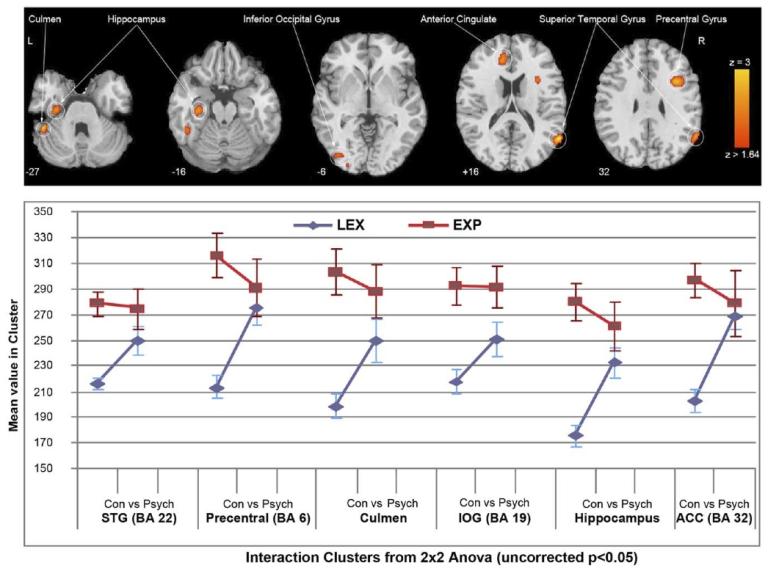 However, what happened during the trance writing was a bit more surprising. Compared with the normal writing conditions, experienced mediums showed much less brain activity in the aforementioned regions during channelling experiences. And oddly, the less-experienced mediums showed sharp rises in activity in the very same regions. The net effect was that the brain activity of the experienced and less experienced mediums seemed to converge on a kind of happy medium during trance writing (see image at right; source: PLOS ONE).
The ratings of the mediums’ writing samples showed that the writings done during psychographic trances were more complex and higher-quality than those done during normal, waking consciousness. This effect was highly significant for the experienced mediums and fell just short of statistical significance for the less experienced mediums.
In other words, when less experienced mediums went into psychographic trances and produced written messages, the parts of their brains associated with complex idea production, planning, and language became much more active – as one might expect. Their writing also became slightly more complex. But when the more experienced mediums went into trance, the very same parts of their brains seemed to suddenly go much quieter…just as their writing became much more sophisticated.
The researchers postulated that this paradoxical effect might be the result of sheer experience. Many experts in different fields show unexpectedly low levels of activity during performance in precisely the areas of the brain most related to their craft or art – suggesting that experience may lead to greater cognitive efficiency. These results are also consistent with the experienced mediums’ claims that they weren’t aware of their actions during trances, since the areas of the brain that went quiet were involved in attention, focus, and planning.
Of course, these results don’t say much about whether psychographic mediums are actually contacting spirits, making up the messages themselves, or unconsciously unlocking their own linguistic skills during trances. But because the patterns of brain activity were different than those one might expect to see in someone who is intentionally lying or deceiving others, it seems unlikely that these mediums were consciously fabricating their trance experiences. What’s more, psychographic mediums in Brazil typically don’t charge money for their services, making it even more unlikely that they were just inventing the whole thing for personal gain. Instead, the researchers suggested that the mediums may have been experiencing a kind of “dissociation,” a psychological term for feeling detached or distant from one’s body and actions. Dissociation is often considered a mental disorder in Western contexts, but there was little evidence that the mediums were mentally disturbed – they rated as well-adjusted psychologically and showed few symptoms of depression, anxiety, or borderline personality disorder.
For the most experienced psychographers, then, trance writing may have been a kind of automatic function, isolated from everyday conscious control but nonetheless very able to draw on the brain’s underlying resources. The mediums entered a kind of unconscious, intuitive state so powerful that it produced measurable changes in brain function, and they were able to generate writing of considerable complexity and skill. So, then, you might scoff at the notion of spirits, but spirits were clearly not the only “people” involved here. The mediums themselves had hidden depths, rooted in the same neural architecture we all share.
For more, check out “Neuroimaging During Trance States: A Contribution to the Study of Dissociation” in PLOS ONE.
Previous Post

June 8, 2013
Over generations, religion shapes genetics
Next Post

June 18, 2013 5 Ways Religion Can Influence Political Beliefs
Browse Our Archives
Select a Category Atheism Cognitive Science of Religion Costly investment theory Cultural psychology Editorial Evolution Evolution of Religion Evolution of religion series Evolutionary psychology Ideology and religion Modeling Religion Project Modern culture and religion Most Popular Practice of science Religion and education Religion and ethics Religion and health Religion and perception Religion and prejudice Religious violence Religious ways of thinking Science and religion Scientific study of religion Secularization Spirituality Uncategorized
Select a Month July 2022 February 2022 December 2021 October 2021 August 2021 July 2021 June 2021 May 2021 April 2021 March 2021 February 2021 January 2021 December 2020 November 2020 October 2020 September 2020 August 2020 July 2020 June 2020 May 2020 April 2020 March 2020 February 2020 January 2020 November 2019 October 2019 September 2019 August 2019 July 2019 June 2019 May 2019 April 2019 March 2019 February 2019 January 2019 December 2018 November 2018 October 2018 September 2018 August 2018 July 2018 June 2018 May 2018 April 2018 March 2018 February 2018 January 2018 December 2017 November 2017 October 2017 September 2017 August 2017 July 2017 June 2017 May 2017 April 2017 March 2017 February 2017 January 2017 December 2016 November 2016 September 2016 August 2016 June 2016 April 2016 March 2016 February 2016 January 2016 November 2015 October 2015 September 2015 August 2015 July 2015 June 2015 May 2015 April 2015 March 2015 February 2015 January 2015 December 2014 November 2014 October 2014 September 2014 August 2014 July 2014 June 2014 May 2014 April 2014 March 2014 February 2014 January 2014 December 2013 November 2013 October 2013 September 2013 August 2013 July 2013 June 2013 May 2013 April 2013 March 2013 February 2013 January 2013 December 2012 November 2012 October 2012 September 2012 August 2012 July 2012 June 2012 May 2012 April 2012 March 2012 February 2012
Follow Us!
TAKE THE
Religious Wisdom Quiz
Which Old Testament prophet called fire down from heaven?
Select your answer to see how you score.
Moses Elijah Isaiah Elisha
Related posts from Science On Religion

Why Rites of Passage Are Painful


Music and Dance in Human Evolution

The Joys and Challenges of Interdisciplinary Research
TRENDING AT PATHEOS Religion News

Catholic Integralists believe that religious values – specifically Christian ones – should...

Electing A Virtuous President Would Make Immunity Irrelevant
Presidential immunity can bring with it many risks. So how can we...

Why The Olympic Games Are A ‘Civil Religious’...
Sporting events form a vital space where Americans display their 'civil religious...

After more than a decade of news, research updates, and insights on...

Q: Why do Southern Baptists and like-minded Protestants...
THE RELIGION GUY’S ANSWER: Why? Simple. Because they believe that’s what the...

THE QUESTION: Is gambling evil? THE RELIGION GUY’S ANSWER: Analysts anticipate a...
view all Religion News blogs
Ad-Free & Subscriber Log-In Subscription Support
- About Us
- 2026 Calendar
- Videos
- Podcasts
- Library of World Religions
- Faith In Media Tracker
- Advertise With Us
- Write for Us
- Privacy Policy
- Terms of Service
- Do Not Sell My Data
- Contact Us
- Radiant Digital
- Manage Newsletter Subscriptions
- Unsubscribe From Notifications
- Sitemap
Copyright 2008-2026, Patheos. All rights reserved.
Subscription Support Ad-Free & Subscriber Log-In
Follow Patheos