
BuddhistCatholicContemplativeEvangelicalGeneral ChristianHinduJewishLatter-day SaintMuslimNew VisionsProgressive Christian
Beliefs
- Buddhist
- Catholic
- Contemplative
- Evangelical
- General Christian
- Hindu
- Jewish
- Latter-day Saint
- More Voices
- Muslim
- New Visions
- Pagan
- Progressive Christian
Topics
- Religion News
- Food and Religion
- Sports and Religion
- Religious Art
- Religious Music and Entertainment
- Religious Events
- History and Religion
- Style and Religion
- Politics and Religion
- Women in Religion
- Recreation Outdoors and Religion
- Business Finance and Religion
- Careers Workplace and Religion
- Education and Religion
- Family Parenting and Religion
- Health Fitness and Religion
- Home and Religion
- Relationships and Religion
- Technology and Religion
- Travel and Religion
Columnists
- Buddhist Columnists
- Business Finance and Religion Columnists
- Careers Workplace and Religion Columnists
- Catholic Columnists
- Contemplative Columnists
- Education and Religion Columnists
- Evangelists Columnists
- Family Parenting and Religion Columnists
- General Christian Columnists
- Health Fitness and Religion Columnists
- Hindu Columnists
- History and Religion Columnists
- Home and Religion Columnists
- Jewish Columnists
- More Voices Columnists
- Latter Day Columnists
- Muslim Columnists
- New Visions Columnists
- Nonreligious Columnists
- Pagan Columnists
- Politics and Religion Columnists
- Progressive Columnists
- Recreation Outdoors and Religion Columnists
- Relationships and Religion Columnists
- Religion News Columnists
- Religious Art Columnists
- Religious Events Columnists
- Religious Music and Entertainment Columnists
- Sports and Religion Columnists
- Style and Religion Columnists
- Technology and Religion Columnists
- Travel and Religion Columnists
- Women in Religion Columnists
Resource Library
- 2026 Calendar
- Library of World Religions
- The 100 Most Holy Places on Earth
- Patheos Answers
- Podcasts
- Videos
- Faith Leaders Database
- Anglican Episcopalian
- Bahai
- Baptist
- Buddhism
- Christianity
- Confucianism
- Eastern Orthodoxy
- Hinduism
- Holiness and Pentecostal
- ISKCON
- Islam
- Judaism
- Lutheran
- Methodist
- The Church of Jesus Christ of Latter-day Saints
- New Age
- Paganism
- Presbytarian and Reformed
- Protestantism
- Religion Behind the Scenes
- Roman Catholic
- Scientology
- Shia Islam
- Sikhism
- Sufism
- Sunni Islam
- Taoism
- Zen
- See all religions
Research Tools
 Ad-Free & Subscriber Log-In Subscription Support
Ad-Free & Subscriber Log-In Subscription Support
Follow Patheos 

- Trending:
- Forgiveness
- |
- Marriage
- |
- Consciousness
- |
- Death Penalty
- |
- Election
- |
- Halloween
 Science On Religion
- Home
- Religion News
- Ritual bypasses conscious cognition
Ritual bypasses conscious cognition
Last updated on: June 25, 2013 at 11:03 am by Connor Wood
Ritual bypasses conscious cognition 2013-06-25T11:03:35-04:00 Connor Wood
Patheos Explore the world's faith through different perspectives on religion and spirituality! Patheos has the views of the prevalent religions and spiritualities of the world.
Connor Wood
Pretend you’re an alien anthropologist come to Earth to study humans. What do you notice most about these strange, bipedal creatures? Their glittering cities? Their fondness for chocolate? Their use of daringly creative insults during traffic jams? Maybe, but let’s not forget one behavior that distinguishes humans almost more than anything else: ritual, and lots of it. No other animal participates in, invents, or performs rituals as complex and detailed as humans. But why? Our bemused alien anthropologist might benefit from new Danish research describing how ritual, using what’s called “cognitive resource depletion,” helps cultures pass knowledge and values down to new members.
Writing in Religion, Brain & Behavior, Uffe Schjødt and a group of colleagues at Aarhus University in Denmark (and one, Joseph Bulbulia, from New Zealand’s Victoria University of Wellington) used recent empirical findings to test a long-held hypothesis: that religious ritual helps cultures transmit knowledge – ethical norms, beliefs about the nature of reality, and so forth. This idea has a long and venerable history; a hundred years ago the sociologist Emile Durkheim argued that group rituals generate a “collective effervescence” that makes participants uniquely open to accepting the values, stories, and beliefs of their society.
Since then, many other scholars have generally agreed with Durkheim, but nobody really knows why ritual works this way. After all, lots of the elements of religious rituals would seem to make people less prepared to learn new information; how well can you be expected to pay attention when you’re also focused on getting just the right bodily postures correct, or when you’re lost in ritual ecstasy?
Well, if Schjødt and his colleagues are right, the answer is that you don’t need to be paying attention at all. In fact, for this kind of cultural transmission to be successful, paying attention is precisely what you want to avoid. Instead, the researchers claim, three seemingly counterintuitive aspects of ritual actually suppress conscious cognition: the regulation of emotion; actions that lack obvious purposes or goals; and the presence of a charismatic authority. By bypassing direct cognition, these features of ritual allow cultural learning to pass from religious experts to ritual participants unimpeded.
Cognitive Resource Depletion
The researchers’ model depends on a process known as “cognitive resource depletion.” The brain is (as we all know) extremely complex, but evolution has also forced it to be very efficient. This means that many cognitive functions run on the same neural hardware. For example, executive cognitive functions – which give rise to focused, goal-oriented behavior, integrating many smaller process and tasks into overarching wholes – largely depend on the same regions of the frontal cortex that power attentional processes. So the more you’re focusing your attention on something specific, like a counting clock, the poorer you’ll perform on tasks that demand executive function.
Emotional regulation, as it happens, is just such an attentional process. Schjødt and his colleagues suggest that controlling emotional expression during religious rituals actually uses up cognitive resources that participants would otherwise use to develop a robust model of what’s happened during the ritual. The researchers describe this model-building as “updating.” Our brains make sense of perception and experience by constantly testing internal models against incoming data; whenever there’s a discrepancy between what the brain thinks it’s going to encounter and what it actually encounters, it compensates by “updating” its internal model. But if you’re overloading your frontal lobes, your brain can’t perform its normal updating function. The result is that you won’t be entirely clear on what’s happened to you, so you’ll need to rely on your prior expectations, your cultural values, and what others tell you in order to make sense of your experience.
Supporting this hypothesis, Schjødt and the other researchers found that Spanish firewalkers had poor recollections of their experiences immediately after completing a firewalking ritual – during which they were expected to be stoic and not express pain or fear. Several months later, however, the firewalkers confidently reported much more detailed memories of the ritual. However, the “new” memories weren’t objectively accurate – many of the newly recalled details matched local religious and cultural expectations of what a firewalking experience was supposed to be, but video recordings showed that they didn’t match what had physically happened during the ritual. The sheer cognitive demand of the firewalking ritual left the participants open to suggestion and guidance from the ambient culture and the religious authorities who led the ritual. Their interpretations and memories of the experience were “filled in” by these external sources.
Similar relationships were discovered when the researchers focused on the non-goal-oriented nature of ritual and on charismatic authority. In one study, participants were asked to describe videos showing both goal-oriented and seemingly purposeless activities. The participants broke down the purposeless activities into more discrete steps – suggesting that their brains were expending energy trying to make sense of what they’d seen. Since nearly all rituals feature activities and behaviors that aren’t aimed at trying to accomplish anything practical, the authors claim, it’s likely that our brains are doing something similar during these seemingly “purposeless” rituals – breaking them down into many small steps, trying but failing to analyze them for an underlying sense. This process also draws heavily on cognitive resources, preventing participants from generating their own interpretations of the ritual experience.
Which leads, finally, to the role of the charismatic authority. According to Schjødt and his fellow co-authors, charismatic religious leaders – priests, shamans, and the like – are able to step into ritual participants’ resource-drained neurology, telling their own stories about what’s happened during the ritual and what its meaning and purpose is. In a very real sense, the massive cognitive deficits people experience during demanding rituals place them in a perfect position to be influenced afterwards by external interpretations flowing from religious authorities. In this way, everyone who participates in a ritual becomes ever-so-slightly enculturated into the ambient religious worldview afterwards.
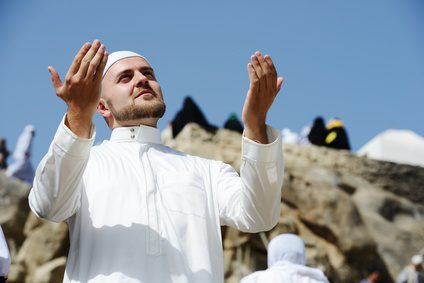
Schjødt and his colleagues leave several questions open, of course. For starters, not all rituals clearly require emotional regulation; ecstatic religious rituals such as a Pentecostal Sunday service or a Voodu fète demand almost anything but the suppression of emotions. More importantly, many religious people would likely balk at the claim that their cherished rituals are “purposeless” or, as the authors put it, “characterized by incomprehensible actions.” Take the Eucharist: to an outsider, it may seem odd to dip a dry bit of bread into wine and eat it, but to the participant the goal is obvious: to participate in the divine body of Christ. Similarly, the prostrations of a Muslim congregation at prayer might not seem “purposeful” to an outsider, but the faithful will quickly tell you that the purpose is obviously to fulfill salat, one of the five pillars of Islam, and to praise Allah.
The definition of “purpose” is always contextual, but Schjødt and his colleagues, following many contemporary biologists and philosophers, assume that purpose only counts if it’s directly associable with the bare Darwinian goals of survival and reproduction. But despite some questionable philosophical assumptions, their findings shed some much-needed light on the mechanisms by which religious rituals shape and drive societies. It’s been known for decades that religious rituals prime participants to accept and be shaped by the beliefs of their religious cultures. Now we may have some real insight into how this works. Schjødt and his colleagues would say that the reason why a Muslim knows the “purpose” of prayer is because cultural authorities have told her what it is after her own cognitive hardware has been depleted by ritual. The believer herself would say it’s because she has faith in Allah. Knowing the actual neurological and cultural pathways through which ritual works may help us mediate – if not actually reconcile – these two competing visions.
Previous Post

June 18, 2013
5 Ways Religion Can Influence Political Beliefs
Next Post

July 3, 2013 Why aren't religious people as creative as unbelievers?
Browse Our Archives
Select a Category Atheism Cognitive Science of Religion Costly investment theory Cultural psychology Editorial Evolution Evolution of Religion Evolution of religion series Evolutionary psychology Ideology and religion Modeling Religion Project Modern culture and religion Most Popular Practice of science Religion and education Religion and ethics Religion and health Religion and perception Religion and prejudice Religious violence Religious ways of thinking Science and religion Scientific study of religion Secularization Spirituality Uncategorized
Select a Month July 2022 February 2022 December 2021 October 2021 August 2021 July 2021 June 2021 May 2021 April 2021 March 2021 February 2021 January 2021 December 2020 November 2020 October 2020 September 2020 August 2020 July 2020 June 2020 May 2020 April 2020 March 2020 February 2020 January 2020 November 2019 October 2019 September 2019 August 2019 July 2019 June 2019 May 2019 April 2019 March 2019 February 2019 January 2019 December 2018 November 2018 October 2018 September 2018 August 2018 July 2018 June 2018 May 2018 April 2018 March 2018 February 2018 January 2018 December 2017 November 2017 October 2017 September 2017 August 2017 July 2017 June 2017 May 2017 April 2017 March 2017 February 2017 January 2017 December 2016 November 2016 September 2016 August 2016 June 2016 April 2016 March 2016 February 2016 January 2016 November 2015 October 2015 September 2015 August 2015 July 2015 June 2015 May 2015 April 2015 March 2015 February 2015 January 2015 December 2014 November 2014 October 2014 September 2014 August 2014 July 2014 June 2014 May 2014 April 2014 March 2014 February 2014 January 2014 December 2013 November 2013 October 2013 September 2013 August 2013 July 2013 June 2013 May 2013 April 2013 March 2013 February 2013 January 2013 December 2012 November 2012 October 2012 September 2012 August 2012 July 2012 June 2012 May 2012 April 2012 March 2012 February 2012
Follow Us!
TAKE THE
Religious Wisdom Quiz
On which mountain did Moses receive the Ten Commandments?
Select your answer to see how you score.
Mount Hermon Mount Carmel Mount Sinai Mount Ararat
Related posts from Science On Religion

Why Rites of Passage Are Painful



Faith and the Evolutionary Predicament
TRENDING AT PATHEOS Religion News

Catholic Integralists believe that religious values – specifically Christian ones – should...

Electing A Virtuous President Would Make Immunity Irrelevant
Presidential immunity can bring with it many risks. So how can we...

Why The Olympic Games Are A ‘Civil Religious’...
Sporting events form a vital space where Americans display their 'civil religious...

After more than a decade of news, research updates, and insights on...

Q: Why do Southern Baptists and like-minded Protestants...
THE RELIGION GUY’S ANSWER: Why? Simple. Because they believe that’s what the...

THE QUESTION: Is gambling evil? THE RELIGION GUY’S ANSWER: Analysts anticipate a...
view all Religion News blogs
Ad-Free & Subscriber Log-In Subscription Support
- About Us
- 2026 Calendar
- Videos
- Podcasts
- Library of World Religions
- Faith In Media Tracker
- Advertise With Us
- Write for Us
- Privacy Policy
- Terms of Service
- Do Not Sell My Data
- Contact Us
- Radiant Digital
- Manage Newsletter Subscriptions
- Unsubscribe From Notifications
- Sitemap
Copyright 2008-2026, Patheos. All rights reserved.
Subscription Support Ad-Free & Subscriber Log-In
Follow Patheos