
BuddhistCatholicContemplativeEvangelicalGeneral ChristianHinduJewishLatter-day SaintMuslimNew VisionsProgressive Christian
Beliefs
- Buddhist
- Catholic
- Contemplative
- Evangelical
- General Christian
- Hindu
- Jewish
- Latter-day Saint
- More Voices
- Muslim
- New Visions
- Pagan
- Progressive Christian
Topics
- Religion News
- Food and Religion
- Sports and Religion
- Religious Art
- Religious Music and Entertainment
- Religious Events
- History and Religion
- Style and Religion
- Politics and Religion
- Women in Religion
- Recreation Outdoors and Religion
- Business Finance and Religion
- Careers Workplace and Religion
- Education and Religion
- Family Parenting and Religion
- Health Fitness and Religion
- Home and Religion
- Relationships and Religion
- Technology and Religion
- Travel and Religion
Columnists
- Buddhist Columnists
- Business Finance and Religion Columnists
- Careers Workplace and Religion Columnists
- Catholic Columnists
- Contemplative Columnists
- Education and Religion Columnists
- Evangelists Columnists
- Family Parenting and Religion Columnists
- General Christian Columnists
- Health Fitness and Religion Columnists
- Hindu Columnists
- History and Religion Columnists
- Home and Religion Columnists
- Jewish Columnists
- More Voices Columnists
- Latter Day Columnists
- Muslim Columnists
- New Visions Columnists
- Nonreligious Columnists
- Pagan Columnists
- Politics and Religion Columnists
- Progressive Columnists
- Recreation Outdoors and Religion Columnists
- Relationships and Religion Columnists
- Religion News Columnists
- Religious Art Columnists
- Religious Events Columnists
- Religious Music and Entertainment Columnists
- Sports and Religion Columnists
- Style and Religion Columnists
- Technology and Religion Columnists
- Travel and Religion Columnists
- Women in Religion Columnists
Resource Library
- 2026 Calendar
- Library of World Religions
- The 100 Most Holy Places on Earth
- Patheos Answers
- Podcasts
- Videos
- Faith Leaders Database
- Anglican Episcopalian
- Bahai
- Baptist
- Buddhism
- Christianity
- Confucianism
- Eastern Orthodoxy
- Hinduism
- Holiness and Pentecostal
- ISKCON
- Islam
- Judaism
- Lutheran
- Methodist
- The Church of Jesus Christ of Latter-day Saints
- New Age
- Paganism
- Presbytarian and Reformed
- Protestantism
- Religion Behind the Scenes
- Roman Catholic
- Scientology
- Shia Islam
- Sikhism
- Sufism
- Sunni Islam
- Taoism
- Zen
- See all religions
Research Tools
 Ad-Free & Subscriber Log-In Subscription Support
Ad-Free & Subscriber Log-In Subscription Support
Follow Patheos 

- Trending:
- Forgiveness
- |
- Marriage
- |
- Consciousness
- |
- Death Penalty
- |
- Election
- |
- Halloween
 Science On Religion
- Home
- Religion News
- How the brain escapes the self
How the brain escapes the self
Last updated on: April 22, 2013 at 10:38 pm by Connor Wood
How the brain escapes the self 2013-04-22T22:38:43-04:00 Connor Wood
Patheos Explore the world's faith through different perspectives on religion and spirituality! Patheos has the views of the prevalent religions and spiritualities of the world.
Connor Wood
Religious experiences get described in a lot of ways. People gushingly talk about a profound sense of oneness, about incredible bliss, joy, and ineffable meaning. One thing you almost never hear, however, is that a religious experience made someone more greedy and selfish. No one ever says, “Hey, you know what? I just experienced ultimate spiritual bliss, and boy, did it ever make me focus neurotically on my own struggles, financial problems, and dating insecurities!” Why this incompatibility between spirituality and self-absorption? A team of researchers from the University of Missouri thinks that the reason might be found in the brain, where reduced function in the region associated with self-awareness is correlated with greater spirituality.
The team, led by Brick Johnstone and Angela Bodling of the University of Missouri’s Department of Health Psychology, was familiar with previous research showing that suppression of the right parietal cortex appeared to inspire religious experiences. The right parietal cortex (or right parietal lobe) is a part of the brain found near the rear and top of your skull. It’s responsible for orienting the body in space and time, largely by keeping tabs on spatial and temporal relationships with nearby reference points. Neuroscientists such as Andrew Newberg of the University of Pennsylvania have previously found that long-term meditators and religious experts have reduced function in the parietal lobe during meditation or other religious exercise, leading many scholars to suspect that meditation dampens one’s sense of a separate self by reducing the ability of the brain to locate the body in relation to the surrounding world.
But much of this previous research was exploratory rather than hypothesis-driven in nature. What’s more, nearly all previous studies suffered from unsophisticated, one-dimensional measurements of spirituality or religiousness. Johnstone, Bodling, and their colleagues aimed to correct these shortcomings by articulating concrete, theory-driven hypotheses at the outset of their study, and by utilizing several different measures of spirituality. These measures assumed that spirituality is a multidimensional construct – that is, just as a person might be fiscally conservative but socially liberal, someone could measure as high in one form of spirituality, such as a sense of meaning in life, but low in another, such as frequency of private prayer. This more responsive and multifaceted way of thinking about spirituality promised to deliver a more intricate picture of the relationship between brain functioning and spiritual experience.
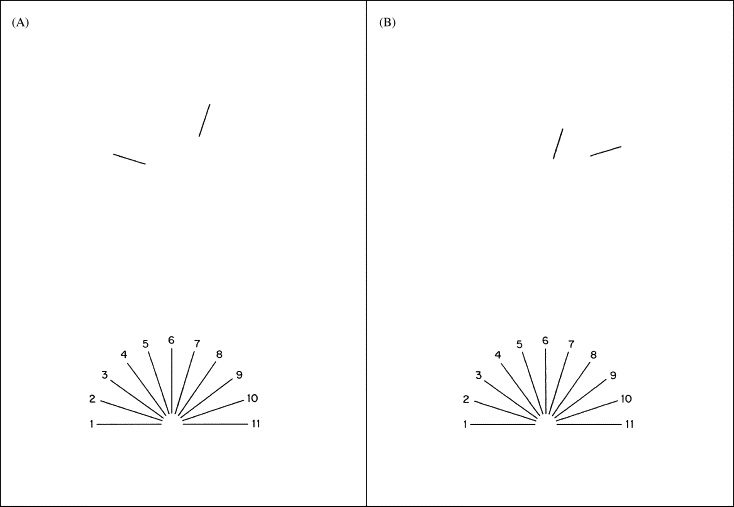 The researchers asked 20 different traumatic brain injury patients to perform a series of cognitive functioning tests that tell clinicians which regions of the brain are not functioning properly. For instance, a test of right parietal functioning asks subjects to match the relative angles of a series of lines (see the figure at right). Patients with high-functioning right parietal cortices can accurately indicate which angles match with the lines, but those with damaged parietal lobes have difficulties assessing spatial relationships and perform poorly on the task.
Unlike many neuroscientists who study religious experience, then, the University of Missouri researchers relied on clinical and behavioral data rather than direct brain imaging. This was intentional – while MRIs and CAT scans can tell you which parts of the brain are active at which times, tests that measure cognitive abilities can give a more reliable picture of the brain’s actual functioning. This behavioral data reduces uncertainty when it comes to pinning specific spiritual phenomena to underlying neural processes.
The researchers hypothesized that brain-injury patients who performed poorly on the tests of right parietal functioning would also report higher levels of different types of spirituality. They also predicted that strong performance on tests of frontal lobe functioning, which require subjects to trace a series of numbers and letters in a maze-like patterns, would be positively associated with spirituality. Tasks that tested functioning in other areas of the brain, such as the right and left temporal lobes, were not expected to be associated with spirituality one way or the other.
While the subject pool was small, the results more than supported the researchers’ hypotheses. Poor performance on right-parietal tasks was positively and significantly associated with spirituality as defined by the 5-dimensional “Inspirit” measure of spirituality, while strong frontal cortex functioning positively predicted private religious practice, such as personal prayer or meditation. Tests of brain function in other lobes didn’t predict spirituality at all.
However, while attenuated right parietal function did predict increased spirituality, it only achieved statistical significance for one of the Inspirit measure’s five dimensions of spirituality: forgiveness. The statistically significant negative correlation between the Inspirit as a whole and right parietal function depended largely on this single dimension of spirituality. In other words, people whose right parietal lobes didn’t work very well – most likely due to serious injury or illness – seemed to have a much easier time forgiving others than average people did.
Of course, one might question whether “forgiveness” really qualifies as a dimension of spirituality. After all, plenty of people who do not consider themselves “spiritual” or religious in any way forgive others around them on a daily basis. (Think about it: if this weren’t true, no atheists would ever be able to maintain marriages or have kids!) So does this research merely show that reduced right parietal functioning makes it easier to forgive others, without telling us anything about spirituality? Maybe not. Three other dimensions of spirituality – daily spiritual experiences, spiritual values and beliefs, and spiritual coping – were also negatively correlated with right parietal function. These relationships didn’t quite attain statistical significance, but together they contributed to the strong negative correlation between parietal function and spirituality. It’s likely that, in a larger sample, each of these dimensions of spirituality would attain significance.
Meanwhile, people who performed strongly on the test of frontal cortex functioning were much more likely than average to report regularly partaking in private religious practices. The frontal cortex is associated with what’s called executive cognitive function – the ability to direct attention, focus one’s awareness, and filter out distractor stimuli in order to concentrate. Thus, participants who prayed often in private – but not necessarily in public settings such as churches – appeared to have greater ability to focus on tasks and ignore distractions. This relationship makes it difficult to argue, as some might be tempted to do, that spirituality is simply the product of an atrophied brain. Counterintuitively, spirituality seems to be associated with enhanced function in some parts of the brain and reduced function in others.
This study is noteworthy because its authors made and corroborated specific hypotheses linking brain function to spirituality. The implications are clear: a reduced ability to orient one’s body in spatial and temporal relationships appears to be associated with greater spirituality – particularly, in this study, the ability to forgive others. The fact that all the measures of spirituality in this study were self-reports notwithstanding, these results are compelling because they’re theory-driven. If you have a data-based idea of how something works, and you come up with a concrete hypothesis based on that idea, even tenuous test results that match your hypothesis tend to support your underlying idea. The body is where our selves, our egos, are located. A brain that can’t tell where the body is in space and time apparently can’t produce a very robust sense of self – opening the gates to a kind of transcendence.
Previous Post

April 16, 2013
Rewriting the script: We change our religious memories
Next Post
April 29, 2013 Does religious belief make you a better person?
Browse Our Archives
Select a Category Atheism Cognitive Science of Religion Costly investment theory Cultural psychology Editorial Evolution Evolution of Religion Evolution of religion series Evolutionary psychology Ideology and religion Modeling Religion Project Modern culture and religion Most Popular Practice of science Religion and education Religion and ethics Religion and health Religion and perception Religion and prejudice Religious violence Religious ways of thinking Science and religion Scientific study of religion Secularization Spirituality Uncategorized
Select a Month July 2022 February 2022 December 2021 October 2021 August 2021 July 2021 June 2021 May 2021 April 2021 March 2021 February 2021 January 2021 December 2020 November 2020 October 2020 September 2020 August 2020 July 2020 June 2020 May 2020 April 2020 March 2020 February 2020 January 2020 November 2019 October 2019 September 2019 August 2019 July 2019 June 2019 May 2019 April 2019 March 2019 February 2019 January 2019 December 2018 November 2018 October 2018 September 2018 August 2018 July 2018 June 2018 May 2018 April 2018 March 2018 February 2018 January 2018 December 2017 November 2017 October 2017 September 2017 August 2017 July 2017 June 2017 May 2017 April 2017 March 2017 February 2017 January 2017 December 2016 November 2016 September 2016 August 2016 June 2016 April 2016 March 2016 February 2016 January 2016 November 2015 October 2015 September 2015 August 2015 July 2015 June 2015 May 2015 April 2015 March 2015 February 2015 January 2015 December 2014 November 2014 October 2014 September 2014 August 2014 July 2014 June 2014 May 2014 April 2014 March 2014 February 2014 January 2014 December 2013 November 2013 October 2013 September 2013 August 2013 July 2013 June 2013 May 2013 April 2013 March 2013 February 2013 January 2013 December 2012 November 2012 October 2012 September 2012 August 2012 July 2012 June 2012 May 2012 April 2012 March 2012 February 2012
Follow Us!
TAKE THE
Religious Wisdom Quiz
Who was the oldest person in the Bible?
Select your answer to see how you score.
Methuselah Abraham Noah Adam
Related posts from Science On Religion

Why Rites of Passage Are Painful


Faith and the Evolutionary Predicament
Music and Dance in Human Evolution
TRENDING AT PATHEOS Religion News

Catholic Integralists believe that religious values – specifically Christian ones – should...

Electing A Virtuous President Would Make Immunity Irrelevant
Presidential immunity can bring with it many risks. So how can we...

Why The Olympic Games Are A ‘Civil Religious’...
Sporting events form a vital space where Americans display their 'civil religious...

After more than a decade of news, research updates, and insights on...

Q: Why do Southern Baptists and like-minded Protestants...
THE RELIGION GUY’S ANSWER: Why? Simple. Because they believe that’s what the...

THE QUESTION: Is gambling evil? THE RELIGION GUY’S ANSWER: Analysts anticipate a...
view all Religion News blogs
Ad-Free & Subscriber Log-In Subscription Support
- About Us
- 2026 Calendar
- Videos
- Podcasts
- Library of World Religions
- Faith In Media Tracker
- Advertise With Us
- Write for Us
- Privacy Policy
- Terms of Service
- Do Not Sell My Data
- Contact Us
- Radiant Digital
- Manage Newsletter Subscriptions
- Unsubscribe From Notifications
- Sitemap
Copyright 2008-2026, Patheos. All rights reserved.
Subscription Support Ad-Free & Subscriber Log-In
Follow Patheos