
BuddhistCatholicContemplativeEvangelicalGeneral ChristianHinduJewishLatter-day SaintMuslimNew VisionsProgressive Christian
Beliefs
- Buddhist
- Catholic
- Contemplative
- Evangelical
- General Christian
- Hindu
- Jewish
- Latter-day Saint
- More Voices
- Muslim
- New Visions
- Pagan
- Progressive Christian
Topics
- Religion News
- Food and Religion
- Sports and Religion
- Religious Art
- Religious Music and Entertainment
- Religious Events
- History and Religion
- Style and Religion
- Politics and Religion
- Women in Religion
- Recreation Outdoors and Religion
- Business Finance and Religion
- Careers Workplace and Religion
- Education and Religion
- Family Parenting and Religion
- Health Fitness and Religion
- Home and Religion
- Relationships and Religion
- Technology and Religion
- Travel and Religion
Columnists
- Buddhist Columnists
- Business Finance and Religion Columnists
- Careers Workplace and Religion Columnists
- Catholic Columnists
- Contemplative Columnists
- Education and Religion Columnists
- Evangelists Columnists
- Family Parenting and Religion Columnists
- General Christian Columnists
- Health Fitness and Religion Columnists
- Hindu Columnists
- History and Religion Columnists
- Home and Religion Columnists
- Jewish Columnists
- More Voices Columnists
- Latter Day Columnists
- Muslim Columnists
- New Visions Columnists
- Nonreligious Columnists
- Pagan Columnists
- Politics and Religion Columnists
- Progressive Columnists
- Recreation Outdoors and Religion Columnists
- Relationships and Religion Columnists
- Religion News Columnists
- Religious Art Columnists
- Religious Events Columnists
- Religious Music and Entertainment Columnists
- Sports and Religion Columnists
- Style and Religion Columnists
- Technology and Religion Columnists
- Travel and Religion Columnists
- Women in Religion Columnists
Resource Library
- 2026 Calendar
- Library of World Religions
- The 100 Most Holy Places on Earth
- Patheos Answers
- Podcasts
- Videos
- Faith Leaders Database
- Anglican Episcopalian
- Bahai
- Baptist
- Buddhism
- Christianity
- Confucianism
- Eastern Orthodoxy
- Hinduism
- Holiness and Pentecostal
- ISKCON
- Islam
- Judaism
- Lutheran
- Methodist
- The Church of Jesus Christ of Latter-day Saints
- New Age
- Paganism
- Presbytarian and Reformed
- Protestantism
- Religion Behind the Scenes
- Roman Catholic
- Scientology
- Shia Islam
- Sikhism
- Sufism
- Sunni Islam
- Taoism
- Zen
- See all religions
Research Tools
 Ad-Free & Subscriber Log-In Subscription Support
Ad-Free & Subscriber Log-In Subscription Support
Follow Patheos 

- Trending:
- Forgiveness
- |
- Marriage
- |
- Consciousness
- |
- Death Penalty
- |
- Election
- |
- Halloween

- Home
- Religious Music & Entertainment
- Populism for me but not for thee
Populism for me but not for thee
Last updated on: February 11, 2022 at 8:00 am by Coyle Neal
Populism for me but not for thee 2022-02-10T17:57:59-07:00 Coyle Neal
Patheos Explore the world's faith through different perspectives on religion and spirituality! Patheos has the views of the prevalent religions and spiritualities of the world.
Thomas Frank made waves in 2005 with the publication of his book What’s the Matter with Kansas? I mean, he may have made waves before that. I don’t know. But that’s when he made the kinds of waves that I noticed as a student/graduate student in Political Science. Now he’s out with a new book digging into the bigger picture underlying his earlier book about populism and the forces arrayed against it.
The People, No: A brief History of Anti-Populism is exactly what the subtitle claims: an overview of the resistance to the late 19th Century American populist movement (and Party) and how Frank sees that resistance passing down the generations to our own time. This book is well-written, interesting, and clearly something that Frank is deeply passionate about. If you’re interested in contemporary politics, American history, or the question of the relationship between the people and political power, you should definitely pick up this book.
That said, I think there is at least one major problem with this book. Namely, Frank defines “populism” in a way that isn’t terribly helpful. Specifically, he applies it to a set of policy proposals promoted by the Populist Party of the 1890s.
“Populism was one of the first of the great political efforts to tame the capitalist system… The Populists were the people who blasted those smug assumptions [of the elites] to pieces, forcing the country to acknowledge that ordinary Americans who were just as worthy as bankers or railroad barons were being ruined by an economic system that in fact answered to no moral laws.” (11)
Frank points out that this isn’t always the way the term is used:
“From the very beginning, then, populism had two meanings. There was Populism as its proponents understood it, meaning a movement in which ordinary citizens demanded democratic economic reforms. And there was Populism as its enemies characterized it: a dangerous movement of groundless resentment in which demagogues led the disreputable.” (13)
No doubt there is truth to both of these points. But I think Frank has made a methodological error here. (And full disclosure, I am both NOT a historian of the topic or era he’s writing about, and I am very much an anti-Populist, though not of the sort he’s writing about in this book. So take my dissent for what it’s worth.) Frank wants to define “populism” according to the Populist Party Platform. And as far as it goes, I think that’s fair enough. That gives us a few ideas whose history can be traced–the Farm Bill, health care reform, tax rates, etc–from the 1890s until today.
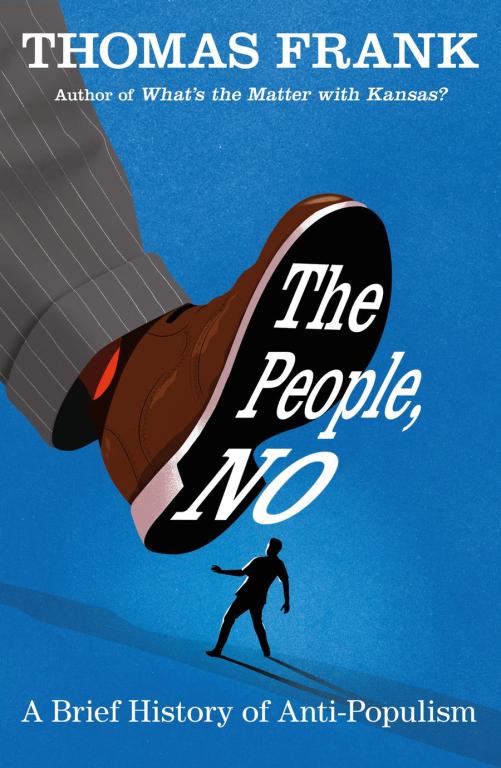
Image: Macmillian

The problem is that Frank’s identification of “populism” with this specific form of “Populism” (note the capitalization change!) is that he is confusing policy results with means. Small ‘p’ populism is, in my read of the affair, much better defined as “a way of accomplishing policy goals” rather than “a set of policy goals themselves.” That is, the Populist Party had the specific things it wanted to work for, say, economic reform. But it also had the idea that the decision makers with regard to those policies should also be the people themselves as much as possible. Sometimes goals and means came together: the people should have more power, so the 17th Amendment was born and Senators since then have been elected by the people of the state instead of chosen by state legislatures (this was a bad Amendment–see? told you I was anti-populist!).
But! By hanging his definition of ‘populism’ on policy positions, it seems that Frank guts the means of populism of any reasonable form or definition. Let’s say for example that in the Obamacare case a few years back the Supreme Court had done what the Obama Administration desperately wanted it to do and declared that healthcare is a right which the government must provide, rather than Obamacare being a tax which Congress can levy or not according to whatever it decides (and leaving aside what I think about the Chief Justice’s attempt at compromise here). Had the Court gone that direction, the one branch of government most distant from the people would by Frank’s definition be the most “populist” branch of government. The Supreme Court, though intentionally and purposefully cut off from democratic processes and passions, would be doing the work of ‘populism.’
By contrast, I think the Oregon referendum in 2002 where the voters overwhelmingly rejected universal healthcare (78% to 21%–though they’re voting on something like it again next year, so who knows what the future holds?) would neatly count as a policy decided on by populist means, even if the result is counter to one of Frank’s core definitions of the term.
And this explains how Frank can so handily deny that there is any such thing as ‘right-wing populism.’ Trump wasn’t a real populist, he was only a “phony populist” using terms that didn’t apply to him for the purposes of winning an election. And you know, I kind-of just want to give Frank this one, since I say something similar about Trump calling himself a ‘conservative’ or ‘Republican’ or ‘Christian’ or any number of other things. The problem is, this refusal to acknowledge the reality of right-wing populism leads to a serious gap in the book. Frank jumps from Reagan (yet another ‘phony populist,’ in Frank’s view) to Trump:
“The disgust I felt that Election Day made me physically ill, and so I hope you will excuse me if I skip over all the preposterous variations on the populist theme worked in the years since then by such flag-waving champions of the working man as Oliver North, Newt Ginbrich, Rush Limbaugh, Bill O’Reilly, Glenn Beck, Sarah Palin; or by George Bush’s son Dubya; or by the NRA, or by Fox News, or by Rick Santelli and the Tea Party movement. I am sick of them all.” (214)
In one sense I’m sympathetic here. Each side is certainly disgusted with the other these days. We shouldn’t be, but we are. The problem is that the “Election Day” in question isn’t the 2016 election but rather was the 1988 election of George H.W. Bush. Granted, I was 5 at the time and don’t remember whether it was a really disgusting election from personal experience. But in retrospect it’s hard to say that that was the real-breaking point, even on the Right. (And yes, I had to look up who Rick Santelli is–who watches CNBC anyway?)
My point is that in sticking to policies rather than means, Frank has his ‘out’ to not have to deal with what’s going on across the aisle from him. And that makes his book that much worse. I get that he doesn’t like right-wing populism (I don’t particularly care for it in its current form myself), but that’s not the same thing as following up with ‘therefore it’s not real populism anyway.’
Again: I think The People, NO is a good book and worth reading, but be aware of what you’re getting into.
A concluding thought for Christians (and to prove that I didn’t forget what kind of blog this is). This issue of the distinction between policy and means is something that we need to keep in mind–especially those on my side of the theological spectrum (i.e. theological conservatives). It is important to have the right doctrine; but it is also important to enact that doctrine in the right way. It might be that a bad belief or practice has worked its way into your local church’s government. You and I can agree that this belief or practice needs to be changed, but we should also remember that it needs to be changed in the proper way. Heck, we might even disagree on what the proper way is. As a congregationalist I’m going to want to talk about member’s meetings and a vote (yet another overlap with populism), while another believer might hold to the presbyterian structure and want to talk about getting the session onboard. In either case, we have to remember that the means matters as much as the policy itself. To forget that is ultimately to undermine our own argument, and The People, NO is a good case study in that–in addition to being a good overview of anti-Populism.
Dr. Coyle Neal is co-host of the City of Man Podcast an Amazon Associate (which is linked in this blog), and an Associate Professor of Political Science at Southwest Baptist University in Bolivar, MO
Previous Post

February 8, 2022
Common Grace, 2.81
Next Post
February 15, 2022 Common Grace, 2.82
Browse Our Archives
Select a Category Action AFI Top 100 Animation Best Picture Winner BFI Top 250 Biography Biopic Books Childrens Christian Classics Classics Comedy Crime Documentary Drama Editor's Choice Family Fantasy Fantasy Films Foreign Historical Historical Fiction History Horror Horror IMDB Top 250 Indie Memoir Modern Novel Musical Mystery Non-Fiction Oscars Philosophy Poetry Popular Literature Reading and Writing Reality Romance Science Fiction Science Fiction Silent Sports Thriller TV Show Uncategorized Western Westerns Young Adult
Select a Month October 2026 September 2026 July 2026 June 2026 May 2026 April 2026 March 2026 February 2026 January 2026 December 2025 November 2025 October 2025 September 2025 August 2025 July 2025 June 2025 May 2025 April 2025 March 2025 February 2025 January 2025 December 2024 July 2024 June 2024 May 2024 April 2024 March 2024 February 2024 January 2024 December 2023 November 2023 October 2023 September 2023 August 2023 July 2023 June 2023 May 2023 April 2023 March 2023 February 2023 January 2023 December 2022 November 2022 October 2022 September 2022 August 2022 July 2022 June 2022 May 2022 April 2022 March 2022 February 2022 January 2022 December 2021 November 2021 October 2021 September 2021 August 2021 July 2021 June 2021 May 2021 April 2021 March 2021 February 2021 January 2021 December 2020 November 2020 October 2020 September 2020 August 2020 July 2020 June 2020 May 2020 April 2020 March 2020 February 2020 January 2020 December 2019 November 2019 October 2019 September 2019 August 2019 July 2019 June 2019 May 2019 April 2019 March 2019 February 2019 January 2019 December 2018 November 2018 October 2018 September 2018 August 2018 July 2018 June 2018 May 2018 April 2018 March 2018 February 2018 January 2018 December 2017 November 2017 October 2017 September 2017 June 2017 January 2017 December 2016 October 2016 September 2016 August 2016 July 2016 June 2016 May 2016 April 2016 March 2016 February 2016 January 2016 December 2015 November 2015 October 2015 September 2015 August 2015 July 2015 June 2015 May 2015 April 2015 March 2015 February 2015 January 2015 December 2014 November 2014 October 2014 September 2014 August 2014 July 2014 June 2014 May 2014 April 2014 March 2014 February 2014 January 2014 December 2013 November 2013 October 2013 September 2013 August 2013 July 2013 June 2013 May 2013 April 2013 March 2013 February 2013 January 2013 December 2012 November 2012 October 2012 September 2012 August 2012 July 2012
Follow Us!
TAKE THE
Religious Wisdom Quiz
True or False: Hebrews teaches that Jesus is the same yesterday, today, and forever.
Select your answer to see how you score.
FALSE TRUE
Related posts from Schaeffer's Ghost




Thinking Critically about Critical Theory
TRENDING AT PATHEOS Religious Music & Entertainment

Methodist Central Hall and Westminster Abbey
Situated on the same square is Methodist Central Hall and Westminster Abbey. ...

57th Dove Awards Honor Dolly Parton, Crown New...
On gospel music’s biggest night, the 57th annual GMA Dove Awards honored...

The First Eucharistic Controversy: Christ’s Real Presence
For Catholics, the Eucharist is the source and summit of the Christian...

What a Stop Sign Can Teach Us About...
How to Make a Decision When You Can't Hear God Main point:...

Archdiocese Hosts Military Marriage Retreat in Germany
RASTATT, Germany — The transient military lifestyle, with its frequent deployments and...

Nearly every morning, I make the drive to Detroit with my high-school-age...
view all Religious Music & Entertainment blogs
Ad-Free & Subscriber Log-In Subscription Support
- About Us
- 2026 Calendar
- Videos
- Podcasts
- Library of World Religions
- Faith In Media Tracker
- Advertise With Us
- Write for Us
- Privacy Policy
- Terms of Service
- Do Not Sell My Data
- Contact Us
- Radiant Digital
- Manage Newsletter Subscriptions
- Unsubscribe From Notifications
- Sitemap
Copyright 2008-2026, Patheos. All rights reserved.
Subscription Support Ad-Free & Subscriber Log-In
Follow Patheos