
BuddhistCatholicContemplativeEvangelicalGeneral ChristianHinduJewishLatter-day SaintMuslimNew VisionsProgressive Christian
Beliefs
- Buddhist
- Catholic
- Contemplative
- Evangelical
- General Christian
- Hindu
- Jewish
- Latter-day Saint
- More Voices
- Muslim
- New Visions
- Pagan
- Progressive Christian
Topics
- Religion News
- Food and Religion
- Sports and Religion
- Religious Art
- Religious Music and Entertainment
- Religious Events
- History and Religion
- Style and Religion
- Politics and Religion
- Women in Religion
- Recreation Outdoors and Religion
- Business Finance and Religion
- Careers Workplace and Religion
- Education and Religion
- Family Parenting and Religion
- Health Fitness and Religion
- Home and Religion
- Relationships and Religion
- Technology and Religion
- Travel and Religion
Columnists
- Buddhist Columnists
- Business Finance and Religion Columnists
- Careers Workplace and Religion Columnists
- Catholic Columnists
- Contemplative Columnists
- Education and Religion Columnists
- Evangelists Columnists
- Family Parenting and Religion Columnists
- General Christian Columnists
- Health Fitness and Religion Columnists
- Hindu Columnists
- History and Religion Columnists
- Home and Religion Columnists
- Jewish Columnists
- More Voices Columnists
- Latter Day Columnists
- Muslim Columnists
- New Visions Columnists
- Nonreligious Columnists
- Pagan Columnists
- Politics and Religion Columnists
- Progressive Columnists
- Recreation Outdoors and Religion Columnists
- Relationships and Religion Columnists
- Religion News Columnists
- Religious Art Columnists
- Religious Events Columnists
- Religious Music and Entertainment Columnists
- Sports and Religion Columnists
- Style and Religion Columnists
- Technology and Religion Columnists
- Travel and Religion Columnists
- Women in Religion Columnists
Resource Library
- 2026 Calendar
- Library of World Religions
- The 100 Most Holy Places on Earth
- Patheos Answers
- Podcasts
- Videos
- Faith Leaders Database
- Anglican Episcopalian
- Bahai
- Baptist
- Buddhism
- Christianity
- Confucianism
- Eastern Orthodoxy
- Hinduism
- Holiness and Pentecostal
- ISKCON
- Islam
- Judaism
- Lutheran
- Methodist
- The Church of Jesus Christ of Latter-day Saints
- New Age
- Paganism
- Presbytarian and Reformed
- Protestantism
- Religion Behind the Scenes
- Roman Catholic
- Scientology
- Shia Islam
- Sikhism
- Sufism
- Sunni Islam
- Taoism
- Zen
- See all religions
Research Tools
 Ad-Free & Subscriber Log-In Subscription Support
Ad-Free & Subscriber Log-In Subscription Support
Follow Patheos 

- Trending:
- Forgiveness
- |
- Marriage
- |
- Consciousness
- |
- Death Penalty
- |
- Election
- |
- Halloween

- Home
- Religious Music & Entertainment
- Your church is weak
Your church is weak
Last updated on: December 11, 2020 at 8:00 am by Coyle Neal
Your church is weak 2020-12-10T11:12:35-07:00 Coyle Neal
Patheos Explore the world's faith through different perspectives on religion and spirituality! Patheos has the views of the prevalent religions and spiritualities of the world.
The American Evangelical church is weak, flabby, and utterly unprepared for the least deprivation, let alone actual physical suffering.
Image: Penguin
“If love was the mortar that bound their [Roman Catholics under communism in the Soviet Union] fellowship, then shared suffering is what activated the bond and made it real. Suffering was the proof test. Love, as Paul tells us, endures all things. And this is the thing about soft totalitarianism: It seduces those–even Christians–who have lost the capacity to love enduringly, for better or for worse. They think they love, but they merely desire. They think they follow Jesus, but in fact, they merely admire him.
Each of us thinks we wouldn’t be like that. But if we have accepted the great lie of our therapeutic culture, which tells us that personal happiness is the greatest good of all, then we will surrender at the first sign of trouble.” (182)
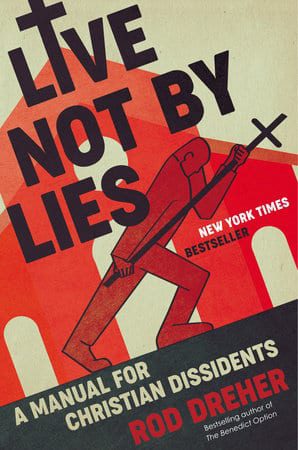
So writes Rod Dreher in his new book Live Not by Lies: A Manual for Christian Dissidents. And as far as it goes, Dreher is certainly right about this. Our skinny jeans preaching (or whatever the 2020 equivalent of that is–I don’t keep up wish fashion trends) and rock concert worship services aren’t preparing us for suffering. No one is going to go to the lions with the latest from Hillsong on their lips.
And yet, Live Not By Lies isn’t nearly as useful as it could have been.
Dreher’s argument starts in his previous book The Benedict Option (itself a more thought-out version of an argument originally danced around in his earlier book Crunchy Cons), where he argues that it’s time for Christians to bunker down and ride out the coming collapse of Western Civilization in order to be able to emerge on the other side and restore all that is right and good in the world. Just as the monks of the Middle Ages preserved and passed down what would become the foundation of all the good things we enjoy today (public order, literacy, justice, morality, etc), so we need a modern version of that. A new ‘rule of St. Benedict for the 21st century’ that builds small, strong, local communities with their own store of inner strength and health and life.
I have my own thoughts about this idea, but I’ll leave them for elsewhere. The important thing here is that Live Not By Lies is a follow-up volume that purports to provide Christians with the tools necessary to build such communities. Specifically, Dreher draws on interviews he has conducted with Eastern Europeans who clung fast to their faith under the ruthless persecution of communism.
Throughout the book he notes that the persecution of today is not the sort that involves physical torture, imprisonment, or the Gulag. Instead it is a “soft totalitarianism” that is physically much easier but spiritually and psychologically much more absolute.
“Back in the Soviet era, totalitarianism demanded love for the Party, and compliance with the Party’s demands was enforced by the state. Today’s totalitarianism demands allegiance to a set of progressive beliefs, many of which are incompatible with logic–and certainly with Christianity. Compliance is forced less by the state than by elites who form public opinion, and by private corporations that, thanks to technology control our lives far more than we would like to admit.” (8)
Dreher regularly notes that we are in a sort-of ‘pre-totalitarian’ state. We’re not quite at the point where being a traditionalist Christian gets you always automatically sent to the cultural and social gulag, but that point is in sight and it’s time to start preparing now.
But how do we go about doing that?
Our response is to be formed by first understanding the nature of the ‘soft totalitarianism’ we will be facing. Specifically we need to understand that it is a combination of progressive ideology and the muscle of the corporate world.
Second, we should respond by following the model of religious resistance under communism during the twentieth century. This involves:
- Holding tightly to the truth;
- “Cultivating cultural memory” that is, know our history and have a vision of the good shaped by the best of our traditions.
“Communism had a particular ideological vision that required it to destroy traditions, including traditional Christianity… Similarly, in contemporary capitalism, cultural memory is subordinate to the logic of the free market, whose mechanisms respond to the liberation of individual desire.” (116) So resist this attempt to destroy the past in the name of abstract rules dictated by flawed logic. - Cultivate healthy households and families. “…the family house must be a real home, ‘that is, a place which is livable and set apart, sheltered from the outer world; a place which is a starting-out point for adventures and experiences with the assurance of a safe return’–in other words, a haven in a heartless world. The loving, secure Christian home is a place that forms children who are capable of loving and serving others within the family, the church, the neighborhood, and indeed the nation. The family does not exist for itself alone, but first for God, and then for the sake of the broader community–a family of families.” (134)
- Know and cling tightly to the doctrines, practices, and traditions, of our religions. “This is the uncompromising rival religion that the post-Christian world will not long tolerate. If you are not rock solid in your commitment to traditional Christianity, then the world will break you.” (163)
- Stand with others and with other groups who are attempting the same thing, and support each other even over different political and theological lines.
- Be prepared to suffer.
In one sense, Dreher is obviously right. The world is increasingly hostile to those of us with traditional sensibilities (whether we’re Christian or not). And much of the advice he gives is the sort of advice that Christians should be following anyway. We should be invested in our local communities and our churches; we should be steeped in our own doctrines and traditions; we should be cultivating healthy households and families as shelters from the chaos of the world; we should be supporting others who are trying to do the same.
And yet, I think this book still misfires on a couple of points for at least two reasons.
First, Americans simply won’t do this. I said I won’t go into my response to the Benedict Option, so I won’t dig into the reasons why I think this is beyond our capacity as contemporary Americans (Christian or not) to pursue. But let’s just leave it that we lack the ability to think in this way about these things.
Second, what we’re really given here is not so much a ‘manual’ as ‘scenes from what should have been a couple of different books.’ For example, we’re not really told about communism in the 20th century or about how the resistance was managed. Instead, we’re given the middle of several conversations affirming that the West is moving in the direction of soft totalitarianism. Dreher assumes that we all know what the Soviet Union was, why it was terrible, what it did to dissidents, and so on. You can pick a bit of this up while reading the book, but if you’ve not already read some history (remember, the USSR collapsed almost 30 years ago at this point) or some Solzhenitsyn, much of this is going to sail by as little more than confirmation bias. So that’s one thing we’re really missing: information about the setting from which Dreher is making his parallels.
The other thing we’re missing is actual application. This is a ‘manual’ only in the sense that we’re told ‘go do it!’ Not in the sense that practical steps are given or that specific guidance is laid out–again, including by way of example from the people Dreher interviewed. We are told a bit about what happened to those who suffered under communism, and we’re given some big-picture perspectives on what resistance looked like. But we’re not really given any information about how the resistance worked. How were church services held? How did they communicate times and dates with each other? What did they read and how did they get their reading materials? What did the service look like? How do we bring all of that into the 21st century? etc. Now again, in one sense that doesn’t matter–a per my first reason above, why bother giving details to a bunch of Americans who aren’t going to use them anyway? But still, it’s not really a ‘manual’ and is more of a ‘reflection on conversations had with Eastern Europeans.’ (And I should note that there are some discussions of details in the book–I want to be sure to give Dreher, and especially those he interviewed, their full due. There just wasn’t nearly enough for what Dreher was trying to accomplish.)
I’m not saying that Live Not By Lies is without value. I think it’s a fine enough book and one that you should probably have on your shelf (unless you’re in the sort of job where being associated with Rod Dreher will get you fired–but for those of us who don’t currently work at Mozilla or the NCAA it should still be safe enough). But it’s neither as good nor as useful as The Benedict Option. So go into this with appropriate expectations.
One final word on reading Live Not By Lies as an Evangelical: the part that we most need to hear out of this book is the part that is least appealing to us as Americans, and especially as Evangelicals. You and I should be digging into the doctrines and traditions of our faith and learning to work within our local institutions. This is about as counter-cultural as you can get. It’s certainly counter to the mainstream culture, which cares nothing for truth or tradition. But it’s also counter to the huge American Evangelical sub-culture that has spent the last 60 years assuring believers that faith and love > doctrine, and that the church isn’t an institution, it’s a family (or a community or whatever). There’s even a sense in which those statements are true.
The problem is that over time repetition has changed us such that we go from hearing ‘perfect doctrine isn’t necessary for salvation’ (it isn’t) to hearing ‘doctrine isn’t important and might even be bad because it divides people’ (it is important and it does divide people; that’s not always a bad thing). Likewise we’ve gone from hearing ‘the church should look more like a family than a government’ (which is true) to hearing ‘the structure of the local church doesn’t really matter at all’ (which is so untrue as to directly contradict what the Bible teaches).
Following the advice of Live Not By Lies will mean that Evangelicals have to launch a head-on assault not just against the mainstream American culture, but against much of what we’ve been taught and have been telling others for the past six decades. This is the equivalent of telling the church that they’re going to have to start holding their services in Welsh. We might convince people there are good reasons to do so (here’s one, Welsh has this word in it: Llanfairpwllgwyngyllgogerychwyrndrobwllllantysiliogogogoch), but most people aren’t going to be willing or able to actually change even if they can see those good reasons. Hence my skepticism about the possibility of this book having any actual impact.
And yet, if we want a church that is healthy rather than weak, we need to do exactly what Dreher is recommending. Pick up the great theological works of our tradition (Martin Luther, John Calvin, Jonathan Edwards, John Wesley, just to name a few from far enough in the past that the majority of people their names will offend are nonbelievers anyway); dig down deep into the best writings about church structures (this is a good place to start for those of us who are Baptist); do all the other things he suggests–and not just by ourselves, but in our local churches and communities. I’d like to think we can all see the value of this kind of renewal, but I also suspect that seeing the value will not necessarily lead to action for most of us. But then again, I’ve been wrong about a lot in the past four years–maybe I’ll be proven wrong here as well?
Dr. Coyle Neal is co-host of the City of Man Podcast and an Associate Professor of Political Science at Southwest Baptist University in Bolivar, MO
Previous Post

December 8, 2020
Common Grace, 2.13
Next Post
December 15, 2020 Common Grace, 2.14-15
Browse Our Archives
Select a Category Action AFI Top 100 Animation Best Picture Winner BFI Top 250 Biography Biopic Books Childrens Christian Classics Classics Comedy Crime Documentary Drama Editor's Choice Family Fantasy Fantasy Films Foreign Historical Historical Fiction History Horror Horror IMDB Top 250 Indie Memoir Modern Novel Musical Mystery Non-Fiction Oscars Philosophy Poetry Popular Literature Reading and Writing Reality Romance Science Fiction Science Fiction Silent Sports Thriller TV Show Uncategorized Western Westerns Young Adult
Select a Month October 2026 September 2026 July 2026 June 2026 May 2026 April 2026 March 2026 February 2026 January 2026 December 2025 November 2025 October 2025 September 2025 August 2025 July 2025 June 2025 May 2025 April 2025 March 2025 February 2025 January 2025 December 2024 July 2024 June 2024 May 2024 April 2024 March 2024 February 2024 January 2024 December 2023 November 2023 October 2023 September 2023 August 2023 July 2023 June 2023 May 2023 April 2023 March 2023 February 2023 January 2023 December 2022 November 2022 October 2022 September 2022 August 2022 July 2022 June 2022 May 2022 April 2022 March 2022 February 2022 January 2022 December 2021 November 2021 October 2021 September 2021 August 2021 July 2021 June 2021 May 2021 April 2021 March 2021 February 2021 January 2021 December 2020 November 2020 October 2020 September 2020 August 2020 July 2020 June 2020 May 2020 April 2020 March 2020 February 2020 January 2020 December 2019 November 2019 October 2019 September 2019 August 2019 July 2019 June 2019 May 2019 April 2019 March 2019 February 2019 January 2019 December 2018 November 2018 October 2018 September 2018 August 2018 July 2018 June 2018 May 2018 April 2018 March 2018 February 2018 January 2018 December 2017 November 2017 October 2017 September 2017 June 2017 January 2017 December 2016 October 2016 September 2016 August 2016 July 2016 June 2016 May 2016 April 2016 March 2016 February 2016 January 2016 December 2015 November 2015 October 2015 September 2015 August 2015 July 2015 June 2015 May 2015 April 2015 March 2015 February 2015 January 2015 December 2014 November 2014 October 2014 September 2014 August 2014 July 2014 June 2014 May 2014 April 2014 March 2014 February 2014 January 2014 December 2013 November 2013 October 2013 September 2013 August 2013 July 2013 June 2013 May 2013 April 2013 March 2013 February 2013 January 2013 December 2012 November 2012 October 2012 September 2012 August 2012 July 2012
Follow Us!
TAKE THE
Religious Wisdom Quiz
Who was Abraham's brother?
Select your answer to see how you score.
Jacob Lot Isaac Nahor
Related posts from Schaeffer's Ghost




Thinking Critically about Critical Theory
TRENDING AT PATHEOS Religious Music & Entertainment

57th Dove Awards Honor Dolly Parton, Crown New...
On gospel music’s biggest night, the 57th annual GMA Dove Awards honored...

The First Eucharistic Controversy: Christ’s Real Presence
For Catholics, the Eucharist is the source and summit of the Christian...

What a Stop Sign Can Teach Us About...
How to Make a Decision When You Can't Hear God Main point:...

Archdiocese Hosts Military Marriage Retreat in Germany
RASTATT, Germany — The transient military lifestyle, with its frequent deployments and...

Nearly every morning, I make the drive to Detroit with my high-school-age...

The Real AI Story Is Adoption Without Trust
Artificial intelligence has crossed a political threshold. It is no longer a...
view all Religious Music & Entertainment blogs
Ad-Free & Subscriber Log-In Subscription Support
- About Us
- 2026 Calendar
- Videos
- Podcasts
- Library of World Religions
- Faith In Media Tracker
- Advertise With Us
- Write for Us
- Privacy Policy
- Terms of Service
- Do Not Sell My Data
- Contact Us
- Radiant Digital
- Manage Newsletter Subscriptions
- Unsubscribe From Notifications
- Sitemap
Copyright 2008-2026, Patheos. All rights reserved.
Subscription Support Ad-Free & Subscriber Log-In
Follow Patheos