
BuddhistCatholicContemplativeEvangelicalGeneral ChristianHinduJewishLatter-day SaintMuslimNew VisionsProgressive Christian
Beliefs
- Buddhist
- Catholic
- Contemplative
- Evangelical
- General Christian
- Hindu
- Jewish
- Latter-day Saint
- More Voices
- Muslim
- New Visions
- Pagan
- Progressive Christian
Topics
- Religion News
- Food and Religion
- Sports and Religion
- Religious Art
- Religious Music and Entertainment
- Religious Events
- History and Religion
- Style and Religion
- Politics and Religion
- Women in Religion
- Recreation Outdoors and Religion
- Business Finance and Religion
- Careers Workplace and Religion
- Education and Religion
- Family Parenting and Religion
- Health Fitness and Religion
- Home and Religion
- Relationships and Religion
- Technology and Religion
- Travel and Religion
Columnists
- Buddhist Columnists
- Business Finance and Religion Columnists
- Careers Workplace and Religion Columnists
- Catholic Columnists
- Contemplative Columnists
- Education and Religion Columnists
- Evangelists Columnists
- Family Parenting and Religion Columnists
- General Christian Columnists
- Health Fitness and Religion Columnists
- Hindu Columnists
- History and Religion Columnists
- Home and Religion Columnists
- Jewish Columnists
- More Voices Columnists
- Latter Day Columnists
- Muslim Columnists
- New Visions Columnists
- Nonreligious Columnists
- Pagan Columnists
- Politics and Religion Columnists
- Progressive Columnists
- Recreation Outdoors and Religion Columnists
- Relationships and Religion Columnists
- Religion News Columnists
- Religious Art Columnists
- Religious Events Columnists
- Religious Music and Entertainment Columnists
- Sports and Religion Columnists
- Style and Religion Columnists
- Technology and Religion Columnists
- Travel and Religion Columnists
- Women in Religion Columnists
Resource Library
- 2026 Calendar
- Library of World Religions
- The 100 Most Holy Places on Earth
- Patheos Answers
- Podcasts
- Videos
- Faith Leaders Database
- Anglican Episcopalian
- Bahai
- Baptist
- Buddhism
- Christianity
- Confucianism
- Eastern Orthodoxy
- Hinduism
- Holiness and Pentecostal
- ISKCON
- Islam
- Judaism
- Lutheran
- Methodist
- The Church of Jesus Christ of Latter-day Saints
- New Age
- Paganism
- Presbytarian and Reformed
- Protestantism
- Religion Behind the Scenes
- Roman Catholic
- Scientology
- Shia Islam
- Sikhism
- Sufism
- Sunni Islam
- Taoism
- Zen
- See all religions
Research Tools
 Ad-Free & Subscriber Log-In Subscription Support
Ad-Free & Subscriber Log-In Subscription Support
Follow Patheos 

- Trending:
- Forgiveness
- |
- Marriage
- |
- Consciousness
- |
- Death Penalty
- |
- Election
- |
- Halloween

- Home
- Religious Music & Entertainment
- Why More Money Doesn’t Make you Healthy
Why More Money Doesn’t Make you Healthy
Last updated on: March 13, 2020 at 8:00 am by Coyle Neal
Why More Money Doesn’t Make you Healthy 2020-02-28T15:58:31-07:00 Coyle Neal
Patheos Explore the world's faith through different perspectives on religion and spirituality! Patheos has the views of the prevalent religions and spiritualities of the world.
For decades now, Americans have been arguing about how to fix the healthcare problem. We’re no closer today to either agreement or a solution than we were when the argument commenced in earnest in the 1990s with the reform attempts of the Clinton Administration. For that matter, we don’t even necessarily agree about what ‘healthcare’ might mean in the first place. Obviously some things are perfectly clear–the trip to the ER, or treatments involving prescription medication, for example. But what about the elliptical I bought to hang laundry on? Does that count as a ‘healthcare’ expense? What about the Tylenol we go through every time one of us get sick? That’s a marginal cost and it’s certainly not covered by insurance, but it’s also clearly medicine–so where does it fall in the discussion? What about just eating a salad once in a while? Or going for a walk?
Again, this is a complicated issue. Fortunately, we have a thoughtful book to at least help us think a bit more clearly about the subject in Elizabeth Bradley’s and Lauren Taylor’s The American Healthcare Paradox: Why Spending More is Getting Us Less.
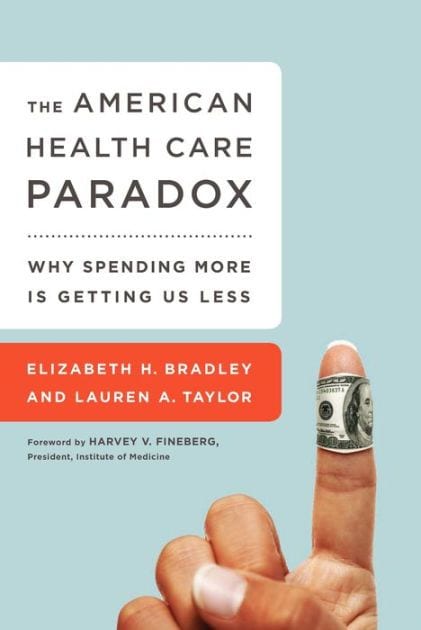
Image: PublicAffairsBooks

Even if this weren’t an election year, this would be a good book to read for a number of reasons. First, it does an excellent job outlining the history of both American health care and American social services. It also does a very good job explaining the connection between these two–a connection that is obvious on reflection but which rarely appears in our public discussions of the issue. We all know that we’ll have to go to the doctor less if we were to eat better, exercise more, and have better personal relationships. And going to the doctor less means fewer expenses, lower premiums, etc. But Americans are generally unwilling to include the government in attempts to manage the social side of our healthcare issues (and perhaps not wrongly). Which gives us the meaning of the subtitle: spending more doesn’t get us better healthcare because we’re spending it on the back end. We go to the doctor when the damage has been done, rather than investing in health on the front end that keeps us from the doctor in the first place. A few more dollars invested in that salad/elliptical now saves us a ton of doctor’s bills down the road.
The American Health Care Paradox also does an excellent job of explaining alternative approaches, both foreign (especially the Scandinavian system) and domestic. This is especially worth reading up on with the 2020 election looming. Most Republicans don’t want to think about single-payer models that have a track record of success, and most Democrats don’t want to think about how de-centralized and reliant on local government autonomy those models are.
Christians should especially have an interest in reading this book. As believers we hold to the unity of the whole person. “Health” isn’t just something we do for the physical body–we have souls that require care as well. Social aspects of our health must be a part of our thought about the issue, whatever we think about the government’s role in those social aspects. What’s more, we should especially believe in the value of things like preventative care–not least because in modern America that means cultivating the virtue of self-control. Christians (and I am preaching to myself here, to be sure) need to be on the front line of resisting slavery to our appetites. The primary reason we do this is for the glory of God, but at least one side effect is the better health we’re looking for.
One thing that’s missing from this book, and it’s not terribly surprising that it is missing, given that the authors are academics and (I assume–possibly wrongly on my part) somewhat distant from the Evangelical world. Attempts to organize health care for pastors outside of otherwise expensive insurance plans like Samaritan Ministries get no mention. Likewise, the Affordable Care Act doesn’t get much attention, either positive or negative. A chapter walking through its details would be dated now that it has been at least partially overturned, but it would also be helpful to guide us in thinking about the successes and failures of the largest attempt at healthcare reform to date.
Even with those components missing, this book is still an excellent place to begin thinking about how to make American healthcare better.
Dr. Coyle Neal is co-host of the City of Man Podcast and an Associate Professor of Political Science at Southwest Baptist University in Bolivar, MO
Previous Post

March 10, 2020
Common Grace, 1.41-42
Next Post
March 17, 2020 Common Grace, 1.43
Browse Our Archives
Select a Category Action AFI Top 100 Animation Best Picture Winner BFI Top 250 Biography Biopic Books Childrens Christian Classics Classics Comedy Crime Documentary Drama Editor's Choice Family Fantasy Fantasy Films Foreign Historical Historical Fiction History Horror Horror IMDB Top 250 Indie Memoir Modern Novel Musical Mystery Non-Fiction Oscars Philosophy Poetry Popular Literature Reading and Writing Reality Romance Science Fiction Science Fiction Silent Sports Thriller TV Show Uncategorized Western Westerns Young Adult
Select a Month October 2026 September 2026 July 2026 June 2026 May 2026 April 2026 March 2026 February 2026 January 2026 December 2025 November 2025 October 2025 September 2025 August 2025 July 2025 June 2025 May 2025 April 2025 March 2025 February 2025 January 2025 December 2024 July 2024 June 2024 May 2024 April 2024 March 2024 February 2024 January 2024 December 2023 November 2023 October 2023 September 2023 August 2023 July 2023 June 2023 May 2023 April 2023 March 2023 February 2023 January 2023 December 2022 November 2022 October 2022 September 2022 August 2022 July 2022 June 2022 May 2022 April 2022 March 2022 February 2022 January 2022 December 2021 November 2021 October 2021 September 2021 August 2021 July 2021 June 2021 May 2021 April 2021 March 2021 February 2021 January 2021 December 2020 November 2020 October 2020 September 2020 August 2020 July 2020 June 2020 May 2020 April 2020 March 2020 February 2020 January 2020 December 2019 November 2019 October 2019 September 2019 August 2019 July 2019 June 2019 May 2019 April 2019 March 2019 February 2019 January 2019 December 2018 November 2018 October 2018 September 2018 August 2018 July 2018 June 2018 May 2018 April 2018 March 2018 February 2018 January 2018 December 2017 November 2017 October 2017 September 2017 June 2017 January 2017 December 2016 October 2016 September 2016 August 2016 July 2016 June 2016 May 2016 April 2016 March 2016 February 2016 January 2016 December 2015 November 2015 October 2015 September 2015 August 2015 July 2015 June 2015 May 2015 April 2015 March 2015 February 2015 January 2015 December 2014 November 2014 October 2014 September 2014 August 2014 July 2014 June 2014 May 2014 April 2014 March 2014 February 2014 January 2014 December 2013 November 2013 October 2013 September 2013 August 2013 July 2013 June 2013 May 2013 April 2013 March 2013 February 2013 January 2013 December 2012 November 2012 October 2012 September 2012 August 2012 July 2012
Follow Us!
TAKE THE
Religious Wisdom Quiz
What does "Tabernacle" mean?
Select your answer to see how you score.
Holy altar Dwelling place Sacrifice Cupboard
Related posts from Schaeffer's Ghost




Thinking Critically about Critical Theory
TRENDING AT PATHEOS Religious Music & Entertainment

Methodist Central Hall and Westminster Abbey
Situated on the same square is Methodist Central Hall and Westminster Abbey. ...

57th Dove Awards Honor Dolly Parton, Crown New...
On gospel music’s biggest night, the 57th annual GMA Dove Awards honored...

The First Eucharistic Controversy: Christ’s Real Presence
For Catholics, the Eucharist is the source and summit of the Christian...

What a Stop Sign Can Teach Us About...
How to Make a Decision When You Can't Hear God Main point:...

Archdiocese Hosts Military Marriage Retreat in Germany
RASTATT, Germany — The transient military lifestyle, with its frequent deployments and...

Nearly every morning, I make the drive to Detroit with my high-school-age...
view all Religious Music & Entertainment blogs
Ad-Free & Subscriber Log-In Subscription Support
- About Us
- 2026 Calendar
- Videos
- Podcasts
- Library of World Religions
- Faith In Media Tracker
- Advertise With Us
- Write for Us
- Privacy Policy
- Terms of Service
- Do Not Sell My Data
- Contact Us
- Radiant Digital
- Manage Newsletter Subscriptions
- Unsubscribe From Notifications
- Sitemap
Copyright 2008-2026, Patheos. All rights reserved.
Subscription Support Ad-Free & Subscriber Log-In
Follow Patheos