
BuddhistCatholicContemplativeEvangelicalGeneral ChristianHinduJewishLatter-day SaintMuslimNew VisionsProgressive Christian
Beliefs
- Buddhist
- Catholic
- Contemplative
- Evangelical
- General Christian
- Hindu
- Jewish
- Latter-day Saint
- More Voices
- Muslim
- New Visions
- Pagan
- Progressive Christian
Topics
- Religion News
- Food and Religion
- Sports and Religion
- Religious Art
- Religious Music and Entertainment
- Religious Events
- History and Religion
- Style and Religion
- Politics and Religion
- Women in Religion
- Recreation Outdoors and Religion
- Business Finance and Religion
- Careers Workplace and Religion
- Education and Religion
- Family Parenting and Religion
- Health Fitness and Religion
- Home and Religion
- Relationships and Religion
- Technology and Religion
- Travel and Religion
Columnists
- Buddhist Columnists
- Business Finance and Religion Columnists
- Careers Workplace and Religion Columnists
- Catholic Columnists
- Contemplative Columnists
- Education and Religion Columnists
- Evangelists Columnists
- Family Parenting and Religion Columnists
- General Christian Columnists
- Health Fitness and Religion Columnists
- Hindu Columnists
- History and Religion Columnists
- Home and Religion Columnists
- Jewish Columnists
- More Voices Columnists
- Latter Day Columnists
- Muslim Columnists
- New Visions Columnists
- Nonreligious Columnists
- Pagan Columnists
- Politics and Religion Columnists
- Progressive Columnists
- Recreation Outdoors and Religion Columnists
- Relationships and Religion Columnists
- Religion News Columnists
- Religious Art Columnists
- Religious Events Columnists
- Religious Music and Entertainment Columnists
- Sports and Religion Columnists
- Style and Religion Columnists
- Technology and Religion Columnists
- Travel and Religion Columnists
- Women in Religion Columnists
Resource Library
- 2026 Calendar
- Library of World Religions
- The 100 Most Holy Places on Earth
- Patheos Answers
- Podcasts
- Videos
- Faith Leaders Database
- Anglican Episcopalian
- Bahai
- Baptist
- Buddhism
- Christianity
- Confucianism
- Eastern Orthodoxy
- Hinduism
- Holiness and Pentecostal
- ISKCON
- Islam
- Judaism
- Lutheran
- Methodist
- The Church of Jesus Christ of Latter-day Saints
- New Age
- Paganism
- Presbytarian and Reformed
- Protestantism
- Religion Behind the Scenes
- Roman Catholic
- Scientology
- Shia Islam
- Sikhism
- Sufism
- Sunni Islam
- Taoism
- Zen
- See all religions
Research Tools
 Ad-Free & Subscriber Log-In Subscription Support
Ad-Free & Subscriber Log-In Subscription Support
Follow Patheos 

- Trending:
- Forgiveness
- |
- Marriage
- |
- Consciousness
- |
- Death Penalty
- |
- Election
- |
- Halloween

- Home
- Religious Music & Entertainment
- This world is not our home
This world is not our home
Last updated on: January 24, 2020 at 9:09 am by Coyle Neal
This world is not our home 2020-01-24T09:09:51-07:00 Coyle Neal
Patheos Explore the world's faith through different perspectives on religion and spirituality! Patheos has the views of the prevalent religions and spiritualities of the world.
For various and largely unconnected reasons, I’ve spent the last few months thinking about the end of the world. More specifically, I’ve spent the last few months thinking about the relationship between the world we live in now and the coming kingdom of heaven. On my podcast we’ve been talking about Niebuhr’s classic work Christ and Culture. On this blog I’ve been working through Abraham Kuyper’s Common Grace (especially this post). And I’ve been reading for review the subject of this post, Ian K. Smith’s Not Home Yet: How the Renewal of the Earth Fits in to God’s Plan of the World.
There have been a lot of passages of Scripture thrown around in the past few months, but I think a typical one is Revelation 21:1-2 (ESV)
“Then I saw a new heaven and a new earth, for the first heaven and the first earth had passed away, and the sea was no more. And I saw the holy city, new Jerusalem, coming down out of heaven from God, prepared as a bride adorned for her husband.”
The question is, what happens to the “old city,” the old Jerusalem? What does it mean that the first heaven and the first earth had ‘passed away’? The main discussion comes between two camps. One argues that the ‘passing away’ of the first heaven and the first earth means they are destroyed/broken and set aside/some other parallel language and replaced by a new heavens and a new earth (this is largely where I fall, I think). The other approach, promoted in Not Home Yet, argues that the old heavens and the old earth are not eliminated, but rather are transformed into the new heavens and the new earth:
“The resurrection of Jesus points to something far bigger than just access to heaven; the resurrection points to the renewal of God’s creation. When we understand this scope of God’s work of salvation, reductionistic and individualistic views are lacking in the grandeur of what God is going to do. Jesus’s resurrection does not only guarantee my resurrection–important thought that is. Jesus is going to raise the universe!” (12)
Specifically, God through the work of Christ is going to reform and revivify the fallen creation so that it is the home promised and prepared for God’s people. When we forget this, or when we reduce salvation to something relevant only for the individual, we run the risk of devaluing our physical lives (including taking up a gnostic view of our bodies) and begin to neglect the important work of creation care and stewardship. And most importantly, he thinks that this view of a renewed creation is the Biblical one.
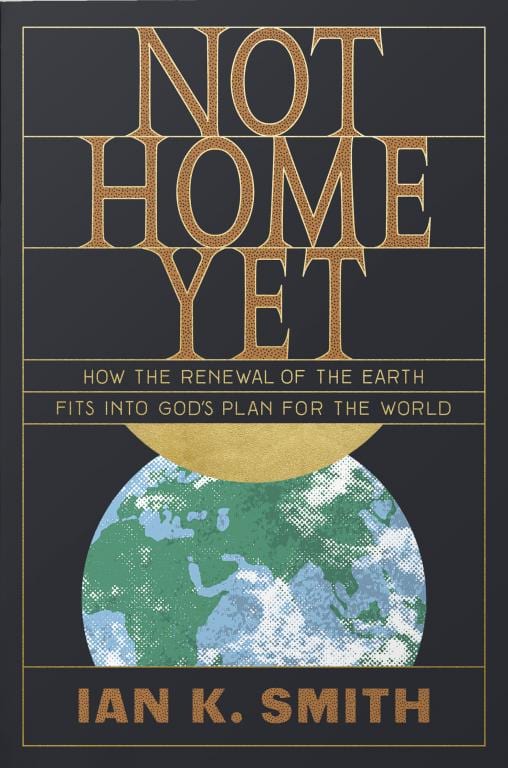
Image: Crossway

Right off the bat (or, you know, five hundred words into the review), I should point out that I agree with most of what is said in Not Home Yet. Christians shouldn’t despise the body or the physical world. Both are fallen, but both are also made good for the glory of God. What’s more, we’re going to agree on most practical issues that Christians are likely to run into in their day-to-day lives. Whichever view of the new heavens and new earth we take, both of us are going to encourage faithfulness in our daily lives. A Christian should always strive to be more patient, kinder, more loving, gentler, etc in the workplace and at home, regardless of whether they see that workplace as a temporary stewardship that will some day cease to exist or as a lasting investment that will some day be transformed into something eternal.
Smith is surely right that the view that this world is temporary can cause problems if applied incorrectly. But that is no argument against the position. If my perspective runs the risk of downplaying the value of the physical creation, the other view runs the risk of downplaying the depth and pervasiveness of sin. I don’t think Not Home Yet does this, though it comes close at times. For example, on pgs 103-105 Smith tells us about his experiences in the tribal society of Vanuatu and how he learned there that ‘Western’ ideas of justification as a means of dealing with guilt mean little to a society where shame, rather than guilt, is the primary felt need. He then points out that ‘guilt’ is likewise on the wane in our own society, and that instead we have different needs:
“I doubt that guilt or shame speaks at the same volume to our current generation [as to previous Western generations]. Furthermore, with the rise of Western skepticism, fear of the supernatural is not a felt need. But within this context, there is yet another aspect of the gospel that speaks with resounding relevance to our increasingly disjointed society: homecoming. With the fragmentation of the family, the breaking down of traditional community structures, and the rise of individualism, many in society ask what it means to belong. We have a hunger for home. We long to reverse alienation. Does the gospel of the death and resurrection of Jesus address this? As with guilt, shame, and fear, the answer is yes.” (105)
Now, there is nothing in this statement that isn’t true. But the fairly obvious omission here and in the two pages leading up to this is the doctrine of sin. No doubt our contemporary society is increasingly callous to feelings of guilt over our sins. How can we feel guilt over what so many are openly celebrating as virtues? Christians ought not respond to this situation by simply dismissing sin and going after what the world does feel like it needs. Instead, we have to do the heavy lifting of expositing the Law, the just punishment that rebelling against God’s Law deserves, and the hope offered in the Gospel. And to his credit, Smith goes on to do just that in later sections. But it is also clear that the temptation to either leave sin out all together or redefine sin as ‘alienation’ or ‘shame’ or any of the other extant felt needs stands open as an easy path for follows of this perspective–just as followers of my perspective can be tempted to disdain the world disproportionately.
As another point of disagreement, I’m not always sold on his exegesis:
“As we come to the end of the Bible, we see not a picture of people being transported to heaven or a picture of heaven. We see a picture of the descent of the New Jerusalem. We see a picture of a new heavens and new earth (rev. 21:1). The heavens and earth that God created (Gen. 1:1) are the same heavens and earth that will be renewed (Rev. 21:1).” (145)
The verse in Revelation being used as a proof text here is the same one cited above in this post, and I think it pretty clearly demonstrates exactly the opposite point Smith is trying to make. The new heavens and new earth are, well, new. The old heaven and old earth have “passed away.” It would seem to be a twisting of the words to make “passed away” = “renewed.” There are other passages that can be used to make this argument, but Revelation 21:1 isn’t one of them. The same applies to most of the examples he uses. This isn’t the place to get into the weeds of the discussion, but virtually all of the examples used in Not Home Yet are examples of things (Eden, the temple, etc) that were not ‘transformed’, they were images and types of coming realities that were broken and replaced by something new. “Transformation” isn’t really the model Scripture gives us for renewal, “recreation” is.
Finally, I don’t particularly find all of his practical arguments compelling either. Talking about the impact of the Gospel, Smith writes:
“It is a simple truth that when people become Christians, it changes them, which should bring about change in all they do. New communities are formed. Society is impacted. Churches come to realize that the work of ministry is not just inward in its focus, with the congregation supporting the church’s programs; it is also outward, with the church supporting the members of the congregation to be distinctively Christian in their respective roles. it is good for every church to think about whether it has the right balance between an inward focus of being supported and an outward focus of supporting.” (119-120)
Obviously, no faithful Christian is going to disagree with this statement. Of course the church should provide a balance of internal building-up between the body of believers and equipping for life and ministry in the world. And yet, that is not to say anything about the nature of that world in which life and ministry are lived. We are pilgrims passing through a fallen world bound for destruction, but that the world is bound for destruction doesn’t make it irrelevant. When we buy a box of diapers, we do so knowing that they will only be with us for a short time. This in no way makes them either unimportant or irrelevant. Their temporary status in our household doesn’t diminish their importance, and the fact that they were created clean and, once soiled, are bound for destruction doesn’t take away from how central a role they currently play in our lives.
Or, to use a more Biblical (and less scatological) example, to agree with Jesus that marriage is a temporary institution that will not last into the new heavens and new earth (Matthew 22:30) does not diminish its value in the present age. In fact, realizing the temporary nature of our stewardship in our families makes is better at obeying Scripture. We see marriage in its proper context and treat it as the temporary blessing it is, using it as a way to better understand the relationship between Christ and the Church (among other things).
And, well, this is a long review already that need not go on. If it isn’t clear from the preceding fifteen hundred words, I thoroughly enjoyed reading Not Home Yet. It certainly gave me a lot to think about and was well-written and thoughtful. What’s more, it challenges us to think well about how to live in God’s good creation as fallen-but-redeemed people.
Dr. Coyle Neal is co-host of the City of Man Podcast and an Associate Professor of Political Science at Southwest Baptist University in Bolivar, MO
Previous Post
January 21, 2020
Common Grace, 1.31
Next Post
January 28, 2020 Common Grace, 1.32-33
Browse Our Archives
Select a Category Action AFI Top 100 Animation Best Picture Winner BFI Top 250 Biography Biopic Books Childrens Christian Classics Classics Comedy Crime Documentary Drama Editor's Choice Family Fantasy Fantasy Films Foreign Historical Historical Fiction History Horror Horror IMDB Top 250 Indie Memoir Modern Novel Musical Mystery Non-Fiction Oscars Philosophy Poetry Popular Literature Reading and Writing Reality Romance Science Fiction Science Fiction Silent Sports Thriller TV Show Uncategorized Western Westerns Young Adult
Select a Month October 2026 September 2026 July 2026 June 2026 May 2026 April 2026 March 2026 February 2026 January 2026 December 2025 November 2025 October 2025 September 2025 August 2025 July 2025 June 2025 May 2025 April 2025 March 2025 February 2025 January 2025 December 2024 July 2024 June 2024 May 2024 April 2024 March 2024 February 2024 January 2024 December 2023 November 2023 October 2023 September 2023 August 2023 July 2023 June 2023 May 2023 April 2023 March 2023 February 2023 January 2023 December 2022 November 2022 October 2022 September 2022 August 2022 July 2022 June 2022 May 2022 April 2022 March 2022 February 2022 January 2022 December 2021 November 2021 October 2021 September 2021 August 2021 July 2021 June 2021 May 2021 April 2021 March 2021 February 2021 January 2021 December 2020 November 2020 October 2020 September 2020 August 2020 July 2020 June 2020 May 2020 April 2020 March 2020 February 2020 January 2020 December 2019 November 2019 October 2019 September 2019 August 2019 July 2019 June 2019 May 2019 April 2019 March 2019 February 2019 January 2019 December 2018 November 2018 October 2018 September 2018 August 2018 July 2018 June 2018 May 2018 April 2018 March 2018 February 2018 January 2018 December 2017 November 2017 October 2017 September 2017 June 2017 January 2017 December 2016 October 2016 September 2016 August 2016 July 2016 June 2016 May 2016 April 2016 March 2016 February 2016 January 2016 December 2015 November 2015 October 2015 September 2015 August 2015 July 2015 June 2015 May 2015 April 2015 March 2015 February 2015 January 2015 December 2014 November 2014 October 2014 September 2014 August 2014 July 2014 June 2014 May 2014 April 2014 March 2014 February 2014 January 2014 December 2013 November 2013 October 2013 September 2013 August 2013 July 2013 June 2013 May 2013 April 2013 March 2013 February 2013 January 2013 December 2012 November 2012 October 2012 September 2012 August 2012 July 2012
Follow Us!
TAKE THE
Religious Wisdom Quiz
Who was told to prophesy to the mountains and valleys of Israel?
Select your answer to see how you score.
Micah Hosea Daniel Ezekiel
Related posts from Schaeffer's Ghost




Thinking Critically about Critical Theory
TRENDING AT PATHEOS Religious Music & Entertainment

Letters on Living the Faith by C.S. Lewis
Most of us met C.S. Lewis as a public intellectual. Mere Christianity....

When Halloween Unmasks Married Hearts
Written by Dr. David K. Ewen from Eternal Truth Bible College Behind...

Aristotle. He’s been called the father of logic, the father of the...

Methodist Central Hall and Westminster Abbey
Situated on the same square is Methodist Central Hall and Westminster Abbey. ...

57th Dove Awards Honor Dolly Parton, Crown New...
On gospel music’s biggest night, the 57th annual GMA Dove Awards honored...

The First Eucharistic Controversy: Christ’s Real Presence
For Catholics, the Eucharist is the source and summit of the Christian...
view all Religious Music & Entertainment blogs
Ad-Free & Subscriber Log-In Subscription Support
- About Us
- 2026 Calendar
- Videos
- Podcasts
- Library of World Religions
- Faith In Media Tracker
- Advertise With Us
- Write for Us
- Privacy Policy
- Terms of Service
- Do Not Sell My Data
- Contact Us
- Radiant Digital
- Manage Newsletter Subscriptions
- Unsubscribe From Notifications
- Sitemap
Copyright 2008-2026, Patheos. All rights reserved.
Subscription Support Ad-Free & Subscriber Log-In
Follow Patheos