
BuddhistCatholicContemplativeEvangelicalGeneral ChristianHinduJewishLatter-day SaintMuslimNew VisionsProgressive Christian
Beliefs
- Buddhist
- Catholic
- Contemplative
- Evangelical
- General Christian
- Hindu
- Jewish
- Latter-day Saint
- More Voices
- Muslim
- New Visions
- Pagan
- Progressive Christian
Topics
- Religion News
- Food and Religion
- Sports and Religion
- Religious Art
- Religious Music and Entertainment
- Religious Events
- History and Religion
- Style and Religion
- Politics and Religion
- Women in Religion
- Recreation Outdoors and Religion
- Business Finance and Religion
- Careers Workplace and Religion
- Education and Religion
- Family Parenting and Religion
- Health Fitness and Religion
- Home and Religion
- Relationships and Religion
- Technology and Religion
- Travel and Religion
Columnists
- Buddhist Columnists
- Business Finance and Religion Columnists
- Careers Workplace and Religion Columnists
- Catholic Columnists
- Contemplative Columnists
- Education and Religion Columnists
- Evangelists Columnists
- Family Parenting and Religion Columnists
- General Christian Columnists
- Health Fitness and Religion Columnists
- Hindu Columnists
- History and Religion Columnists
- Home and Religion Columnists
- Jewish Columnists
- More Voices Columnists
- Latter Day Columnists
- Muslim Columnists
- New Visions Columnists
- Nonreligious Columnists
- Pagan Columnists
- Politics and Religion Columnists
- Progressive Columnists
- Recreation Outdoors and Religion Columnists
- Relationships and Religion Columnists
- Religion News Columnists
- Religious Art Columnists
- Religious Events Columnists
- Religious Music and Entertainment Columnists
- Sports and Religion Columnists
- Style and Religion Columnists
- Technology and Religion Columnists
- Travel and Religion Columnists
- Women in Religion Columnists
Resource Library
- 2026 Calendar
- Library of World Religions
- The 100 Most Holy Places on Earth
- Patheos Answers
- Podcasts
- Videos
- Faith Leaders Database
- Anglican Episcopalian
- Bahai
- Baptist
- Buddhism
- Christianity
- Confucianism
- Eastern Orthodoxy
- Hinduism
- Holiness and Pentecostal
- ISKCON
- Islam
- Judaism
- Lutheran
- Methodist
- The Church of Jesus Christ of Latter-day Saints
- New Age
- Paganism
- Presbytarian and Reformed
- Protestantism
- Religion Behind the Scenes
- Roman Catholic
- Scientology
- Shia Islam
- Sikhism
- Sufism
- Sunni Islam
- Taoism
- Zen
- See all religions
Research Tools
 Ad-Free & Subscriber Log-In Subscription Support
Ad-Free & Subscriber Log-In Subscription Support
Follow Patheos 

- Trending:
- Forgiveness
- |
- Marriage
- |
- Consciousness
- |
- Death Penalty
- |
- Election
- |
- Halloween

- Home
- Religious Music & Entertainment
- Another not-so-gentle classic
Another not-so-gentle classic
Last updated on: November 29, 2019 at 8:00 am by Coyle Neal
Another not-so-gentle classic 2019-11-22T13:50:26-07:00 Coyle Neal
Patheos Explore the world's faith through different perspectives on religion and spirituality! Patheos has the views of the prevalent religions and spiritualities of the world.
A couple of weeks ago, this blog covered Sheri Tepper’s sci-fi classic Grass. The subject of today’s review, Raising the Stones, is not exactly a sequel but rather is another tale set in the same universe albeit hundreds of years in the future after the events of Grass. You can read it as a stand-alone work, but if you’ve read Grass first you’ll recognize a few items of technology here and there (specifically the doors that allow instant travel between planets, introduced at the end of Grass). The main character of Grass likewise plays a bit role in the origin story of one of the religions featured in Raising the Stones. Otherwise Raising the Stones is a perfectly servicable story in its own right.

Image: Amazon

For better or worse (mostly better), Raising the Stones is far too complex a book to summarize in a short review. It is the story of the conflict of two religions. It is the story of Sam Girat’s becoming a hero, while coming to realize what true heroism is. It is the story of conflict between patriarchy and matriarchy. And it is the story of the difference between a proper, healthy, joyful pastoralism and a slavish (literally), cruel, and hateful pastoralism. Any of these would be fair game for reflection, but given the nature of this blog it’s probably best to focus on some of the book’s religious reflections.
What we see unfolding across the novel is in one sense a fairly shallow and old-fashioned view of religion with a New-Agey twist. For example, the words of the prophetess (the main character from Grass) that found one of the main religions in the novel include tidbits like:
“”It is our minds and not any other attribute which gives us personhood and value. We share intelligence with other living things, and they are no less important then we. Even creatures without detectable intelligence have adapted themselves to play necessary roles. To make God in our image or we in God’s is blasphemy….
There is no sin inherent in any mind save the sin of pride in believing one has seen or been taught the absolute truth. The second greatest sin is refusing ot search for the truth one must acknowledge on will never absolutely find…
Even when people are well-meaning, do not let them fool with your heads.” (131-132)
Evil isn’t inherent in us, the only evil is not being true to ourselves. In part, this is because of the view of God. What some people want is a God of thunder and lightning and righteous fury. But the reality is that “God” is a quiet, unobtrusive force that speaks and influences quietly through a subtle closeness to nature:
This common God: “‘…should have come out of a fiery cloud. It should have descended from heaven…. It should have come through a fiery gate, like that prophetess…. But it just grew in the dirt like a turnip… How can we feel this way about something so common, somehting that just grew in the dirt?’
‘Because it works. It doesn’t threaten us. It doesn’t damn us to hell… It doesn’t require rituals… It just works.;” (228-229)
The true God is not a God of dominance, but rather a God who coordinates and unites and harmonizes and creates, rather than one who oppresses and destroys.
The other God, the one pretty clearly referencing the future descendant of Islam, has a different origin and a different function:
“… the retributive religions… they all came from a pastoral background. In primitive times, everything out there in the dark was a predator. One had to guard against everything that threatened the flock, had to kill it if possible. At night, the flock had to be sequestered, put in the fold and guarded. The shepherd had to stand guard, sleepless, night after night… The shepherd had to be afraid of everything… Only the people survived who were very alert and perpetually firghtened, and thus very irritable and quick to attack.” (371-372)
Again, this is all the sort of thing people would have learned in a public university Intro to Religion class fifty years ago. And as far as that goes the responses of apologetics fifty years ago are fine places to go. For example, is there any justice in the God portrayed in this book? Individual nature and the physical body have both been kicked out, so why should any single person matter at all? And is there any atonement possible for sins committed in the past? Etc.
Fortunately, none of this takes away from the quality of the book. It’s still a great story well worth reading.
One final note on the structure of the book: it’s super-irritating. For whatever reason, the publisher (I assume) decided to put the title of the book over a single bullet point on every page, followed by the page number, followed by the text.
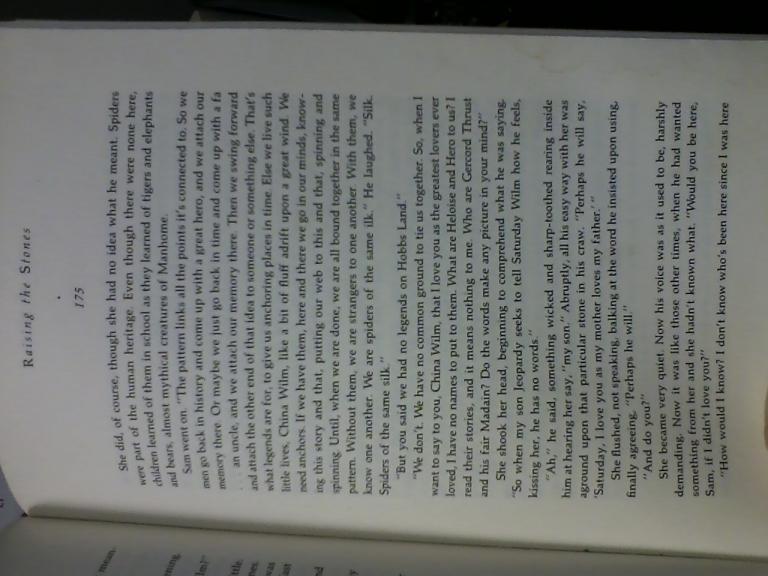
If you’re a book publisher, please never do this.
If you’re a book reader, you should pick up and enjoy Raising the Stones.
Dr. Coyle Neal is co-host of the City of Man Podcast and an Associate Professor of Political Science at Southwest Baptist University in Bolivar, MO
Previous Post

November 26, 2019
Common Grace, 1.24-25
Next Post
December 3, 2019 Common Grace, 1.26
Browse Our Archives
Select a Category Action AFI Top 100 Animation Best Picture Winner BFI Top 250 Biography Biopic Books Childrens Christian Classics Classics Comedy Crime Documentary Drama Editor's Choice Family Fantasy Fantasy Films Foreign Historical Historical Fiction History Horror Horror IMDB Top 250 Indie Memoir Modern Novel Musical Mystery Non-Fiction Oscars Philosophy Poetry Popular Literature Reading and Writing Reality Romance Science Fiction Science Fiction Silent Sports Thriller TV Show Uncategorized Western Westerns Young Adult
Select a Month October 2026 September 2026 July 2026 June 2026 May 2026 April 2026 March 2026 February 2026 January 2026 December 2025 November 2025 October 2025 September 2025 August 2025 July 2025 June 2025 May 2025 April 2025 March 2025 February 2025 January 2025 December 2024 July 2024 June 2024 May 2024 April 2024 March 2024 February 2024 January 2024 December 2023 November 2023 October 2023 September 2023 August 2023 July 2023 June 2023 May 2023 April 2023 March 2023 February 2023 January 2023 December 2022 November 2022 October 2022 September 2022 August 2022 July 2022 June 2022 May 2022 April 2022 March 2022 February 2022 January 2022 December 2021 November 2021 October 2021 September 2021 August 2021 July 2021 June 2021 May 2021 April 2021 March 2021 February 2021 January 2021 December 2020 November 2020 October 2020 September 2020 August 2020 July 2020 June 2020 May 2020 April 2020 March 2020 February 2020 January 2020 December 2019 November 2019 October 2019 September 2019 August 2019 July 2019 June 2019 May 2019 April 2019 March 2019 February 2019 January 2019 December 2018 November 2018 October 2018 September 2018 August 2018 July 2018 June 2018 May 2018 April 2018 March 2018 February 2018 January 2018 December 2017 November 2017 October 2017 September 2017 June 2017 January 2017 December 2016 October 2016 September 2016 August 2016 July 2016 June 2016 May 2016 April 2016 March 2016 February 2016 January 2016 December 2015 November 2015 October 2015 September 2015 August 2015 July 2015 June 2015 May 2015 April 2015 March 2015 February 2015 January 2015 December 2014 November 2014 October 2014 September 2014 August 2014 July 2014 June 2014 May 2014 April 2014 March 2014 February 2014 January 2014 December 2013 November 2013 October 2013 September 2013 August 2013 July 2013 June 2013 May 2013 April 2013 March 2013 February 2013 January 2013 December 2012 November 2012 October 2012 September 2012 August 2012 July 2012
Follow Us!
TAKE THE
Religious Wisdom Quiz
Whom did Paul leave sick at Miletus, showing that early Christians sometimes suffered illness?
Select your answer to see how you score.
Barnabas Trophimus Timothy Silas
Related posts from Schaeffer's Ghost




Thinking Critically about Critical Theory
TRENDING AT PATHEOS Religious Music & Entertainment

The Iron Gates and the Lion of the...
Yesterday, I didn't finish my report about, well, yesterday. So I'll...

Dolly Parton’s Last Song Wins Dove Award with...
Bluegrass band The Grascals, speaking on the red carpet at the 57th...

The Image: On the Horror of Capitalism and...
The Image Then went the Pharisees, and took counsel how they might...

We are approaching the date of our new American national holiday: October...

Letters on Living the Faith by C.S. Lewis
Most of us met C.S. Lewis as a public intellectual. Mere Christianity....

When Halloween Unmasks Married Hearts
Written by Dr. David K. Ewen from Eternal Truth Bible College Behind...
view all Religious Music & Entertainment blogs
Ad-Free & Subscriber Log-In Subscription Support
- About Us
- 2026 Calendar
- Videos
- Podcasts
- Library of World Religions
- Faith In Media Tracker
- Advertise With Us
- Write for Us
- Privacy Policy
- Terms of Service
- Do Not Sell My Data
- Contact Us
- Radiant Digital
- Manage Newsletter Subscriptions
- Unsubscribe From Notifications
- Sitemap
Copyright 2008-2026, Patheos. All rights reserved.
Subscription Support Ad-Free & Subscriber Log-In
Follow Patheos