
BuddhistCatholicContemplativeEvangelicalGeneral ChristianHinduJewishLatter-day SaintMuslimNew VisionsProgressive Christian
Beliefs
- Buddhist
- Catholic
- Contemplative
- Evangelical
- General Christian
- Hindu
- Jewish
- Latter-day Saint
- More Voices
- Muslim
- New Visions
- Pagan
- Progressive Christian
Topics
- Religion News
- Food and Religion
- Sports and Religion
- Religious Art
- Religious Music and Entertainment
- Religious Events
- History and Religion
- Style and Religion
- Politics and Religion
- Women in Religion
- Recreation Outdoors and Religion
- Business Finance and Religion
- Careers Workplace and Religion
- Education and Religion
- Family Parenting and Religion
- Health Fitness and Religion
- Home and Religion
- Relationships and Religion
- Technology and Religion
- Travel and Religion
Columnists
- Buddhist Columnists
- Business Finance and Religion Columnists
- Careers Workplace and Religion Columnists
- Catholic Columnists
- Contemplative Columnists
- Education and Religion Columnists
- Evangelists Columnists
- Family Parenting and Religion Columnists
- General Christian Columnists
- Health Fitness and Religion Columnists
- Hindu Columnists
- History and Religion Columnists
- Home and Religion Columnists
- Jewish Columnists
- More Voices Columnists
- Latter Day Columnists
- Muslim Columnists
- New Visions Columnists
- Nonreligious Columnists
- Pagan Columnists
- Politics and Religion Columnists
- Progressive Columnists
- Recreation Outdoors and Religion Columnists
- Relationships and Religion Columnists
- Religion News Columnists
- Religious Art Columnists
- Religious Events Columnists
- Religious Music and Entertainment Columnists
- Sports and Religion Columnists
- Style and Religion Columnists
- Technology and Religion Columnists
- Travel and Religion Columnists
- Women in Religion Columnists
Resource Library
- 2026 Calendar
- Library of World Religions
- The 100 Most Holy Places on Earth
- Patheos Answers
- Podcasts
- Videos
- Faith Leaders Database
- Anglican Episcopalian
- Bahai
- Baptist
- Buddhism
- Christianity
- Confucianism
- Eastern Orthodoxy
- Hinduism
- Holiness and Pentecostal
- ISKCON
- Islam
- Judaism
- Lutheran
- Methodist
- The Church of Jesus Christ of Latter-day Saints
- New Age
- Paganism
- Presbytarian and Reformed
- Protestantism
- Religion Behind the Scenes
- Roman Catholic
- Scientology
- Shia Islam
- Sikhism
- Sufism
- Sunni Islam
- Taoism
- Zen
- See all religions
Research Tools
 Ad-Free & Subscriber Log-In Subscription Support
Ad-Free & Subscriber Log-In Subscription Support
Follow Patheos 

- Trending:
- Forgiveness
- |
- Marriage
- |
- Consciousness
- |
- Death Penalty
- |
- Election
- |
- Halloween

- Home
- Religious Music & Entertainment
- God does not abandon his children
God does not abandon his children
Last updated on: October 18, 2019 at 8:00 am by Coyle Neal
God does not abandon his children 2019-09-23T09:24:03-06:00 Coyle Neal
Patheos Explore the world's faith through different perspectives on religion and spirituality! Patheos has the views of the prevalent religions and spiritualities of the world.
We all feel down at times. Low blood sugar, tragedy, and everything in between can bring on depression. The translation of Spiritual Desertion by Gisbertus Voetius and Johannes Hoornbeeck is not targeted at any of these kinds of ailments. Instead, they are responding to the uniquely Christian feeling of the collapse of assurance and sense of having been abandoned–deserted–by God. This is really two books, with the first having been started by Voetius, then re-started and completed by Hoornbeeck. There is also an excellent introduction that sorts this out and puts both writers in their context.
So what is “spiritual desertion”?
We describe spiritual desertion as follows: It is an inner cross or spiritual sorrow and trial as a result of which a person, now being truly converted to God, fails to feel his or her heart’s delight in God and divine things. It results from the darkening of one’s assurance and clarity with respect to appropriation by a personal faith.” (pg 30)
In other words, it is exactly what it sounds like–the sense that God has abandoned us. This is not a doubt about the nature of the faith, or a failure to believe that Scripture is true, or any of the other topics that apologetics is designed to grapple with. Instead, it is the sense that these things are not true for me. Yes, Christ died for the sins of all who repent and believe, and there are people who have been redeemed and are going to heaven, but I do not feel as if these promises are true for me.
“The true subjects of [spiritual] desertion, the people in whose life it is found, are only believers, for this is their peculiar and incommunicable kind of suffering and illness, just as eclipses only occur in the case of the sun and the moon. Unbelievers and hypocrites are only ‘wandering stars’ (Jude 13), not those two great lights. Hence in them that which was never there cannot be eclipsed and lacking.” (pg 31-32)
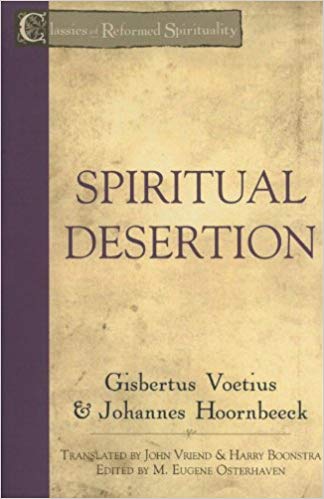
Image: Dutch Reformed Translation Society
This is a problem for Christians alone, and one that seems to be largely unique to us.
There are, according to Voetius, specific reasons why God subjects believers to this situation:
“The immediate ends for which God sends desertion, or abandonment, are:
-that the believer may be tested and so become better known to himself and others;
-that the desire for grace and glory may increasingly be strengthened in him;
-that hidden sins may be uncovered and future sins prevented;
-that he be taught tenderness of conscience and a correct and precise observation of his conduct;
-that he become empty and poor of spirit;
-that he obtain an aversion to this world and to the pilgrim’s life;
-that he be weaned of external, earthly joy and consolation;
-that he learn to be fed with tears as the only delicacy of consolation when the Comforter is not present;
-that on account of these things he may cling to his God all the more firmly.” (pg 40)
And just as spiritual desertion is not without reason, so it is not without cure (though the cure is never promised, and may only come late in life). Fortunately, there is no mystery when it comes to curing spiritual desertion. It is the same cure that applies to all of mankind’s greatest needs: the application of the Gospel to the soul. As with salvation, in cases of spiritual desertion this will happen in God’s time, rather than in ours. Yet, there are some things we can do and things we should keep in mind when we are deserted ourselves, or (especially) when we are helping others who are feeling deserted.
First, check into potential physiological causes. We want to be sure that the cause is genuinely spiritual, and not biochemical (my word, not the word the Dutch theologians use). Second,
“We must avoid false remedies, such as
(1) earthy comforts in the form of sensual pleasure sand enjoyments, vain pastimes, the lessening of activity and the relaxation of zeal for self-mortification, and especially the scrupulous practices of godliness, and so forth…
(2) We must not praise the patients too much, elevating them above many other believers, by which it is more or less suggested to them that they must draw peace of conscience and consolation from their own works.
(3) We must guard against trivializing this evil as if it did not exist or amount to much or as if it is nothing but a concoction of their own foolishness and pessimistic attitude.
(4) We must similarly avoid trivializing sins and an all too ready, general, and undiscerning expansion of the mercy of God.
(5) We must guard against a stripped-down version of the commandments: Do this, believe that, tell yourself this, avoid that, reject this or that, and so on, without in the process persuading people that the grace they do not feel, and deny feeling, in themselves is in fact in them.”
What, then, are the true remedies?
“The means to be used are part purgative and part restorative. Those of the first kind are the examination of conscience and its relief by the renewal of penitence, along with fasting and prayer. Those of the other kind [restorative] are:
(1) the general means such as the exercise of godliness, both in the home and outside it, diligent exertion in one’s daily occupation, keeping company with godly folks, especially the ministers of the Word. These ought above all to be equipped with the gift and art of consolation and to watch over the consciences of the people entrusted to their care in this state… Add to this the use of medicines and keeping a diet, if the body has perhaps also been affected, either before the abandonment, or concurrently with it, or later by its influence.
(2) The special means are the restorative aids of the consolations composed of the experiences and remembrances of the past, the contemplation of the present, and the desire or yearning for the future, or that which is not yet visible. Let the general remedy be a spiritual yearning accompanied by sorrows. Once this has been found, as it is in all who are truly converted, we can firmly conclude–against all doubts and evil suspicions–that they are in the state of grace, as can be seen from the immovable grounds of Holy Scripture.” (46-47)
In other words: trust God, reflect on the Gospel, repent of your sins, and work with others. And a good place to start doing all of this is by reading this excellent book.
Dr. Coyle Neal is co-host of the City of Man Podcast and an Associate Professor of Political Science at Southwest Baptist University in Bolivar, MO
Previous Post

October 15, 2019
Common Grace 1.16-17
Next Post
October 22, 2019 Common Grace, 1.18-19
Browse Our Archives
Select a Category Action AFI Top 100 Animation Best Picture Winner BFI Top 250 Biography Biopic Books Childrens Christian Classics Classics Comedy Crime Documentary Drama Editor's Choice Family Fantasy Fantasy Films Foreign Historical Historical Fiction History Horror Horror IMDB Top 250 Indie Memoir Modern Novel Musical Mystery Non-Fiction Oscars Philosophy Poetry Popular Literature Reading and Writing Reality Romance Science Fiction Science Fiction Silent Sports Thriller TV Show Uncategorized Western Westerns Young Adult
Select a Month October 2026 September 2026 July 2026 June 2026 May 2026 April 2026 March 2026 February 2026 January 2026 December 2025 November 2025 October 2025 September 2025 August 2025 July 2025 June 2025 May 2025 April 2025 March 2025 February 2025 January 2025 December 2024 July 2024 June 2024 May 2024 April 2024 March 2024 February 2024 January 2024 December 2023 November 2023 October 2023 September 2023 August 2023 July 2023 June 2023 May 2023 April 2023 March 2023 February 2023 January 2023 December 2022 November 2022 October 2022 September 2022 August 2022 July 2022 June 2022 May 2022 April 2022 March 2022 February 2022 January 2022 December 2021 November 2021 October 2021 September 2021 August 2021 July 2021 June 2021 May 2021 April 2021 March 2021 February 2021 January 2021 December 2020 November 2020 October 2020 September 2020 August 2020 July 2020 June 2020 May 2020 April 2020 March 2020 February 2020 January 2020 December 2019 November 2019 October 2019 September 2019 August 2019 July 2019 June 2019 May 2019 April 2019 March 2019 February 2019 January 2019 December 2018 November 2018 October 2018 September 2018 August 2018 July 2018 June 2018 May 2018 April 2018 March 2018 February 2018 January 2018 December 2017 November 2017 October 2017 September 2017 June 2017 January 2017 December 2016 October 2016 September 2016 August 2016 July 2016 June 2016 May 2016 April 2016 March 2016 February 2016 January 2016 December 2015 November 2015 October 2015 September 2015 August 2015 July 2015 June 2015 May 2015 April 2015 March 2015 February 2015 January 2015 December 2014 November 2014 October 2014 September 2014 August 2014 July 2014 June 2014 May 2014 April 2014 March 2014 February 2014 January 2014 December 2013 November 2013 October 2013 September 2013 August 2013 July 2013 June 2013 May 2013 April 2013 March 2013 February 2013 January 2013 December 2012 November 2012 October 2012 September 2012 August 2012 July 2012
Follow Us!
TAKE THE
Religious Wisdom Quiz
Who defeated the Midianites with just 300 men?
Select your answer to see how you score.
Gideon Saul Samson Joshua
Related posts from Schaeffer's Ghost




Thinking Critically about Critical Theory
TRENDING AT PATHEOS Religious Music & Entertainment

57th Dove Awards Honor Dolly Parton, Crown New...
On gospel music’s biggest night, the 57th annual GMA Dove Awards honored...

The First Eucharistic Controversy: Christ’s Real Presence
For Catholics, the Eucharist is the source and summit of the Christian...

What a Stop Sign Can Teach Us About...
How to Make a Decision When You Can't Hear God Main point:...

Archdiocese Hosts Military Marriage Retreat in Germany
RASTATT, Germany — The transient military lifestyle, with its frequent deployments and...

Nearly every morning, I make the drive to Detroit with my high-school-age...

The Real AI Story Is Adoption Without Trust
Artificial intelligence has crossed a political threshold. It is no longer a...
view all Religious Music & Entertainment blogs
Ad-Free & Subscriber Log-In Subscription Support
- About Us
- 2026 Calendar
- Videos
- Podcasts
- Library of World Religions
- Faith In Media Tracker
- Advertise With Us
- Write for Us
- Privacy Policy
- Terms of Service
- Do Not Sell My Data
- Contact Us
- Radiant Digital
- Manage Newsletter Subscriptions
- Unsubscribe From Notifications
- Sitemap
Copyright 2008-2026, Patheos. All rights reserved.
Subscription Support Ad-Free & Subscriber Log-In
Follow Patheos