
BuddhistCatholicContemplativeEvangelicalGeneral ChristianHinduJewishLatter-day SaintMuslimNew VisionsProgressive Christian
Beliefs
- Buddhist
- Catholic
- Contemplative
- Evangelical
- General Christian
- Hindu
- Jewish
- Latter-day Saint
- More Voices
- Muslim
- New Visions
- Pagan
- Progressive Christian
Topics
- Religion News
- Food and Religion
- Sports and Religion
- Religious Art
- Religious Music and Entertainment
- Religious Events
- History and Religion
- Style and Religion
- Politics and Religion
- Women in Religion
- Recreation Outdoors and Religion
- Business Finance and Religion
- Careers Workplace and Religion
- Education and Religion
- Family Parenting and Religion
- Health Fitness and Religion
- Home and Religion
- Relationships and Religion
- Technology and Religion
- Travel and Religion
Columnists
- Buddhist Columnists
- Business Finance and Religion Columnists
- Careers Workplace and Religion Columnists
- Catholic Columnists
- Contemplative Columnists
- Education and Religion Columnists
- Evangelists Columnists
- Family Parenting and Religion Columnists
- General Christian Columnists
- Health Fitness and Religion Columnists
- Hindu Columnists
- History and Religion Columnists
- Home and Religion Columnists
- Jewish Columnists
- More Voices Columnists
- Latter Day Columnists
- Muslim Columnists
- New Visions Columnists
- Nonreligious Columnists
- Pagan Columnists
- Politics and Religion Columnists
- Progressive Columnists
- Recreation Outdoors and Religion Columnists
- Relationships and Religion Columnists
- Religion News Columnists
- Religious Art Columnists
- Religious Events Columnists
- Religious Music and Entertainment Columnists
- Sports and Religion Columnists
- Style and Religion Columnists
- Technology and Religion Columnists
- Travel and Religion Columnists
- Women in Religion Columnists
Resource Library
- 2026 Calendar
- Library of World Religions
- The 100 Most Holy Places on Earth
- Patheos Answers
- Podcasts
- Videos
- Faith Leaders Database
- Anglican Episcopalian
- Bahai
- Baptist
- Buddhism
- Christianity
- Confucianism
- Eastern Orthodoxy
- Hinduism
- Holiness and Pentecostal
- ISKCON
- Islam
- Judaism
- Lutheran
- Methodist
- The Church of Jesus Christ of Latter-day Saints
- New Age
- Paganism
- Presbytarian and Reformed
- Protestantism
- Religion Behind the Scenes
- Roman Catholic
- Scientology
- Shia Islam
- Sikhism
- Sufism
- Sunni Islam
- Taoism
- Zen
- See all religions
Research Tools
 Ad-Free & Subscriber Log-In Subscription Support
Ad-Free & Subscriber Log-In Subscription Support
Follow Patheos 

- Trending:
- Forgiveness
- |
- Marriage
- |
- Consciousness
- |
- Death Penalty
- |
- Election
- |
- Halloween

- Home
- Religious Music & Entertainment
- Identity Politics Ahead of its Time
Identity Politics Ahead of its Time
Last updated on: January 18, 2019 at 8:00 am by Coyle Neal
Identity Politics Ahead of its Time 2019-01-17T10:18:26-07:00 Coyle Neal
Patheos Explore the world's faith through different perspectives on religion and spirituality! Patheos has the views of the prevalent religions and spiritualities of the world.
A.E. van Vogt was ahead of his time. So far ahead of his time, in fact, that I think he hasn’t been as appreciated as much as he deserves. Take for example his 1972 book The Darkness on Diamondia. I can certainly understand that this book was not well received in its day, and consequently has been overlooked by later generations. This is unfortunate, because it is dealing with issues that are directly relevant now.
That said, I can understand why science fiction aficionados would pass over this one. The technology aspect of this book is muted at best. [Spoilers abound from here on out.] At first glance, The Darkness on Diamondia is just another space opera more reminiscent of the 1950s golden-era of sci-fi rather than the more surreal 1970s works. It appears that the basic plot has to do with the perils of colonization. The human “Diamondians” are a minority on the planet Diamondia, and have come under attack by the native Irsk. Only the Earth Federation military stands between the Diamondians and extermination by the Irsk (despite a healthy contingent of Irsk who are “friends of the Diamondians”). Colonel Charles Morton has been sent as a part of the Federation Negotiating Committee nominally to find a peaceful resolution so that both sides can live in harmony, but in reality simply to extricate the Earth Federation forces regardless of the cost to the Diamondians. This is made emotionally difficult by the fact that the Diamondians live in the traditional Earth fashion (and are perhaps the only people left in the galaxy who do). In an age of spaceships and intergalactic travel, the Diamondians zip around cities like “New Naples” in cars and live in traditional houses. Familiar Earth landmarks dot the city (Neapolitan ones, anyway) and create a sense of being at home. In this setting, Morton has to navigate the political alliances and factions in an effort to accomplish his mission as quickly and peacefully as possible.
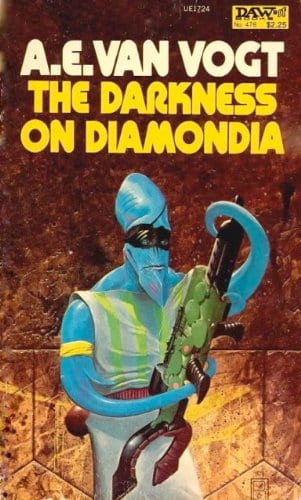
Image: Amazon
That is the nominal plot, but if you go into this book thinking that you’re going to get a straightforward sci-fi political thriller, well, it’s no wonder many people got turned off. Because pretty quickly it becomes clear that there is a second layer to this book. It’s not just about inter-species war and politics, it’s also about logic. Specifically, it’s about what Morton calls “Modern” logic as contrasted with “finite” logic. I’ll admit that I don’t remember which is which, but from what I can tell this book involves an attempt by van Vogt to contrast “set theory” with what today we would call “chaos theory.” (I mean, it might have been called that in the 1970s too, I’m neither a mathematician nor a historian of mathematical theory, so take that point and all of the rest of this for what they are worth.) The idea here is that the old, 20th century style of logic treated everything in ‘sets’. Computers operated on the principle that a switch was either on or off, and that all parts in the same set could be interchangeable. So a transistor in one computer (computers use transistors, right?) can be switched out with another transistor if it breaks. Mathematicians and engineers deep down all knew that there was something wrong with the theory, but as long as it kind of worked nobody cared. At some point in the early 21st century, set theory collapsed when functionally all complex machines stopped working. This was a failure of set theory, but was historically personalized as all individuals in the set standing up and saying “I’m an individual, and must be treated as such.” This led to the new form of logic which led to multiple technological breakthroughs.
We never get details about the new form of logic. Every time Morton starts to reflect on how different things are after this intellectual revolution, he is interrupted and we are left without an explanation of it. In part, this is because “logic” is only the second layer of the book. The third layer has to do with identity. Morton and all of the other humans on Diamondia occasionally struggle from moments of… darkness, for lack of a better word. That is, every so often the world goes a bit dim and Morton has to stop and concentrate to regain his focus. The more he learns about the planet, the more he realizes that this is not a natural occurrence. In fact, the native Irsk are not individual beings the same way that the human Diamondians are. While they do have individual bodies (their sole individual features are their names), they are all connected through an overarching “government” that binds them together in a great unity, and which is planning to conquer the known galaxy by bringing all beings into this binding unity. The “darkness” is the effect this entity has on human beings–and it’s getting stronger.
By freak accident, Morton finds himself at the helm of the darkness, but lacking the knowledge of how to direct it. He can join or even become any person on Diamondia, but he can’t figure out how to stop the Darkness from eliminating all human life on the planet and expanding its conquest across the galaxy. Even as more and more people “become” Morton, the future looks increasingly grim for mankind. If Morton gives up control of the Darkness, the Irsk will eliminate the Diamondians. If he doesn’t, he will cease being an individual and become just one of a set of “Mortons” as his identity is imprinted on more and more people under the influence of the Darkness.
I’ve talked about each of these levels as if they are separate plot devices running side-by-side, but as with any good work of fiction, they all flow in and out through each other seamlessly. Each by itself would make an interesting book, but all together make a fascinating read–especially in our contemporary world of identity politics. Just what does it mean to be an individual and a human at the same time? Are we all interchangeable as members of the “human being” set, and therefore all basically the same? Or are we all unique individuals with our own identities who don’t fit (perfectly or otherwise) in any specific set? Christianity historically teaches both, though obviously with nuances and conditions. We are all made in God’s image, part of Adam’s race, fallen, and in need of salvation through Christ. But we are also all individuals with our own characters, identities, and responsibilities. Clearly this is a complicated issue, and as such books like The Darkness on Diamondia are helpful in thinking it through.
Don’t get me wrong. This isn’t a fast read. I read this book in 2-and-3 page chunks over the course of a couple of weeks. I don’t know that I could have absorbed it any faster than that. So do pick it up and read it, but do also take your time and chew slowly as you work through this complex novel.
Dr. Coyle Neal is co-host of the City of Man Podcast and an Assistant Professor of Political Science at Southwest Baptist University in Bolivar, MO. He controls neither the Darkness nor the identity of those around him.
Previous Post

January 15, 2019
In "The Outsider" King wins again
Next Post

January 22, 2019 "The Most Dangerous Branch" catches up with conservatives
Browse Our Archives
Select a Category Action AFI Top 100 Animation Best Picture Winner BFI Top 250 Biography Biopic Books Childrens Christian Classics Classics Comedy Crime Documentary Drama Editor's Choice Family Fantasy Fantasy Films Foreign Historical Historical Fiction History Horror Horror IMDB Top 250 Indie Memoir Modern Novel Musical Mystery Non-Fiction Oscars Philosophy Poetry Popular Literature Reading and Writing Reality Romance Science Fiction Science Fiction Silent Sports Thriller TV Show Uncategorized Western Westerns Young Adult
Select a Month October 2026 September 2026 July 2026 June 2026 May 2026 April 2026 March 2026 February 2026 January 2026 December 2025 November 2025 October 2025 September 2025 August 2025 July 2025 June 2025 May 2025 April 2025 March 2025 February 2025 January 2025 December 2024 July 2024 June 2024 May 2024 April 2024 March 2024 February 2024 January 2024 December 2023 November 2023 October 2023 September 2023 August 2023 July 2023 June 2023 May 2023 April 2023 March 2023 February 2023 January 2023 December 2022 November 2022 October 2022 September 2022 August 2022 July 2022 June 2022 May 2022 April 2022 March 2022 February 2022 January 2022 December 2021 November 2021 October 2021 September 2021 August 2021 July 2021 June 2021 May 2021 April 2021 March 2021 February 2021 January 2021 December 2020 November 2020 October 2020 September 2020 August 2020 July 2020 June 2020 May 2020 April 2020 March 2020 February 2020 January 2020 December 2019 November 2019 October 2019 September 2019 August 2019 July 2019 June 2019 May 2019 April 2019 March 2019 February 2019 January 2019 December 2018 November 2018 October 2018 September 2018 August 2018 July 2018 June 2018 May 2018 April 2018 March 2018 February 2018 January 2018 December 2017 November 2017 October 2017 September 2017 June 2017 January 2017 December 2016 October 2016 September 2016 August 2016 July 2016 June 2016 May 2016 April 2016 March 2016 February 2016 January 2016 December 2015 November 2015 October 2015 September 2015 August 2015 July 2015 June 2015 May 2015 April 2015 March 2015 February 2015 January 2015 December 2014 November 2014 October 2014 September 2014 August 2014 July 2014 June 2014 May 2014 April 2014 March 2014 February 2014 January 2014 December 2013 November 2013 October 2013 September 2013 August 2013 July 2013 June 2013 May 2013 April 2013 March 2013 February 2013 January 2013 December 2012 November 2012 October 2012 September 2012 August 2012 July 2012
Follow Us!
TAKE THE
Religious Wisdom Quiz
Who was Samson's mother?
Select your answer to see how you score.
Manoah's wife Hannah Ruth Delilah
Related posts from Schaeffer's Ghost




Thinking Critically about Critical Theory
TRENDING AT PATHEOS Religious Music & Entertainment

Emotion in Early Christianity by Andrew Crislip
Andrew Crislip’s Emotion in Early Christianity examines an often overlooked dimension of...

16 Spiritual Touchstones for a More Grounded Life
After decades of spiritual study, here are 16 principles I try...

Catholic Evangelization: Sharing Your Faith Every Day
Welcome back to the Graceful Awakening mini-series called, “From Faith to Mission.” ...

The Pillar of the Boatmen: the Ancient Monument...
The Pillar of the Boatmen is a Romano-Gaulish sculpture that dates from...

In one sense walking into Westminster Abbey is like walking down the...

'Super Scam Me' Exposes AI Jon Bon Jovi...
Leslie Pickett believed she was in a relationship with Jon Bon Jovi....
view all Religious Music & Entertainment blogs
Ad-Free & Subscriber Log-In Subscription Support
- About Us
- 2026 Calendar
- Videos
- Podcasts
- Library of World Religions
- Faith In Media Tracker
- Advertise With Us
- Write for Us
- Privacy Policy
- Terms of Service
- Do Not Sell My Data
- Contact Us
- Radiant Digital
- Manage Newsletter Subscriptions
- Unsubscribe From Notifications
- Sitemap
Copyright 2008-2026, Patheos. All rights reserved.
Subscription Support Ad-Free & Subscriber Log-In
Follow Patheos