
BuddhistCatholicContemplativeEvangelicalGeneral ChristianHinduJewishLatter-day SaintMuslimNew VisionsProgressive Christian
Beliefs
- Buddhist
- Catholic
- Contemplative
- Evangelical
- General Christian
- Hindu
- Jewish
- Latter-day Saint
- More Voices
- Muslim
- New Visions
- Pagan
- Progressive Christian
Topics
- Religion News
- Food and Religion
- Sports and Religion
- Religious Art
- Religious Music and Entertainment
- Religious Events
- History and Religion
- Style and Religion
- Politics and Religion
- Women in Religion
- Recreation Outdoors and Religion
- Business Finance and Religion
- Careers Workplace and Religion
- Education and Religion
- Family Parenting and Religion
- Health Fitness and Religion
- Home and Religion
- Relationships and Religion
- Technology and Religion
- Travel and Religion
Columnists
- Buddhist Columnists
- Business Finance and Religion Columnists
- Careers Workplace and Religion Columnists
- Catholic Columnists
- Contemplative Columnists
- Education and Religion Columnists
- Evangelists Columnists
- Family Parenting and Religion Columnists
- General Christian Columnists
- Health Fitness and Religion Columnists
- Hindu Columnists
- History and Religion Columnists
- Home and Religion Columnists
- Jewish Columnists
- More Voices Columnists
- Latter Day Columnists
- Muslim Columnists
- New Visions Columnists
- Nonreligious Columnists
- Pagan Columnists
- Politics and Religion Columnists
- Progressive Columnists
- Recreation Outdoors and Religion Columnists
- Relationships and Religion Columnists
- Religion News Columnists
- Religious Art Columnists
- Religious Events Columnists
- Religious Music and Entertainment Columnists
- Sports and Religion Columnists
- Style and Religion Columnists
- Technology and Religion Columnists
- Travel and Religion Columnists
- Women in Religion Columnists
Resource Library
- 2026 Calendar
- Library of World Religions
- The 100 Most Holy Places on Earth
- Patheos Answers
- Podcasts
- Videos
- Faith Leaders Database
- Anglican Episcopalian
- Bahai
- Baptist
- Buddhism
- Christianity
- Confucianism
- Eastern Orthodoxy
- Hinduism
- Holiness and Pentecostal
- ISKCON
- Islam
- Judaism
- Lutheran
- Methodist
- The Church of Jesus Christ of Latter-day Saints
- New Age
- Paganism
- Presbytarian and Reformed
- Protestantism
- Religion Behind the Scenes
- Roman Catholic
- Scientology
- Shia Islam
- Sikhism
- Sufism
- Sunni Islam
- Taoism
- Zen
- See all religions
Research Tools
 Ad-Free & Subscriber Log-In Subscription Support
Ad-Free & Subscriber Log-In Subscription Support
Follow Patheos 

- Trending:
- Forgiveness
- |
- Marriage
- |
- Consciousness
- |
- Death Penalty
- |
- Election
- |
- Halloween

- Home
- Religious Music & Entertainment
- Kiln People makes for excellent-if-weird-copy
Kiln People makes for excellent-if-weird-copy
Last updated on: March 27, 2018 at 8:00 am by Coyle Neal
Kiln People makes for excellent-if-weird-copy 2018-03-25T14:01:19-06:00 Coyle Neal
Patheos Explore the world's faith through different perspectives on religion and spirituality! Patheos has the views of the prevalent religions and spiritualities of the world.
Unless you’re a more-than-casual reader of science fiction, you’ve probably only indirectly heard of David Brin. Indirectly because he was the author of the excellent book The Postman, which was made into the significantly-less-than-excellent movie The Postman. This is unfortunate for many reasons, not least of which is that the book really is a classic work of science fiction that ought to be read; while the movie is a classic work of garbage that ought to be watched only as a cautionary tale for aspiring filmmakers.
Kiln People is definitely closer to the book The Postman than to the movie The Postman, but it’s a long ways from being another essential classic of sci-fi. That said, it’s still a solid and thoughtful read that only stumbles a bit at the end as it wanders into some silly quasi-mystical speculation. Spoilers abound through the rest of the review.
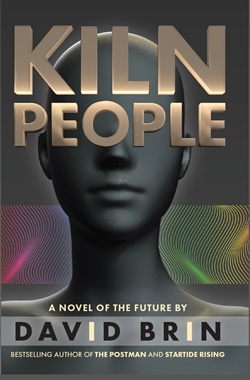
Source: DavidBrin.com
Albert Morris is a soft-boiled detective in an time when the popular technology of choice is ‘dittoing,’ or making a clay copy of yourself that lasts only a day but which carries an authentic soul imprint and can perform any one of a number of functions (complete with gimmicky modifications to the baked copy). At the end of the ditto’s 24-hour lifespan, the copy returns home and uploads its memories back into the original. The process can be repeated as many times as the original desires/can afford, with modifications to the baked clay body that include everything from increased mental focus with decreased appetites (the “ebony” copies) to increased appetites with decreased mental reservations (the “ivory” copies). In addition to being a detective, Albert Morris makes very-nearly perfect “dittos”, which he then dispatches do facilitate his detective work. This particular story focuses on two ‘grey’ dittos, who are nearly-human in their physiology and mental capabilities, and one ‘green’ who is created to do chores and perform mundane daily tasks.
Morris is hired to investigate the death of one of the founders of Universal Kilns, the inventors of dittoing technology. Hijinks ensue, and we eventually learn that the victim was killed by one of his own dittos (see? told you there’d be spoilers), who has found a way to imprint his soul not just on a copy built of clay, but on the fundamental structure of the universe itself. The problem is that uploading such an imprint requires the energy released from the sacrificial death of millions of innocents via a biological weapon, because that’s how quantum physics works apparently. The human original had hangups like conscience and fear, but his ditto decided to remove the original and go ahead with his plan to become a god. Will Morris and his dittos put together the pieces and stop the mad scientist from killing lots of people on his quest to ascend?
Along the way, Brin gives us a few interesting reflections on the nature of the relationship between the soul and the body (what does it mean to copy yourself into a constructed object?), as well as the place of God in the universe. he also gives us not a few silly platitudes that aren’t really worthy of a writer as thoughtful and competent as David Brin. To be fair it’s not always possible to tell what arguments Brin is genuinely making, and what are just the ravings of his trippy characters. For example:
Technology. That’s what made things better! In fits and starts–and often horribly abused along the way–that’s where we found answers that were consistent, dependable, uncapricious. Answers that applied to lord and vassal alike. Answers that improved life across the board and never went away.
So, why not use technology to solve the greatest age-old riddle–immortality for the soul? (pg 378)
This is of course rubbish. Technology is a multiplier, nothing more. It is a tool that can bring out something that is already there on an increasingly large scale, but it is not an end in-and-of itself. At root is always going to be the person using the technology–not the technology itself. What’s ironic is that Brin’s book is a great fictional example of this. Some people use their dittos as means to enhance their own lives and to serve others; other people use their dittos to self-aggrandize; and others commit acts of horrendous evil. We do the same thing with a hammer, albeit on a much smaller scale.
Even with these moments of trite shallowness, the book still raises interesting questions about the nature of the soul and its relationship to the body. Is the soul nothing more than an electrical current? If so, then conceivably it could be copied, and even imprinted on something else (a golem made of clay of course, might not be our first choice). If the soul is an electric current, that raises further questions about the relationship between the individual and the mass of mankind–are we all different aspects of one current running through some kind of planetary grid? Or are we solitary bolts of lightening separate from everyone else, however close we may be in time and space otherwise? (Clearly, I’m not an electrician…) In addition to these reflections, we see in the background of the story occasional commentary on the effects of this developing technology on society, and on the social unrest and upheaval that results from such a massive advancement. If anything, more of this kind of reflection would have been interesting–but the book was already 450+ pages. So maybe we should just leave well enough alone.
Kiln People is probably a hundred pages longer than it needs to be. And the various villains’ motivations are all a bit shallow. But this is still a good, solid, read, and worth at least a once-through.
Dr. Coyle Neal is co-host of the City of Man Podcast and an Assistant Professor of Political Science at Southwest Baptist University in Bolivar, MO. One of him is probably enough.
Previous Post

March 23, 2018
Please Put Down the iPhone, Mr. Soderbergh
Next Post

March 29, 2018 Spielberg Wants to Recapture Younger Viewers. Do We Want What They Want?
Browse Our Archives
Select a Category Action AFI Top 100 Animation Best Picture Winner BFI Top 250 Biography Biopic Books Childrens Christian Classics Classics Comedy Crime Documentary Drama Editor's Choice Family Fantasy Fantasy Films Foreign Historical Historical Fiction History Horror Horror IMDB Top 250 Indie Memoir Modern Novel Musical Mystery Non-Fiction Oscars Philosophy Poetry Popular Literature Reading and Writing Reality Romance Science Fiction Science Fiction Silent Sports Thriller TV Show Uncategorized Western Westerns Young Adult
Select a Month October 2026 September 2026 July 2026 June 2026 May 2026 April 2026 March 2026 February 2026 January 2026 December 2025 November 2025 October 2025 September 2025 August 2025 July 2025 June 2025 May 2025 April 2025 March 2025 February 2025 January 2025 December 2024 July 2024 June 2024 May 2024 April 2024 March 2024 February 2024 January 2024 December 2023 November 2023 October 2023 September 2023 August 2023 July 2023 June 2023 May 2023 April 2023 March 2023 February 2023 January 2023 December 2022 November 2022 October 2022 September 2022 August 2022 July 2022 June 2022 May 2022 April 2022 March 2022 February 2022 January 2022 December 2021 November 2021 October 2021 September 2021 August 2021 July 2021 June 2021 May 2021 April 2021 March 2021 February 2021 January 2021 December 2020 November 2020 October 2020 September 2020 August 2020 July 2020 June 2020 May 2020 April 2020 March 2020 February 2020 January 2020 December 2019 November 2019 October 2019 September 2019 August 2019 July 2019 June 2019 May 2019 April 2019 March 2019 February 2019 January 2019 December 2018 November 2018 October 2018 September 2018 August 2018 July 2018 June 2018 May 2018 April 2018 March 2018 February 2018 January 2018 December 2017 November 2017 October 2017 September 2017 June 2017 January 2017 December 2016 October 2016 September 2016 August 2016 July 2016 June 2016 May 2016 April 2016 March 2016 February 2016 January 2016 December 2015 November 2015 October 2015 September 2015 August 2015 July 2015 June 2015 May 2015 April 2015 March 2015 February 2015 January 2015 December 2014 November 2014 October 2014 September 2014 August 2014 July 2014 June 2014 May 2014 April 2014 March 2014 February 2014 January 2014 December 2013 November 2013 October 2013 September 2013 August 2013 July 2013 June 2013 May 2013 April 2013 March 2013 February 2013 January 2013 December 2012 November 2012 October 2012 September 2012 August 2012 July 2012
Follow Us!
TAKE THE
Religious Wisdom Quiz
Who was the mother of Samuel?
Select your answer to see how you score.
Sarah Mary Deborah Hannah
Related posts from Schaeffer's Ghost




Thinking Critically about Critical Theory
TRENDING AT PATHEOS Religious Music & Entertainment

The Dangers of Gradual Accommodation (Winking at Sin)
Recently, the “law of gradualness” resurfaced during the opening of a weeklong,...

The Iron Gates and the Lion of the...
Yesterday, I didn't finish my report about, well, yesterday. So I'll...

Dolly Parton’s Last Song Wins Dove Award with...
Bluegrass band The Grascals, speaking on the red carpet at the 57th...

The Image: On the Horror of Capitalism and...
The Image Then went the Pharisees, and took counsel how they might...

We are approaching the date of our new American national holiday: October...

Letters on Living the Faith by C.S. Lewis
Most of us met C.S. Lewis as a public intellectual. Mere Christianity....
view all Religious Music & Entertainment blogs
Ad-Free & Subscriber Log-In Subscription Support
- About Us
- 2026 Calendar
- Videos
- Podcasts
- Library of World Religions
- Faith In Media Tracker
- Advertise With Us
- Write for Us
- Privacy Policy
- Terms of Service
- Do Not Sell My Data
- Contact Us
- Radiant Digital
- Manage Newsletter Subscriptions
- Unsubscribe From Notifications
- Sitemap
Copyright 2008-2026, Patheos. All rights reserved.
Subscription Support Ad-Free & Subscriber Log-In
Follow Patheos