
BuddhistCatholicContemplativeEvangelicalGeneral ChristianHinduJewishLatter-day SaintMuslimNew VisionsProgressive Christian
Beliefs
- Buddhist
- Catholic
- Contemplative
- Evangelical
- General Christian
- Hindu
- Jewish
- Latter-day Saint
- More Voices
- Muslim
- New Visions
- Pagan
- Progressive Christian
Topics
- Religion News
- Food and Religion
- Sports and Religion
- Religious Art
- Religious Music and Entertainment
- Religious Events
- History and Religion
- Style and Religion
- Politics and Religion
- Women in Religion
- Recreation Outdoors and Religion
- Business Finance and Religion
- Careers Workplace and Religion
- Education and Religion
- Family Parenting and Religion
- Health Fitness and Religion
- Home and Religion
- Relationships and Religion
- Technology and Religion
- Travel and Religion
Columnists
- Buddhist Columnists
- Business Finance and Religion Columnists
- Careers Workplace and Religion Columnists
- Catholic Columnists
- Contemplative Columnists
- Education and Religion Columnists
- Evangelists Columnists
- Family Parenting and Religion Columnists
- General Christian Columnists
- Health Fitness and Religion Columnists
- Hindu Columnists
- History and Religion Columnists
- Home and Religion Columnists
- Jewish Columnists
- More Voices Columnists
- Latter Day Columnists
- Muslim Columnists
- New Visions Columnists
- Nonreligious Columnists
- Pagan Columnists
- Politics and Religion Columnists
- Progressive Columnists
- Recreation Outdoors and Religion Columnists
- Relationships and Religion Columnists
- Religion News Columnists
- Religious Art Columnists
- Religious Events Columnists
- Religious Music and Entertainment Columnists
- Sports and Religion Columnists
- Style and Religion Columnists
- Technology and Religion Columnists
- Travel and Religion Columnists
- Women in Religion Columnists
Resource Library
- 2026 Calendar
- Library of World Religions
- The 100 Most Holy Places on Earth
- Patheos Answers
- Podcasts
- Videos
- Faith Leaders Database
- Anglican Episcopalian
- Bahai
- Baptist
- Buddhism
- Christianity
- Confucianism
- Eastern Orthodoxy
- Hinduism
- Holiness and Pentecostal
- ISKCON
- Islam
- Judaism
- Lutheran
- Methodist
- The Church of Jesus Christ of Latter-day Saints
- New Age
- Paganism
- Presbytarian and Reformed
- Protestantism
- Religion Behind the Scenes
- Roman Catholic
- Scientology
- Shia Islam
- Sikhism
- Sufism
- Sunni Islam
- Taoism
- Zen
- See all religions
Research Tools
 Ad-Free & Subscriber Log-In Subscription Support
Ad-Free & Subscriber Log-In Subscription Support
Follow Patheos 

- Trending:
- Forgiveness
- |
- Marriage
- |
- Consciousness
- |
- Death Penalty
- |
- Election
- |
- Halloween

- Home
- Religious Music & Entertainment
- A classic work of nearly-non-Western Science Fiction
A classic work of nearly-non-Western Science Fiction
Last updated on: January 19, 2018 at 8:00 am by Coyle Neal
A classic work of nearly-non-Western Science Fiction 2018-01-14T13:06:03-07:00 Coyle Neal
Patheos Explore the world's faith through different perspectives on religion and spirituality! Patheos has the views of the prevalent religions and spiritualities of the world.
I like to think that the author of Solaris would agree with me that the main character was completely wrong at the end of the book. If this is not the case, then an otherwise excellent classic of science fiction has a fairly weak ending.
Older readers of this blog will likely have heard of Solaris through the George Clooney adaptation or the earlier Soviet version, neither of which I’ve seen and so cannot comment on. The book by the Polish author Stanislaw Lem, however, I can say is excellent. (And it’s because the author was writing in Poland during Communist rule that ‘nearly non-Western’ is in the title of this review: clearly Poland is a nation between two worlds.)
There are two main threads running through this book. The first is the mystery of the planet Solaris. This world is an astronomical mystery, in that it is perfectly balanced between a binary star system yet maintains an environment and atmosphere suitable for life (without being torn apart by gravitational forces). Human scientists can only concluded that some form of intelligence is at work with regard to this planet–yet, where is it and how do we make contact with it? Adding to the mystery of the mere existence of this planet is the surface of the planet itself. Covered by an ocean, the liquid surface of this world throws up immense patterns of varying complexity, beauty, rationality, and occasionally even tragedy or (apparently) evil. These creations exist for varying lengths of time only to collapse or be destroyed in ways that are at the same time regular and diverse. As one example:
“The ‘extensor’ appears to be an independent creation, stretching for miles between membranous walls swollen with ‘ossified growths,’ like some colossal python which after swallowing a mountain is sluggishly digesting the meal, while a slow shudder occasionally ripples along its creeping body.” (Lem, 112)
And the central mystery of the story: what should the human scientists on the planet make of the people from their past who suddenly appear on the science station and do not seem to know that they’re anything other than fully human?
In other words, his book has all the makings of a great work of science fiction.
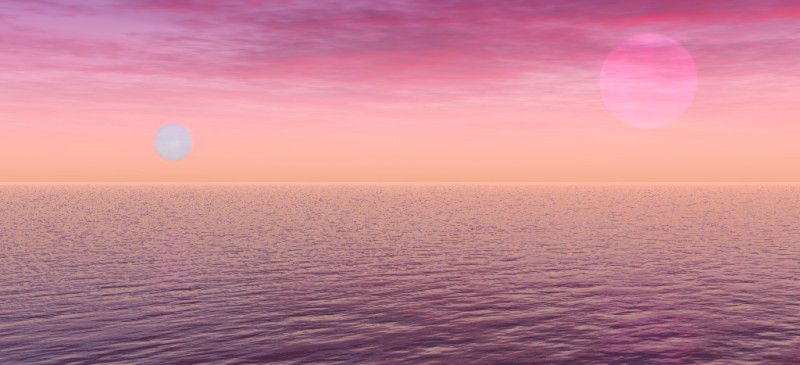
Source: Wikipedia
Yet the ocean planet Solaris is not the only thread running through the book–it may not even be the major one. The other dominant presence is the scientific community itself. Pages and pages of narrative are dedicated to the beginning, development, and collapse of competing theories about the nature of the planet Solaris. This field is called ‘Solaristics’, and is so well developed by the time in which the novel is set that there are theories about the theories about Solaris. A kind of scientific literary criticism has grown up to explain the various theories put out by the Solarists.
What’s clear on reading is the parallel between these two threads. Over and over we’re told that the scientific consensus is that meaningful contact between humans and alien life (especially whatever is on/involved with Solaris) is impossible given the differences between the species. The main character’s conclusion [spoiler alert] is that contact with Solaris has been so difficult to contact because it is the intellectual equivalent of a child. All the actions of the planet are explicable, according to the narrator, because they are dealing with an infant (or at least a ‘toddler’) deity. A creature of unimaginable power, but one that is still in the early stages of mental development.
Now, to be fair, that reading does fit some of the planet’s actions in the narrative. But only some of them. I would suggest two alternative readings, either of which is possible and either of which I’d like to see worked out by others who know more about Lem and the genre in general than I do. (To be fair: these ideas may already out there somewhere, I’m not a Lem or sci-fi scholar.)
First, Lem hints at some kind of relationship between the nearby stars and Solaris. On several occasions events in one or the other of the suns directly lead to actions on the planet’s surface, including actions that directly affect the doings of human beings. The first time something like this happened, I thought the book was moving in the direction of the alien intelligence being in the stars somehow and the planet being the equivalent of a big computer (or, more likely for the mid-20th century, a big calculator). The book did not explicitly move in that direction, but I think it might still be a legitimate reading.
Second, the two threads mentioned above are so obviously parallel to each other I thought the main character would realize that the fluctuations and creations of the ocean on the planet Solaris were similar to–if not the same as– the fluctuations and creations of the scientific community. For that matter, the same parallel could be drawn with civilizations, individual human beings, tribes, and any other number of human phenomenon. Contact, in that case, would have been a matter not of explicitly using words, but of conveying lives and world-historical movements. Just as the ocean creates diverse phenomena of varying (but still regular) structures and appearances that develop and unfold before collapsing back into primal matter, so human history and individual lives are thrown up, develop and unfold before collapsing back into that from whence they came. In both cases there is an overarching order and reason present, which we know instinctively, but which also defies explicit classification. (Which is where we as Christians can step in and talk about our theologies of Providence.) This similarity is one thing that might be useful in establishing what the scientists in the story so desire–meaningful contact between rational beings.
So there you have it, my 1000-word interpretation of a sci-fi classic. Please do pick this up and read it, it is excellent and well worth your time.
Dr. Coyle Neal is co-host of the City of Man Podcast and an Assistant Professor of Political Science at Southwest Baptist University in Bolivar, MO, located squarely on the center of the surface of planet Earth.
Previous Post

January 16, 2018
Christian's Top 20 Movies of 2017
Next Post

January 23, 2018 With all due respect, I disagree...
Browse Our Archives
Select a Category Action AFI Top 100 Animation Best Picture Winner BFI Top 250 Biography Biopic Books Childrens Christian Classics Classics Comedy Crime Documentary Drama Editor's Choice Family Fantasy Fantasy Films Foreign Historical Historical Fiction History Horror Horror IMDB Top 250 Indie Memoir Modern Novel Musical Mystery Non-Fiction Oscars Philosophy Poetry Popular Literature Reading and Writing Reality Romance Science Fiction Science Fiction Silent Sports Thriller TV Show Uncategorized Western Westerns Young Adult
Select a Month October 2026 September 2026 July 2026 June 2026 May 2026 April 2026 March 2026 February 2026 January 2026 December 2025 November 2025 October 2025 September 2025 August 2025 July 2025 June 2025 May 2025 April 2025 March 2025 February 2025 January 2025 December 2024 July 2024 June 2024 May 2024 April 2024 March 2024 February 2024 January 2024 December 2023 November 2023 October 2023 September 2023 August 2023 July 2023 June 2023 May 2023 April 2023 March 2023 February 2023 January 2023 December 2022 November 2022 October 2022 September 2022 August 2022 July 2022 June 2022 May 2022 April 2022 March 2022 February 2022 January 2022 December 2021 November 2021 October 2021 September 2021 August 2021 July 2021 June 2021 May 2021 April 2021 March 2021 February 2021 January 2021 December 2020 November 2020 October 2020 September 2020 August 2020 July 2020 June 2020 May 2020 April 2020 March 2020 February 2020 January 2020 December 2019 November 2019 October 2019 September 2019 August 2019 July 2019 June 2019 May 2019 April 2019 March 2019 February 2019 January 2019 December 2018 November 2018 October 2018 September 2018 August 2018 July 2018 June 2018 May 2018 April 2018 March 2018 February 2018 January 2018 December 2017 November 2017 October 2017 September 2017 June 2017 January 2017 December 2016 October 2016 September 2016 August 2016 July 2016 June 2016 May 2016 April 2016 March 2016 February 2016 January 2016 December 2015 November 2015 October 2015 September 2015 August 2015 July 2015 June 2015 May 2015 April 2015 March 2015 February 2015 January 2015 December 2014 November 2014 October 2014 September 2014 August 2014 July 2014 June 2014 May 2014 April 2014 March 2014 February 2014 January 2014 December 2013 November 2013 October 2013 September 2013 August 2013 July 2013 June 2013 May 2013 April 2013 March 2013 February 2013 January 2013 December 2012 November 2012 October 2012 September 2012 August 2012 July 2012
Follow Us!
TAKE THE
Religious Wisdom Quiz
What does the name "Samuel" mean?
Select your answer to see how you score.
Gifted by God Sent by God Heard by God Saved by God
Related posts from Schaeffer's Ghost




Thinking Critically about Critical Theory
TRENDING AT PATHEOS Religious Music & Entertainment

When Halloween Unmasks Married Hearts
Written by Dr. David K. Ewen from Eternal Truth Bible College Behind...

Aristotle. He’s been called the father of logic, the father of the...

Methodist Central Hall and Westminster Abbey
Situated on the same square is Methodist Central Hall and Westminster Abbey. ...

57th Dove Awards Honor Dolly Parton, Crown New...
On gospel music’s biggest night, the 57th annual GMA Dove Awards honored...

The First Eucharistic Controversy: Christ’s Real Presence
For Catholics, the Eucharist is the source and summit of the Christian...

What a Stop Sign Can Teach Us About...
How to Make a Decision When You Can't Hear God Main point:...
view all Religious Music & Entertainment blogs
Ad-Free & Subscriber Log-In Subscription Support
- About Us
- 2026 Calendar
- Videos
- Podcasts
- Library of World Religions
- Faith In Media Tracker
- Advertise With Us
- Write for Us
- Privacy Policy
- Terms of Service
- Do Not Sell My Data
- Contact Us
- Radiant Digital
- Manage Newsletter Subscriptions
- Unsubscribe From Notifications
- Sitemap
Copyright 2008-2026, Patheos. All rights reserved.
Subscription Support Ad-Free & Subscriber Log-In
Follow Patheos