
BuddhistCatholicContemplativeEvangelicalGeneral ChristianHinduJewishLatter-day SaintMuslimNew VisionsProgressive Christian
Beliefs
- Buddhist
- Catholic
- Contemplative
- Evangelical
- General Christian
- Hindu
- Jewish
- Latter-day Saint
- More Voices
- Muslim
- New Visions
- Pagan
- Progressive Christian
Topics
- Religion News
- Food and Religion
- Sports and Religion
- Religious Art
- Religious Music and Entertainment
- Religious Events
- History and Religion
- Style and Religion
- Politics and Religion
- Women in Religion
- Recreation Outdoors and Religion
- Business Finance and Religion
- Careers Workplace and Religion
- Education and Religion
- Family Parenting and Religion
- Health Fitness and Religion
- Home and Religion
- Relationships and Religion
- Technology and Religion
- Travel and Religion
Columnists
- Buddhist Columnists
- Business Finance and Religion Columnists
- Careers Workplace and Religion Columnists
- Catholic Columnists
- Contemplative Columnists
- Education and Religion Columnists
- Evangelists Columnists
- Family Parenting and Religion Columnists
- General Christian Columnists
- Health Fitness and Religion Columnists
- Hindu Columnists
- History and Religion Columnists
- Home and Religion Columnists
- Jewish Columnists
- More Voices Columnists
- Latter Day Columnists
- Muslim Columnists
- New Visions Columnists
- Nonreligious Columnists
- Pagan Columnists
- Politics and Religion Columnists
- Progressive Columnists
- Recreation Outdoors and Religion Columnists
- Relationships and Religion Columnists
- Religion News Columnists
- Religious Art Columnists
- Religious Events Columnists
- Religious Music and Entertainment Columnists
- Sports and Religion Columnists
- Style and Religion Columnists
- Technology and Religion Columnists
- Travel and Religion Columnists
- Women in Religion Columnists
Resource Library
- 2026 Calendar
- Library of World Religions
- The 100 Most Holy Places on Earth
- Patheos Answers
- Podcasts
- Videos
- Faith Leaders Database
- Anglican Episcopalian
- Bahai
- Baptist
- Buddhism
- Christianity
- Confucianism
- Eastern Orthodoxy
- Hinduism
- Holiness and Pentecostal
- ISKCON
- Islam
- Judaism
- Lutheran
- Methodist
- The Church of Jesus Christ of Latter-day Saints
- New Age
- Paganism
- Presbytarian and Reformed
- Protestantism
- Religion Behind the Scenes
- Roman Catholic
- Scientology
- Shia Islam
- Sikhism
- Sufism
- Sunni Islam
- Taoism
- Zen
- See all religions
Research Tools
 Ad-Free & Subscriber Log-In Subscription Support
Ad-Free & Subscriber Log-In Subscription Support
Follow Patheos 

- Trending:
- Forgiveness
- |
- Marriage
- |
- Consciousness
- |
- Death Penalty
- |
- Election
- |
- Halloween

- Home
- Religious Music & Entertainment
- INTERVIEW: 60 Minutes journalists in pursuit of “Truth”
INTERVIEW: 60 Minutes journalists in pursuit of “Truth”
Last updated on: October 23, 2015 at 12:29 pm by Andrew Collins
INTERVIEW: 60 Minutes journalists in pursuit of “Truth” 2015-10-23T12:29:40-06:00 Andrew Collins
Patheos Explore the world's faith through different perspectives on religion and spirituality! Patheos has the views of the prevalent religions and spiritualities of the world.
Based on Interview with James Vanderbilt, Writer and Director of Truth
CBS made headlines last week when it turned down a multimillion dollar ad buy from Sony Pictures on behalf of the film “Truth,” the freshman directing effort by screenwriter James Vanderbilt.
That’s because “Truth” is based on a book of the same name by former 60 Minutes producer Mary Mapes. The story recounts (from her perspective) the events leading up to and following the disastrous “60 Minutes” report by famed CBS anchor Dan Rather claiming it had documentation showing President George W. Bush had received special treatment during his service in the National Guard. Further scrutiny found the documents were not adequately verified by CBS before Mapes and Rather took them on air. Experts denounced them as forgeries, leading to Rather’s exit from CBS and costing producer Mary Mapes her job.
It cost CBS some credibility at the time too, as many people at the network surely remember. In addition to rejecting the movie’s ad dollars, a CBS spokesman has called it “a disservice not just to the public but to journalists across the world.”
Shots fired. It’s been ten years now – long enough for us to look at the incident a little more objectively, says Vanderbilt – but denouncement of Mapes and Rather has begun again all the same. News websites are already alight with criticism, correcting the bent of the film for its seeming portrayal of the Mapes-Rather team (played by Cate Blanchett and Robert Redford, respectively) as victims of corporate forces looking out for the bottom line.
No doubt, this criticism provides a valuable part of the conversation. The journalistic consensus is that Mary Mapes screwed up in an epic case of shoddy reporting. “Truth,” however, draws first and foremost from Mapes’ book (in which she essentially spreads the blame around to everyone but herself), and Vanderbilt’s film adaptation explores the outcome and even the tone of the whole ordeal with more complexity. In the movie, the issue at stake isn’t so much whether or not Mapes was wrong. Instead, it dwells on the fact that she was a three-dimensional person operating at a pivotal moment in the news industry.
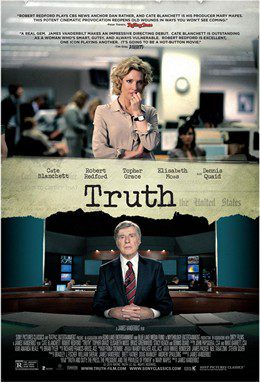
Image Source: Wikimedia

“I know people look at it as a political movie. I don’t necessarily think it is as much,” says Vanderbilt. “I had a great writing professor who said ‘If you want to send a message, call Western Union.’”
Story is king, goes the old adage, but that raises the question: Of all the stories out there, why bring “Truth” to the silver screen? Vanderbilt says he was drawn in out of good old-fashioned curiosity when he encountered Mapes story in a book excerpt in Vanity Fair not long after the controversy.
“I was struck by how much I didn’t know a story I thought I knew a lot about. Because I had followed this, like a lot of people did, when the piece first aired,” he says. As someone who grew up with Dan Rather as the face of CBS news, Vanderbilt sees this story as a critical moment in the digital transition that has rocked the journalism industry over the past decade. The old guard was giving way to a new frenzy of insane speed made possible by the Internet.
“I was born in 1975, and Dan Rather got the anchor chair in 1981, so basically from the time I was six years old to when this happened he was the face of CBS news,” he says. “To go from that period to where we are now where I have a little computer in my pocket that I can turn on and get ten thousand ways into the news, that’s an enormous shift. And (“Truth”) was a tipping point moment in it because it was the first time that the internet kind of rose up and affected a story in the way it did and with the speed that it did,” he says. “I think if you chart it, this is that moment. Clearly it leads to the downfall of one of those voices of God.”
Rather, who has praised the film, echoes this: “The core of it is about what’s happened to news reporting: Why it’s happened, how it’s happened, and why anybody should care about what’s happened in the news.”
Rather still argues that his team reported a true story in that infamous segment and says he doesn’t have any regrets about it. At one point he remarks in the film (similar to what he has said in real life) that his critics have missed the deeper thrust and underlying truth of the story – that the scandal over the forged documents has caused onlookers to miss the forest for a few rotten trees.
Put the nitpicking over details aside, and Rather may have a point, but that’s not how journalism works, and anyone with even the most basic knowledge of the news industry knows it. Journalism is a vehicle of facts, and while those facts can be twisted and presented in a way that skews the picture of what’s really going on, if you don’t at least get the facts right, then you get nothing right. The news is held to a high standard in this department, and rightfully so.
The purported story running underneath the facts, however, is fair game for the artist. Unlike journalists, the poets, authors, and filmmakers get to fudge, fictionalize, and rearrange the details in order to capture the deeper truths. This is what really makes “Truth” an intriguing subject. As a film (in contrast to being a news story), I found it quite enjoyable. Redford and Blanchett are in especially fine form, portraying characters that are largely empathetic. The news industry is tough on people, after all, and even when you do your job with aplomb it can chew you up. So when you screw up such a high-stakes story on national TV, sometimes you don’t get a second chance to do better next time.
“I always thought that my job first and foremost was to tell an interesting story, to put as many different viewpoints in the film as possible, and to not demonize anyone,” says Vanderbilt. “Everybody in the film is really just trying to do their jobs – just trying to get through this in one form or another. And they’re real people who are still walking around with real families. The movie’s going to come out and it’s going to have some effect on their lives.”
In this case the plurality of perspectives Vanderbilt worked into the film makes for an especially tricky proposition because Mapes, the protagonist toward which the audience is expected to show a healthy dose of sympathy, misled a lot of people and gave her employer a black eye. And so she ends up suspended in the middle of all of this somewhere along the spectrum between hero and villain, complete with her own professional aspirations, personal baggage, family to look after, and sources to protect.
“It was really important to me not to make anybody a mustache-twirling villain,” Vanderbilt says, “because A: That’s not how life works, and B: Nobody was a mustache-twirling villain.”
Critics from the right, of course, will say that every story has a message, and many are chalking “Truth” up to a piece of leftist Hollywood fare, prime evidence of the industry’s liberal bias. And maybe it is, even though Vanderbilt, for his part, seems pretty evenhanded. There is a deliberate, innate subjectivity to the film, and it’s a subjectivity that he welcomes.
“I spoke to a number of people who were not very pro-Mary or pro-Dan, and all of that I think is in the film,” he says. “It was important for me to put all of that in the film. I like movies that ask questions of the audience rather than give them clear-cut answers… What’s been really interesting is seeing people come out of the theater, and husbands and wives arguing: ‘Absolutely she should have been fired,’ and ‘How can you say that?’”
Indeed, Vanderbilt sees this lack of consensus as an attribute of the film. The freedom to have these sorts of debates, after all, is one of the beautiful things about democracy. The film’s title, “Truth,” suggests some sort of dogmatism at first glance, but it actually is indicative of just the opposite. The story doesn’t revolve around a central truth so much as it captures the futile attempts to pin down said truth. After all, Truth is the goal at the center of all journalism, but many extenuating factors affect that pursuit – the pressure of deadlines, sources that will or won’t talk, the ever-dwindling resources newsrooms have to invest in investigative journalism. And of course there’s the human element of reporters themselves. Dan Rather may have been a proverbial “voice of God” in his prime, but he’s fallible just like the rest of us.
And after all the dust has settled, there it remains, 10 years later, somewhere out there: the truth.
“It’s not easy to get to,” says Vanderbilt. “In this story in particular it’s incredibly elusive. It keeps changing… People lose their careers trying to get to it. They crash on the rocks. But it’s still an incredibly important thing to strive for.”
Previous Post

October 10, 2015
Labyrinth of Lies powerfully confronts the silence of postwar Germany
Next Post

October 30, 2015 Middleburg Film Festival Puts Spotlight on Church Scandal
Browse Our Archives
Select a Category Action AFI Top 100 Animation Best Picture Winner BFI Top 250 Biography Biopic Books Childrens Christian Classics Classics Comedy Crime Documentary Drama Editor's Choice Family Fantasy Fantasy Films Foreign Historical Historical Fiction History Horror Horror IMDB Top 250 Indie Memoir Modern Novel Musical Mystery Non-Fiction Oscars Philosophy Poetry Popular Literature Reading and Writing Reality Romance Science Fiction Science Fiction Silent Sports Thriller TV Show Uncategorized Western Westerns Young Adult
Select a Month October 2026 September 2026 July 2026 June 2026 May 2026 April 2026 March 2026 February 2026 January 2026 December 2025 November 2025 October 2025 September 2025 August 2025 July 2025 June 2025 May 2025 April 2025 March 2025 February 2025 January 2025 December 2024 July 2024 June 2024 May 2024 April 2024 March 2024 February 2024 January 2024 December 2023 November 2023 October 2023 September 2023 August 2023 July 2023 June 2023 May 2023 April 2023 March 2023 February 2023 January 2023 December 2022 November 2022 October 2022 September 2022 August 2022 July 2022 June 2022 May 2022 April 2022 March 2022 February 2022 January 2022 December 2021 November 2021 October 2021 September 2021 August 2021 July 2021 June 2021 May 2021 April 2021 March 2021 February 2021 January 2021 December 2020 November 2020 October 2020 September 2020 August 2020 July 2020 June 2020 May 2020 April 2020 March 2020 February 2020 January 2020 December 2019 November 2019 October 2019 September 2019 August 2019 July 2019 June 2019 May 2019 April 2019 March 2019 February 2019 January 2019 December 2018 November 2018 October 2018 September 2018 August 2018 July 2018 June 2018 May 2018 April 2018 March 2018 February 2018 January 2018 December 2017 November 2017 October 2017 September 2017 June 2017 January 2017 December 2016 October 2016 September 2016 August 2016 July 2016 June 2016 May 2016 April 2016 March 2016 February 2016 January 2016 December 2015 November 2015 October 2015 September 2015 August 2015 July 2015 June 2015 May 2015 April 2015 March 2015 February 2015 January 2015 December 2014 November 2014 October 2014 September 2014 August 2014 July 2014 June 2014 May 2014 April 2014 March 2014 February 2014 January 2014 December 2013 November 2013 October 2013 September 2013 August 2013 July 2013 June 2013 May 2013 April 2013 March 2013 February 2013 January 2013 December 2012 November 2012 October 2012 September 2012 August 2012 July 2012
Follow Us!
TAKE THE
Religious Wisdom Quiz
Who led the Israelites out of Egypt?
Select your answer to see how you score.
Moses Caleb Joshua Aaron
Related posts from Schaeffer's Ghost



Mortal Kombat 2: Can Video Game Movies Save...

TRENDING AT PATHEOS Religious Music & Entertainment

The Problem with False Prophets
Miller’s Station UMC| 10/18/26| Anchor Verse: Jeremiah 23: 1, 9-23 I...

Emotion in Early Christianity by Andrew Crislip
Andrew Crislip’s Emotion in Early Christianity examines an often overlooked dimension of...

16 Spiritual Touchstones for a More Grounded Life
After decades of spiritual study, here are 16 principles I try...

Catholic Evangelization: Sharing Your Faith Every Day
Welcome back to the Graceful Awakening mini-series called, “From Faith to Mission.” ...

The Pillar of the Boatmen: the Ancient Monument...
The Pillar of the Boatmen is a Romano-Gaulish sculpture that dates from...

In one sense walking into Westminster Abbey is like walking down the...
view all Religious Music & Entertainment blogs
Ad-Free & Subscriber Log-In Subscription Support
- About Us
- 2026 Calendar
- Videos
- Podcasts
- Library of World Religions
- Faith In Media Tracker
- Advertise With Us
- Write for Us
- Privacy Policy
- Terms of Service
- Do Not Sell My Data
- Contact Us
- Radiant Digital
- Manage Newsletter Subscriptions
- Unsubscribe From Notifications
- Sitemap
Copyright 2008-2026, Patheos. All rights reserved.
Subscription Support Ad-Free & Subscriber Log-In
Follow Patheos