
BuddhistCatholicContemplativeEvangelicalGeneral ChristianHinduJewishLatter-day SaintMuslimNew VisionsProgressive Christian
Beliefs
- Buddhist
- Catholic
- Contemplative
- Evangelical
- General Christian
- Hindu
- Jewish
- Latter-day Saint
- More Voices
- Muslim
- New Visions
- Pagan
- Progressive Christian
Topics
- Religion News
- Food and Religion
- Sports and Religion
- Religious Art
- Religious Music and Entertainment
- Religious Events
- History and Religion
- Style and Religion
- Politics and Religion
- Women in Religion
- Recreation Outdoors and Religion
- Business Finance and Religion
- Careers Workplace and Religion
- Education and Religion
- Family Parenting and Religion
- Health Fitness and Religion
- Home and Religion
- Relationships and Religion
- Technology and Religion
- Travel and Religion
Columnists
- Buddhist Columnists
- Business Finance and Religion Columnists
- Careers Workplace and Religion Columnists
- Catholic Columnists
- Contemplative Columnists
- Education and Religion Columnists
- Evangelists Columnists
- Family Parenting and Religion Columnists
- General Christian Columnists
- Health Fitness and Religion Columnists
- Hindu Columnists
- History and Religion Columnists
- Home and Religion Columnists
- Jewish Columnists
- More Voices Columnists
- Latter Day Columnists
- Muslim Columnists
- New Visions Columnists
- Nonreligious Columnists
- Pagan Columnists
- Politics and Religion Columnists
- Progressive Columnists
- Recreation Outdoors and Religion Columnists
- Relationships and Religion Columnists
- Religion News Columnists
- Religious Art Columnists
- Religious Events Columnists
- Religious Music and Entertainment Columnists
- Sports and Religion Columnists
- Style and Religion Columnists
- Technology and Religion Columnists
- Travel and Religion Columnists
- Women in Religion Columnists
Resource Library
- 2026 Calendar
- Library of World Religions
- The 100 Most Holy Places on Earth
- Patheos Answers
- Podcasts
- Videos
- Faith Leaders Database
- Anglican Episcopalian
- Bahai
- Baptist
- Buddhism
- Christianity
- Confucianism
- Eastern Orthodoxy
- Hinduism
- Holiness and Pentecostal
- ISKCON
- Islam
- Judaism
- Lutheran
- Methodist
- The Church of Jesus Christ of Latter-day Saints
- New Age
- Paganism
- Presbytarian and Reformed
- Protestantism
- Religion Behind the Scenes
- Roman Catholic
- Scientology
- Shia Islam
- Sikhism
- Sufism
- Sunni Islam
- Taoism
- Zen
- See all religions
Research Tools
 Ad-Free & Subscriber Log-In Subscription Support
Ad-Free & Subscriber Log-In Subscription Support
Follow Patheos 

- Trending:
- Forgiveness
- |
- Marriage
- |
- Consciousness
- |
- Death Penalty
- |
- Election
- |
- Halloween

- Home
- Religious Music & Entertainment
- Engaging, Understanding, and Assessing Roman Catholicism from an Evangelical Perspective
Engaging, Understanding, and Assessing Roman Catholicism from an Evangelical Perspective
Last updated on: May 4, 2015 at 7:48 am by Guest Contributor
Engaging, Understanding, and Assessing Roman Catholicism from an Evangelical Perspective 2015-05-04T07:48:25-06:00 Guest Contributor
Patheos Explore the world's faith through different perspectives on religion and spirituality! Patheos has the views of the prevalent religions and spiritualities of the world.
Review of Roman Catholic Theology & Practice: An Evangelical Assessment, by Gregg Allison
KAITLYN BELLOLI
During a recent friendly, but spirited, discussion with a Catholic priest seated next to me on a plane, we covered a wide variety of topics: salvation, universalism, authority, purgatory, and Christian love. Our Bibles open, we took turns choosing passages for discussion in an attempt to explain the basis for our differing beliefs, while noting areas of agreement. In the background of my own mind during these discussions is often the 1994 Catechism of the Catholic Church. As an overview of official Catholic teachings, it has helped me to understand and assess the beliefs of the Roman Catholic Church in which I was raised, in relation to my Evangelical convictions.
This is why I was pleased to learn that Gregg Allison, a professor at the Southern Baptist Theological Seminary, had written a book assessing the Catechism in its entirety. Roman Catholic Theology & Practice: An Evangelical Assessment is a thorough and balanced Evangelical evaluation of the Catholic teachings outlined in the Catechism both from a systematic approach of Catholic beliefs (chapter 2) and a point-by-point approach of specific Catholic teachings (chapters 3-13).
Allison’s assessment appreciates the similarities or topics of “intrigue” between Roman Catholic theology and Evangelical theology, while persuasively “critiquing” Roman Catholicism from a broadly Evangelical perspective that is occasionally influenced by specifically Reformed theology. He begins with an overview of Evangelical theology and an overview of the “all-encompassing system” of Catholic theology. This view of Catholicism considers Catholic beliefs as integrated into a coherent system of thought that should be engaged accordingly. In particular, Allison relies on two points of integration—the “nature-grace interdependence” and the “Christ-Church interconnection”— as foundational axioms of other Catholic beliefs and practices. Throughout the book, each Catholic belief is considered in relation to these two axioms.
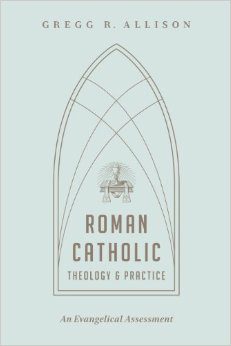
Image Source: Crossway
Nature, the created order, and grace, God’s working in the world, exist on a continuum in Catholic theology where nature is the channel of God’s grace and grace perfects nature. Sin is then a secondary, but serious, component in the Catholic system. In contrast, Evangelicals view nature as completely corrupted by sin, preferring to refer to nature as “creation.” Instead of a continuum between nature and grace that allows for the participation of nature in God’s work in the world, Evangelical theology understands that there is a chasm between creation and God due to sin. This complete separation from God results in an inability to cooperate with grace. Allison describes these foundational differences as the basis for disparities on doctrines of sin, salvation, humanity, biblical interpretation, epistemology, ecclesiology, moral theology, sacramental theology, hierarchy, and Mary. For if nature can join in God’s work of grace, then human reason and ability can have a greater role in the work of redemption, created elements (bread, wine, water, oil) can function as channels of God’s grace, and specific persons (Mary, other saints, clergy) can be exemplars of participation with grace.
The second axiom, the Christ-Church interconnection, focus’ on the Catholic Church’s mediatorial role in dispensing grace to nature. According to this belief, the Catholic Church exists as Christ’s agent—the continuation of His incarnation— to mediate between God and man. As a result, “when the sacraments are administered in the Church, Christ himself is the one who baptizes, Christ himself celebrates the Eucharist, Christ himself ordains, and so forth.” In addition, this foundational belief explains how Catholics can understand the Church as being able to grant faith, define the canon and be the only true church (Evangelical gatherings are viewed as “ecclesial communities” instead of churches).
After establishing the basis for Roman Catholic theology as an “all encompassing system” and evaluating that basis from an Evangelical perspective, Allison spends the rest of the book explaining each belief of the Catechism, focusing on representing the belief fairly first,and then assessing that belief as an Evangelical. In these assessments, Allison first notes the areas of agreement before offering a critique. He covers sections from the first three parts of the Catechism: the profession of faith, the celebration of the Christian mystery, and life in Christ. This part can become occasionally repetitive as he is addressing beliefs that are connected to the two axioms already considered, but that reflects his goal to treat Catholicism as a coherent belief system. It also allows the book to be used as reference tool to both understand and address specific Catholic teachings.
These sections cover a lot of theological ground and address a wide variety of topics of interest to Christians even apart from engaging with Roman Catholicism. For example, Allison convincingly explains why the Apocrypha should not be included in the Canon by considering its lack of use in the New Testament and absence from early lists of the Canon. Augustine’s role in including the Apocryphal books is examined and critiqued. Other examples include interesting evaluations of the role of baptism, the Eucharist/Lord’s Supper, social justice, and even angels. This is truly a sweeping approach to comparing Catholicism and Evangelicalism.
While the majority of this book covers specific beliefs in the Catechism, the systematic approach to evaluating Catholic doctrine underscores the seriousness of Catholic/Evangelical divergences on topics such as Mary, transubstantiation, or purgatory. These beliefs are connected to a full system that is in conflict with the gospel as understood by Evangelicals. While Allison frequently praises the significant harmony between Catholic and Evangelical theology, he also acknowledges that the disputes are not merely minor points of theology, but reflective of disparate approaches to the whole system of Christian thought.
This brings me back to my conversation with my Catholic friend on the airplane. As we talked, I discovered that he was taking a seminary class on how to engage “lapsed Catholics,” making me an intriguing case study for him. While we discussed specific areas of disagreement, the underlying structure of beliefs that lead to these distinctions was mostly unaddressed. In a sense, Evangelical-Catholic conversations like these can become “like two ships passing in the night.” If I may recommend a book to both Catholics and Protestants who are interested in an in-depth engagement of these discussions, Allison’s Roman Catholic Theology & Practice: An Evangelical Assessment is an excellent overview and reference tool.
Previous Post
April 29, 2015
Reflections on "Reflections on the Movies"
Next Post

May 6, 2015 Far from the Madding Crowd is a welcome reinterpretation
Browse Our Archives
Select a Category Action AFI Top 100 Animation Best Picture Winner BFI Top 250 Biography Biopic Books Childrens Christian Classics Classics Comedy Crime Documentary Drama Editor's Choice Family Fantasy Fantasy Films Foreign Historical Historical Fiction History Horror Horror IMDB Top 250 Indie Memoir Modern Novel Musical Mystery Non-Fiction Oscars Philosophy Poetry Popular Literature Reading and Writing Reality Romance Science Fiction Science Fiction Silent Sports Thriller TV Show Uncategorized Western Westerns Young Adult
Select a Month October 2026 September 2026 July 2026 June 2026 May 2026 April 2026 March 2026 February 2026 January 2026 December 2025 November 2025 October 2025 September 2025 August 2025 July 2025 June 2025 May 2025 April 2025 March 2025 February 2025 January 2025 December 2024 July 2024 June 2024 May 2024 April 2024 March 2024 February 2024 January 2024 December 2023 November 2023 October 2023 September 2023 August 2023 July 2023 June 2023 May 2023 April 2023 March 2023 February 2023 January 2023 December 2022 November 2022 October 2022 September 2022 August 2022 July 2022 June 2022 May 2022 April 2022 March 2022 February 2022 January 2022 December 2021 November 2021 October 2021 September 2021 August 2021 July 2021 June 2021 May 2021 April 2021 March 2021 February 2021 January 2021 December 2020 November 2020 October 2020 September 2020 August 2020 July 2020 June 2020 May 2020 April 2020 March 2020 February 2020 January 2020 December 2019 November 2019 October 2019 September 2019 August 2019 July 2019 June 2019 May 2019 April 2019 March 2019 February 2019 January 2019 December 2018 November 2018 October 2018 September 2018 August 2018 July 2018 June 2018 May 2018 April 2018 March 2018 February 2018 January 2018 December 2017 November 2017 October 2017 September 2017 June 2017 January 2017 December 2016 October 2016 September 2016 August 2016 July 2016 June 2016 May 2016 April 2016 March 2016 February 2016 January 2016 December 2015 November 2015 October 2015 September 2015 August 2015 July 2015 June 2015 May 2015 April 2015 March 2015 February 2015 January 2015 December 2014 November 2014 October 2014 September 2014 August 2014 July 2014 June 2014 May 2014 April 2014 March 2014 February 2014 January 2014 December 2013 November 2013 October 2013 September 2013 August 2013 July 2013 June 2013 May 2013 April 2013 March 2013 February 2013 January 2013 December 2012 November 2012 October 2012 September 2012 August 2012 July 2012
Follow Us!
TAKE THE
Religious Wisdom Quiz
What were the first man and woman’s names in the Bible?
Select your answer to see how you score.
Samson and Delilah Joseph and Mary Jacob and Rachel Adam and Eve
Related posts from Schaeffer's Ghost




Thinking Critically about Critical Theory
TRENDING AT PATHEOS Religious Music & Entertainment

Emotion in Early Christianity by Andrew Crislip
Andrew Crislip’s Emotion in Early Christianity examines an often overlooked dimension of...

16 Spiritual Touchstones for a More Grounded Life
After decades of spiritual study, here are 16 principles I try...

Catholic Evangelization: Sharing Your Faith Every Day
Welcome back to the Graceful Awakening mini-series called, “From Faith to Mission.” ...

The Pillar of the Boatmen: the Ancient Monument...
The Pillar of the Boatmen is a Romano-Gaulish sculpture that dates from...

In one sense walking into Westminster Abbey is like walking down the...

'Super Scam Me' Exposes AI Jon Bon Jovi...
Leslie Pickett believed she was in a relationship with Jon Bon Jovi....
view all Religious Music & Entertainment blogs
Ad-Free & Subscriber Log-In Subscription Support
- About Us
- 2026 Calendar
- Videos
- Podcasts
- Library of World Religions
- Faith In Media Tracker
- Advertise With Us
- Write for Us
- Privacy Policy
- Terms of Service
- Do Not Sell My Data
- Contact Us
- Radiant Digital
- Manage Newsletter Subscriptions
- Unsubscribe From Notifications
- Sitemap
Copyright 2008-2026, Patheos. All rights reserved.
Subscription Support Ad-Free & Subscriber Log-In
Follow Patheos