
BuddhistCatholicContemplativeEvangelicalGeneral ChristianHinduJewishLatter-day SaintMuslimNew VisionsProgressive Christian
Beliefs
- Buddhist
- Catholic
- Contemplative
- Evangelical
- General Christian
- Hindu
- Jewish
- Latter-day Saint
- More Voices
- Muslim
- New Visions
- Pagan
- Progressive Christian
Topics
- Religion News
- Food and Religion
- Sports and Religion
- Religious Art
- Religious Music and Entertainment
- Religious Events
- History and Religion
- Style and Religion
- Politics and Religion
- Women in Religion
- Recreation Outdoors and Religion
- Business Finance and Religion
- Careers Workplace and Religion
- Education and Religion
- Family Parenting and Religion
- Health Fitness and Religion
- Home and Religion
- Relationships and Religion
- Technology and Religion
- Travel and Religion
Columnists
- Buddhist Columnists
- Business Finance and Religion Columnists
- Careers Workplace and Religion Columnists
- Catholic Columnists
- Contemplative Columnists
- Education and Religion Columnists
- Evangelists Columnists
- Family Parenting and Religion Columnists
- General Christian Columnists
- Health Fitness and Religion Columnists
- Hindu Columnists
- History and Religion Columnists
- Home and Religion Columnists
- Jewish Columnists
- More Voices Columnists
- Latter Day Columnists
- Muslim Columnists
- New Visions Columnists
- Nonreligious Columnists
- Pagan Columnists
- Politics and Religion Columnists
- Progressive Columnists
- Recreation Outdoors and Religion Columnists
- Relationships and Religion Columnists
- Religion News Columnists
- Religious Art Columnists
- Religious Events Columnists
- Religious Music and Entertainment Columnists
- Sports and Religion Columnists
- Style and Religion Columnists
- Technology and Religion Columnists
- Travel and Religion Columnists
- Women in Religion Columnists
Resource Library
- 2026 Calendar
- Library of World Religions
- The 100 Most Holy Places on Earth
- Patheos Answers
- Podcasts
- Videos
- Faith Leaders Database
- Anglican Episcopalian
- Bahai
- Baptist
- Buddhism
- Christianity
- Confucianism
- Eastern Orthodoxy
- Hinduism
- Holiness and Pentecostal
- ISKCON
- Islam
- Judaism
- Lutheran
- Methodist
- The Church of Jesus Christ of Latter-day Saints
- New Age
- Paganism
- Presbytarian and Reformed
- Protestantism
- Religion Behind the Scenes
- Roman Catholic
- Scientology
- Shia Islam
- Sikhism
- Sufism
- Sunni Islam
- Taoism
- Zen
- See all religions
Research Tools
 Ad-Free & Subscriber Log-In Subscription Support
Ad-Free & Subscriber Log-In Subscription Support
Follow Patheos 

- Trending:
- Forgiveness
- |
- Marriage
- |
- Consciousness
- |
- Death Penalty
- |
- Election
- |
- Halloween

- Home
- Religious Music & Entertainment
- Still Alice: Memory and the self-made woman
Still Alice: Memory and the self-made woman
Last updated on: January 18, 2015 at 1:41 am by Andrew Collins
Still Alice: Memory and the self-made woman 2015-01-18T01:41:57-07:00 Andrew Collins
Patheos Explore the world's faith through different perspectives on religion and spirituality! Patheos has the views of the prevalent religions and spiritualities of the world.
Review of Still Alice, Directed by Richard Glatzer and Wash Westmoreland
The premise of Still Alice is remarkable simple: a woman gets early-onset Alzheimer’s disease. But it is also remarkably compelling – something like a holiday family movie meets Memento – and the result is both heart-warming and frightening. Memory holds our own subjective, individual world together. It gives us our sense of identity and grounds our relationships. Without it, is there anything of us left?
As the film unfolds, we see how profoundly humbling a disease like Alzheimer’s can be, especially a case of early onset. Alice loses her job and becomes dependent on her family. Soon she becomes so impotent that she can’t find her way to the bathroom – and eventually so incapable that she cannot even take her own life, despite perfectly clear video instructions she recorded for her future self. Here we see the pinnacle of weakness – that someone could be so incapable of functioning that she is unable to prevent her life from continuing, even when she doesn’t even realize she is trying to stop it.
This arc from Alice’s golden years to despair to blissful ignorance is high tragedy: the self-made woman, text-book authoring professor, trophy wife, and all-star mom totters around atop her legacy, unable to remember it. And the tragedy is crowned with the irony that she worked in the field of linguistics, because words are the first thing to go.
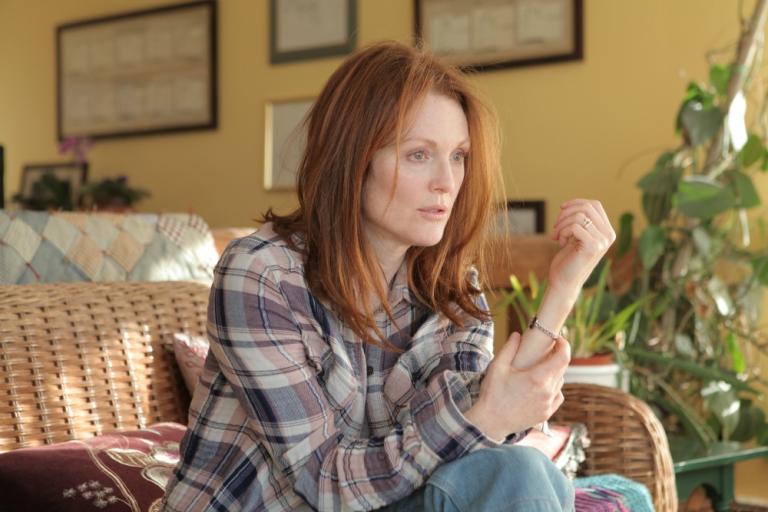
Image Credit: Sony Classics
The film’s cinematography further pulls us into Alice’s experience, as certain shots leave the foreground, background, and sometimes even the entire screen excessively blurry. It almost makes the viewer nauseous. This is by design, a simple metaphor for the fog of Alice’s mind. Her own description of having Alzheimer’s brings this home. It’s like having the word that you need dangling in the air right in front of you, just out of reach. Or another time: It’s like the floor of your mind drops away, and you find yourself without a foundation, disoriented, confused – like a house suspended in midair, unattached to the neighborhood, sidewalk, and street that give it a sense of meaning and place.
Meaning. This is the rub that Alice must confront. Upon discovery of her disease, she soon concludes that without her memory intact enough to preserve her most basic identity, she and her family will be better off if she kills herself. In the end, however, as more of her old self disappears, Alice begins to experience life moment by moment in blissful ignorance. She may not even be able to remember those most important things – her birthday, the names of her children – but the film ends in the hope that even in the mysterious ravages of a disease like Alzheimer’s, something remains to keep us human. It concludes that the sufferings and pains of life somehow grow us, making us more human even in the face of dehumanizing tragedies.
Equally as significant as Alice’s transformation in the film is how her family responds to the adversity of their mother’s mental deterioration. Alice finds clever ways to cope with Alzheimer’s, but she laid the far more important groundwork of family in the decades leading up to the months we see in the film. It has all the usual small squabbling and disagreements we’d expect to see in an upper-middle class New York family – the chill but faithful father, the daughter who has it all together, the daughter who wants to blaze her own trail, and the son who can’t hold down a girlfriend from one holiday to the next.
Brought together by the crucible of their deteriorating mother, they respond with a touching love toward her that ends up spilling over to each other – temporarily drawing them closer. But they only love as long as enough of Alice is there to appreciate it. Once she really starts to go, they get on with their lives. From the standpoint of a viewer it seems cold that a father would leave his ailing wife for a promising new job in another state, but given that she’ll hardly miss him, you can’t deny the logic of it. Most real-life families in their shoes would probably do the same thing.
In the end, only Alice’s prodigal daughter makes the sacrificial decision, leaving her promising new theater gig to move across the country so that she can take care of her mother. If there is any beauty to be found amidst a disease which seems to be beyond the reach of redemption, it is in this final gesture.
Previous Post

January 2, 2015
Coyle's Best of 2014
Next Post
January 24, 2015 “Can you draw out Leviathan with a fishhook?”
Browse Our Archives
Select a Category Action AFI Top 100 Animation Best Picture Winner BFI Top 250 Biography Biopic Books Childrens Christian Classics Classics Comedy Crime Documentary Drama Editor's Choice Family Fantasy Fantasy Films Foreign Historical Historical Fiction History Horror Horror IMDB Top 250 Indie Memoir Modern Novel Musical Mystery Non-Fiction Oscars Philosophy Poetry Popular Literature Reading and Writing Reality Romance Science Fiction Science Fiction Silent Sports Thriller TV Show Uncategorized Western Westerns Young Adult
Select a Month October 2026 September 2026 July 2026 June 2026 May 2026 April 2026 March 2026 February 2026 January 2026 December 2025 November 2025 October 2025 September 2025 August 2025 July 2025 June 2025 May 2025 April 2025 March 2025 February 2025 January 2025 December 2024 July 2024 June 2024 May 2024 April 2024 March 2024 February 2024 January 2024 December 2023 November 2023 October 2023 September 2023 August 2023 July 2023 June 2023 May 2023 April 2023 March 2023 February 2023 January 2023 December 2022 November 2022 October 2022 September 2022 August 2022 July 2022 June 2022 May 2022 April 2022 March 2022 February 2022 January 2022 December 2021 November 2021 October 2021 September 2021 August 2021 July 2021 June 2021 May 2021 April 2021 March 2021 February 2021 January 2021 December 2020 November 2020 October 2020 September 2020 August 2020 July 2020 June 2020 May 2020 April 2020 March 2020 February 2020 January 2020 December 2019 November 2019 October 2019 September 2019 August 2019 July 2019 June 2019 May 2019 April 2019 March 2019 February 2019 January 2019 December 2018 November 2018 October 2018 September 2018 August 2018 July 2018 June 2018 May 2018 April 2018 March 2018 February 2018 January 2018 December 2017 November 2017 October 2017 September 2017 June 2017 January 2017 December 2016 October 2016 September 2016 August 2016 July 2016 June 2016 May 2016 April 2016 March 2016 February 2016 January 2016 December 2015 November 2015 October 2015 September 2015 August 2015 July 2015 June 2015 May 2015 April 2015 March 2015 February 2015 January 2015 December 2014 November 2014 October 2014 September 2014 August 2014 July 2014 June 2014 May 2014 April 2014 March 2014 February 2014 January 2014 December 2013 November 2013 October 2013 September 2013 August 2013 July 2013 June 2013 May 2013 April 2013 March 2013 February 2013 January 2013 December 2012 November 2012 October 2012 September 2012 August 2012 July 2012
Follow Us!
TAKE THE
Religious Wisdom Quiz
Who said, "What is impossible with man is possible with God"?
Select your answer to see how you score.
Moses Jesus Paul Peter
Related posts from Schaeffer's Ghost



Mortal Kombat 2: Can Video Game Movies Save...

TRENDING AT PATHEOS Religious Music & Entertainment

The Brazilian Remake of Kendricks' 'Flywheel' Opens in...
“Flywheel,” the story that launched the Kendrick Brothers’ filmmaking career is getting...

The Dangers of Gradual Accommodation (Winking at Sin)
Recently, the “law of gradualness” resurfaced during the opening of a weeklong,...

The Iron Gates and the Lion of the...
Yesterday, I didn't finish my report about, well, yesterday. So I'll...

Dolly Parton’s Last Song Wins Dove Award with...
Bluegrass band The Grascals, speaking on the red carpet at the 57th...

The Image: On the Horror of Capitalism and...
The Image Then went the Pharisees, and took counsel how they might...

We are approaching the date of our new American national holiday: October...
view all Religious Music & Entertainment blogs
Ad-Free & Subscriber Log-In Subscription Support
- About Us
- 2026 Calendar
- Videos
- Podcasts
- Library of World Religions
- Faith In Media Tracker
- Advertise With Us
- Write for Us
- Privacy Policy
- Terms of Service
- Do Not Sell My Data
- Contact Us
- Radiant Digital
- Manage Newsletter Subscriptions
- Unsubscribe From Notifications
- Sitemap
Copyright 2008-2026, Patheos. All rights reserved.
Subscription Support Ad-Free & Subscriber Log-In
Follow Patheos