
BuddhistCatholicContemplativeEvangelicalGeneral ChristianHinduJewishLatter-day SaintMuslimNew VisionsProgressive Christian
Beliefs
- Buddhist
- Catholic
- Contemplative
- Evangelical
- General Christian
- Hindu
- Jewish
- Latter-day Saint
- More Voices
- Muslim
- New Visions
- Pagan
- Progressive Christian
Topics
- Religion News
- Food and Religion
- Sports and Religion
- Religious Art
- Religious Music and Entertainment
- Religious Events
- History and Religion
- Style and Religion
- Politics and Religion
- Women in Religion
- Recreation Outdoors and Religion
- Business Finance and Religion
- Careers Workplace and Religion
- Education and Religion
- Family Parenting and Religion
- Health Fitness and Religion
- Home and Religion
- Relationships and Religion
- Technology and Religion
- Travel and Religion
Columnists
- Buddhist Columnists
- Business Finance and Religion Columnists
- Careers Workplace and Religion Columnists
- Catholic Columnists
- Contemplative Columnists
- Education and Religion Columnists
- Evangelists Columnists
- Family Parenting and Religion Columnists
- General Christian Columnists
- Health Fitness and Religion Columnists
- Hindu Columnists
- History and Religion Columnists
- Home and Religion Columnists
- Jewish Columnists
- More Voices Columnists
- Latter Day Columnists
- Muslim Columnists
- New Visions Columnists
- Nonreligious Columnists
- Pagan Columnists
- Politics and Religion Columnists
- Progressive Columnists
- Recreation Outdoors and Religion Columnists
- Relationships and Religion Columnists
- Religion News Columnists
- Religious Art Columnists
- Religious Events Columnists
- Religious Music and Entertainment Columnists
- Sports and Religion Columnists
- Style and Religion Columnists
- Technology and Religion Columnists
- Travel and Religion Columnists
- Women in Religion Columnists
Resource Library
- 2026 Calendar
- Library of World Religions
- The 100 Most Holy Places on Earth
- Patheos Answers
- Podcasts
- Videos
- Faith Leaders Database
- Anglican Episcopalian
- Bahai
- Baptist
- Buddhism
- Christianity
- Confucianism
- Eastern Orthodoxy
- Hinduism
- Holiness and Pentecostal
- ISKCON
- Islam
- Judaism
- Lutheran
- Methodist
- The Church of Jesus Christ of Latter-day Saints
- New Age
- Paganism
- Presbytarian and Reformed
- Protestantism
- Religion Behind the Scenes
- Roman Catholic
- Scientology
- Shia Islam
- Sikhism
- Sufism
- Sunni Islam
- Taoism
- Zen
- See all religions
Research Tools
 Ad-Free & Subscriber Log-In Subscription Support
Ad-Free & Subscriber Log-In Subscription Support
Follow Patheos 

- Trending:
- Forgiveness
- |
- Marriage
- |
- Consciousness
- |
- Death Penalty
- |
- Election
- |
- Halloween

- Home
- Religious Music & Entertainment
- My Neighbor Totoro
My Neighbor Totoro
Last updated on: May 8, 2013 at 6:45 am by Paul D. Miller
My Neighbor Totoro 2013-05-08T06:45:20-06:00 Paul D. Miller
Patheos Explore the world's faith through different perspectives on religion and spirituality! Patheos has the views of the prevalent religions and spiritualities of the world.
My Neighbor Totoro, by Hayao Miyazaki
My Neighbor Totoro (1988) is a quiet, calm, beautiful film. There is no dialogue for very long stretches of story while characters explore, watch, and discover—akin to the opening sequence of WALL-e. There is no sass talk, there are no quick cuts, no pop-culture references, and no special effects. Nothing explodes. The movie is rated G. It is a hand-drawn animated film made a quarter-century ago. I watched it together with my two children, aged 3 and 4. They were absolutely riveted. So was I.
See this film.
Totoro is one of the earliest masterpieces from the legendary Studio Ghibli, a Japanese animation house. Ghibli’s best known recent work includes the incomparable Spirited Away (2001), Howl’s Moving Castle (2004; see our review here), and Ponyo (2008), all directed by Hayao Miyazaki. Miyazaki’s films regularly appear on the lists of greatest movies, and Spirited Away won the Oscar for Best Animated Film. But Totoro is the original on which Ghibli and Miyazaki built their reputation.
Totoro follows two sisters as they and their dad move into a new house in the countryside. The two girls explore the house and the surrounding woods, encountering magical woodland creatures along the way. The girls’ mother is sick, but gets better. The end.
The plot summary sounds a little dull. It is a good illustration of the principle that what matters is not what a movie is about, but how it is about it. (Although you can take that principle too far. I cringe every time I hear someone praise The Battleship Potemkin or The Birth of a Nation as great films. They were technically proficient propaganda films for evil causes. Human sin is ingenious enough to twist genuinely creative artistry to wicked ends.) 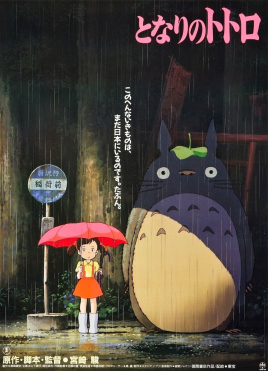
A description of Totoro’s plot doesn’t do it justice. The whole point of Totoro is its atmosphere, the sense of the world it conveys. I’ve written elsewhere in praise of stories that reflect and celebrate the enchantment of the world. Totoro is one of them. Old houses are populated by soot sprites—little balls of black dust that scurry about in the shadows. They’re a little creepy, but ultimately harmless. In the woods you find creatures akin to a cross between a rabbit and teddy bear, some small, some extremely large. The big one is the eponymous Totoro.
These creatures don’t accommodate themselves to the children. They’re frankly weird, a little scary, and do their own thing. This isn’t a baby-proofed world: real danger lurks here and there. It is an enchanted world, but that doesn’t mean its Disney Land. The girls explore, not fearlessly, but despite their fear. The movie is more respectful of the children in its audience by showing that children, too, experience the world full of dangers and mysteries, not simply as a padded crib.
I appreciated the interaction between the adults and children in this film. The girls are always respectful, but they don’t stop being children: energetic, a little wild, and fiercely imaginative. The adults neither condescend to the girls by merely pretending to believe in the spirits, nor bludgeon them with an insistent materialist by telling them to stop believing in childish nonsense. Instead, they encourage the girls’ belief in spirits and sprites largely, one thinks, because they also believe.
Some Christians may object to mild hints of paganism implicit in the film. Some characters speak and bow to a tree; others pray at what I took to be a Buddhist shrine. These brief scenes didn’t bother me. I’d rather my kids grow up thinking of trees as something to be respected than an object to be used (the creation mandate is for us to exercise dominion, not domination). As for the Buddhism, the positive portrayal of any religiosity in cinema is so rare that I’ll take what I can get.
The movie leaves us with a question. Are the kids just making all this magical stuff up as a psychological crutch to cope with their mother’s illness? That seems to be one way of reading the film. When trials come, we flee to fantasies for relief. Certainly children do such things. In one scene they see a massive tree grow overnight, but the next morning it is gone, suggesting they imagined the whole thing.
But the movie leaves small hints that makes it hard to dismiss the supernatural so easily. Totoro gives them a small gift, which is still there the next day. Later he takes them to see their mother, and they leave a small gift which she really receives. Such small evidences act like faint traces of the enchantment that surrounds them, hinting at a benevolent love that surrounds and cares for them even when they’re not looking.
Previous Post

May 7, 2013
Republocrat: The Pitfalls of American Politics
Next Post
May 9, 2013 'Bound Together' in Suffering...and Salvation
Browse Our Archives
Select a Category Action AFI Top 100 Animation Best Picture Winner BFI Top 250 Biography Biopic Books Childrens Christian Classics Classics Comedy Crime Documentary Drama Editor's Choice Family Fantasy Fantasy Films Foreign Historical Historical Fiction History Horror Horror IMDB Top 250 Indie Memoir Modern Novel Musical Mystery Non-Fiction Oscars Philosophy Poetry Popular Literature Reading and Writing Reality Romance Science Fiction Science Fiction Silent Sports Thriller TV Show Uncategorized Western Westerns Young Adult
Select a Month October 2026 September 2026 July 2026 June 2026 May 2026 April 2026 March 2026 February 2026 January 2026 December 2025 November 2025 October 2025 September 2025 August 2025 July 2025 June 2025 May 2025 April 2025 March 2025 February 2025 January 2025 December 2024 July 2024 June 2024 May 2024 April 2024 March 2024 February 2024 January 2024 December 2023 November 2023 October 2023 September 2023 August 2023 July 2023 June 2023 May 2023 April 2023 March 2023 February 2023 January 2023 December 2022 November 2022 October 2022 September 2022 August 2022 July 2022 June 2022 May 2022 April 2022 March 2022 February 2022 January 2022 December 2021 November 2021 October 2021 September 2021 August 2021 July 2021 June 2021 May 2021 April 2021 March 2021 February 2021 January 2021 December 2020 November 2020 October 2020 September 2020 August 2020 July 2020 June 2020 May 2020 April 2020 March 2020 February 2020 January 2020 December 2019 November 2019 October 2019 September 2019 August 2019 July 2019 June 2019 May 2019 April 2019 March 2019 February 2019 January 2019 December 2018 November 2018 October 2018 September 2018 August 2018 July 2018 June 2018 May 2018 April 2018 March 2018 February 2018 January 2018 December 2017 November 2017 October 2017 September 2017 June 2017 January 2017 December 2016 October 2016 September 2016 August 2016 July 2016 June 2016 May 2016 April 2016 March 2016 February 2016 January 2016 December 2015 November 2015 October 2015 September 2015 August 2015 July 2015 June 2015 May 2015 April 2015 March 2015 February 2015 January 2015 December 2014 November 2014 October 2014 September 2014 August 2014 July 2014 June 2014 May 2014 April 2014 March 2014 February 2014 January 2014 December 2013 November 2013 October 2013 September 2013 August 2013 July 2013 June 2013 May 2013 April 2013 March 2013 February 2013 January 2013 December 2012 November 2012 October 2012 September 2012 August 2012 July 2012
Follow Us!
TAKE THE
Religious Wisdom Quiz
Which book of the Bible contains the Ten Plagues of Egypt?
Select your answer to see how you score.
Leviticus Deuteronomy Genesis Exodus
Related posts from Schaeffer's Ghost



Mortal Kombat 2: Can Video Game Movies Save...

TRENDING AT PATHEOS Religious Music & Entertainment

The First Eucharistic Controversy: Christ’s Real Presence
For Catholics, the Eucharist is the source and summit of the Christian...

What a Stop Sign Can Teach Us About...
How to Make a Decision When You Can't Hear God Main point:...

Archdiocese Hosts Military Marriage Retreat in Germany
RASTATT, Germany — The transient military lifestyle, with its frequent deployments and...

Nearly every morning, I make the drive to Detroit with my high-school-age...

The Real AI Story Is Adoption Without Trust
Artificial intelligence has crossed a political threshold. It is no longer a...

A new article, written by Jeff Lindsay and Gale L. Pooley,...
view all Religious Music & Entertainment blogs
Ad-Free & Subscriber Log-In Subscription Support
- About Us
- 2026 Calendar
- Videos
- Podcasts
- Library of World Religions
- Faith In Media Tracker
- Advertise With Us
- Write for Us
- Privacy Policy
- Terms of Service
- Do Not Sell My Data
- Contact Us
- Radiant Digital
- Manage Newsletter Subscriptions
- Unsubscribe From Notifications
- Sitemap
Copyright 2008-2026, Patheos. All rights reserved.
Subscription Support Ad-Free & Subscriber Log-In
Follow Patheos