
BuddhistCatholicContemplativeEvangelicalGeneral ChristianHinduJewishLatter-day SaintMuslimNew VisionsProgressive Christian
Beliefs
- Buddhist
- Catholic
- Contemplative
- Evangelical
- General Christian
- Hindu
- Jewish
- Latter-day Saint
- More Voices
- Muslim
- New Visions
- Pagan
- Progressive Christian
Topics
- Religion News
- Food and Religion
- Sports and Religion
- Religious Art
- Religious Music and Entertainment
- Religious Events
- History and Religion
- Style and Religion
- Politics and Religion
- Women in Religion
- Recreation Outdoors and Religion
- Business Finance and Religion
- Careers Workplace and Religion
- Education and Religion
- Family Parenting and Religion
- Health Fitness and Religion
- Home and Religion
- Relationships and Religion
- Technology and Religion
- Travel and Religion
Columnists
- Buddhist Columnists
- Business Finance and Religion Columnists
- Careers Workplace and Religion Columnists
- Catholic Columnists
- Contemplative Columnists
- Education and Religion Columnists
- Evangelists Columnists
- Family Parenting and Religion Columnists
- General Christian Columnists
- Health Fitness and Religion Columnists
- Hindu Columnists
- History and Religion Columnists
- Home and Religion Columnists
- Jewish Columnists
- More Voices Columnists
- Latter Day Columnists
- Muslim Columnists
- New Visions Columnists
- Nonreligious Columnists
- Pagan Columnists
- Politics and Religion Columnists
- Progressive Columnists
- Recreation Outdoors and Religion Columnists
- Relationships and Religion Columnists
- Religion News Columnists
- Religious Art Columnists
- Religious Events Columnists
- Religious Music and Entertainment Columnists
- Sports and Religion Columnists
- Style and Religion Columnists
- Technology and Religion Columnists
- Travel and Religion Columnists
- Women in Religion Columnists
Resource Library
- 2026 Calendar
- Library of World Religions
- The 100 Most Holy Places on Earth
- Patheos Answers
- Podcasts
- Videos
- Faith Leaders Database
- Anglican Episcopalian
- Bahai
- Baptist
- Buddhism
- Christianity
- Confucianism
- Eastern Orthodoxy
- Hinduism
- Holiness and Pentecostal
- ISKCON
- Islam
- Judaism
- Lutheran
- Methodist
- The Church of Jesus Christ of Latter-day Saints
- New Age
- Paganism
- Presbytarian and Reformed
- Protestantism
- Religion Behind the Scenes
- Roman Catholic
- Scientology
- Shia Islam
- Sikhism
- Sufism
- Sunni Islam
- Taoism
- Zen
- See all religions
Research Tools
 Ad-Free & Subscriber Log-In Subscription Support
Ad-Free & Subscriber Log-In Subscription Support
Follow Patheos 

- Trending:
- Forgiveness
- |
- Marriage
- |
- Consciousness
- |
- Death Penalty
- |
- Election
- |
- Halloween

- Home
- Religious Music & Entertainment
- Wreck It, But Be Nice to Your Sister
Wreck It, But Be Nice to Your Sister
Last updated on: April 29, 2013 at 6:51 am by Paul D. Miller
Wreck It, But Be Nice to Your Sister 2013-04-29T06:51:31-06:00 Paul D. Miller
Patheos Explore the world's faith through different perspectives on religion and spirituality! Patheos has the views of the prevalent religions and spiritualities of the world.
Review of Wreck-It Ralph, Directed by Rich Moore
Confession: I love video games. When I was 2, my dad bought the Apple II computer. Some of my earliest memories are playing stone-age video games together as a family. I remember playing Cranston Manor. This was a game only slightly more sophisticated than Pong. It was a mystery game. A still image was on the screen, painted in plain 8-bit color graphics. Two lines of text described the scene. “You are standing in the forest. A piece of paper lies on the ground.” A few vertical brown and green lines stood in for trees. A yellow square was paper. You type two-word commands. “Go west,” or “Get paper,” or “Swallow poison.” We all sat around the living room shouting suggestions. “Go East, Dad, go East!” “No no! Get the paper first!” “Try hitting the tree.” We’d play an hour a night on weekends, and the simple mysteries would last weeks.
Later we got an Atari. My brother was the Pole Position expert; I preferred Q-bert; but together we were unbeatable at the original Mario Brothers. We went through the Commodore 64, the Texas Instruments, the Colico Vision, and finally arrived at the Nintendo. Video games were a porthole to adventure, a social catalyst, a meeting place, an escape, a grand dreamscape of mystery lands and imperiled princesses and dark lords and burning villages and epic quests; of athletic championships and gridiron warriors and the boys of October and the burning rubber of racing cars and the smell of the ice beneath the puck; of war and flame and explosion with bullets flying and bazookas firing at aliens and monsters charging like lemmings at the Action Hero; of alien invasion, detective mystery, raining tetrads, mushroom kingdoms, flying ninjas, comic embattled toads, secret agents, deep mazes and underground labyrinths, mutated jellyfish, leaping purple kangaroo-dragons, technological fortresses defended by screaming lasers, vampires and mysteries unending.
To say, then, that I enjoyed Disney’s Wreck-It Ralph (2012)—a movie set inside the world of 1980s arcade games—is a bit of an understatement. To my particular taste, this is quite possibly one of the greatest movies ever made.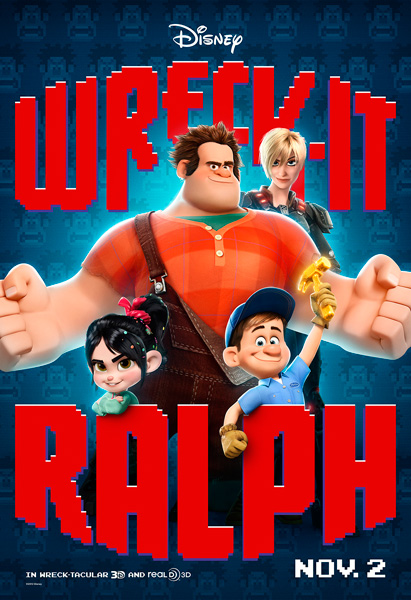
Ralph is the bad guy in a (fictional) arcade game called “Fix-It Felix” (loosely based on “Donkey Kong”). Ralph wrecks a building; the player, controlling the eponymous Felix, fixes it, whereupon the inhabitants seize Ralph and throw him off the building. Repeat for 30 years. Ralph grows weary. He hates being the bad guy all the time. He hates being the outcast, living in a dump. He wants (gasp!) to be the good guy. He goes rogue, setting out to invade another game, win a medal, and prove he, too, can be a hero. Antics ensue.
The movie absolutely nails the aesthetic of the old, 8-bit arcade games: simple, charming, and innocent. We get nods to some very old games (Q-bert, Street Fighter, Super Mario Brothers). The movie implicitly endorses this older, quainter style of gaming: Ralph wanders into a modern first-person-shooter game called “Hero’s Duty” (think “Halo” crossed with “Call of Duty”) and finds himself thrust into a war zone between shell-shocked soldiers and marauding alien bugs. Ralph flees in terror, shrieking “When did video games get so violent and scary?”
(Side note: as a parent, I greatly appreciate that there is a video game rating system. It was invented largely in reaction to the gruesome violence of some early-1990s games like “Mortal Kombat,” which, yes, I also played but which, on retrospect, was not at all edifying.)
Okay, so another confession: the best part of this movie is not the video-game backdrop—which is just fun scenery and in-jokes, nothing more—but the story. Wreck-It Ralph somehow ends up being a very sweet movie about a big brother protecting his little sister. Ralph finds himself on a quest to save a little girl whom he befriends during his adventures. She (Vanellope, voiced by Sarah Silverman), is a glitch in a nearby racing game and is trying to get into the race to become a real racer. She is pursued by King Candy, whose reasons for fighting her are mysterious. Ralph starts out on a selfish mission to win (or steal) a medal to flaunt in people’s faces. He ends by giving it all up to save Vanellope—and proving he really is a good guy, medal or no.
I admired so much about this movie. As a story, Ralph approached Pixar-esque quality. As a whole it was predictable, but it took a few unexpected turns to get there (Ralph gets the medal about 20 minutes into the film; Vanellope doesn’t actually win the race, etc.). The pacing and pitch was flawless: it didn’t avoid emotional low points just because it was a “kids” movie, nor did it dwell overlong on eye-candy or action sequences but kept them moving along briskly. Ralph’s final act of sacrifice (all heroes have to make a sacrifice) was so well done that I am tempted to call it iconic. (Note the music as he plunges to the earth: it is the soft, healing music of redemption, not the fast and loud music of an action scene).
I appreciated that the central relationship was between (essentially) adoptive siblings, rather than boyfriend and girlfriend. Too many movies rely on romance as the lowest common denominator in any audience. But siblings are among our most important relationships, and they are present throughout our lives. Ralph finds in Vanellope a little sister who needs help and protection; she finds in him a big brother she can tease and love at the same time.
Finally, the movie actually contains a surprising reflection on good, evil, and human nature. Ralph wants to be a good guy, and sets off to prove he can be. He ends up abandoning his quest, unable to change his bad-guy nature. He turns against Vallelope, smashes her race car, and betrays his friends, giving in to his evil nature despite his desire not to. He recites to himself the Bad Guy’s Creed: “I’m bad, and that’s good. I’ll never be good, and that’s not bad.” I’m tempted to call this a Calvinist recognition of human depravity.
But then Ralph repents, throws away his medal, and violates the games’ programming to save Vanellope, developing a new character in the process. (Okay, so this is more like salvation by works than a real gospel story, but it still has lots to commend it). He recites the bad guy creed but, as he recites the final line (“There’s no one I’d rather be than me”), he looks at a gift Vallenope gave him that says “You’re my hero.” That’s who Ralph has become. How true. We find ourselves irredeemably lost and corrupt in this world, and our own efforts to save ourselves are hopeless. But God is kind to adopt us into his family, to give us brothers and sisters and children and spouses to love; in loving others we stop thinking about ourselves—and that’s good.
Previous Post

April 26, 2013
If you love America, go see Pain & Gain
Next Post
April 30, 2013 Last Train Home in Industrializing China
Browse Our Archives
Select a Category Action AFI Top 100 Animation Best Picture Winner BFI Top 250 Biography Biopic Books Childrens Christian Classics Classics Comedy Crime Documentary Drama Editor's Choice Family Fantasy Fantasy Films Foreign Historical Historical Fiction History Horror Horror IMDB Top 250 Indie Memoir Modern Novel Musical Mystery Non-Fiction Oscars Philosophy Poetry Popular Literature Reading and Writing Reality Romance Science Fiction Science Fiction Silent Sports Thriller TV Show Uncategorized Western Westerns Young Adult
Select a Month October 2026 September 2026 July 2026 June 2026 May 2026 April 2026 March 2026 February 2026 January 2026 December 2025 November 2025 October 2025 September 2025 August 2025 July 2025 June 2025 May 2025 April 2025 March 2025 February 2025 January 2025 December 2024 July 2024 June 2024 May 2024 April 2024 March 2024 February 2024 January 2024 December 2023 November 2023 October 2023 September 2023 August 2023 July 2023 June 2023 May 2023 April 2023 March 2023 February 2023 January 2023 December 2022 November 2022 October 2022 September 2022 August 2022 July 2022 June 2022 May 2022 April 2022 March 2022 February 2022 January 2022 December 2021 November 2021 October 2021 September 2021 August 2021 July 2021 June 2021 May 2021 April 2021 March 2021 February 2021 January 2021 December 2020 November 2020 October 2020 September 2020 August 2020 July 2020 June 2020 May 2020 April 2020 March 2020 February 2020 January 2020 December 2019 November 2019 October 2019 September 2019 August 2019 July 2019 June 2019 May 2019 April 2019 March 2019 February 2019 January 2019 December 2018 November 2018 October 2018 September 2018 August 2018 July 2018 June 2018 May 2018 April 2018 March 2018 February 2018 January 2018 December 2017 November 2017 October 2017 September 2017 June 2017 January 2017 December 2016 October 2016 September 2016 August 2016 July 2016 June 2016 May 2016 April 2016 March 2016 February 2016 January 2016 December 2015 November 2015 October 2015 September 2015 August 2015 July 2015 June 2015 May 2015 April 2015 March 2015 February 2015 January 2015 December 2014 November 2014 October 2014 September 2014 August 2014 July 2014 June 2014 May 2014 April 2014 March 2014 February 2014 January 2014 December 2013 November 2013 October 2013 September 2013 August 2013 July 2013 June 2013 May 2013 April 2013 March 2013 February 2013 January 2013 December 2012 November 2012 October 2012 September 2012 August 2012 July 2012
Follow Us!
TAKE THE
Religious Wisdom Quiz
I wrote of a new covenant where God's law would be written not on stone but where?
Select your answer to see how you score.
On their hearts On scrolls In a book In the temple
Related posts from Schaeffer's Ghost



Mortal Kombat 2: Can Video Game Movies Save...

TRENDING AT PATHEOS Religious Music & Entertainment

In one sense walking into Westminster Abbey is like walking down the...

'Super Scam Me' Exposes AI Jon Bon Jovi...
Leslie Pickett believed she was in a relationship with Jon Bon Jovi....

The Brazilian Remake of Kendricks' 'Flywheel' Opens in...
“Flywheel,” the story that launched the Kendrick Brothers’ filmmaking career is getting...

The Dangers of Gradual Accommodation (Winking at Sin)
Recently, the “law of gradualness” resurfaced during the opening of a weeklong,...

The Iron Gates and the Lion of the...
Yesterday, I didn't finish my report about, well, yesterday. So I'll...

The Image: On the Horror of Capitalism and...
The Image Then went the Pharisees, and took counsel how they might...
view all Religious Music & Entertainment blogs
Ad-Free & Subscriber Log-In Subscription Support
- About Us
- 2026 Calendar
- Videos
- Podcasts
- Library of World Religions
- Faith In Media Tracker
- Advertise With Us
- Write for Us
- Privacy Policy
- Terms of Service
- Do Not Sell My Data
- Contact Us
- Radiant Digital
- Manage Newsletter Subscriptions
- Unsubscribe From Notifications
- Sitemap
Copyright 2008-2026, Patheos. All rights reserved.
Subscription Support Ad-Free & Subscriber Log-In
Follow Patheos