
BuddhistCatholicContemplativeEvangelicalGeneral ChristianHinduJewishLatter-day SaintMuslimNew VisionsProgressive Christian
Beliefs
- Buddhist
- Catholic
- Contemplative
- Evangelical
- General Christian
- Hindu
- Jewish
- Latter-day Saint
- More Voices
- Muslim
- New Visions
- Pagan
- Progressive Christian
Topics
- Religion News
- Food and Religion
- Sports and Religion
- Religious Art
- Religious Music and Entertainment
- Religious Events
- History and Religion
- Style and Religion
- Politics and Religion
- Women in Religion
- Recreation Outdoors and Religion
- Business Finance and Religion
- Careers Workplace and Religion
- Education and Religion
- Family Parenting and Religion
- Health Fitness and Religion
- Home and Religion
- Relationships and Religion
- Technology and Religion
- Travel and Religion
Columnists
- Buddhist Columnists
- Business Finance and Religion Columnists
- Careers Workplace and Religion Columnists
- Catholic Columnists
- Contemplative Columnists
- Education and Religion Columnists
- Evangelists Columnists
- Family Parenting and Religion Columnists
- General Christian Columnists
- Health Fitness and Religion Columnists
- Hindu Columnists
- History and Religion Columnists
- Home and Religion Columnists
- Jewish Columnists
- More Voices Columnists
- Latter Day Columnists
- Muslim Columnists
- New Visions Columnists
- Nonreligious Columnists
- Pagan Columnists
- Politics and Religion Columnists
- Progressive Columnists
- Recreation Outdoors and Religion Columnists
- Relationships and Religion Columnists
- Religion News Columnists
- Religious Art Columnists
- Religious Events Columnists
- Religious Music and Entertainment Columnists
- Sports and Religion Columnists
- Style and Religion Columnists
- Technology and Religion Columnists
- Travel and Religion Columnists
- Women in Religion Columnists
Resource Library
- 2026 Calendar
- Library of World Religions
- The 100 Most Holy Places on Earth
- Patheos Answers
- Podcasts
- Videos
- Faith Leaders Database
- Anglican Episcopalian
- Bahai
- Baptist
- Buddhism
- Christianity
- Confucianism
- Eastern Orthodoxy
- Hinduism
- Holiness and Pentecostal
- ISKCON
- Islam
- Judaism
- Lutheran
- Methodist
- The Church of Jesus Christ of Latter-day Saints
- New Age
- Paganism
- Presbytarian and Reformed
- Protestantism
- Religion Behind the Scenes
- Roman Catholic
- Scientology
- Shia Islam
- Sikhism
- Sufism
- Sunni Islam
- Taoism
- Zen
- See all religions
Research Tools
 Ad-Free & Subscriber Log-In Subscription Support
Ad-Free & Subscriber Log-In Subscription Support
Follow Patheos 

- Trending:
- Forgiveness
- |
- Marriage
- |
- Consciousness
- |
- Death Penalty
- |
- Election
- |
- Halloween

- Home
- Religious Music & Entertainment
- The Sense of an Ending: Meditations on Memory and Self-Deception
The Sense of an Ending: Meditations on Memory and Self-Deception
Last updated on: April 8, 2013 at 6:35 am by Kendrick Kuo
The Sense of an Ending: Meditations on Memory and Self-Deception 2013-04-08T06:35:53-06:00 Kendrick Kuo
Patheos Explore the world's faith through different perspectives on religion and spirituality! Patheos has the views of the prevalent religions and spiritualities of the world.
Review of The Sense of an Ending by Julian Barnes
The Sense of an Ending is a novella by Julian Barnes that explores the limits of memory and how memory affects defines us. Published in 2011, it won the Man Booker Prize in October of that year. Often, The Sense of an Ending reads more like a compilation of philosophical one-liners or paragraphs that make you sit there and ponder about abstractions, rather than a story. But Barnes’s craftsmanship lies in his ability to keep readers turning the page with a curious expectation.
The Sense of an Ending is split into two parts, the first part being much shorter than the second. In the first section, Barnes recounts the school years of Tony Webster and his three friends, of which the most important is Adrian Finn. Adrian is different than the rest. Tony and the other two circle around Adrian despite his aloofness and an intellect that towers over the rest of the student body. Near graduation time, a student commits suicide after impregnating his girlfriend, leading to much philosophical discourse on history and how this unfortunate individual would be remembered.
The four friends go off to university and Tony ends up in a sexually-frustrating relationship with Veronica. After some time the relationship is ended, but not after Tony has met her family and she has met Tony’s three friends. Later, Tony receives a letter from Adrian explaining how he’s begun dating Veronica, to which Tony shoots a nasty response calling a curse upon their relationship and potential future offspring. Before part one ends, Adrian commits suicide with a philosophical note claiming the right to renounce life after having done a thorough examination of it.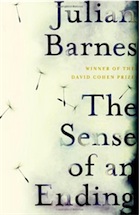
Skip several decades ahead. In part two, Tony was married and then divorced and has a daughter. He’s living a somewhat boring existence. Then one day a letter comes informing Tony that Veronica’s mother has bequeathed him 500 pounds and Adrian’s diary. Why? That’s the rest of the novella. Tony gets back in touch with Veronica and tries to piece back his memory.
Some books endue readers with awe for the writer’s vast experience, whether it be travelogue or creative pieces. We get the sense that the author has gone out into the world, tasted the food, can speak of intricate details of faraway places (or places that don’t even exist); and we are inundated with names, nuances, and the nitty-gritty borne of precise observations of life in the world.
The Sense of an Ending is not this kind of book. In many ways, it’s an internal novel that sits in the recesses of the mind. The narrator is soliloquizing for a significant portion of the book, grappling with his ignorance of the past–not the past in the sense of history textbooks, but his personal past. He feels that he should have the authoritative say on the metaphorical transcript of his own life. Ironically, he finds that his personal history lacks an objective ruling.
The Sense of an Ending is littered with meditation-worthy nuggets, such as:
[Block quote]History is that certainty produced at the point where the imperfection of memory meet the inadequacies of documentation.[/block quote]
And,
[Block quote]History isn’t the lies of the victors, as I once glibly assured Old Joe Hunt; I know that now. It’s more the memories of the survivors, most of whom are neither victorious or defeated.[/block quote]
But to understand The Sense of an Ending, we need to grasp Julian Barnes’s goal in giving us an unreliable narrator. We doubt our narrator’s ability to tell us what actually happened with Adrian and Veronica. As Tony unravels these hidden truths, Veronica is constantly reminding him of his ignorance when she repeats the refrain, “You still don’t get it. You never did.” And that is what Barnes is making us consider.
Our pasts shape our identity, but it is not a one-way street. We shape our understanding of our history by forgetting the ugly things and remembering the attractive memories. So, in a sense, with our tunnel vision, we create who we are by altering our memories. And who can question such a re-creation if there are no witnesses to our internal thoughts and our secret deeds, or rather our perception of our thoughts and deeds.
There are two things here for the Christian to ponder. First, we should consider our self-deception and how Scripture reads us when we read Scripture. The Word is a mirror that shows us an ugly vision of ourselves. Tony is right to doubt what he thinks he knows about the past—or about himself. We all should.
Second, we should be careful about applying that skepticism too broadly. It can be dangerously tempting to give up on the search for certainty and give in to the postmodernist’s flippant nihilism. In class, a teenage Adrian Finn says,
[Block quote]That’s one of the central problems of history, isn’t it, sir? The question of subjective versus objective interpretation, the fact that we need to know the history of the historian in order to understand the version that is being put in front of us.[/block quote]
And so on, in infinite regress. Without an ultimate foundation, there is no grounds for knowledge or, ultimately, life. Thus the importance, as Christians, of holding on to the authoritative account of history as recorded in Scripture. The ultimate Historian’s character is one of absolute trustworthiness—his past deeds and words demonstrate this—and therefore we can know ourselves, our past, and our God.
Previous Post

April 5, 2013
The Evil Dead: “Please, God: Give Me a Break”
Next Post
April 9, 2013 End of Watch: A Portrait of Male Friendship
Browse Our Archives
Select a Category Action AFI Top 100 Animation Best Picture Winner BFI Top 250 Biography Biopic Books Childrens Christian Classics Classics Comedy Crime Documentary Drama Editor's Choice Family Fantasy Fantasy Films Foreign Historical Historical Fiction History Horror Horror IMDB Top 250 Indie Memoir Modern Novel Musical Mystery Non-Fiction Oscars Philosophy Poetry Popular Literature Reading and Writing Reality Romance Science Fiction Science Fiction Silent Sports Thriller TV Show Uncategorized Western Westerns Young Adult
Select a Month October 2026 September 2026 July 2026 June 2026 May 2026 April 2026 March 2026 February 2026 January 2026 December 2025 November 2025 October 2025 September 2025 August 2025 July 2025 June 2025 May 2025 April 2025 March 2025 February 2025 January 2025 December 2024 July 2024 June 2024 May 2024 April 2024 March 2024 February 2024 January 2024 December 2023 November 2023 October 2023 September 2023 August 2023 July 2023 June 2023 May 2023 April 2023 March 2023 February 2023 January 2023 December 2022 November 2022 October 2022 September 2022 August 2022 July 2022 June 2022 May 2022 April 2022 March 2022 February 2022 January 2022 December 2021 November 2021 October 2021 September 2021 August 2021 July 2021 June 2021 May 2021 April 2021 March 2021 February 2021 January 2021 December 2020 November 2020 October 2020 September 2020 August 2020 July 2020 June 2020 May 2020 April 2020 March 2020 February 2020 January 2020 December 2019 November 2019 October 2019 September 2019 August 2019 July 2019 June 2019 May 2019 April 2019 March 2019 February 2019 January 2019 December 2018 November 2018 October 2018 September 2018 August 2018 July 2018 June 2018 May 2018 April 2018 March 2018 February 2018 January 2018 December 2017 November 2017 October 2017 September 2017 June 2017 January 2017 December 2016 October 2016 September 2016 August 2016 July 2016 June 2016 May 2016 April 2016 March 2016 February 2016 January 2016 December 2015 November 2015 October 2015 September 2015 August 2015 July 2015 June 2015 May 2015 April 2015 March 2015 February 2015 January 2015 December 2014 November 2014 October 2014 September 2014 August 2014 July 2014 June 2014 May 2014 April 2014 March 2014 February 2014 January 2014 December 2013 November 2013 October 2013 September 2013 August 2013 July 2013 June 2013 May 2013 April 2013 March 2013 February 2013 January 2013 December 2012 November 2012 October 2012 September 2012 August 2012 July 2012
Follow Us!
TAKE THE
Religious Wisdom Quiz
Who said, "It is more blessed to give than to receive"?
Select your answer to see how you score.
Jesus Paul Peter Solomon
Related posts from Schaeffer's Ghost




Thinking Critically about Critical Theory
TRENDING AT PATHEOS Religious Music & Entertainment

'Super Scam Me' Exposes AI Jon Bon Jovi...
Leslie Pickett believed she was in a relationship with Jon Bon Jovi....

The Brazilian Remake of Kendricks' 'Flywheel' Opens in...
“Flywheel,” the story that launched the Kendrick Brothers’ filmmaking career is getting...

The Dangers of Gradual Accommodation (Winking at Sin)
Recently, the “law of gradualness” resurfaced during the opening of a weeklong,...

The Iron Gates and the Lion of the...
Yesterday, I didn't finish my report about, well, yesterday. So I'll...

The Image: On the Horror of Capitalism and...
The Image Then went the Pharisees, and took counsel how they might...

We are approaching the date of our new American national holiday: October...
view all Religious Music & Entertainment blogs
Ad-Free & Subscriber Log-In Subscription Support
- About Us
- 2026 Calendar
- Videos
- Podcasts
- Library of World Religions
- Faith In Media Tracker
- Advertise With Us
- Write for Us
- Privacy Policy
- Terms of Service
- Do Not Sell My Data
- Contact Us
- Radiant Digital
- Manage Newsletter Subscriptions
- Unsubscribe From Notifications
- Sitemap
Copyright 2008-2026, Patheos. All rights reserved.
Subscription Support Ad-Free & Subscriber Log-In
Follow Patheos