
BuddhistCatholicContemplativeEvangelicalGeneral ChristianHinduJewishLatter-day SaintMuslimNew VisionsProgressive Christian
Beliefs
- Buddhist
- Catholic
- Contemplative
- Evangelical
- General Christian
- Hindu
- Jewish
- Latter-day Saint
- More Voices
- Muslim
- New Visions
- Pagan
- Progressive Christian
Topics
- Religion News
- Food and Religion
- Sports and Religion
- Religious Art
- Religious Music and Entertainment
- Religious Events
- History and Religion
- Style and Religion
- Politics and Religion
- Women in Religion
- Recreation Outdoors and Religion
- Business Finance and Religion
- Careers Workplace and Religion
- Education and Religion
- Family Parenting and Religion
- Health Fitness and Religion
- Home and Religion
- Relationships and Religion
- Technology and Religion
- Travel and Religion
Columnists
- Buddhist Columnists
- Business Finance and Religion Columnists
- Careers Workplace and Religion Columnists
- Catholic Columnists
- Contemplative Columnists
- Education and Religion Columnists
- Evangelists Columnists
- Family Parenting and Religion Columnists
- General Christian Columnists
- Health Fitness and Religion Columnists
- Hindu Columnists
- History and Religion Columnists
- Home and Religion Columnists
- Jewish Columnists
- More Voices Columnists
- Latter Day Columnists
- Muslim Columnists
- New Visions Columnists
- Nonreligious Columnists
- Pagan Columnists
- Politics and Religion Columnists
- Progressive Columnists
- Recreation Outdoors and Religion Columnists
- Relationships and Religion Columnists
- Religion News Columnists
- Religious Art Columnists
- Religious Events Columnists
- Religious Music and Entertainment Columnists
- Sports and Religion Columnists
- Style and Religion Columnists
- Technology and Religion Columnists
- Travel and Religion Columnists
- Women in Religion Columnists
Resource Library
- 2026 Calendar
- Library of World Religions
- The 100 Most Holy Places on Earth
- Patheos Answers
- Podcasts
- Videos
- Faith Leaders Database
- Anglican Episcopalian
- Bahai
- Baptist
- Buddhism
- Christianity
- Confucianism
- Eastern Orthodoxy
- Hinduism
- Holiness and Pentecostal
- ISKCON
- Islam
- Judaism
- Lutheran
- Methodist
- The Church of Jesus Christ of Latter-day Saints
- New Age
- Paganism
- Presbytarian and Reformed
- Protestantism
- Religion Behind the Scenes
- Roman Catholic
- Scientology
- Shia Islam
- Sikhism
- Sufism
- Sunni Islam
- Taoism
- Zen
- See all religions
Research Tools
 Ad-Free & Subscriber Log-In Subscription Support
Ad-Free & Subscriber Log-In Subscription Support
Follow Patheos 

- Trending:
- Forgiveness
- |
- Marriage
- |
- Consciousness
- |
- Death Penalty
- |
- Election
- |
- Halloween

- Home
- Religious Music & Entertainment
- How to Murder Sin
How to Murder Sin
Last updated on: April 4, 2013 at 6:42 am by Paul D. Miller
How to Murder Sin 2013-04-04T06:42:42-06:00 Paul D. Miller
Patheos Explore the world's faith through different perspectives on religion and spirituality! Patheos has the views of the prevalent religions and spiritualities of the world.
Review of The Mortification of Sin by John Owen
This is one of the most challenging books I have ever read. Every Christian would benefit from reading this book: no one would profit from skimming it. Read this book, but do so slowly. Turn the page only after the previous one has worked its way into your soul. You will otherwise gain only a superficial intellectual familiarity with Owen’s argument and callous your soul to the challenge and reward of God’s work in your life.
The nature of that reward is one of the first things Owen takes up. The reward of the Christian life is not merely escaping to heaven after death. Eternal life isn’t only the indefinite extension of our lives into infinity in the afterlife, a simple addition to the quantity of life. Rather, godliness pays off now because we enjoy a better quality of life. We have more peace with God, more inner contentment, a cleaner conscience, deeper joy in everything, and consequently a more fruitful ministry to our families, friends, and churches. Owen says that “The vigor, and power, and comfort of our spiritual life depend on the mortification of the deeds of the flesh,” (24).
Because holiness pays off now, we should desire to kill sin. Owen’s book is a harsh condemnation of Christian laziness. If you truly understand the gospel and grasp what God is offering, you will be possessed of a fanatical zeal to murder the evil that haunts your soul. If you don’t find that yearning in your life, you either don’t understand the gospel or you don’t understand the danger you are in every day from sin and death. 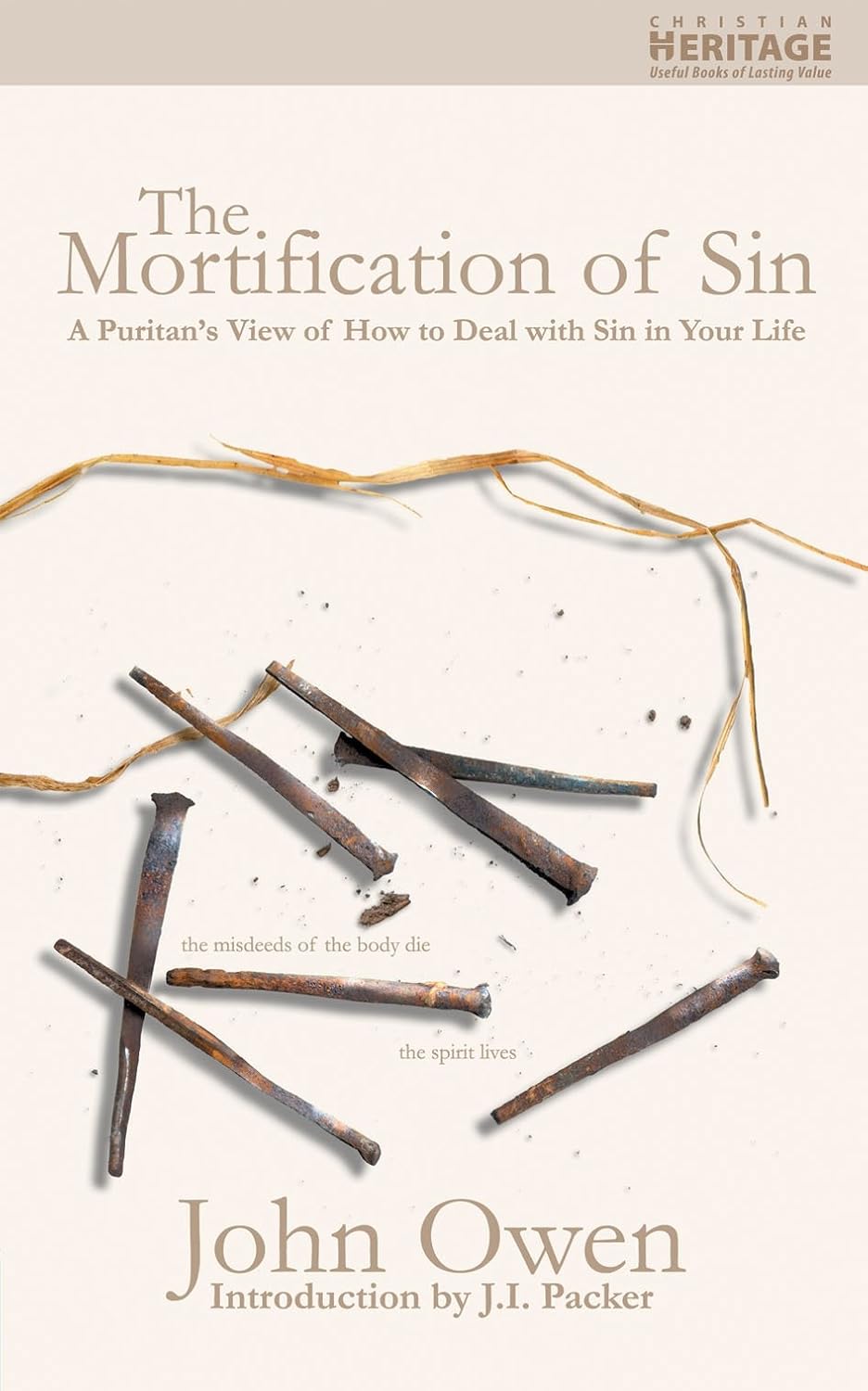
Sin is ever active; we are thus constantly in danger. “If, then, sin will be always acting, and we be not always mortifying, we are lost creatures,” (29). Sin is crafty and deceptive. “It is modest, as it were, in its first motions and proposals; but having once got footing in the heart by them, it constantly makes good its ground, and presseth on to some further degrees,” (31). Sin saps our spiritual strength; it “weakens the soul, and deprives it of its strength,” (51).
Sin, unaddressed, breeds disbelief. If we keep on sinning, we will never see evidence in our lives of the blessings God promises to his people, and we will thus gradually lose faith in those promises. “As sin weakens, so it darkens the soul. It is a cloud, a thick cloud, that spreads itself over the face of the soul, and intercepts all the beams of God’s love and favour. It takes away all sense of the privilege of our adoption; and if the soul begins to gather up thoughts of consolation, sin quickly scatters them,” (52). It hardens the heart, rendering it “sermon-proof,” so that “thou shalt not be at all concerned; but shall be able to pass over duties, praying, hearing, reading, and they heart not in the least effected,” (111).
All that is frightening enough. Here’s the truly terrifying part: there’s nothing we can do about it. Our own efforts are completely insufficient to fight sin. Rack and stack human nature against the power of sin, and we lose every time. Within this world, sin is an all-consuming, devouring beast. Left to ourselves, we are damned. “A soul under the power of conviction from the law, is pressed to fight against sin, but hath no strength for the combat. They cannot but fight, and they can never conquer; they are like men thrust on the sword of enemies, in purpose to be slain,” (46).
Our own work is futile. “Men are galled with the guilt of sin that hath prevailed over them; they instantly promise to themselves and God that they will do so no more; they watch over themselves and pray for a season, until this heat waxes cold and the sense of sin is worn off; and so mortification goes also, and sin returns to its former dominion.” (42-3). Relying on our own efforts to kill sin ensures whatever success we have will be temporary.
Owen makes clear what “mortifying” sin is not. It is not replacing bad habits with good ones, natural maturation, a change in circumstances, a discipline of self-improvement, or being frightened into good behavior out of fear of punishment (57-60, 99). None of those address the inward disposition of the heart. “A man may beat down the bitter fruit from an evil tree, until he is weary; whilst the root abides in strength and vigour, the beating down of the present fruit will not hinder it from bringing forth more,” (68). Mortifying sin means killing sinful dispositions in the heart.
In other words, we must view sin with God’s eyes and hate it. We must hate it because of its essence, not because it annoys us or makes us feel guilty, but because it is inherently hateful. Such hatred of sin comes ultimately from loving God. “Hatred of sin as sin, not only as galling or disquieting; [and] a sense of love of Christ in the cross; lie at the bottom of all true spiritual mortification…If thou hatest sin as sin, every evil way, thou wouldst be no less watchful against every thing that grieves and disquiets the Spirit of God, than against that which grieves and disquiets thine own soul. It is evident that thou contendest against sin merely because of thine own trouble by it.” (89).
So what do we actually do? Owen doesn’t offer his main point until halfway through the book. Mortifying is a matter of inner spiritual exercises. It involves “the implantation, habitual residence and cherishing of a principle of grace, that stands in direct opposition to [sin], and is destructive of it,” (71). “Whilst a man keeps a diligent watch over his heart, its root and fountain…lust withers and dies in it,” (90). The good news is that God has given his Spirit to his people to work for our sanctification. “He works in us and with us, not against us or without us,” (46). “All graces and good works which are in us are his,” (45). The Spirit mortifies sin in us “by causing our hearts to abound in grace;” through “a real, physical efficiency on the root and habit of sin;” and by “bring[ing] the cross of Christ into the heart of a sinner by faith,” (45).
Because I like checklists of concrete action, Owen’s emphasis on the inner state seemed highly abstract to me. I found myself trying to boil Owen’s recommendations down to specific things I can do (more Bible study, prayer, confession), which is probably the opposite of what Owen intends. He warns repeatedly against turning mortification into a series of behaviors lest you fall into legalism, a works-based salvation, or Catholicism. I confess I found this frustrating because it seemed to replace one conundrum (how to fight sin) with another (how to love God). Owen’s argument felt tautological: you get victory over sin once you love God perfectly, which is another way of saying the same thing.
Owen’s argument is (for anyone interested in the philosophical parallels) the triumph of Platonism over Aristotelianism. Plato argued that we achieve virtue through an inward turning of the soul. He has always been more popular with Protestants because of his influence on Augustine and thence Calvin and Luther. Aristotle, who emphasized the importance of practicing virtue through repeated behavior, has always been more popular with Catholics through his influence on Aquinas.
Owen gives the barest acknowledgment to the importance of practice and behavior in mortifying sin. “Exercise and success are the two main cherishers of grace in the heart: when it is suffered to lie still, it withers and decays,” (33) he says. Later, he acknowledges the importance of studying how, when, and where we sin so as to be better equipped to avoid it. “To labour to be acquainted with the ways, wiles, methods, advantages, and occasions of its success, is the beginning of this warfare,” (69; see also 129). These are pretty much the only comments he makes in this direction.
Owen (and Plato) is, of course, right. Outward behaviors are useless for one who has not yet made the turn, glimpsed the hatefulness of sin, been overcome by the cross of Christ, and been humbled by the grace of God. Afterwards, habits of discipline can be good means by which to remind ourselves of God’s grace, but beforehand they can be unhelpful distractions. “Duties are excellent food for a healthy soul; they are no physic for a sick soul,” (43). If your soul is healthy and you are looking for a good book on cultivating those duties, read Donald Whitney’s Spiritual Disciplines for the Christian Life. If you are struggling against a persistent sin and feel powerless over it, read John Owen’s book. It is one of the most intense, sustained meditations on the need for the inward turn away from sin, self, and death and towards the cross, Christ, and life ever written.
Previous Post

April 3, 2013
May the Force Be With You
Next Post
April 5, 2013 Integrity and Fatherhood Beyond the Pines
Browse Our Archives
Select a Category Action AFI Top 100 Animation Best Picture Winner BFI Top 250 Biography Biopic Books Childrens Christian Classics Classics Comedy Crime Documentary Drama Editor's Choice Family Fantasy Fantasy Films Foreign Historical Historical Fiction History Horror Horror IMDB Top 250 Indie Memoir Modern Novel Musical Mystery Non-Fiction Oscars Philosophy Poetry Popular Literature Reading and Writing Reality Romance Science Fiction Science Fiction Silent Sports Thriller TV Show Uncategorized Western Westerns Young Adult
Select a Month October 2026 September 2026 July 2026 June 2026 May 2026 April 2026 March 2026 February 2026 January 2026 December 2025 November 2025 October 2025 September 2025 August 2025 July 2025 June 2025 May 2025 April 2025 March 2025 February 2025 January 2025 December 2024 July 2024 June 2024 May 2024 April 2024 March 2024 February 2024 January 2024 December 2023 November 2023 October 2023 September 2023 August 2023 July 2023 June 2023 May 2023 April 2023 March 2023 February 2023 January 2023 December 2022 November 2022 October 2022 September 2022 August 2022 July 2022 June 2022 May 2022 April 2022 March 2022 February 2022 January 2022 December 2021 November 2021 October 2021 September 2021 August 2021 July 2021 June 2021 May 2021 April 2021 March 2021 February 2021 January 2021 December 2020 November 2020 October 2020 September 2020 August 2020 July 2020 June 2020 May 2020 April 2020 March 2020 February 2020 January 2020 December 2019 November 2019 October 2019 September 2019 August 2019 July 2019 June 2019 May 2019 April 2019 March 2019 February 2019 January 2019 December 2018 November 2018 October 2018 September 2018 August 2018 July 2018 June 2018 May 2018 April 2018 March 2018 February 2018 January 2018 December 2017 November 2017 October 2017 September 2017 June 2017 January 2017 December 2016 October 2016 September 2016 August 2016 July 2016 June 2016 May 2016 April 2016 March 2016 February 2016 January 2016 December 2015 November 2015 October 2015 September 2015 August 2015 July 2015 June 2015 May 2015 April 2015 March 2015 February 2015 January 2015 December 2014 November 2014 October 2014 September 2014 August 2014 July 2014 June 2014 May 2014 April 2014 March 2014 February 2014 January 2014 December 2013 November 2013 October 2013 September 2013 August 2013 July 2013 June 2013 May 2013 April 2013 March 2013 February 2013 January 2013 December 2012 November 2012 October 2012 September 2012 August 2012 July 2012
Follow Us!
TAKE THE
Religious Wisdom Quiz
True or False: King Saul was anointed by the prophet Nathan.
Select your answer to see how you score.
FALSE TRUE
Related posts from Schaeffer's Ghost




Thinking Critically about Critical Theory
TRENDING AT PATHEOS Religious Music & Entertainment

57th Dove Awards Honor Dolly Parton, Crown New...
On gospel music’s biggest night, the 57th annual GMA Dove Awards honored...

The First Eucharistic Controversy: Christ’s Real Presence
For Catholics, the Eucharist is the source and summit of the Christian...

What a Stop Sign Can Teach Us About...
How to Make a Decision When You Can't Hear God Main point:...

Archdiocese Hosts Military Marriage Retreat in Germany
RASTATT, Germany — The transient military lifestyle, with its frequent deployments and...

Nearly every morning, I make the drive to Detroit with my high-school-age...

The Real AI Story Is Adoption Without Trust
Artificial intelligence has crossed a political threshold. It is no longer a...
view all Religious Music & Entertainment blogs
Ad-Free & Subscriber Log-In Subscription Support
- About Us
- 2026 Calendar
- Videos
- Podcasts
- Library of World Religions
- Faith In Media Tracker
- Advertise With Us
- Write for Us
- Privacy Policy
- Terms of Service
- Do Not Sell My Data
- Contact Us
- Radiant Digital
- Manage Newsletter Subscriptions
- Unsubscribe From Notifications
- Sitemap
Copyright 2008-2026, Patheos. All rights reserved.
Subscription Support Ad-Free & Subscriber Log-In
Follow Patheos