
BuddhistCatholicContemplativeEvangelicalGeneral ChristianHinduJewishLatter-day SaintMuslimNew VisionsProgressive Christian
Beliefs
- Buddhist
- Catholic
- Contemplative
- Evangelical
- General Christian
- Hindu
- Jewish
- Latter-day Saint
- More Voices
- Muslim
- New Visions
- Pagan
- Progressive Christian
Topics
- Religion News
- Food and Religion
- Sports and Religion
- Religious Art
- Religious Music and Entertainment
- Religious Events
- History and Religion
- Style and Religion
- Politics and Religion
- Women in Religion
- Recreation Outdoors and Religion
- Business Finance and Religion
- Careers Workplace and Religion
- Education and Religion
- Family Parenting and Religion
- Health Fitness and Religion
- Home and Religion
- Relationships and Religion
- Technology and Religion
- Travel and Religion
Columnists
- Buddhist Columnists
- Business Finance and Religion Columnists
- Careers Workplace and Religion Columnists
- Catholic Columnists
- Contemplative Columnists
- Education and Religion Columnists
- Evangelists Columnists
- Family Parenting and Religion Columnists
- General Christian Columnists
- Health Fitness and Religion Columnists
- Hindu Columnists
- History and Religion Columnists
- Home and Religion Columnists
- Jewish Columnists
- More Voices Columnists
- Latter Day Columnists
- Muslim Columnists
- New Visions Columnists
- Nonreligious Columnists
- Pagan Columnists
- Politics and Religion Columnists
- Progressive Columnists
- Recreation Outdoors and Religion Columnists
- Relationships and Religion Columnists
- Religion News Columnists
- Religious Art Columnists
- Religious Events Columnists
- Religious Music and Entertainment Columnists
- Sports and Religion Columnists
- Style and Religion Columnists
- Technology and Religion Columnists
- Travel and Religion Columnists
- Women in Religion Columnists
Resource Library
- 2026 Calendar
- Library of World Religions
- The 100 Most Holy Places on Earth
- Patheos Answers
- Podcasts
- Videos
- Faith Leaders Database
- Anglican Episcopalian
- Bahai
- Baptist
- Buddhism
- Christianity
- Confucianism
- Eastern Orthodoxy
- Hinduism
- Holiness and Pentecostal
- ISKCON
- Islam
- Judaism
- Lutheran
- Methodist
- The Church of Jesus Christ of Latter-day Saints
- New Age
- Paganism
- Presbytarian and Reformed
- Protestantism
- Religion Behind the Scenes
- Roman Catholic
- Scientology
- Shia Islam
- Sikhism
- Sufism
- Sunni Islam
- Taoism
- Zen
- See all religions
Research Tools
 Ad-Free & Subscriber Log-In Subscription Support
Ad-Free & Subscriber Log-In Subscription Support
Follow Patheos 

- Trending:
- Forgiveness
- |
- Marriage
- |
- Consciousness
- |
- Death Penalty
- |
- Election
- |
- Halloween

- Home
- Religious Music & Entertainment
- The Wave of Fascism and Redemption in the Church
The Wave of Fascism and Redemption in the Church
Last updated on: December 7, 2012 at 6:20 am by Kendrick Kuo
The Wave of Fascism and Redemption in the Church 2012-12-07T06:20:00-07:00 Kendrick Kuo
Patheos Explore the world's faith through different perspectives on religion and spirituality! Patheos has the views of the prevalent religions and spiritualities of the world.
Review of Die Welle (The Wave), Directed by Dennis Gansel
By KENDRICK KUO
Is a resurgence of fascism possible? Die Welle answers yes.
This German film is based on a 1967 social experiment in a Californian high school that sought to recreate a fascist society in a world history class. “Die Welle” means “The Wave” and is the name of the student group formed in the experiment. (In the actual experiment, the group was named “The Third Wave”.) In Die Welle, the experiment takes place in a German high school “project week” class titled Autocracy. Rainer Wenger, the teacher, decides to run a weeklong experiment to emulate what it would be like to live under a fascist regime similar to the Nazis. He is addressed as “Herr Wenger,” students must stand up before they speak, march together in rhythm, don a uniform of white shirt and jeans, create their own symbol, and have a special salute.
As I’m not entirely familiar with the actual events, I will not try to parse out what was real and what was not—other than to say my cursory look into the online resources revealed that a number of elements were accurate. The main differences were that firearms were not involved and that the ending in the movie was purely for cinematic punch—the experiment ended peacefully and the teacher was not arrested.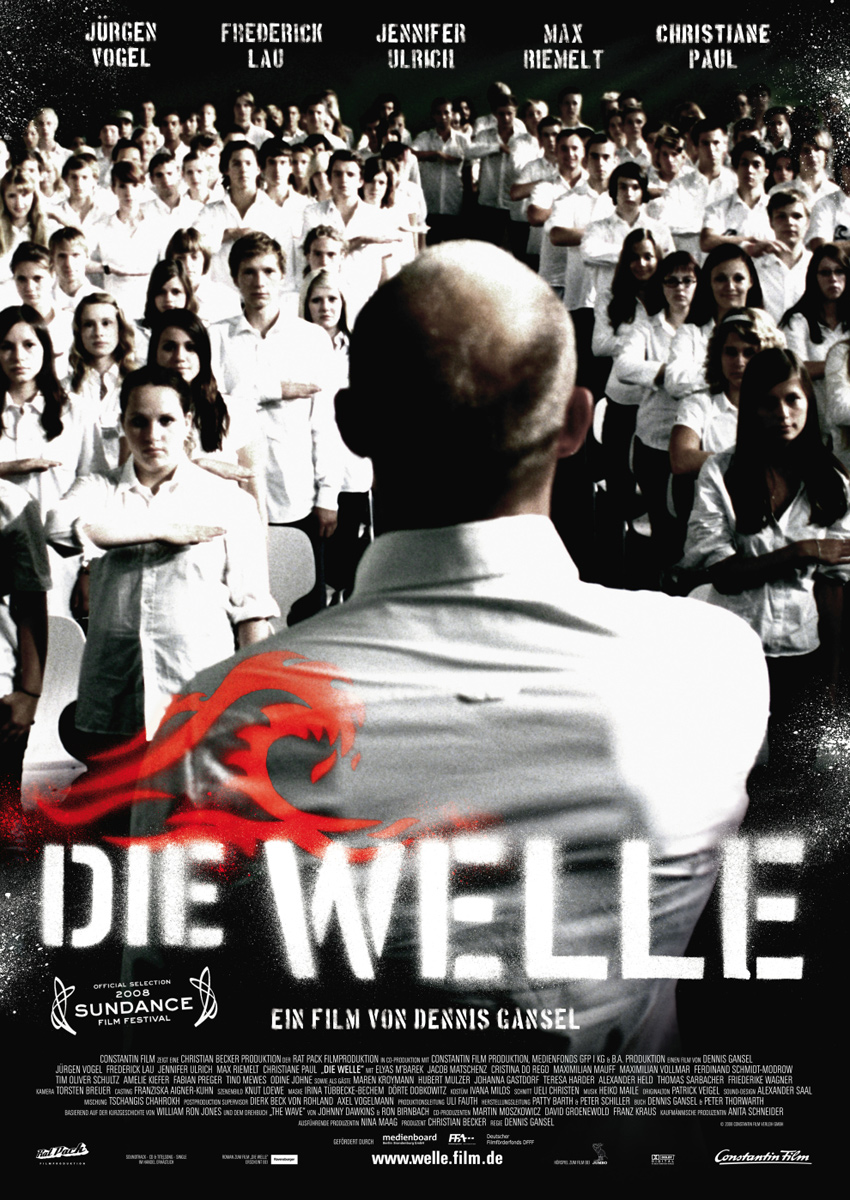
The story centers around Herr Wenger, Tim (an insecure, mentally unstable student), Marco, and Karo (Marco’s girlfriend). Karo is quickly ostracized from the Die Welle because she refused to wear the uniform and develops into the most outspoken opponent of Die Welle. In the process, she is estranged from Marco—a ready devotee of the group. The first signs of group unity begin when two members of Die Welle defend Tim, a clearly unpopular kid in school, against two bullies. Ironically, one of Tim’s defenders is himself a bully who begins to reform through Die Welle and befriends Tim. Soon Die Welle goes on a PR campaign, sticking their logo throughout the city, throws a beach party that’s limited to Die Welle members and friends, and only allows members to use the skateboarding half-pipe.
The film reaches its climax at the very end, when Wenger is confronted with the choice of whether or not to “relinquish power” and disband Die Welle. He admittedly enjoys the way his students now listen to his every word, but his wife and Marco insist that things are getting out of hand. Wenger holds a Saturday rally in the school auditorium to which hundreds of students attend, all wearing the white shirt, blue jeans uniform. During an inspiring speech of how Die Welle will wash over Germany and reform the country, Marco stands up and decries Wenger’s megalomania before the other students. Wenger orders Marco to be brought onto the stage, and the rally falls into hysteria, Die Welle members outraged by Marco’s impudence. But then Wenger turns the tables and rhetorically asks his captive audience what they expect him to do. Kill Marco?
With a sigh of relief, the tension is broken as Wenger explains the moral of the story: dictatorship is still possible in even a democratic society and must be guarded against. Unexpectedly, Tim pulls out a gun and threatens to kill Wenger for taking everything away from him. Die Welle had become his family and the anchor of his sense of belonging. Instead of killing Wenger, he turns the gun on himself. This lends weight to Wenger’s warning—within a week, Tim the insecure outcast had become part of a group and devoted to the cause to the point of violence.
After watching Die Welle, I wasn’t shocked into a heightened vigilance against encroaching dictatorship in the United States. I was instead drawn to the powerful display of group identity and the innate desire to be part of a larger unit—a desire totalitarian regimes can easily twist to their own devices. This is why the hyper-individualism of Ayn Rand seems to me to be completely one-sided and incomplete. Perhaps there’s reason why group ideologies such as communism and fascism have succeeded in making the jump from theory to practice, while anarchism remains an untouchable ideal.
This is also why the church as a divinely-mandated institution has such a profound ability to address the human condition. It is in the church that true group identity, found in Christ, is exemplified in its most beautiful form. While totalitarian regimes abuse the human need for group identification, the church is the perfect fulfillment. Just as politics is sanctified in the church polity (authority rightly exercised coupled with submission rightly given), identity politics is resolved in union with Christ and with one another and crosses ethnic, class, and gender lines.
The church acts as an outpost of heaven, displaying the glory of God to the world. In this role, it must address the way groups function. The world’s conflicts are rooted in inter-group tensions, which is also sadly the case inside many churches where factions form based on various issues. To look different than the world requires a proper understanding of biblical ecclesial polity, which oftentimes means entering paradoxes. The church draws a line around its membership to distinguish itself from the world; yet at the same time must welcome new members who leave the kingdom of darkness. Members must submit to their elders; yet at the same time abuse of authority must be kept in check. This is in stark contrast to the group identity depicted in Die Welle, with its burgeoning personality cult, elitism, mindless submission, and abuse of authority.
Previous Post

December 6, 2012
Pulitzer Prize-Winning Anti-Christian Screed (The Swerve)
Next Post
December 10, 2012 Smug Seuss Cinema Sells Story Short
Browse Our Archives
Select a Category Action AFI Top 100 Animation Best Picture Winner BFI Top 250 Biography Biopic Books Childrens Christian Classics Classics Comedy Crime Documentary Drama Editor's Choice Family Fantasy Fantasy Films Foreign Historical Historical Fiction History Horror Horror IMDB Top 250 Indie Memoir Modern Novel Musical Mystery Non-Fiction Oscars Philosophy Poetry Popular Literature Reading and Writing Reality Romance Science Fiction Science Fiction Silent Sports Thriller TV Show Uncategorized Western Westerns Young Adult
Select a Month October 2026 September 2026 July 2026 June 2026 May 2026 April 2026 March 2026 February 2026 January 2026 December 2025 November 2025 October 2025 September 2025 August 2025 July 2025 June 2025 May 2025 April 2025 March 2025 February 2025 January 2025 December 2024 July 2024 June 2024 May 2024 April 2024 March 2024 February 2024 January 2024 December 2023 November 2023 October 2023 September 2023 August 2023 July 2023 June 2023 May 2023 April 2023 March 2023 February 2023 January 2023 December 2022 November 2022 October 2022 September 2022 August 2022 July 2022 June 2022 May 2022 April 2022 March 2022 February 2022 January 2022 December 2021 November 2021 October 2021 September 2021 August 2021 July 2021 June 2021 May 2021 April 2021 March 2021 February 2021 January 2021 December 2020 November 2020 October 2020 September 2020 August 2020 July 2020 June 2020 May 2020 April 2020 March 2020 February 2020 January 2020 December 2019 November 2019 October 2019 September 2019 August 2019 July 2019 June 2019 May 2019 April 2019 March 2019 February 2019 January 2019 December 2018 November 2018 October 2018 September 2018 August 2018 July 2018 June 2018 May 2018 April 2018 March 2018 February 2018 January 2018 December 2017 November 2017 October 2017 September 2017 June 2017 January 2017 December 2016 October 2016 September 2016 August 2016 July 2016 June 2016 May 2016 April 2016 March 2016 February 2016 January 2016 December 2015 November 2015 October 2015 September 2015 August 2015 July 2015 June 2015 May 2015 April 2015 March 2015 February 2015 January 2015 December 2014 November 2014 October 2014 September 2014 August 2014 July 2014 June 2014 May 2014 April 2014 March 2014 February 2014 January 2014 December 2013 November 2013 October 2013 September 2013 August 2013 July 2013 June 2013 May 2013 April 2013 March 2013 February 2013 January 2013 December 2012 November 2012 October 2012 September 2012 August 2012 July 2012
Follow Us!
TAKE THE
Religious Wisdom Quiz
What does Proverbs say about hard work?
Select your answer to see how you score.
Diligence brings profit Sleep always Lazy people win It is pointless
Related posts from Schaeffer's Ghost



Mortal Kombat 2: Can Video Game Movies Save...

TRENDING AT PATHEOS Religious Music & Entertainment

Looking at the Largest Orthodox Cathedral on Earth
There is often a considerable amount of anger and, shall we...

The Problem with False Prophets
Miller’s Station UMC| 10/18/26| Anchor Verse: Jeremiah 23: 1, 9-23 I...

Emotion in Early Christianity by Andrew Crislip
Andrew Crislip’s Emotion in Early Christianity examines an often overlooked dimension of...

16 Spiritual Touchstones for a More Grounded Life
After decades of spiritual study, here are 16 principles I try...

Catholic Evangelization: Sharing Your Faith Every Day
Welcome back to the Graceful Awakening mini-series called, “From Faith to Mission.” ...

The Pillar of the Boatmen: the Ancient Monument...
The Pillar of the Boatmen is a Romano-Gaulish sculpture that dates from...
view all Religious Music & Entertainment blogs
Ad-Free & Subscriber Log-In Subscription Support
- About Us
- 2026 Calendar
- Videos
- Podcasts
- Library of World Religions
- Faith In Media Tracker
- Advertise With Us
- Write for Us
- Privacy Policy
- Terms of Service
- Do Not Sell My Data
- Contact Us
- Radiant Digital
- Manage Newsletter Subscriptions
- Unsubscribe From Notifications
- Sitemap
Copyright 2008-2026, Patheos. All rights reserved.
Subscription Support Ad-Free & Subscriber Log-In
Follow Patheos